
Imagine you’ve just purchased a beautiful condo at Friday Harbour, you’re excited about the rental income potential, and then you discover that your building’s declaration prohibits stays shorter than 30 days. Or worse, you’ve already listed on Airbnb without a municipal licence and you’re facing fines before your first guest even checks in. These situations happen more often than you’d think, and they’re almost always avoidable with the right preparation. This guide walks you through every essential step: understanding Ontario’s short-term rental definitions, securing the correct licences, navigating resort community rules, and protecting your investment for the long term.
Key Takeaways
| Point | Details |
|---|---|
| Know local definitions | Every Ontario community sets its own short-term rental rules, so check local bylaws before listing. |
| Licence before you list | Register and obtain licences as required before advertising your property to avoid enforcement penalties. |
| Check condo and building restrictions | Private condo rules can be more restrictive than municipal laws, especially in resorts like Friday Harbour. |
| Stay compliant, maximize returns | Maintaining up-to-date paperwork and insurance keeps your earning potential high and risks low. |
Understanding Ontario short-term rental rules
Ontario does not have a single, province-wide definition of what counts as a short-term rental. Every municipality sets its own rules, and the differences between them can be significant. This is the first thing every property owner needs to understand before listing a single night online.
In Toronto, for example, a short-term rental means renting all or part of a dwelling unit for less than 28 consecutive days, with specific exclusions for hotels, motels, and certain student residences. That 28-day threshold is the defining line between a short-term rental and a standard tenancy in Toronto’s framework.
“In the City of Toronto, a short-term rental is renting all or part of a dwelling unit for less than 28 consecutive days.”
— City of Toronto
Other municipalities draw the line differently. Some use fewer days, some focus on frequency of rentals per year, and others apply restrictions based on zoning. This patchwork of rules means that what’s perfectly legal in one town could be a bylaw violation two kilometres down the road.
Here’s a quick overview of how definitions and key rules vary across Ontario:
| Municipality | STR definition | Key rule |
|---|---|---|
| Toronto | Less than 28 consecutive days | Principal residence only |
| Innisfil (Friday Harbour) | Varies by building | Condo rules may override |
| Wasaga Beach | Short-stay accommodations | Licence and neighbourhood plan required |
| Central Elgin | Short-term accommodation | Licence required from Jan 2026 |
The most common categories excluded from short-term rental rules include:
- Hotels and motels
- Bed and breakfasts with on-site owners
- Student housing operated by educational institutions
- Long-term residential leases (28 days or more)
Why does this matter practically? Because the definition affects how you advertise, how you price, and how you structure your lease agreements. If you’re operating in a resort community like Friday Harbour, understanding the Friday Harbour Airbnb rules is not optional. It’s the foundation of everything else.
Required licences and registration steps across Ontario
Once you know how your municipality defines a short-term rental, the next step is understanding what paperwork you need before you can legally operate. The licensing landscape across Ontario has tightened considerably in recent years, and the penalties for skipping this step are real.
Toronto requires short-term rental operators to register and collect Municipal Accommodation Tax (MAT) on transient accommodations. The MAT rate is changing from 6% to 8.5% for the period from June 1, 2025 to July 31, 2026, which directly affects your pricing and remittance obligations. You must register before advertising or accepting bookings.
Central Elgin is another example worth noting. Beginning January 1, 2026, operators in that municipality must hold a valid licence to legally operate, and the licence must be obtained before advertising, booking, or operating. This is a strict sequence: licence first, listing second.
Here’s how the requirements compare across three popular Ontario destinations:
| Requirement | Toronto | Central Elgin | Wasaga Beach |
|---|---|---|---|
| Licence required | Yes | Yes (from Jan 2026) | Yes |
| Register before advertising | Yes | Yes | Yes |
| MAT collection | Yes (8.5% from June 2025) | No (check locally) | No (check locally) |
| Principal residence rule | Yes | No | No |
| Neighbourhood plan | No | No | Yes |
For most Ontario municipalities, the typical application process follows these steps:
- Confirm your property’s zoning allows short-term rentals before spending time on any application.
- Review your condo declaration or building rules to confirm the building permits STRs at all.
- Complete the municipal application form, which usually requires proof of ownership, a site plan, and contact details.
- Pay the applicable licence fee, which varies by municipality but commonly ranges from $100 to $500 annually.
- Schedule any required property inspection if your municipality mandates one.
- Receive your licence number and include it in all listings and advertising as required.
- Register for MAT collection if your municipality requires it, and set up a remittance schedule.
If you’re planning to list a Friday Harbour rental, the same principle applies: confirm all permissions are in place before your listing goes live.
Pro Tip: Apply for your municipal licence at least four to six weeks before your intended launch date. Processing times vary, and listing before your licence is approved can trigger enforcement action even if your application is pending.
Local bylaws and building rules: Resort communities and Friday Harbour
Municipal approval is only half the picture. In resort-style communities, the building or condominium corporation often has its own rules that can be more restrictive than anything the town requires. This is where many well-intentioned owners run into trouble.

Not all condos allow short-term rentals, and some set minimum rental periods of 30 days or more, which effectively rules out Airbnb-style bookings regardless of what the municipality permits. At Friday Harbour in Innisfil, this is a particularly important distinction. Some buildings within the community allow short-term rentals, while others do not. And within buildings that do allow them, minimum stay requirements can vary.
The types of accommodations available at Friday Harbour range from hotel-style units to privately owned condos, and each category operates under different rules. A hotel-managed unit and a privately owned condo in the same building can have entirely different rental permissions.
Common local rules that owners frequently overlook include:
- Minimum rental period clauses in the condo declaration (often 30, 60, or 90 days)
- Guest registration requirements with the building management office
- Noise and conduct rules that apply specifically to short-term guests
- Amenity access restrictions for guests versus owners
- Subletting approval requirements that require written consent from the condo board
- Insurance requirements that go beyond standard home insurance
- Limits on the number of rentals per year in some declarations
Not all condos at Friday Harbour allow short-term rentals. Some require minimum rental periods of 30 days or more, which may limit Airbnb-style use regardless of municipal permissions.
Pro Tip: Always read the condo declaration, the rules and regulations, and the status certificate before you purchase a property you intend to rent short-term. Once you own it, you’re bound by those rules whether you knew about them or not. We always advise our clients to request and review these documents as part of their due diligence, not as an afterthought.
Risk management, new bylaws and profit pitfalls
Understanding the rules is one thing. Avoiding the traps that cost owners real money is another. Ontario’s short-term rental landscape is evolving quickly, and municipalities are adding teeth to their enforcement programmes.
Wasaga Beach is a strong example of this trend. The municipality is introducing stricter rules for short-term accommodations, including a requirement for operators to submit a neighbourhood partnership plan, carry increased liability insurance, and implement guest and noise mitigation standards as part of the licensing process. These are not minor administrative hurdles. They represent a meaningful shift toward treating short-term rentals as accountable businesses rather than casual side income.
“Wasaga Beach is introducing stricter rules for certain short-term accommodations, including requiring a neighbourhood partnership plan, increased liability insurance, and guest and noise mitigation standards.”
— Simcoe.com
The hidden profit pitfalls in this market include more than just fines. Here are the ones we see most often:
- Unexpected minimum rental periods that prevent you from filling weekends or short gaps in your calendar
- Insurance gaps when standard home insurance doesn’t cover commercial rental activity
- Noise complaints that trigger bylaw investigations and jeopardise your licence renewal
- Condo board pushback when rental activity violates the building’s rules, leading to legal disputes
- Platform delisting when Airbnb or Vrbo removes your listing due to non-compliance with local regulations
- Tax obligations you weren’t aware of, including HST registration if your annual rental income exceeds $30,000
- Maintenance costs that rise faster than expected when units are turned over frequently
If you’re thinking about using your Friday Harbour condo as a vacation property, building a realistic financial model that accounts for all of these factors is essential before you commit to a rental strategy.
The best way to futureproof your rental business is to document every permission you receive in writing, stay subscribed to your municipality’s bylaw updates, and review your condo declaration annually for any amendments passed by the board.
Enforcement, verification and next steps
Setting up correctly is important, but staying compliant over time is what keeps your rental income uninterrupted. Ontario municipalities are becoming more active in enforcing short-term rental rules, and the consequences of non-compliance have grown more serious.
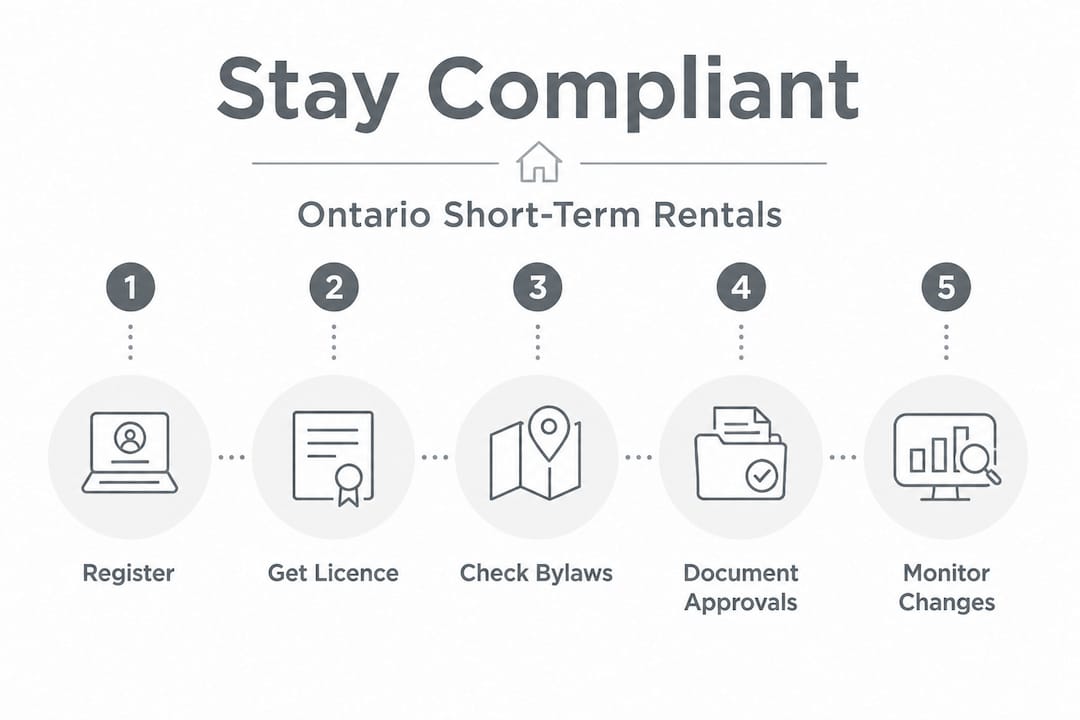
Advertising or operating without a licence in a municipality like Central Elgin can lead to enforcement action and fines. Beyond municipal fines, operators risk being reported to online travel agencies (OTAs) like Airbnb and Vrbo, which now cooperate with municipalities to remove non-compliant listings. A forced delisting can mean weeks or months of lost income while you sort out the paperwork.
Common enforcement mechanisms across Ontario include:
- Municipal bylaw officers responding to neighbour complaints
- Cross-referencing OTA listings with municipal licence databases
- Fines issued per day of non-compliant operation
- Legal orders requiring you to cease operations immediately
- Referral to the Landlord and Tenant Board in certain circumstances
Here’s a practical compliance checklist to work through regularly:
- Confirm your municipal licence is current and renewal dates are tracked in your calendar.
- Verify your listing includes your licence number as required by your municipality.
- Review your condo declaration for any amendments that may have changed rental permissions.
- Confirm your insurance policy covers short-term rental activity and request written confirmation from your broker.
- Check that your MAT remittances are up to date if you operate in Toronto or another MAT-applicable municipality.
- Save all written approvals, correspondence with your condo board, and municipal communications in a single digital folder.
- Review any new bylaws or proposed changes in your municipality at least once per year.
Pro Tip: Create a dedicated folder in your email and cloud storage labelled “STR compliance” and save every approval, licence, and correspondence there. If you’re ever questioned by a bylaw officer or a platform, having everything in one place saves enormous time and stress.
Our take: Why most owners underestimate short-term rental rules
Here’s something we’ve observed consistently working with investors in resort communities across Ontario: most owners who run into trouble weren’t trying to cut corners. They simply didn’t realise there were two separate layers of rules to navigate, and they assumed that municipal approval was the finish line.
It isn’t. The condo declaration can be stricter than the town bylaw, and it almost always takes precedence for privately owned units within a corporation. We’ve seen buyers purchase units at Friday Harbour with a clear rental income plan, only to discover after closing that their building requires a minimum 60-day rental period. That’s not a minor inconvenience. It fundamentally changes the investment model.
The edge case that catches even experienced investors off guard is this: even where community-level resort amenities operate under separate approvals such as noise bylaw exemptions for amplified sound, your unit’s right to host short stays can still be constrained by condo rules and any municipal STR licensing framework. The resort’s overall permissions and your individual unit’s permissions are entirely separate matters.
Our advice is straightforward: get everything in writing before you buy, before you renovate, and before you list. A verbal confirmation from a property manager or a seller’s agent is not a legal permission. The condo declaration, the board’s written approval, and your municipal licence are the only documents that protect you.
The accommodation options at Friday Harbour are genuinely exciting for investors, but the due diligence process needs to match that excitement. The owners who build sustainable, profitable rental businesses here are the ones who treat compliance as a foundation, not a formality.
Need help with Friday Harbour rentals or Ontario short-term rental strategy?
Navigating Ontario’s short-term rental rules is manageable when you have the right guidance from the start. Whether you’re exploring Friday Harbour waterfront rentals for inspiration, researching the best waterfront condos before making a purchase, or looking for personalised advice on setting up a compliant and profitable rental operation, Karin Rotem’s team is here to help. With deep expertise in Friday Harbour and Ontario resort-area real estate, we guide investors through every step, from due diligence to listing strategy. Visit karinrotem.com to connect with our team and get the local insight you need to make your investment work.
Frequently asked questions
What is classified as a short-term rental in Ontario?
A short-term rental usually means renting for less than 28 consecutive days, but always check your specific municipality’s definition, as it varies across Ontario.
Do I need a licence to offer a short-term rental in Ontario?
Yes, most urban and resort areas require a licence or registration before advertising or operating. Central Elgin requires a valid licence to operate and advertise starting January 1, 2026.
Can I run a short-term rental in any Friday Harbour condo?
No. Some Friday Harbour condos prohibit STRs entirely, while others require minimum rental periods of 30 days or more, so always review the condo declaration before purchasing or listing.
What happens if I operate without the required licence?
You risk fines, removal from listing platforms, and legal orders to stop operations. Advertising without a licence in municipalities like Central Elgin can trigger immediate enforcement action.
What’s the Municipal Accommodation Tax (MAT) in Toronto for short-term rentals?
The MAT rate increases to 8.5% from June 1, 2025 to July 31, 2026, up from the previous 6%, and applies to all short-term stays in Toronto.
Recommended
- Can I Airbnb My Friday Harbour Condo? | Short-Term Rental Rules Explained – Karin Rotem Real Estate Agent
- Can I Use My Friday Harbour Condo as a Vacation Property? | Smart Usage Ideas – Karin Rotem Real Estate Agent
- Understanding the Rental Contract at Friday Harbour: Key Points – Karin Rotem Real Estate Agent
- Can I Rent Out My Friday Harbour Condo? | What Buyers Need to Know – Karin Rotem Real Estate Agent