
Closing day feels like the finish line, but for many buyers and investors, it arrives with far more complexity than expected. The assumption that closing is simply a formality—sign a few papers, pick up the keys—can lead to costly surprises, especially when you are purchasing a waterfront property in Ontario. Missed title issues, last-minute liens, and environmental compliance concerns can derail even the most carefully negotiated deal. Understanding what your real estate lawyer actually does, from the weeks before closing right through to key release, gives you the confidence and clarity to protect your investment every step of the way.
Key Takeaways
| Point | Details |
|---|---|
| Lawyer’s core duties | Your lawyer carefully handles funds, title transfer, registration, and legal requirements to finalise ownership. |
| Waterfront property risks | Unique rules and land use challenges make experienced legal guidance essential for waterfront purchases. |
| Pre-closing groundwork | Title searches and requisition deadlines are the backbone of a trouble-free closing; missing them can leave you exposed. |
| Common closing challenges | Uncovered liens, work orders, or paperwork errors can derail deals without proactive legal management. |
| Engage legal help early | Consulting your lawyer before offer and throughout the process is your best safeguard against costly surprises. |
What does a real estate lawyer do on closing day?
With the misconception out of the way, let’s unpack what your lawyer actually does on closing day—and why every step matters.
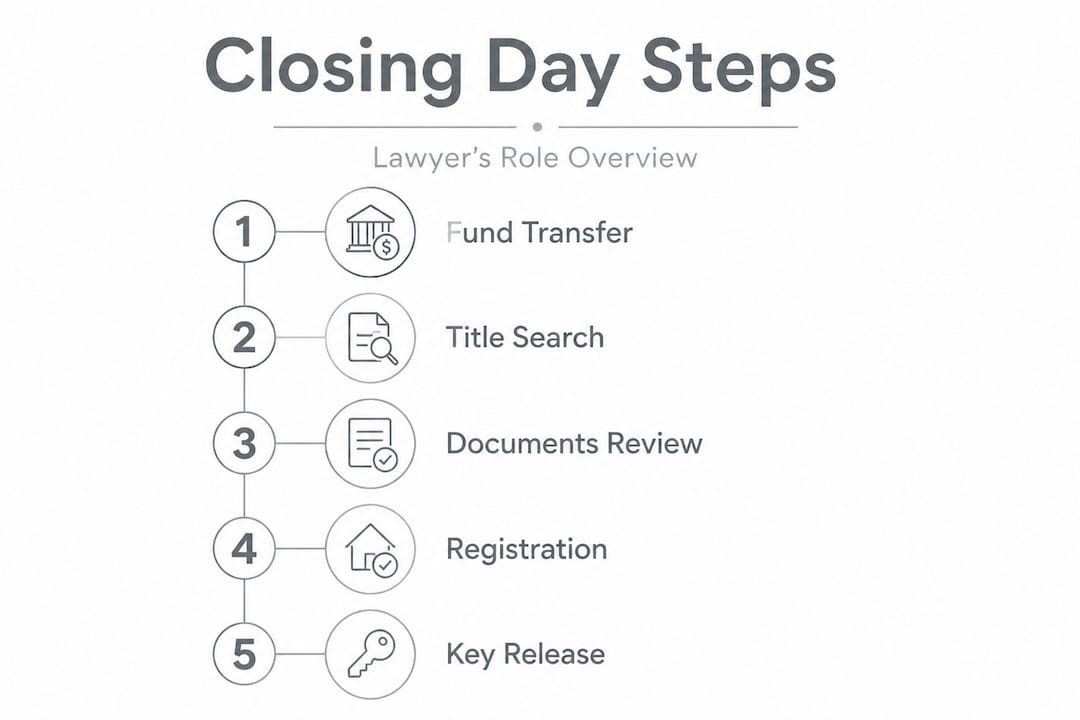
Closing in Ontario is far more than a document exchange. Your lawyer is the control point for one of the largest financial transactions of your life. Closing in Ontario involves the lawyer coordinating the exchange of funds and documents, verifying title clarity, and then registering the transfer and mortgage changes electronically through Ontario’s Teraview system before releasing keys. Each step is sequenced deliberately, and skipping or rushing any one of them creates real risk.
Here is how the process unfolds, in order:
- Receiving and verifying funds. Your lawyer receives your down payment and the mortgage funds from your lender. These are held in a trust account, which is a legally protected account used exclusively to manage client funds in a transaction.
- Reviewing closing documents. The lawyer reviews the transfer deed, mortgage documents, title insurance commitment, and any undertakings from the seller’s lawyer.
- Conducting final title checks. Even after the pre-closing title search, a final check confirms no new registrations or encumbrances have appeared.
- Coordinating with the seller’s lawyer. Both lawyers confirm that all conditions are satisfied and that the closing can proceed.
- Registering the transaction in Teraview. Ontario uses an electronic land registration system called Teraview. Your lawyer registers the transfer and any new mortgage electronically.
- Releasing keys. Only after registration is confirmed and all funds are properly distributed are the keys released to you.
“On closing day, Ontario lawyers act as the control point for large sums held in trust: receiving lender funds and down payment components, paying the seller and discharging mortgages and obligations, and ensuring the correct registration documents are ready to be filed.” Nesbitt Law
The table below summarises the key responsibilities and their purpose:
| Lawyer’s task | Why it matters |
|---|---|
| Receiving and holding funds in trust | Protects both buyer and seller from fraud or loss |
| Final title search | Confirms no new liens registered since initial search |
| Document review and execution | Ensures all legal obligations are correctly captured |
| Electronic registration via Teraview | Creates the official public record of ownership transfer |
| Coordinating fund disbursement | Pays out seller, discharges existing mortgages, covers fees |
| Key release confirmation | Confirms legal ownership has transferred before possession |
If you are purchasing a Friday Harbour condo, the closing costs and process carry additional layers, including condo corporation documentation and status certificates. Your lawyer manages all of it.
The crucial pre-closing work: title search, requisitions, and risk management
Having outlined the major closing day steps, it is even more important to understand the legal foundation your lawyer lays before you ever reach that day.
The most impactful work your lawyer does often happens in the weeks before closing. A title search is the process of examining the history of ownership and any registered interests on a property to confirm it can be transferred with a “clean” title—meaning free of unresolved debts, liens, or restrictions. This is not a simple database lookup. It requires careful review of historical registrations, court orders, and any encumbrances that may affect your use or ownership of the property.

Once the title search is complete, your lawyer enters the requisition period. This is the window of time defined in your agreement of purchase and sale during which your lawyer can formally raise title issues and require the seller to resolve them before closing. Pre-closing title review work determines whether closing can safely proceed; if title defects or liens are not addressed by required deadlines, closing may be delayed or the buyer may be forced to accept defects.
The stakes are significant. Here is a comparison of what happens depending on whether issues are caught in time:
| Scenario | Outcome |
|---|---|
| Title defect found within requisition period | Seller is required to resolve it before closing proceeds |
| Title defect found after requisition deadline | Buyer may have limited recourse and could be forced to accept the defect |
| No title defects found | Closing proceeds on schedule with clean title |
| Lien discovered post-closing without title insurance | Buyer may inherit the debt or face legal action |
Key areas your lawyer examines during the pre-closing review include:
- Outstanding liens or judgments registered against the property or the seller
- Easements and rights-of-way that may restrict how you use the land
- Restrictive covenants that limit construction or alterations
- Zoning compliance to confirm the property’s current use is legally permitted
- Outstanding property taxes or municipal charges that must be cleared before transfer
- Permit history to identify any unpermitted work that may trigger a work order
Understanding the taxes and fees involved in buying at a waterfront community like Friday Harbour is equally important, and your lawyer coordinates the payment and confirmation of these amounts at closing.
Pro Tip: Engage your lawyer as early as possible after your offer is accepted. Fixes after the requisition deadline may not be enforceable, and you could find yourself closing on a property with unresolved issues that become your legal responsibility.
If you are considering waterfront condos at Friday Harbour, the pre-closing review also includes the status certificate, which reveals the financial health and legal standing of the condo corporation. Your lawyer interprets this document and flags any red flags before you are committed.
Unique legal concerns for Ontario waterfront closings
The general legal groundwork becomes even more critical for waterfront properties, where unique rules and risks come into play.
Purchasing a waterfront property in Ontario is not the same as buying a standard residential home. The proximity to water introduces a layer of regulatory complexity that extends well beyond the standard title search. Legal guidance for waterfront properties can extend beyond the closing mechanics into waterfront land use and related approvals and agreements, which directly impacts whether a property can be used as intended after closing.
Your lawyer’s review for a waterfront transaction should cover:
- Conservation authority restrictions. Properties near lakes, rivers, or wetlands often fall within the jurisdiction of a local conservation authority. These bodies regulate development, grading, and vegetation removal within defined setback zones. Your lawyer checks whether any existing structures or planned improvements comply with these rules.
- Shoreline setbacks. Provincial and municipal regulations establish minimum distances from the water’s edge within which construction or alteration is prohibited. Violations can result in mandatory removal at the owner’s expense.
- Dock and boathouse approvals. Installing or modifying a dock or boathouse may require permits from the municipality, the conservation authority, and in some cases Transport Canada. Your lawyer confirms whether existing structures have the necessary approvals.
- Environmental site assessments. If there is any history of fuel storage, industrial use, or contamination near the shoreline, your lawyer may recommend an environmental assessment before closing.
- Outstanding municipal work orders. Any unresolved orders from the municipality related to bylaw violations or required repairs must be identified and addressed before title transfers cleanly.
- Land use and zoning compliance. Waterfront properties sometimes carry unique zoning designations that restrict short-term rentals, commercial activity, or certain types of development. This is especially relevant if you are purchasing as an investment.
If you are exploring waterfront rental options at Friday Harbour, understanding the zoning and condo corporation rules that govern short-term rentals is essential. Your lawyer confirms these details so you are not caught off guard after closing.
Common closing day problems—and how a lawyer protects you
Now that you know the unique detail required for waterfront closings, let’s examine the most common pitfalls and how skilled lawyers prepare for these possible disruptions.
Even well-prepared transactions can hit unexpected obstacles in the final days before closing. Common closing-day edge cases in Ontario include last-minute undisclosed liens, municipal work orders for unpermitted renovations, financing and funding failures, and unconditional offer risk—each of which can derail closing without proper early legal handling.
Here are the issues we see most often, and what your lawyer does to address them:
- Last-minute liens. A creditor may register a lien against the property between the initial title search and closing day. Your lawyer’s final title check catches these before funds are released.
- Unpermitted renovations. If the seller completed work without a building permit, the municipality may have issued a work order. Your lawyer identifies these orders and ensures they are resolved or accounted for in the closing terms.
- Boundary and right-of-way disputes. Surveys sometimes reveal encroachments or disputed boundaries. Your lawyer reviews the survey and raises any concerns within the requisition period.
- Lender funding delays. If your mortgage lender does not transfer funds on time, closing cannot proceed. Your lawyer coordinates with the lender in advance and monitors the funding timeline closely.
- Missing fire insurance confirmation. Most lenders require proof of valid fire insurance before releasing mortgage funds. Your lawyer confirms this is in place before closing day.
- Unconditional offer traps. Once you waive all conditions on an offer, your legal options for renegotiating or withdrawing are extremely limited. The terms of the written agreement control what can and cannot be changed.
If you are purchasing a waterfront condo, your lawyer also reviews the status certificate in detail to flag any pending special assessments, litigation involving the condo corporation, or underfunded reserve funds—issues that could affect your costs and rights as an owner.
Pro Tip: Always consult your lawyer before going unconditional on an offer, particularly for waterfront or unique properties. What you cannot see in a property can cost far more than the deal you think you are securing.
What most buyers miss about the lawyer’s role in closing
Understanding the practical side is critical, but there is a deeper lesson most buyers never hear directly from their lawyer.
When we work with buyers at Friday Harbour and across Toronto’s waterfront markets, we notice a consistent pattern. Buyers focus on closing day as the event. They track the date, arrange the movers, and wait for the call that keys are ready. What they rarely see is the weeks of legal work that made that call possible.
The visible hand-off of keys is just the finale. The lawyer’s most impactful work happens in the pre-closing phase, where risks are identified, requisitions are raised, and problems are resolved before they become crises. A closing delay is most often caused by earlier legal, contract, or timing issues such as title objections, lender instructions, or insurance binders, rather than anything that happens on closing day itself.
This matters because it changes how you should think about engaging your lawyer. The earlier you bring them in, the more options you have. A title defect discovered three weeks before closing can usually be resolved. The same defect discovered the morning of closing puts everyone in a difficult position.
For waterfront properties, this lesson is even more critical. Environmental restrictions, conservation authority rules, and land use approvals are not issues that surface quickly. They require thorough research, sometimes involving multiple government bodies. A lawyer who begins that work early gives you real protection. One who is engaged at the last minute is managing risk rather than preventing it.
We always encourage our clients to think of their lawyer not as a closing-day service provider, but as a risk manager for the entire transaction. If you are weighing whether Friday Harbour condos are a good investment, that risk management lens applies to the investment analysis as much as it does to the legal process.
Expert support for a smooth waterfront closing
For those ready to put these lessons into practice, local expertise and hands-on guidance make all the difference.
Navigating the closing process on a waterfront property requires more than a checklist. It requires a team that understands the specific legal landscape of communities like Friday Harbour and the broader Toronto waterfront market. At Karin Rotem’s team, we work closely with buyers and investors to ensure every stage of the transaction is handled with care, from the first offer through to key release. Whether you are exploring waterfront rental options at Friday Harbour or purchasing your primary waterfront residence, we connect you with the right legal and real estate expertise to protect your investment. Reach out to our team today to start your waterfront journey with confidence.
Frequently asked questions
What are the main documents a lawyer reviews before closing?
A lawyer reviews the agreement of purchase and sale, title history, mortgage instructions, and closing documents to ensure a smooth transfer. They also manage key documents including the deed, mortgage papers, and title insurance commitment.
What risks are unique to closing waterfront properties?
Waterfront closings may involve environmental regulations, land use approvals, and planning zone compliance—a lawyer checks these to prevent costly legal issues. Legal guidance for waterfront properties extends into land use and related approvals that affect post-closing use.
When do buyers get property keys in Ontario?
Keys are released only after funds transfer, title registration, and all closing conditions are confirmed by the lawyer. After the lawyer confirms title is clear and the transaction is registered, the deal is considered closed and keys are released.
Can a closing be delayed due to last-minute problems?
Yes—issues like undiscovered liens, financing hiccups, or missing documents can postpone closing without proactive legal oversight. Edge-case legal roadblocks like liens or funding issues can derail closing even in well-prepared transactions.
Why do I need a lawyer if I have an agent?
Agents focus on negotiation and finding property; only a lawyer secures title transfer, manages funds, and ensures legal compliance on closing. Your agent and lawyer serve distinct, complementary roles that together protect your interests throughout the entire purchase process.
Recommended
- What Are the Closing Costs for a Friday Harbour Condo? | Buyer’s Checklist – Karin Rotem Real Estate Agent
- Should I Use a Real Estate Agent to Sell My Friday Harbour Property? – Karin Rotem Real Estate Agent
- Understanding the Rental Contract at Friday Harbour: Key Points – Karin Rotem Real Estate Agent
- Karin Rotem Real Estate | Friday Harbour | Toronto – Karin Rotem Real Estate Agent