
Receiving multiple offers on your Innisfil home is exciting, but it can quickly become overwhelming if you’re not prepared. The instinct is to jump at the highest number, and that’s understandable. But the highest offer isn’t always the safest or most profitable choice when you account for financing risk, contingencies, and closing timelines. Whether you’re selling a waterfront property at Friday Harbour or a family home in one of Innisfil’s growing neighbourhoods, knowing how to evaluate and negotiate competing offers puts you firmly in control of your outcome.
Key Takeaways
| Point | Details |
|---|---|
| Preparation drives results | Understanding market timing and pre-listing strategies can create more competitive offers. |
| Terms matter more than price | The best offer often combines strong financials, minimal contingencies, and a reliable closing timeline. |
| Negotiation needs strategy | A controlled, term-focused ranking process can deliver a cleaner outcome than simply taking the highest bid. |
| Local market context | Using Innisfil-specific data helps set realistic deadlines and expectations for multiple offers. |
| Handle contingencies wisely | Kick-out clauses and clear timelines help protect sellers and keep deals moving. |
What you need before listing: Preparation for multiple offers
Generating multiple offers doesn’t happen by accident. It takes deliberate preparation, and the groundwork you lay before listing often determines the quality and quantity of offers you receive.
Start with solid local market data. You need to know average days on market, recent sale prices for comparable properties, and the level of buyer activity in your area. Innisfil home prices surged 22.9% to $860,215 in January 2026, with active listings reflecting strong buyer interest across the region. That context matters when you’re setting your list price and offer deadline.
Here are the key preparation steps every Innisfil seller should take before listing:
- Price strategically, not emotionally. Listing slightly below market value in a heated market can trigger multiple offers and actually drive the final sale price higher.
- Set a clear offer deadline. Announcing an offer date gives buyers time to prepare strong bids and creates a structured competitive environment.
- Invest in professional photography and staging. First impressions online are everything. Listings with high-quality visuals attract significantly more showings.
- Complete minor repairs and pre-listing inspections. Buyers who feel confident about the property’s condition are more likely to submit clean offers with fewer conditions.
- Brief your agent on your priorities. Is your ideal outcome a quick close, maximum price, or certainty of completion? Sharing this guides how your agent presents your listing.
Understanding local agent advantages in the Innisfil market is especially important. Agents with established networks can reach qualified buyers quickly and generate early momentum before the offer deadline even arrives.
| Preparation action | Impact on offer quality |
|---|---|
| Strategic list price | Increases likelihood of multiple competing bids |
| Pre-listing inspection | Reduces buyer-added conditions |
| Professional photography | Drives higher showing volume |
| Set offer deadline | Creates urgency and structured competition |
| Agent buyer network outreach | Attracts pre-qualified, motivated buyers |
Your listing agent should also be well-versed in pre-listing bidding strategies that can generate buyer momentum before offers are even submitted. Timing your listing around local seasonal demand, for example, can meaningfully shift how many buyers compete for your property. Use market timing insights specific to Friday Harbour and surrounding Innisfil communities to your advantage.
Pro Tip: Ask your agent to send a pre-listing email to their buyer network before the property hits MLS. This simple step can generate early interest and set the stage for a competitive offer night.
With your market research and preparation in place, the next step is to understand what defines a strong offer.
Comparing offers: Price versus terms and conditions
Once you have several offers in hand, the challenge becomes evaluating which one best serves your goals. Price is the most visible number on the page, but it’s far from the only one that matters.

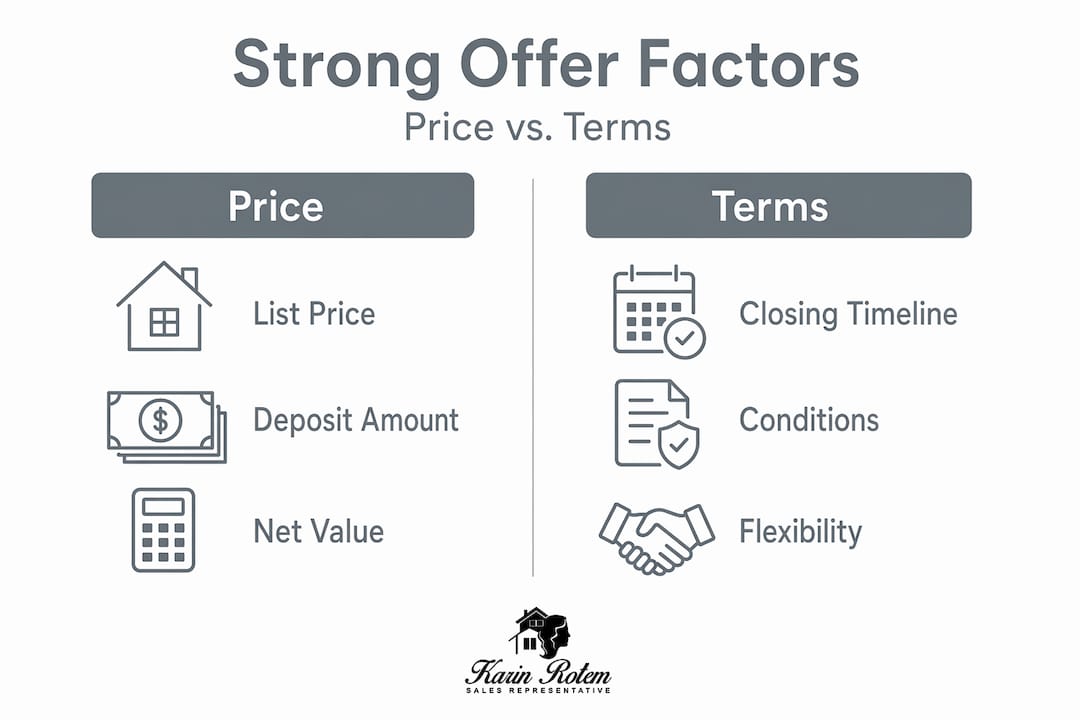
In multiple-offer situations, the best offer is not necessarily the highest price. Sellers should evaluate price alongside financial terms such as financing versus cash, contingencies, earnest deposit amount, closing timeline, and other deal conditions.
Consider this scenario. You receive three offers: $950,000 with mortgage financing and a home inspection condition, $920,000 cash with no conditions, and $940,000 with financing already confirmed and a flexible closing date. The first offer looks best on paper, but the second and third carry significantly less risk. A deal that collapses due to failed financing costs you time, money, and market momentum.
Here’s what to examine in each offer:
- Financing type. Cash offers remove financing risk entirely. Pre-approved mortgage buyers carry less risk than those with only a pre-qualification letter.
- Deposit amount. A larger earnest money deposit signals a serious, committed buyer. It also provides some financial security if the deal falls through.
- Conditions attached. Home inspection conditions, financing conditions, and sale-of-existing-home conditions all add varying levels of uncertainty to the deal.
- Closing date. Does the buyer’s preferred closing date align with your plans? A misaligned timeline can create real inconvenience and added cost.
- Escalation clauses. Some buyers include clauses stating they’ll beat any other offer by a set amount up to a ceiling price. These complicate comparisons but can benefit sellers who know how to use them.
“The offer with the best terms may serve you far better than the offer with the highest price. Net value and deal certainty together define what ‘best’ actually means in practice.”
Use a structured comparison table to evaluate offers side by side. This removes emotion from the process and helps you see the real picture clearly.
| Offer | Price | Financing type | Conditions | Deposit | Closing timeline |
|---|---|---|---|---|---|
| Buyer A | $950,000 | Bank mortgage | Inspection + financing | $20,000 | 60 days |
| Buyer B | $920,000 | Cash | None | $50,000 | 30 days |
| Buyer C | $940,000 | Pre-approved mortgage | None | $35,000 | Flexible |
In this comparison, Buyer C offers the strongest combination of price, security, and flexibility, even though Buyer A offered the most money. Understanding local buyer preferences also helps, as Innisfil attracts a particular mix of lifestyle buyers, investors, and Toronto-area families, each with different financial profiles and motivations.
Pro Tip: Create a net value worksheet for each offer that factors in closing costs, adjustment credits, and any agreed-upon inclusions. The number you keep is more important than the number on the front page.
Understanding contingencies and contract terms
Having compared offers, the next priority is understanding exactly what each contract term means for your sale outcome. Contingencies are conditions that must be satisfied before the sale can finalise. If they’re not met within the agreed timeframe, the contract may be cancelled without penalty.
Common contingency types in Ontario real estate transactions include:
- Financing condition. The buyer’s offer depends on securing mortgage approval. If their lender declines, the deal can be voided.
- Home inspection condition. The buyer has the right to hire an inspector, and if the report reveals significant issues, they may renegotiate or walk away.
- Home sale condition. The buyer needs to sell their existing property before they can complete the purchase of yours.
- Home close condition. Similar to a home sale condition, but specifically tied to the closing of their current property rather than its sale.
In Ontario real estate, contingencies including home sale and home close concepts, kick-out clauses, and financing must be clearly articulated with specific timelines. If those timelines are not met, parties may cancel the contract without financial penalty in good faith.
| Contingency type | Risk to seller | Typical timeline |
|---|---|---|
| Financing condition | Moderate: deal may fall through | 5 to 7 business days |
| Home inspection | Low to moderate: may trigger renegotiation | 5 to 10 days |
| Home sale condition | High: dependent on buyer’s sale | 30 to 90 days |
| Home close condition | Moderate: depends on closing timing | 30 to 60 days |
A kick-out clause is one of the most valuable tools available to sellers accepting a contingent offer. It allows you to continue marketing your property and accept another offer, provided you give the original buyer a short window (typically 24 to 72 hours) to remove their conditions and proceed. This protects your position without forcing you to reject an otherwise solid offer.
“A kick-out clause keeps your options open. It tells the contingent buyer that if a better offer arrives, they must decide quickly or step aside.”
Timeline language within contracts is equally important. Vague wording like “as soon as possible” creates ambiguity and potential disputes. Clear, specific dates protect everyone and keep the transaction on track. When reviewing any offer, pay close attention to how the buyer contract steps are structured, as each condition has consequences for both sides if the timeline is missed.
Executing negotiations: Securing the best deal (not just the highest bid)
With contract terms clearly understood, the last step is actively managing negotiations to ensure your sale closes smoothly and profitably.
Here’s a structured approach to managing multiple-offer negotiations:
- Review all offers simultaneously. Avoid negotiating in sequence, as this gives later buyers an unfair advantage and can create legal complications.
- Rank offers using a term-focused scoring approach. Assign weight to financing strength, condition load, deposit size, and closing alignment, not just price.
- Issue a counter-offer or call for ‘best and final’ bids. Depending on your market conditions, you may choose to counter the top two or three offers or simply request final bids by a set deadline.
- Confirm all verbal agreements in writing. Any modification to an offer must be documented to be legally enforceable.
- Communicate decisions promptly. Leaving buyers waiting without clear updates damages goodwill and can cause strong candidates to withdraw.
Negotiation edge cases arise frequently when offers include escalation clauses, which change how you compare net value and timing. A controlled, term-focused ranking consistently yields a cleaner, more reliable outcome than simply accepting the top dollar on the page.
Common negotiation mistakes sellers make include:
- Focusing only on price. Ignoring terms, conditions, and closing dates can lead to a deal that looks good initially but collapses before closing.
- Reacting emotionally to lowball offers. Every offer represents a real buyer. A measured counter often brings them closer to your target.
- Disclosing too much about competing bids. Sharing details of other offers, unless permitted and strategic, can undermine your negotiating position.
- Rushing to accept too quickly. The offer deadline exists to serve you. Use the full window to gather and compare all bids.
Review the Innisfil villa insights section of our resources to understand how buyer expectations and negotiating behaviour differ across Friday Harbour property types.
Pro Tip: When two offers are very close in price but one has fewer conditions, the cleaner offer is almost always the better choice. A conditional deal that falls apart after 30 days costs you far more than the price difference on paper.
Our take: What most sellers overlook in Innisfil’s bidding wars
We’ve seen many sellers approach offer night focused entirely on the number at the top of the page. It’s natural, but it’s also where deals go sideways.
The sellers who achieve the best outcomes in Innisfil are the ones who invest in the process before the first offer arrives. That means choosing the right listing agent, timing the launch correctly, and presenting the property in a way that signals value to serious buyers. These choices shape the type of buyer who submits an offer, and that directly affects how clean and certain the deal will be.
There’s a local dimension to this that genuinely matters. Innisfil’s market is heavily influenced by seasonal lifestyle buyers, particularly around Friday Harbour. A buyer seeking a summer waterfront retreat has very different motivations, timelines, and financial profiles compared to a Toronto family relocating for school catchment areas. Recognising those differences helps you read an offer more accurately.
We’ve also noticed that sellers sometimes underestimate the value of a well-structured counteroffer. Rather than simply accepting the top bid, a strategic counter can encourage your best-positioned buyers to sharpen their terms, not just their price. That’s where real value is often unlocked.
Understanding the advantages of working with local expert strategies is not just about having someone who knows the streets. It’s about having an agent who understands buyer psychology, seasonal patterns, and how to position your home to attract offers that actually close.
Explore your options with Karin Rotem Real Estate
Selling your Innisfil home in a competitive market takes more than just listing it and waiting. Karin Rotem’s team brings deep local knowledge, proven marketing strategies, and strong negotiation skills to every transaction, so you capture maximum value without unnecessary stress. Whether you’re preparing to list or already fielding interest, we’re here to guide you through every step of the process. Browse our available properties to understand the current market, or view current listings to see how we position properties for competitive results. Reach out today for a personalized consultation on preparing your home for Innisfil’s active market.
Frequently asked questions
What is a ‘kick-out clause’ in a home sale offer?
A kick-out clause lets a seller accept a contingent offer while keeping the property on the market. If a better offer arrives, the original buyer has a set deadline to remove their conditions or step aside for another buyer.
Is it legal for sellers to disclose competing offer details to buyers?
Ontario law permits sellers to disclose offer terms if they choose, but agents must adhere to real estate board guidelines and only share information the seller has explicitly authorised. Disclosing strategically and within those rules can sometimes encourage stronger bids.
Does the highest offer always win in Innisfil home sales?
No. The strongest offer often has the best combination of terms, not just the highest price. Sellers frequently choose offers with solid financing, fewer conditions, and a better closing fit over a slightly higher but riskier bid.
How long should I give buyers to submit offers?
Most Innisfil sellers set a window of 3 to 5 days from listing to offer night. Your agent should recommend a timeline based on current local market activity and the level of buyer interest your property is generating.
What happens if a buyer’s contingency isn’t met?
If a contingency deadline passes without fulfilment, either party may cancel the contract in good faith without financial penalty, provided the process follows the terms outlined in the agreement.