
Many buyers shopping Friday Harbour real estate assume all properties work the same way. They don’t. The difference between leasehold and freehold ownership shapes your rights, your costs, your resale prospects, and even how easily you can get a mortgage. Understanding Friday Harbour leasehold vs freehold before you make an offer is not a legal formality. It’s one of the most consequential decisions you’ll make as a buyer or investor in this market.
Key takeaways
| Point | Details |
|---|---|
| Freehold means permanent ownership | You own the land and building outright with full control over modifications and no lease to expire. |
| Leasehold carries extra costs and risks | Service charges, resort fees, and resale losses affect leasehold owners more than freehold counterparts. |
| Transaction timelines differ significantly | Leasehold deals take considerably longer to close and fall through at a much higher rate than freehold sales. |
| Friday Harbour adds resort-specific layers | Management agreements for amenities like the Marina and Lake Club affect all owners, but leaseholders face additional restrictions. |
| Professional review is non-negotiable | Always have a real estate lawyer and experienced agent confirm tenure type and review all agreements before committing. |
Leasehold vs freehold at Friday Harbour, defined
Before weighing the pros and cons, you need a clear picture of what each tenure type actually means in law and in practice.
Freehold ownership grants you perpetual, unconditional ownership of both the land and the structure on it. There is no expiry date, no landlord above you, and no lease terms dictating what you can or cannot do with the property. You control modifications, decide whether to rent it out, and retain full ownership rights indefinitely. In the context of Friday Harbour, freehold typically applies to townhomes and detached properties.
Leasehold ownership works differently. You purchase the right to occupy a property for a fixed term. That term is commonly 99, 125, or 999 years, but at Friday Harbour many condominium units fall into this category under complex management structures. Once the lease expires, ownership reverts to the freeholder unless extended. Leaseholders also face ongoing obligations that freehold owners simply don’t.
Here is a quick breakdown of what those leasehold obligations typically include:
- Service charges: Regular fees for maintenance of common areas and shared building infrastructure
- Ground rent: Payments to the freeholder for the land the building sits on
- Lease restrictions: Conditions governing alterations, subletting, pets, and use of shared amenities
- Consent requirements: Getting written permission from the freeholder or management company before making changes to the property
At Friday Harbour specifically, the complex management agreements governing amenities like the Marina and Lake Club create an additional layer of governance that interacts with your tenure type. Knowing which category your property falls into matters before you ever sign a purchase agreement.
Practical impact: costs, restrictions, and resale risk
This is where the difference between leasehold and freehold becomes real money and real frustration for buyers who didn’t do their homework.
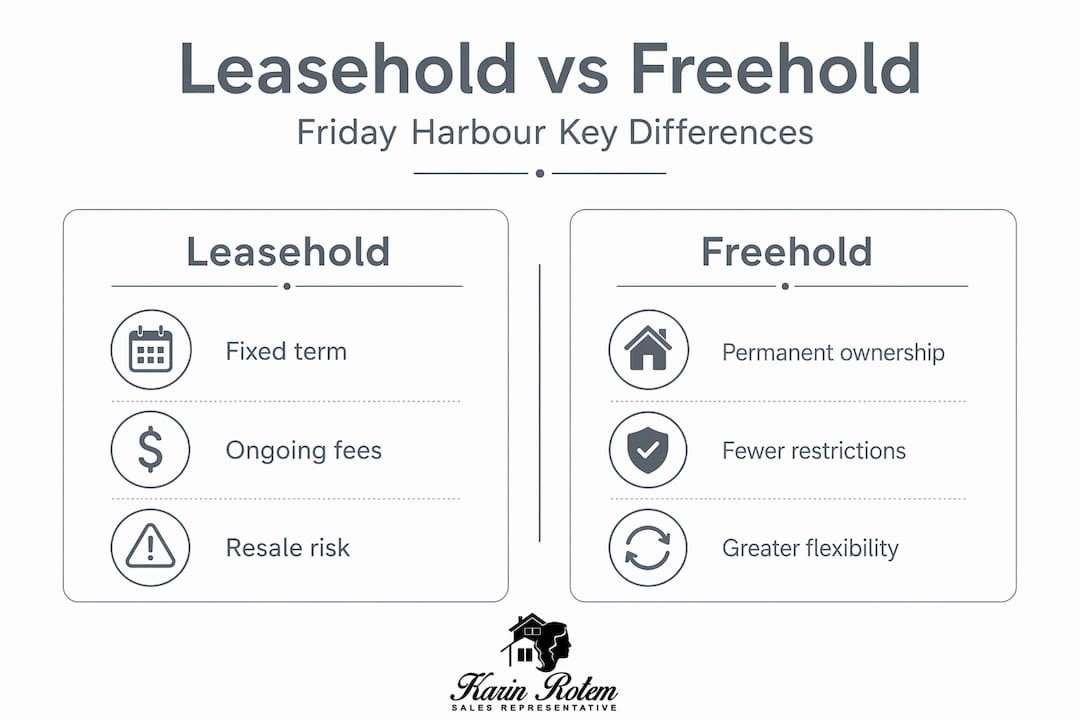
| Factor | Leasehold | Freehold |
|---|---|---|
| Ownership duration | Fixed term (e.g. 99 or 125 years) | Permanent |
| Service charges | Yes, ongoing and variable | No (HOA fees may apply) |
| Ground rent | Potentially applicable | Not applicable |
| Modification freedom | Restricted, requires consent | Full control |
| Subletting rules | Governed by lease terms | Owner’s discretion |
| Transaction timeline | Longer, more complex | Faster, simpler |
| Resale risk | Higher | Lower |
The transaction data alone should give investors pause. Leasehold deals average 155 days to reach exchange compared to just 97 days for freehold sales. The fall-through rate for leasehold transactions sits at 43%. That’s not a minor inconvenience. It represents real financial exposure, especially if you’re part of a chain or working against a timeline.
Then there’s the resale picture. 27.1% of leasehold flats sold at a loss in early 2026, compared to just 6.1% of freehold properties. The growing buyer risk-aversion toward leasehold is a market trend, not just an anecdote.
Service charges, ground rents, and resort fees represent ongoing costs that freehold owners simply don’t face in the same way. At a resort community like Friday Harbour, where premium amenities drive the lifestyle appeal, these fees can be significant and subject to escalation. Buyers who only look at the purchase price and ignore the annual fee obligations often end up surprised.
Pro Tip: Always request a full service charge history for the past three years on any leasehold property at Friday Harbour. What you pay now may not reflect what you’ll pay in two years, and lenders factor these costs into affordability assessments.
Before buying, leaseholders should scrutinise lease terms for what’s permitted around alterations, subletting, and short-term rentals. At Friday Harbour, rental rules add another dimension to this review. Understanding what your lease actually allows is a separate exercise from understanding what the resort’s rules permit, and both matter.
Friday Harbour’s resort structure and what it means for owners
Friday Harbour is not a standard residential neighbourhood. It’s a resort community with a managed amenity structure that affects every property owner, but the experience differs noticeably depending on your tenure type.

For freehold owners, the main ongoing obligations typically relate to community association or homeowner fees that fund shared infrastructure and landscaping. You maintain direct control over your unit or home and deal with maintenance on your own terms. You still participate in the resort lifestyle through the same amenities, but your legal relationship with the land is fundamentally simpler.
For leasehold owners, the picture is more layered. Friday Harbour listings that include condos operate under management agreements covering amenities like the Marina and Lake Club. These frameworks govern how owners access and use shared facilities, what rules they must follow, and what fees fund the operation of those amenities. Leaseholders are subject to both the lease’s own conditions and the broader resort governance structure.
A few things worth checking before you commit:
- Tenure confirmation: Have your agent and lawyer verify in writing whether the property is leasehold or freehold, not just the property type
- Management agreement review: Understand what amenity access fees apply, how they’re calculated, and whether they can increase
- Rental permissions: Confirm what the lease says about short-term or long-term renting, particularly if income generation is part of your plan
- Lease length remaining: A lease with fewer than 80 years remaining creates mortgage challenges and reduces resale appeal significantly
Pro Tip: Ask your agent for the Friday Harbour buyer rules specific to the property you’re considering. Resort communities have layers of governance that go beyond what standard real estate disclosure covers.
It’s also worth knowing that legal reforms in 2026 are pushing toward commonhold ownership models for new builds, which would give flat owners permanent title and collective management rights. But those changes don’t affect existing leasehold agreements. If you’re buying a resale property at Friday Harbour, legacy leasehold terms still fully apply.
How to choose: matching your goals to the right tenure
The right ownership type depends entirely on what you want the property to do for you. Here are the questions I’d walk through with any client evaluating a Friday Harbour purchase:
-
What is your investment horizon? If you plan to hold the property for 20 or more years and eventually resell, freehold offers considerably more stability and exit flexibility. Leasehold resale is demonstrably harder.
-
How important is rental income? If generating short-term rental revenue is a priority, review the lease terms carefully. Not all leasehold properties at Friday Harbour permit it, and rental rules vary by property type.
-
What does the total cost of ownership look like? Calculate the purchase price plus all ongoing fees. For leasehold, include service charges, ground rent, and resort fees. Compare this to a freehold option at a similar price point.
-
Can you get the mortgage you need? Some lenders are hesitant about leasehold properties with shorter remaining lease terms. Confirming your financing options before falling in love with a listing saves a lot of time.
-
How much control do you want over the property? If you want to renovate, redecorate, or make structural changes, freehold is the cleaner path. Leasehold requires consent for most material changes, and that consent isn’t always granted.
-
Have you reviewed the full legal documentation? Never rely on the listing description or the seller’s verbal summary. A legal review of the condo ownership documents is part of basic due diligence, not an optional extra.
When leasehold can still make sense: if the property is priced to reflect the tenure complexity, the lease has significant remaining years (800+ or 999 years), and your goals centre on lifestyle rather than long-term capital growth, the numbers can still work in your favour. The mistake most buyers make is not in choosing leasehold. It’s in choosing it without fully understanding what they’re taking on.
What to carry forward about tenure at Friday Harbour
The core distinctions come down to control, cost, and time.
- Freehold gives you permanent ownership, full autonomy, and a cleaner resale path
- Leasehold provides access to premium resort living at a potentially lower entry price, but with ongoing obligations and resale risk
- Friday Harbour’s resort management structure adds complexity on top of the standard leasehold framework
- Due diligence is not optional. Every buyer should have both a real estate lawyer and a knowledgeable local agent review tenure and all associated agreements
- Your financial and lifestyle goals must drive the decision, not the aesthetics of the listing
The data reinforces what experienced buyers already know. Leasehold properties face a steeper resale challenge, with leasehold losses nearly five times higher than freehold. That doesn’t make leasehold the wrong choice for everyone. It makes it the right choice only when you go in with clear eyes.
My take on this decision after years at Friday Harbour
What I tell my clients every single time is this: the label “leasehold” or “freehold” tells you the structure, not the value. I’ve seen clients walk away from beautifully priced leasehold condos because they were scared of the term, only to regret it. I’ve also seen clients buy without reading their lease and spend years frustrated by restrictions they never anticipated.
In my experience, the buyers who make the best decisions at Friday Harbour are the ones who ask the specific questions early. Not “is this leasehold or freehold?” in isolation, but “what does that tenure type actually mean for my specific goals with this specific property?”
Where I tend to steer clients toward freehold is when resale value and long-term flexibility are the priority. The data is hard to argue with. Freehold properties move faster, sell for more, and attract broader buyer pools. For investors with a clear exit strategy, that matters enormously.
Leasehold at Friday Harbour can still be a sound choice for lifestyle buyers who want waterfront resort living with a lower entry point and have no plans to rent or significantly renovate. The key is that it has to be an informed choice, backed by a thorough legal review and an honest look at all the fees involved.
What I’ve learned from real client experiences is that surprises in real estate almost always trace back to questions that weren’t asked early enough. That’s what I’m here to help you avoid.
— Karin Rotem
Explore Friday Harbour properties with the right guidance
Whether you’re drawn to a freehold townhome or considering a leasehold condo at Friday Harbour, the most important step is getting a full picture of what ownership actually involves before you buy. At Karinrotem, we specialise in helping buyers make that decision with confidence. We know this community’s property types, management structures, and tenure nuances inside out, and we’ll walk you through every layer before you commit.
Browse our Friday Harbour listings to see current freehold and leasehold options, or explore our full property listings to compare your options. When you’re ready for a personal conversation about how each ownership type fits your goals, reach out directly. Your waterfront investment deserves a clear-eyed approach from the start.
FAQ
What is the main difference between leasehold and freehold?
Freehold gives you permanent ownership of the land and building, while leasehold grants occupancy for a fixed term with ongoing obligations to the freeholder.
Are Friday Harbour condos typically leasehold or freehold?
Friday Harbour includes both tenure types, with townhomes commonly sold as freehold and many condo units structured as leasehold. Always confirm tenure with a lawyer before making an offer.
Does leasehold affect my ability to get a mortgage?
Yes. Lenders may decline or restrict financing on leasehold properties with fewer remaining years on the lease. Short lease terms significantly reduce the pool of eligible buyers and lenders.
Is leasehold a bad investment at Friday Harbour?
Not necessarily, but leasehold resale losses run significantly higher than freehold. It depends on your goals, the specific lease terms, and whether the price reflects the tenure complexity.
What due diligence should I do before buying a leasehold property?
Review the full lease document, request three years of service charge history, confirm what rental and alteration permissions exist, and work with a lawyer experienced in resort community properties.