
If you’ve been wondering what is a short-term rental income property, you’re asking exactly the right question before putting money into one. A short-term rental (STR) property, as the industry formally calls it, is real estate rented to guests for brief stays rather than long-term tenancy. It sounds simple. It isn’t. STRs operate differently from traditional rental properties in terms of income potential, tax treatment, regulatory exposure, and day-to-day management. Understanding those differences is what separates a well-informed investor from one who buys on projected gross revenue and gets a surprise a year in.
Key takeaways
| Point | Details |
|---|---|
| STRs differ from long-term rentals | Short-term rentals involve stays under 30 days and carry unique income, tax, and regulatory profiles. |
| Net income is what matters | Management, HOA, and maintenance fees can consume 25–50% of gross revenue, so always underwrite on net cash flow. |
| Regulations vary significantly | Local rules including caps, registration deadlines, and zoning can limit your ability to operate or resell. |
| Tax treatment is complex | CRA and IRS rules hinge on average stay length and material participation, not just the income amount. |
| Market metrics guide decisions | Occupancy rates, vacancy trends, and rent growth are the key figures for evaluating STR investment viability. |
What is a short-term rental income property?
A short-term rental income property is real estate that generates revenue through guest stays typically lasting fewer than 30 days, targeting tourists, vacationers, business travellers, and remote workers. Some tax jurisdictions draw the line at 90 days, but the 30-day threshold is the most widely used definition across Canadian municipalities and major platforms.
The property types that qualify are broad. Single-family homes, waterfront cottages, resort condos, furnished urban apartments, and even shared suites all fall under the STR umbrella. What they share is a guest-focused rental model, typically facilitated through platforms like Airbnb or VRBO, rather than a tenant-based lease arrangement.

The average length of stay matters more than most investors realise. It affects how a property is classified for tax purposes, what licences are required, and whether income is treated as passive or active. A property rented to weekend travellers is a fundamentally different asset than one rented to monthly workers, even if the physical building looks identical.
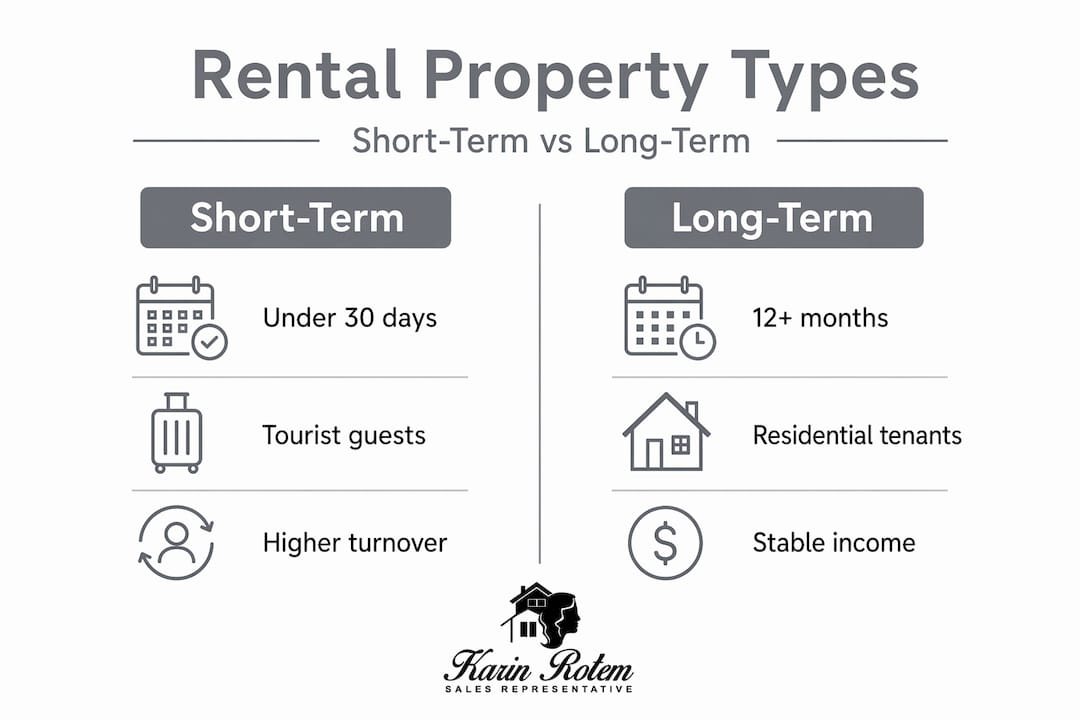
Here’s a comparison that clarifies the key differences:
| Feature | Short-term rental | Long-term rental |
|---|---|---|
| Typical stay length | Under 30 days | 12 months or more |
| Income consistency | Seasonal and variable | Steady monthly |
| Management intensity | High (turnover, cleaning, guest comms) | Low (set and collect) |
| Tax classification | Potentially active income | Typically passive income |
| Regulatory scrutiny | High and increasing | Lower, more stable |
| Income potential | Higher per night | Lower but predictable |
Understanding this table is the foundation of any honest STR investment conversation.
Income, expenses, and real profitability
Here’s where most first-time STR investors get into trouble. They see a projected gross booking revenue of $60,000 per year and assume they’ve found a strong asset. They haven’t done the math yet.
The true measure of any STR investment is net owner cash flow after all expenses are accounted for. In resort and HOA-managed communities, management fees can reach 25 to 50 percent of gross rental revenue, depending on the programme structure. Add property taxes, insurance, maintenance reserves, and condo or HOA fees, and you can see a significant portion of that $60,000 disappear quickly.
The most common costs to account for include:
- Rental management fees: Typically 20–50% of gross revenue for full-service programmes in resort communities
- HOA or condo fees: Monthly fees that apply regardless of occupancy, often substantial in lifestyle or waterfront properties
- Property taxes: Assessed annually and non-negotiable regardless of your rental performance
- Insurance: STR-specific insurance is more expensive than standard homeowner coverage
- Maintenance and reserves: Furnishings, appliances, and finishes wear faster with high guest turnover
- Platform fees: Airbnb and VRBO both charge service fees that reduce effective revenue
Income from vacation rentals can also fluctuate due to seasonality and quiet periods, unlike long-term rentals that provide steady monthly income. A property at Friday Harbour, for example, will earn most of its income between May and October, and that off-season carrying cost needs to be part of your financial model.
Personal use also affects your numbers in ways that catch people off guard. Every night you use the property is a night it isn’t generating revenue. That’s an opportunity cost, not a free benefit.
Pro Tip: Always ask the seller for actual owner income statements from the past two or three years, not developer projections or marketing estimates. Verified historical data is the only reliable basis for underwriting a short-term rental investment.
Regulations and compliance
Regulatory risk is one of the most underappreciated factors in STR investing, and it’s the one that can genuinely strand you. Local rules can materially affect whether an STR can legally operate, through caps on the number of licensed units, registration deadlines that lock out late applicants, and zoning restrictions that prohibit STRs in certain building types.
In Canadian markets, the regulatory picture varies widely by municipality. What’s permitted in one township may be entirely prohibited one kilometre away. Before buying any short-term rental property in Ontario, you need to understand:
- Municipal registration requirements: Most Ontario municipalities now require STR registration or a business licence
- Principal residence rules: Many jurisdictions restrict STRs to your primary residence only, which limits pure investment plays
- Caps on licences: Some communities issue a finite number of STR licences, and once they’re full, new operators cannot register
- Licence transferability: In some cases, an STR licence does not transfer with a property sale, meaning the buyer cannot operate without reapplying
The Friday Harbour community operates under Innisfil’s STR framework, and understanding Friday Harbour’s rental rules is a non-negotiable first step before making an offer on any property there. Licence restrictions can affect both your ability to operate and your eventual resale value. A property with a grandfathered licence in a capped market is worth more than one without, and that difference needs to be reflected in your purchase price.
Pro Tip: Before you buy, verify whether the existing STR licence transfers to you at closing, and confirm with the municipality directly. Relying on the seller’s assurances alone is a risk not worth taking.
Tax implications and income classification
Tax treatment of STR income is where the rules get genuinely complex, and where working with a qualified tax adviser pays for itself many times over.
The Canada Revenue Agency’s treatment of STR income depends on how the property is used, how actively you’re involved in operating it, and what services you provide to guests. Parallels exist in U.S. tax rules under the IRS framework, which is relevant for Canadians who hold cross-border properties.
Key tax considerations to understand:
- Average stay length matters: When the average guest stay is seven days or fewer, U.S. tax rules may treat the income as non-passive business income rather than passive rental income, with significant implications for loss deductions
- Material participation tests: To treat STR income as non-passive, the taxpayer must meet IRS material participation standards under Section 469, which requires meaningful, regular involvement in operations
- Deductible expenses: Qualifying STRs can deduct a proportionate share of mortgage interest, insurance, utilities, and depreciation against rental income
- The Augusta Rule: In the U.S., renting your personal residence for 14 days or fewer per year allows you to exclude that income entirely under IRC 280A(g), though no expenses can be deducted for those days
In Canada, the CRA looks at whether your STR activity constitutes a business or passive investment, with services beyond basic accommodation (cleaning, meals, concierge) pushing income toward business classification. That distinction affects which expenses are deductible, how losses are treated, and your HST obligations.
Tax outcomes hinge more on participation level and stay structure than on the income amount itself. Getting this wrong costs far more than an accountant’s fee.
Pro Tip: Meet with a tax adviser who has specific STR experience before you purchase, not after. The way you structure ownership and operations from day one affects your tax position for the entire holding period.
Market dynamics and investment evaluation
Choosing the right property in the right market is where strategy and numbers come together. Not all STR markets perform equally, and the post-pandemic normalisation has changed the landscape considerably.
In markets like Orlando, vacancy rates have settled around 9% with annual rent growth slowing to roughly 1 to 2%, a significant deceleration from the double-digit gains seen in 2021 and 2022. That context matters for anyone evaluating whether now is the right time to buy in a saturated STR market versus a market with constrained supply like a regulated resort community.
When evaluating any short-term rental income resort community or individual STR property, these are the metrics and criteria that matter most:
| Evaluation criterion | What to look for |
|---|---|
| Occupancy rate | Verified historical rate above 70% for resort markets |
| Net owner income | Actual cash flow statements, not developer projections |
| Regulatory stability | Is the current licence framework likely to tighten? |
| Management structure | Who operates it, and what do they charge? |
| Seasonality profile | How pronounced is the off-season, and what are carrying costs? |
| Property features | Does it have amenities that command premium nightly rates? |
| Exit strategy | How liquid is resale, and are buyers willing to pay for STR income? |
For markets in Ontario, particularly waterfront destinations like Friday Harbour, supply constraints are a meaningful advantage. The features investors prioritise in furnished rental properties, including docking access, premium finishes, and proximity to resort amenities, directly support both occupancy rates and nightly pricing.
Understanding how to invest in rentals at a destination like Friday Harbour means layering these evaluation criteria against the specific regulatory context and local demand profile. Numbers that work in one community may not work in another even 20 kilometres away.
My honest take on what investors often miss
In my experience working with buyers at Friday Harbour and across the Innisfil and Toronto markets, the most common mistake I see isn’t choosing the wrong property. It’s evaluating the right property with the wrong information.
What I tell my clients is this: gross revenue projections are a marketing tool. They are not an investment thesis. The real question is what lands in your account after the management company, the condo corporation, the municipality, and the CRA all take their share. That’s the number you make your decision on.
I’ve also watched buyers underestimate regulatory risk. A municipality that permits STRs today can introduce licensing caps or principal-residence-only rules within a single budget cycle. That changes your operating rights and, by extension, your property’s value. I always recommend checking Ontario’s STR compliance requirements before committing to any purchase.
What genuinely excites me about well-positioned STR properties in resort communities is the dual benefit: meaningful income potential when managed properly, combined with personal enjoyment of the property. That balance is real. But it requires honest numbers, current regulations, and a realistic understanding of what you’re buying into.
— Karin Rotem
Explore STR investment opportunities with Karinrotem
If this article has clarified what a short-term rental income property actually involves, the natural next step is finding one that matches your goals. Karinrotem’s team specialises in helping buyers understand the full picture at Friday Harbour, one of Ontario’s most sought-after waterfront resort communities, where income potential and lifestyle value genuinely align.
Whether you’re exploring your first investment property or adding to an existing portfolio, the team provides verified market data, regulatory guidance, and honest analysis of net income potential. Browse current Friday Harbour listings to see what’s available, or view the full available properties portfolio for investment-grade options across the region. When you’re ready to talk numbers and strategy, Karinrotem is here to guide you through it with the local knowledge and candour you deserve.
FAQ
What qualifies as a short-term rental property?
A short-term rental property is one rented to guests for stays typically under 30 days, catering to tourists, business travellers, and vacationers through platforms like Airbnb or VRBO.
How is STR income taxed in Canada?
The CRA treats STR income as either rental income or business income depending on the services provided and level of owner involvement, with HST obligations potentially applying when revenue exceeds the registration threshold.
What is the biggest financial mistake STR investors make?
The most common error is underwriting on gross booking revenue rather than net owner cash flow after management fees, HOA fees, insurance, and taxes, which can consume 25 to 50% of gross income in resort communities.
Can STR regulations affect my property’s resale value?
Yes. Local licensing caps, registration restrictions, and principal-residence-only rules can materially limit operating rights, which reduces buyer demand and can lower resale values for properties in tightly regulated markets.
What makes Friday Harbour a strong STR market?
Friday Harbour benefits from constrained supply, strong seasonal demand, resort-quality amenities, and a regulated framework that limits new STR licences, which supports occupancy rates and nightly pricing for existing licence holders.