
Yes, multiple representation is legal in Ontario, but only when the brokerage gives you written disclosure and gets your written consent first. Once that happens, three things change immediately: your agent can no longer advise you on price or terms, you’ll be asked to sign an acknowledgement (usually OREA Form 320), and you retain the right to say no. Here’s what actually happens when your agent tells you they’re also representing the other side:
- Your agent shifts from advocate to neutral facilitator, by law.
- You must receive written disclosure before the brokerage does anything further.
- You can refuse and ask for a different representative or a different brokerage.
The full rulebook lives in RECO Bulletin 3.2 and the Trust in Real Estate Services Act (TRESA). The rest of this guide breaks down what that means for your specific transaction.
Key Takeaways
Multiple representation is legal in Ontario only with mandatory written disclosure, documented acknowledgement, and written consent from every client involved.
| Point | Details |
|---|---|
| Legal status | Multiple representation is permitted under TRESA, but only with written disclosure, acknowledgement, and consent. |
| Duties narrow | Agents can’t advise on price or terms, or share one client’s confidential information with the other. |
| Designated representation exists | Ask your brokerage if separate registrants can represent each side, preserving full advocacy for both. |
| Paperwork matters | Request OREA Form 320 and keep copies of every disclosure and acknowledgement you sign. |
| You can refuse | RECO protects your right to say no or request a different representative at any point. |
What is multiple representation in Ontario?
Multiple representation happens when one brokerage, or one registrant within it, represents more than one client with competing interests in the same deal. The most familiar version is “double ending,” where the same agent lists your house and also brings the buyer. It happens in a few common shapes:
- Double ending: one agent represents both the seller and the buyer on the same sale.
- Two buyers, one brokerage: the same office has two clients competing for the same listing.
- Cross-side overlap: a brokerage represents the seller and also has a buyer client interested in that property, even if a different registrant handles each side.
The conflict shows up the moment your interests and the other party’s interests diverge, usually around price. That’s exactly when disclosure has to happen, not after an offer is already on the table.
Is multiple representation legal in Ontario?
Legal, yes, but conditional. TRESA and RECO Bulletin 3.2 lay out three preconditions a brokerage must meet before it can represent more than one client in the same trade. Skip any of them, and the brokerage is offside.
- Mandatory written disclosure, delivered as soon as the brokerage knows multiple representation applies.
- Best efforts to obtain a written acknowledgement that the client received and understood that disclosure.
- Written consent from each client to proceed, not a verbal “that’s fine.”
RECO’s own guidance is blunt about the order of operations: disclosure comes first, before the brokerage takes any further action on your behalf. OREA Form 320, the Confirmation of Cooperation and Representation, is the standard paper trail most Ontario brokerages use to document all of this. If your agent raises multiple representation verbally and moves on without paperwork, that’s a red flag, not a formality being skipped for convenience.
TRESA also gives brokerages a cleaner alternative, which we’ll get to shortly. RECO’s FAQ guidance actually warns brokerages against mixing representation models, since that inconsistency is what causes accidental multiple representation in the first place.
How your agent’s duties change under multiple representation
This is the part most buyers and sellers don’t fully grasp until they’re mid-negotiation. Once multiple representation kicks in, your agent stops being your advocate and becomes something closer to a referee.
What they can no longer do:
- Advise you on what offering price or terms to use.
- Tell the other side your negotiating limits, your motivations for buying or selling, or anything confidential you’ve shared.
- Push for an outcome that favours one client over the other.
What they still must do:
- Disclose material facts about the property to both sides.
- Tell you about competing offers when they exist.
- Meet every other disclosure obligation TRESA requires, regardless of representation status.
RECO describes this as an impartial facilitator role, which sounds neutral on paper but has real teeth in a negotiation. You lose the person who’s supposed to be in your corner telling you when to push harder or when to walk.
Pro Tip: If you’re heading into multiple representation on a big-ticket property, especially waterfront or investment purchases, get a second opinion from a real estate lawyer before you sign anything. Your agent legally cannot give you that strategic advice anymore, so someone else has to.
Designated representation: the alternative worth asking about

Designated representation lets a brokerage assign two different registrants, one for the buyer, one for the seller, so each person can keep advocating fully for their own client. The brokerage itself isn’t considered to be in multiple representation, because the individuals doing the actual negotiating are different people with separate obligations.
This is why many larger Ontario brokerages build their systems around it. It sidesteps the narrowed-duty problem entirely while still letting a single office handle both sides of a deal. TRESA guidance and industry tip cards frame it as a deliberate structural choice, not a loophole.
Before you sign anything, ask your brokerage directly:
- “Will I have my own designated representative, separate from the other party’s?”
- “Who at your brokerage is handling the other side of this deal?”
- “Can I see a copy of the representation agreement before I commit?”
The terms you’ll hear, and what they actually mean
A few phrases show up constantly once multiple representation enters the conversation, and knowing them upfront saves confusion later.
- Double ending: one agent, both sides of the same deal.
- Brokerage representation: the whole office is considered to represent you, not just one person.
- Designated representative: a specific registrant assigned to advocate only for you.
- Self-represented party (SRP): someone without an agent at all, common in FSBO situations.
Disclosure gets triggered the moment an offer is being drafted, or the second another buyer registers interest in a property your agent already represents on the seller side. Watch for that timing.
What can go wrong: risks and RECO discipline
The practical risk is straightforward: you lose an advocate exactly when you need one most. Weaker negotiation support, no tailored pricing advice, and a lingering question about whether commission structure quietly favours closing the deal over protecting your interests.
- Reduced negotiation leverage, since your agent can’t coach you on strategy.
- No access to the other party’s motivations or limits, even if that information would help you.
- A structural incentive for the brokerage to close the transaction rather than push for your best possible terms.
RECO discipline in this area tends to follow a familiar pattern: a registrant proceeds on verbal consent instead of documented written consent, skips the acknowledgement step, or fails to disclose at all. One widely cited case involved a brokerage fined for failing to disclose multiple representation properly, a reminder that missing paperwork isn’t a technicality to RECO. It’s the whole compliance test.
What to ask, demand, and sign before you consent
Don’t let this move faster than you’re comfortable with. Here’s the checklist I’d hand any client facing this decision:
- Ask for the written disclosure in full, before you agree to anything verbally.
- Get the exact scope of narrowed duties in writing, not a verbal summary.
- Request a copy of OREA Form 320 once it’s prepared.
- Ask whether designated representation is available as an alternative.
- Confirm your written acknowledgement is on file, and keep your own copy.
Useful lines to actually say to your agent: “What exactly changes about your duties to me if I agree to this?” and “Is there a designated representative option instead?”
Pro Tip: If something about this feels off, you’re allowed to ask for a different designated representative or move to another brokerage entirely. Consent has to be freely given, and RECO explicitly protects your right to refuse.
The paperwork you should keep on file
OREA Form 320, the Confirmation of Cooperation and Representation, is the document most Ontario brokerages use to formally record who represents whom. It’s your paper trail if a dispute ever comes up.
The brokerage has to make genuine effort to get your written acknowledgement, not just email it and move on. Keep copies of everything:
- The written disclosure itself.
- Your signed acknowledgement.
- Any designated representation agreement, if that route was offered.
- Correspondence discussing alternatives you were given.
How to exit a buyer representation agreement
Changed your mind after signing on? You’ve got options, though the exact path depends on what your agreement says.
- Reread your buyer representation agreement for a termination or cancellation clause.
- Request a direct meeting with the brokerage, not just your individual agent.
- Send a clear, written request to terminate or reassign representation.
- Ask for written confirmation that the termination was processed.
- Talk to a real estate lawyer if the brokerage pushes back or claims you owe a fee.
A simple template: “I’m requesting to terminate my buyer representation agreement dated [date], effective immediately. Please confirm receipt in writing.” Some brokerages can legally retain a fee if you buy a property they introduced you to, even after termination, so check the termination language in your own buyer representation agreement closely before you sign that request.
What I tell my clients about multiple representation
What most buyers don’t realize is that consenting to multiple representation isn’t automatically a bad move. It just means you need to bring your own negotiation backup. I’ve had Toronto clients on competitive Friday Harbour listings where the brokerage offered designated representation instead, and that structural fix solved the problem before it ever became one.
Here’s my honest take:
- I lean toward designated representation whenever it’s available, because you keep a real advocate.
- I only accept straight multiple representation when a client fully understands the trade-off and has independent legal advice lined up.
- On competitive waterfront listings, I protect a client’s position by pushing for that designated split early, before offers start coming in.
If you’re weighing your options on a seller representation agreement or want a second read on your negotiation position, that’s exactly the kind of conversation worth having before you sign anything.
Get local guidance before you sign anything
Reading the rules is one thing. Applying them to a specific Friday Harbour condo or a Toronto bidding war is another. If you’re buying or selling in Innisfil, Friday Harbour, or the greater Toronto area and want someone who’ll flag a multiple representation situation before it becomes a problem, browse current listings or reach out directly. For buyers specifically weighing what tailored representation actually looks like day to day, the lifestyle-driven buyer guidance page walks through what to expect. And if you’re still sorting out the difference between agents and brokers before you even get to representation questions, this breakdown is a solid starting point.
An editorial take on why the paperwork matters more than the concept
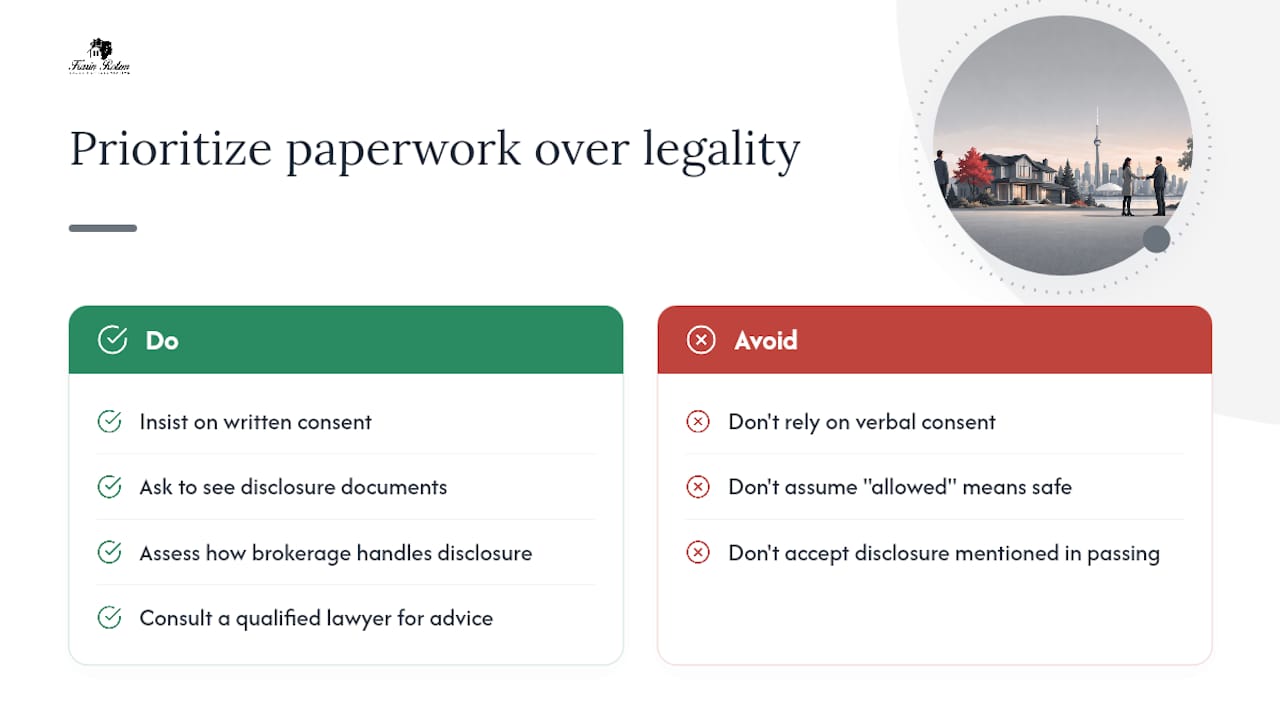
The conventional advice on multiple representation tends to focus on whether it’s legal, as if that settles the question. It doesn’t. The real issue is that most disputes RECO handles don’t come from brokerages doing something exotic, they come from skipping a signature. Verbal consent instead of written consent. A disclosure mentioned in passing instead of handed over in writing.
What gets underestimated is how much leverage a buyer or seller actually has to say no. Consent isn’t a formality you’re supposed to nod through, it’s a genuine decision point, and RECO’s own guidance backs that up explicitly. If there’s one thing worth prioritizing above everything else in this guide, it’s this: don’t evaluate whether multiple representation is “allowed.” Evaluate whether the specific brokerage in front of you is handling the disclosure properly. That’s where the actual risk lives.
This article is general information, not a substitute for advice from a qualified lawyer. Consult a qualified legal professional about your own circumstances before acting on anything here.
Sources
- RECO bulletin 3.2 multiple representation
FAQ
Can you work with multiple realtors in Ontario?
Generally, no, if you’ve signed an exclusive buyer representation agreement with one brokerage, you’re bound to that arrangement until it ends or is terminated in writing.
What is the most common complaint filed against realtors?
Missing or verbal consent in multiple representation situations is a frequently cited compliance issue, since RECO discipline often follows when written acknowledgement wasn’t properly obtained.
What is a representation agreement in Ontario?
It’s a written contract that defines the duties a brokerage owes you, including how they’ll handle disclosure, negotiation, and any potential conflict like multiple representation.
How do I get out of a buyer representation agreement in Ontario?
Review your agreement’s termination clause, send a written cancellation request to the brokerage, and get confirmation in writing; consult a lawyer if the brokerage disputes the termination or claims a fee is owed.