
Include a financing condition unless you’re paying cash or already hold unconditional lender approval in writing. Conditional approval, pre-approval, or a verbal “you’re good to go” from your broker doesn’t count. If any part of your purchase depends on a mortgage, that clause is what stands between you and losing your deposit over something outside your control.
Two things to do right now, before you do anything else:
- Send your mortgage broker or lender the full purchase contract the day you sign it.
- Pull together every outstanding document (pay stubs, T4s, down payment proof) and get it to them immediately, not “this week.”
Waiving this condition without a written commitment in hand isn’t confidence, it’s a gamble with your deposit and possible legal exposure.
Key Takeaways
Protecting your deposit during a financing condition comes down to written lender confirmation, realistic timelines, and a documented paper trail at every step.
| Point | Details |
|---|---|
| Keep the condition unless unconditional | Only waive financing with written, unconditional lender commitment covering both you and the property. |
| Set a realistic timeline | Budget 3 to 7 business days, longer for rural, waterfront, or condo purchases needing appraisals. |
| Act within hours, not days | Send your contract to your broker and forward outstanding documents the same day you sign. |
| Review condo status certificates early | Order and forward the status certificate immediately to catch reserve fund or litigation issues. |
| Document everything | Keep every email, approval letter, and appraisal report in case of a dispute later. |
What is a financing condition in Ontario?
A financing condition is a clause in your Agreement of Purchase and Sale that makes your offer dependent on securing mortgage approval on terms acceptable to you. Until that condition is satisfied or waived, you’re not legally bound to close, and your deposit stays protected. It’s the single most important safety mechanism in an Ontario real estate transaction, which is exactly why some buyers get pressured into dropping it in hot markets.
The clause covers more ground than most buyers assume. It’s not just “will the bank say yes.” Your lender is also checking:
- Your credit history and supporting documents
- Whether the property itself is acceptable to them (condition, location, type)
- The appraised value versus your purchase price
- Proof and timing of your down payment
- Whether mortgage insurance is available for the deal
A financing condition typically runs 3 to 7 business days in Ontario transactions and exists precisely to give a lender time to confirm all of the above. Waive it before that confirmation exists, and you’ve traded legal protection for a faster closing date. That’s rarely a fair trade.
How long should your conditional period be?
Most Ontario buyers land on somewhere between 3 and 7 business days for financing, and that range isn’t arbitrary. It reflects how long a typical lender needs to underwrite a file, order an appraisal, and issue written commitment. A shorter window can make your offer look more competitive to a seller, but it only works if your file is clean and your broker already has most of your documents.
Several factors stretch that timeline whether you want them to or not:
- Appraisal requirements. If your lender needs a physical appraisal rather than an automated valuation, add days, sometimes a week, especially outside major centres.
- Condo status certificates. Reviewing the certificate for red flags takes time and often runs in parallel with financing.
- Underwriting backlogs. Some lenders move faster than others depending on volume; spring and early fall tend to be busier.
- Seasonal demand. Appraisers and lawyers both get booked solid during peak buying months.
The smartest move is talking to your broker before you write the offer, not after. Tell them what condition period you’re considering and ask directly whether it’s realistic given the property type and your current file. A broker who’s honest with you will say so if 3 days is too tight for a rural property needing a full appraisal.
Your day-by-day plan to satisfy financing
Treat the conditional period like a countdown, not a waiting game. Here’s the sequence that keeps you moving:
- Day 0 (offer accepted): Send the full Agreement of Purchase and Sale to your broker or lender within hours, not days. Ask for a written list of everything still outstanding on your file.
- Day 1 to 3: Book the appraisal immediately if one’s required. Deliver proof of down payment (bank statements, gift letters, RRSP withdrawal confirmation) the same day your broker asks.
- Ongoing: Get every underwriting note or request in writing, and reply the same day. A phone call promise from an underwriter means nothing if the deal falls apart later.
- Before you waive anything: Confirm your lender’s written commitment actually addresses property acceptability and appraisal, not just your personal creditworthiness. If it doesn’t mention the property, you don’t have full approval yet.
- If you’re not ready by the deadline: Ask your agent to request a short extension rather than letting the condition lapse or waiving it under pressure.
Pro Tip: Ask your lender specifically, “Does this letter confirm the property is acceptable, or only that I’m approved as a borrower?” Those are two different letters, and buyers waive on the wrong one more often than you’d think.
What happens if you waive too early
Waiving your financing condition before you have full written approval turns a conditional offer into a firm one. If the deal then falls through because financing doesn’t come together, you can lose your deposit and face legal claims from a seller who’s entitled to rely on your firm commitment.
The failures I see aren’t usually about creditworthiness. They’re timing and documentation problems:
- Appraisal shortfalls. The home appraises below your offer price, and the lender won’t fund the gap.
- Changed circumstances. A new car loan, a job change, or a missed credit card payment between pre-approval and closing can undo everything.
- Expired rate holds. Your rate lock runs out before closing, and the new rate changes your qualifying numbers.
- Slow document verification. Missing paperwork sits in an inbox for days while your clock runs down.
None of these fully disappear just by being careful, but you can reduce the odds. Get every lender confirmation in writing. Coordinate closely with your broker so nothing sits unanswered for more than a day. And build in a few extra days of contingency rather than shaving your timeline to the bone to look competitive on paper.
Condo financing: status certificates and warrantability
Condos add a layer that freehold buyers never deal with. Lenders don’t just approve you, they also review the building. A status certificate reveals special assessments, reserve fund health, and pending litigation, and any of those can slow or derail your financing entirely.

Warrantability matters just as much. A non-warrantable condo (think high rental concentration, commercial space imbalance, or a struggling reserve fund) limits which lenders will even consider the file, which usually means fewer options and longer waits, sometimes through a DSCR-style lender for condos outside standard warrantability rules.
What actually helps:
- Order the status certificate the day your offer is accepted, don’t wait.
- Send it to your lender immediately, even before they ask.
- Ask your broker directly whether your lender treats this building as warrantable. If it’s borderline, learn about special assessments and what they mean for your budget before you commit further.
Wording your financing condition properly
Vague wording is where disputes start. “Subject to financing satisfactory to the buyer” sounds fine until nobody agrees on what “satisfactory” means three days before closing. Reference specific timelines, specific approval terms, and be explicit about what counts as fulfillment.
Documents worth keeping from day one:
- Every email from your lender or broker, timestamped
- Written approval letters, including any conditions attached to them
- Appraisal reports and correspondence about appraised value
- Proof of funds and down payment confirmations
- Notes from every call with your broker, dated
If you need more time, ask your agent to request an extension before the deadline passes, not after. Sellers commonly expect something in return, a short delay in exchange for a firm commitment date, or occasionally a small deposit top-up. Knowing your numbers ahead of time through a mortgage and affordability calculator makes that negotiation faster.
Pro Tip: Never rely on a verbal “we’re extending it, don’t worry” from the other side. If it’s not in writing and signed, it hasn’t happened.
What I tell my clients across the GTA and Friday Harbour
In competitive Toronto pockets, I sometimes see buyers accept a 3-day financing condition to win a bidding war. That works when their file is spotless and pre-approval is airtight. In Friday Harbour and rural Innisfil, I push back on short windows more often, appraisals there simply take longer, and status certificates on newer builds can carry surprises.
What I coordinate for every client is a direct line between their broker and their real estate lawyer from day one, not after a problem appears. That single habit catches more issues than any amount of paperwork after the fact.
How financing conditions affect your mortgage approval odds
A financing condition doesn’t change whether a lender approves you, it changes when and how thoroughly they check. Buyers sometimes assume waiving the condition somehow speeds up approval or improves their odds. It doesn’t. The lender applies the same underwriting standard either way; the condition simply determines whether you’re protected if that underwriting turns up a problem.
Interest rates work similarly. Your rate is locked based on your application and rate hold period, not on whether you kept or waived the financing condition. What can move your rate is timing: if your conditional period drags past your rate hold expiry, you may be requoted at a new rate, which can shift your qualifying numbers enough to matter on a tight budget.
Where the condition genuinely affects your odds is indirect. A longer conditional period gives your broker room to fix small issues, a credit report error, a missing letter of explanation, before they become a denial. A rushed 3-day window doesn’t give anyone that room. Buyers who waive early and then discover a problem have no recourse; buyers who kept the condition can walk away or renegotiate.
Some borrowers also assume pre-approval guarantees the loan. It doesn’t. Pre-approval reflects your finances at a point in time. Lenders can still decline once they review the specific property, an appraisal that comes back low, a condo with reserve fund problems, or insurance that isn’t available for that unit type. The financing condition exists specifically to protect you against that gap between pre-approval and final commitment.
How financing conditions shape your negotiating position
A financing condition isn’t just protection, it’s leverage, and how you use it shapes how sellers and their agents treat your offer. A conditional offer generally reads as lower risk to accept over a rushed unconditional one from a seller’s standpoint, but in multiple-offer situations, sellers often favour whichever offer carries the fewest conditions or the shortest timelines.
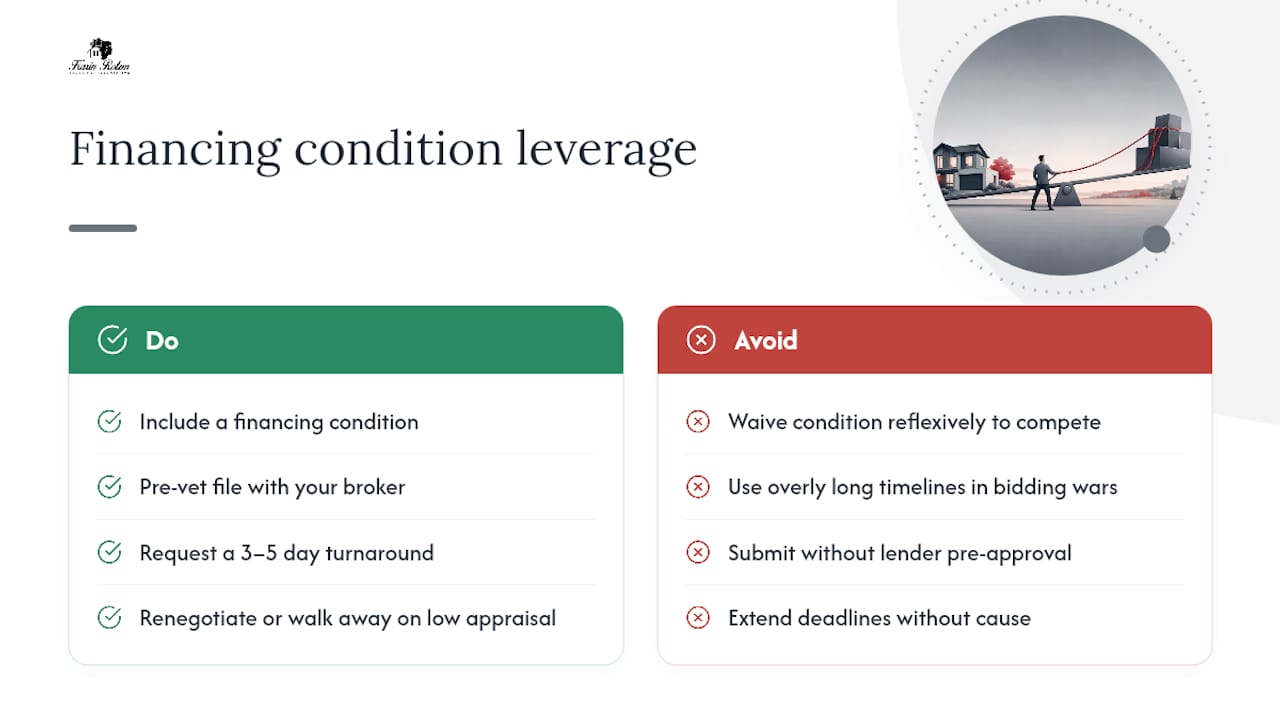
That creates real pressure to shorten your financing window or waive it outright to compete. Resist doing that reflexively. A well-prepared conditional offer, one where your broker has pre-vetted most of your file and can confirm a fast 3 to 5 day turnaround, competes just as well as an unconditional offer without exposing your deposit.
The condition also gives you negotiating room after acceptance. If an appraisal comes back below purchase price, a financing condition lets you go back to the seller and renegotiate price or walk away cleanly. Without it, you’re stuck closing at the original price or defaulting. Sellers who’ve been through this before usually understand that a financing condition with a realistic, tight timeline is a sign of a serious, well-prepared buyer, not a weak one.
The leverage cuts both ways during the conditional period itself. If problems surface, a low appraisal, a lender request for more documentation, you have standing to ask for an extension or renegotiated terms rather than losing the deal entirely. That flexibility is worth more than the extra few days it costs you at offer time.
Financing conditions for freehold, rural, and commercial properties
Financing conditions don’t work identically across every property type, and treating a rural property or a commercial purchase like a standard condo deal is a common mistake.
Freehold homes are usually the most straightforward. No status certificate, no condo board to review, so financing conditions tend to move faster and appraisals are more predictable since comparable sales are easier to find in established neighbourhoods.
Rural and waterfront properties, common territory around Innisfil and the broader Friday Harbour region, often need longer conditional periods. Appraisers have fewer comparable sales to draw from, septic systems and wells may require separate inspections that feed into the lender’s decision, and some lenders limit financing on properties without municipal services. If you’re eyeing a waterfront property near Toronto, build extra days into your financing window from the start rather than negotiating for them later.
Commercial and mixed-use properties operate under a different lending framework entirely. Lenders assess income potential, tenant leases, and zoning compliance alongside the buyer’s creditworthiness, which routinely pushes conditional periods well past the standard 7-day window residential buyers are used to. Anyone moving from a residential purchase into an income property should expect a longer, more document-heavy process, and should ask upfront how it differs from what they’ve experienced before.
Ready to move forward with confidence?
Every point above matters more when you’re actually negotiating an offer under a deadline, not reading about it in theory. That’s where having someone coordinate your financing condition, your lawyer, and your timeline in real time makes the difference between a smooth closing and a stressful one.
If you’re actively looking in Toronto, Innisfil, or the Friday Harbour community, I’d rather walk you through your specific situation than have you guess at timelines alone. Browse our current listings to see what’s available now, or reach out before you write an offer so we can build the right financing condition into it from the start.
An editorial take on fast, safe conditional periods
The conventional advice on financing conditions treats every deal the same: pick a few days, cross your fingers, move on. That’s backwards. The research here points to something more specific: the deals that go sideways aren’t usually about creditworthiness, they’re about timing gaps and vague written commitments that nobody clarified early enough.
What’s overrated is the race to shorten conditional periods to win a bidding war. A tight window only helps if the file behind it is genuinely ready, appraisal booked, documents in hand, lender已 briefed. Otherwise it just moves the risk from “will I win this offer” to “will I lose my deposit.”
What actually matters, and what most buyers skip, is treating the written lender commitment as a legal document worth scrutinizing line by line. Does it mention the property? Does it name an appraisal outcome? If not, you don’t have what you think you have. Prioritize that clarity over speed, every time.
Sources
- Conditions of financing in Ontario — Abbi Stevenson Mortgages
- Typical conditions you’ll encounter during a home sale — CREA Café
- Agreement of Purchase and Sale — Lamba Law
FAQ
What is a financing condition?
A financing condition is a clause in your Agreement of Purchase and Sale that makes your offer dependent on securing mortgage approval on acceptable terms, protecting your deposit until it’s satisfied or waived.
How much income do you need to qualify for a $500,000 mortgage in Canada?
Required income depends on your down payment, interest rate, other debts, and the lender’s specific qualifying rules, so there’s no single fixed figure. Speak with a mortgage broker who can run your exact numbers through current lender criteria.
What are the new mortgage rules in Canada for 2026?
Mortgage rules and stress test thresholds change periodically and vary by lender and insurer, so always confirm current requirements directly with your mortgage broker before relying on any specific figure.
What happens if a buyer can’t get financing?
If the financing condition hasn’t been waived, the buyer can walk away from the deal and have their deposit returned. If it was already waived, the buyer risks losing the deposit and facing potential legal claims from the seller.