If you want the largest buyer pool and the strongest price, list between March and May. If you’d rather deal with fewer buyers but more serious ones, early September is your window. Both plans hinge on the same math: closings typically take 6 to 8 weeks after your home goes firm, so back your listing date up from your ideal closing month before you commit.
TL;DR:
- Listing in spring (March to May) generally yields the highest sale prices and the largest buyer pool, but also involves more competition among sellers.
- Early September can be advantageous for serious buyers and less competition, especially since listings tend to stand out longer during this period.
- Current market conditions in Innisfil show roughly eight months of inventory, indicating a buyer’s market where realistic pricing and presentation are critical.
- Proper preparation and a 60 to 90-day marketing calendar can significantly improve sale outcomes, particularly for waterfront properties requiring extra inspections.
- External factors like nearby development milestones and regional employment trends influence buyer interest more than seasonal timing alone.
Innisfil’s current market snapshot: what the numbers say about timing
Innisfil’s market has shifted enough in 2026 that the old “just list in spring” advice needs a second look. Average sold prices across the town sit in the $651,000 to $804,000 range depending on the reporting window, with median days on market running in the mid-30s. That’s respectable, but not the frantic, multiple-offer pace some sellers remember from a few years back.
The bigger story is inventory. Local trackers reported roughly eight months of inventory in mid-2026, which puts Innisfil closer to buyer’s market territory than seller’s. Anything above five or six months of inventory generally means buyers have leverage: more homes to compare, more room to negotiate, less urgency to act fast.
Pro Tip: When you’re checking market data, look at the benchmark price from the MLS® Home Price Index rather than a simple average. Averages get skewed by one waterfront sale or one estate teardown; the benchmark tracks a consistent, typical home, which gives you a truer read on where your property actually sits.*
What this means for your listing month:
- Rising inventory rewards sellers who prep thoroughly and price realistically over those who just wait for “the season.”
- Days on market figures reported today reflect homes that went firm 6 to 8 weeks ago, so the market may already be moving before the stats catch up.
- A buyer’s market doesn’t cancel out seasonal demand. It just means presentation and pricing carry more weight than the calendar alone.
Which season fits your selling goal?
Not every seller wants the same outcome, and Innisfil’s calendar rewards different goals in different months.
- Spring (March to May) brings the largest buyer pool of the year. Homelight’s Ontario analysis found sellers listing in May can net about 3.34% more than the yearly average and sell roughly six days faster, largely because school-year timing and better weather pull more buyers into the market at once. The trade-off: you’re also competing against the most other sellers, so your presentation needs to hold up.
- Summer (June to August) suits sellers with family-driven deadlines, especially those wanting to close before September’s school start. It’s also the strongest window for waterfront and Friday Harbour properties, since buyers want to see the dock, the water, and the landscaping at their best before they commit.
- Early fall (September to October) is Innisfil’s most underrated window. Buyer traffic drops from the summer peak, but the buyers who are still looking tend to be pre-approved, motivated, and past the “just browsing” stage. Less competition from other sellers often means your listing stands out longer instead of getting buried on page two of search results.
- Winter and other off-peak stretches work when inventory is genuinely tight or when you need to move on your own timeline regardless of season. Buyer volume drops, but so does your competition, and a well-priced, well-presented home can still move quickly if it’s one of the only options on the market.
Pro Tip: If you’re listing a waterfront or Friday Harbour property outside of summer, shoot your marketing photos during peak season even if you don’t list until fall. Buyers respond to water views and green landscaping far more than bare docks and brown grass, and that gap in emotional appeal shows up in offer strength.
How to build a 90-day listing calendar that actually works
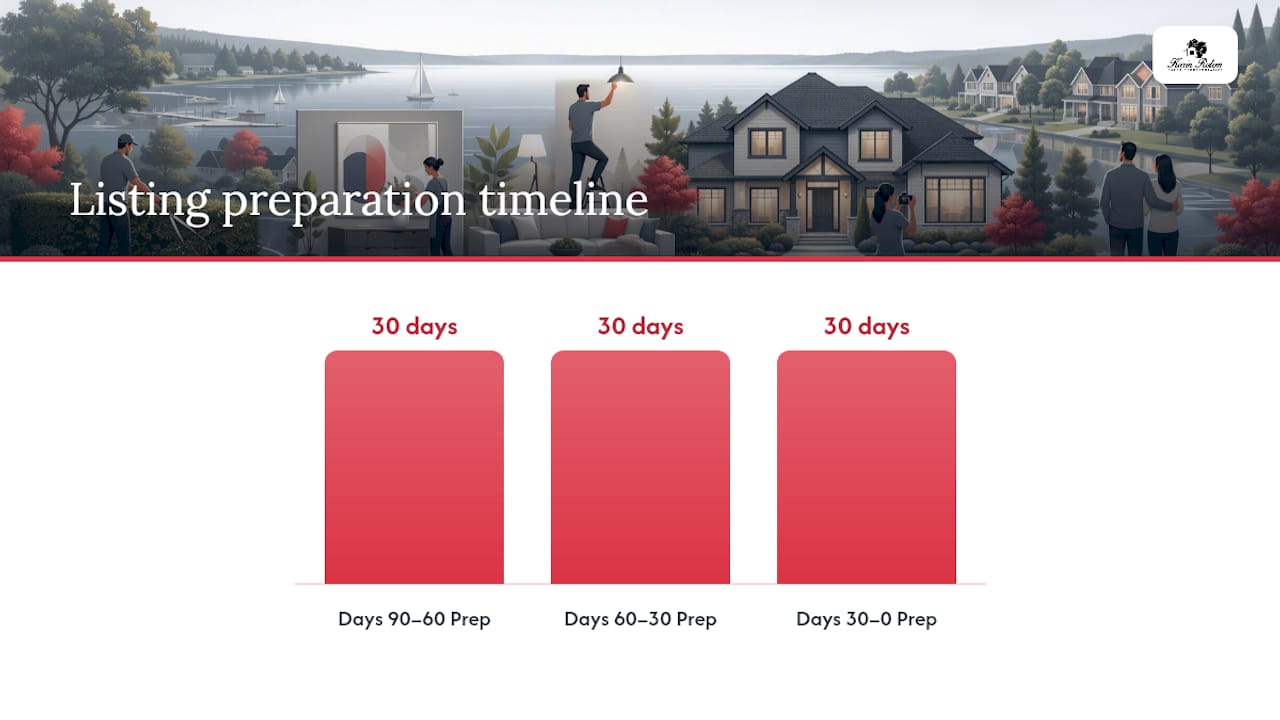
A rushed listing almost always sells at a discount. Sellers who give themselves 60 to 90 days to prepare consistently land stronger outcomes than those who list the week they decide to sell.
Here’s how that window typically breaks down:
- Days 90 to 60: Book a pre-listing inspection, tackle deferred maintenance, and interview agents so you’re not scrambling later.
- Days 60 to 30: Declutter, handle landscaping (especially for waterfront or rural lots), and schedule professional photography timed to your target listing month.
- Days 30 to 0: Finalize pricing strategy, launch pre-marketing to build buyer awareness, and confirm your listing date against your ideal closing month.
Waterfront sellers need to build in extra lead time for shoreline and septic inspections, since these can take longer to schedule and their condition affects both pricing and buyer confidence. If you’re coordinating a sale with a purchase elsewhere, aligning your listing date to buyer mortgage approval timelines and school calendars tends to produce clearer negotiations and stronger offers, according to seasonal market guidance for Ontario sellers. For families with a hard back-to-school deadline, working backward from that date, rather than forward from “whenever we’re ready,” keeps the whole process from feeling rushed.
If you’re still choosing who’ll guide you through that calendar, our guide to picking a listing agent in Innisfil covers what actually matters beyond commission rate.
Pricing and negotiating in a market that favours buyers
With inventory sitting around eight months in parts of Innisfil, pricing at or slightly below comparable benchmark values usually generates more traffic and stronger offers than testing a high number and waiting. Overpricing in a buyer-leaning market tends to backfire twice: you lose the critical first two weeks of interest, then have to chase the market down with price cuts that make buyers suspicious.
- Consider a short “offer date” window to concentrate buyer attention instead of accepting offers as they trickle in.
- Small, targeted upgrades (paint, fixtures, entry repairs) often return more than their cost in this kind of market.
- Flexible possession dates can be worth more to a buyer than a lower price, especially with today’s rate-sensitive shoppers watching their mortgage terms closely.
- If your home has sat 45+ days with no offers and no showings booked, that’s a red flag to revisit price or presentation, not wait it out.
Pro Tip: If you’re getting showings but no offers, the problem is almost always price. If you’re getting no showings at all, the problem is almost always the photos or the listing description.
For sellers navigating more than one offer at once, our post on handling multiple offers on your Innisfil home walks through the negotiating mechanics in more detail.
What I tell clients about Lefroy, rural Innisfil, and Friday Harbour
Innisfil isn’t one market. It’s several smaller ones stitched together, and treating them the same way is a mistake I see often. TRREB’s Q1 2026 community report shows real gaps between neighbourhoods: some pockets carry average days on market well above the town-wide figure even while overall Innisfil metrics look healthy.
- Lefroy tends to move faster than rural Innisfil, largely on the strength of its family-buyer demand and proximity to amenities.
- Rural Innisfil properties often sit longer, partly because the buyer pool is smaller and more selective about acreage, septic systems, and commute distance.
- Friday Harbour and waterfront homes respond less to calendar month and more to visual season. A listing that photographs beautifully in July can outperform one listed “on schedule” in a colder month.
Property type matters just as much as neighbourhood. Local snapshots for July 2026 show detached homes, townhomes, and condo-towns moving at genuinely different paces, so a strategy built for a detached bungalow rarely transfers cleanly to a condo-style unit at Friday Harbour.
How interest rates and employment trends shape your best selling window
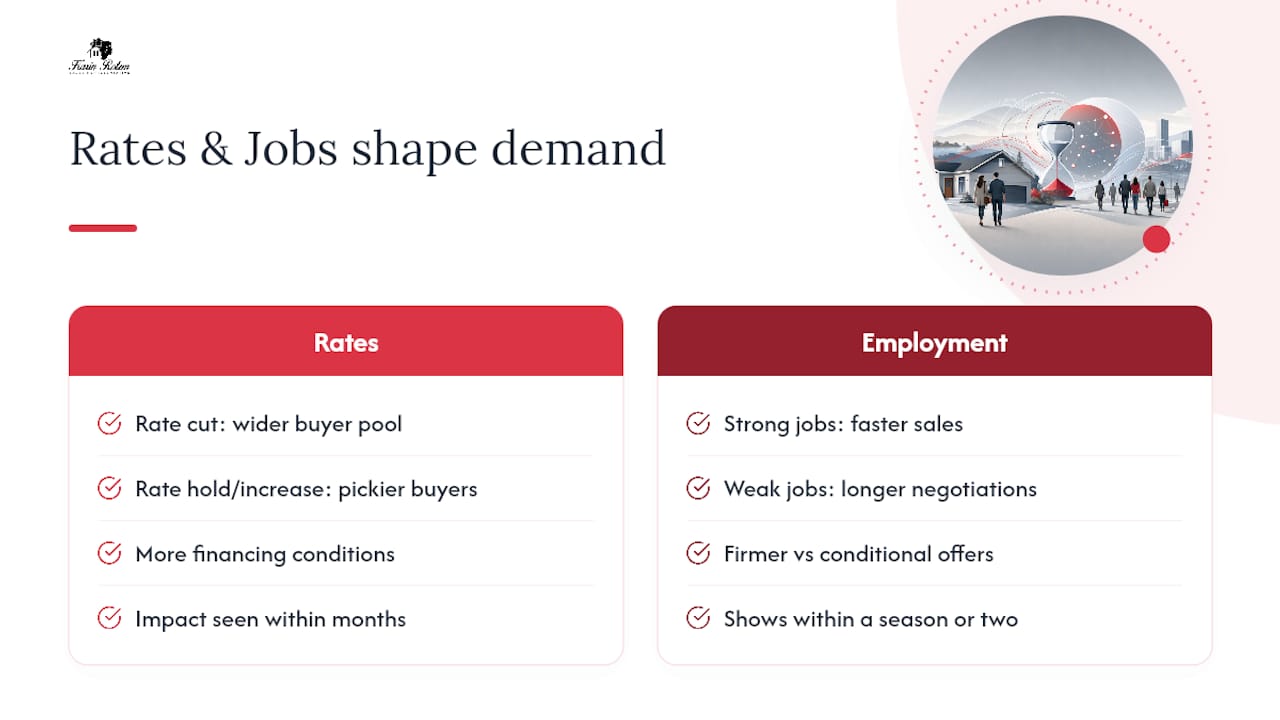
Mortgage rates and local job stability do more to move buyer behaviour than the season on the calendar. When rates ease, buyer affordability improves almost immediately, and that tends to pull hesitant buyers off the sidelines faster than any spring bloom does. When rates hold steady or climb, buyers get pickier, financing conditions become more common in offers, and negotiations slow down regardless of month.
Employment trends matter just as much in a commuter market like Innisfil. A large share of buyers here work in Barrie, the broader GTA, or remotely, so shifts in regional job postings and commute patterns show up in buyer demand within a season or two. Strong local and regional employment numbers tend to support faster sales and firmer offers, while softer employment data usually shows up as longer negotiations and more conditional offers.
For sellers, the practical takeaway is to watch the Bank of Canada’s rate decisions in the months leading up to your planned listing date, not just the season. A rate cut announced two months before your target listing window can meaningfully widen your buyer pool. A rate hold or increase in that same window might argue for pricing a touch more conservatively or building extra flexibility into your closing terms to keep rate-sensitive buyers interested. Watching these signals alongside the seasonal patterns gives you a more complete read than the calendar alone ever will.
What historical price trends in Innisfil reveal about timing
Looking at price movement over several years, rather than just the current month, tells you whether you’re selling into an appreciating stretch or a flat one, and that context changes how patient you can afford to be. Innisfil, like much of the broader Barrie and Simcoe County corridor, has generally seen values climb over the longer run, even though shorter windows within any given year show real volatility.
The MLS® Home Price Index is built specifically to strip out that noise. Because it tracks a consistent benchmark home rather than a simple average, it lets you compare this spring to last spring, or this fall to three falls ago, without one large waterfront sale or one distressed sale skewing the picture. CREA reviews and adjusts the index periodically, which keeps the comparison honest over time.
For sellers, the practical use of this history is simple: if recent years show your property type and neighbourhood appreciating steadily, waiting an extra season to catch a stronger window can pay off. If prices have been flat or slipping, as some July 2026 snapshots suggest for certain property types, the calculation flips. Waiting for a “better” season carries more risk than it did two or three years ago, because there’s no guarantee the next season will outperform this one. That’s the real value of multi-year data: it tells you whether time is working for you or against you before you commit to a listing date.
Do nearby development projects affect when you should list?
Planned infrastructure and development in and around Innisfil, from road improvements to new residential and commercial growth tied to the broader Barrie and Simcoe County corridor, tends to shift buyer interest gradually rather than overnight. Buyers researching a move often factor in upcoming amenities, transit improvements, and commercial development when deciding not just whether to buy in Innisfil, but which pocket of it to target.
The timing effect shows up most clearly around announcement and construction milestones. A confirmed infrastructure project or new amenity opening can pull buyer attention toward a specific community for a season or two, which is part of why neighbourhood-level data matters more than town-wide averages when you’re picking a listing month. If you know a nearby development is close to completion, timing your listing after that milestone, rather than during the disruption of active construction, usually serves you better.
For sellers in growth corridors, it’s worth checking whether any nearby project is scheduled to reach a visible milestone in the months around your planned listing date. A finished road, a newly opened amenity, or a completed phase of a residential development can make your immediate area more attractive to buyers than it was even six months earlier, and that’s a timing edge that has nothing to do with spring or fall.
What I tell my Innisfil seller clients about timing in 2026
Readiness beats the calendar. A prepared home listed in September will usually outperform a rushed one listed in May. Most sellers should target spring or early fall; investors chasing cash flow and waterfront owners chasing visual appeal often do better bending that rule. Check your neighbourhood’s current snapshot before locking in a month.
— Felix
Time it right with a team that knows Innisfil block by block
Karin Rotem’s team is the local alternative to guessing your listing date off a generic seasonal chart. Where a national blog gives you town-wide averages, we work from the same current inventory and days-on-market data broken down by community, whether that’s Lefroy, rural Innisfil, or Friday Harbour, and build your prep calendar around it. That means staging coordination, pricing strategy, and negotiation support tuned to what’s actually happening in your specific pocket of Innisfil right now, not what happened town-wide last spring.
Our team has helped sellers across Innisfil and Friday Harbour navigate exactly this kind of shifting, inventory-heavy market, and our sold listings show how that local read translates into results. If you’re weighing whether to list this spring, wait for fall, or move now while competition is lower, browse our current listings and reach out for a market-ready plan built around your property and your timeline, not a generic seasonal calendar.
Sources
- When Is the Best Time to Sell a House in Ontario? – HomeLight
- Innisfil housing market report | Zolo
- TRREB Innisfil Q1 2026 community report
- Innisfil market report — SearchListingsOnline
- The best time of year to sell a house in Ontario: 2026 strategic guide — Noble Real Estate
FAQ
What is the best time to sell in Innisfil?
Spring, from March through May, draws the largest buyer pool and typically the strongest prices, while early September offers a strong second window with less competition and more serious buyers.
How is the housing market in Innisfil right now?
Innisfil’s market leans toward buyers in 2026, with roughly eight months of inventory reported in mid-year snapshots and average sold prices generally in the $651,000 to $804,000 range.
What is the hardest month to sell a home?
January and February tend to be the slowest months for showings and offers in Ontario, since buyer activity drops off after the holidays and doesn’t pick back up until closer to spring.
Are cottage and waterfront prices falling in Ontario?
Some property types in Innisfil showed price softness in mid-2026 snapshots, though trends vary sharply by property type and neighbourhood, so waterfront and cottage pricing should be checked against current local data rather than assumed from provincial averages.
What is the hottest housing market in Canada right now?
Market heat shifts regionally and changes with rate movements, so rather than naming one national leader, it’s more useful for Innisfil sellers to track local inventory and days-on-market figures against the benchmark pricing tracked by CREA’s MLS® Home Price Index.