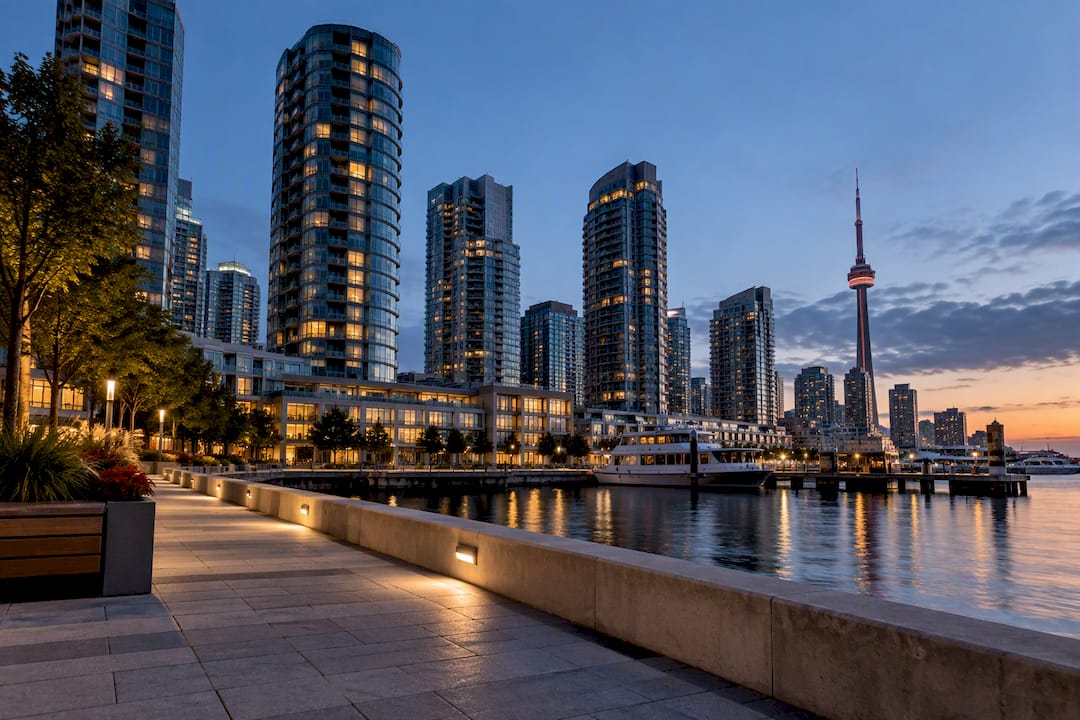
A Toronto waterfront condo makes sense for a long-term investor who can hold through a construction cycle and cover carrying costs during softer rent months. It rarely makes sense for a short-term speculator counting on quick appreciation. Before you commit, check three things: the building’s transit and walkability, its reserve fund health, and whether a realistic rental yield still works once fees and taxes are subtracted. The sections below walk through each one.
TL;DR:
- Fewer active listings and steady demand in Q2 2026 indicate the GTA condo market is stabilizing, but large project timelines mean supply will arrive in phases over years.
- Infrastructure improvements, building quality, a healthy reserve fund, and rental demand near transit hubs are key factors supporting long-term condo appreciation.
- Units with lake or skyline views and usable balconies tend to sell and rent faster, especially one-bedroom and one-bedroom-plus-den units near transit and the PATH.
- Stress-test yield models by lowering rent 5% and increasing fees 10% to ensure the deal remains profitable in fee-heavy buildings.
- Conduct thorough due diligence on the reserve fund, upcoming assessments, and building restrictions before making an offer, prioritizing the building’s financial health over location alone.
2026 market snapshot for Toronto waterfront condos
The GTA condo market moved in the investor’s favour through the first half of 2026. Sales volume rose year over year while the pool of active listings shrank, a combination that usually signals a market working through its backlog rather than one flooded with new supply.
In TRREB’s Q2 2026 condo report, 4,783 condo apartments sold across the GTA with an average selling price of $634,972, while active listings fell 15.4% year over year. That drop in inventory matters more for waterfront buyers than the headline price, because it means fewer competing units in a segment that was already thin.
- Sales activity: 4,783 GTA condo transactions in Q2 2026, an increase over the prior year.
- Pricing: average GTA condo price of $634,972 in Q2 2026.
- Supply: active listings down 15.4% year over year, tightening competition for well-priced units.
Fewer listings and steady demand together suggest the GTA condo market is stabilizing, which can support renewed price growth if inventory stays tight through the back half of the year.
Waterfront micro-markets do not move in lockstep with the broader GTA figures, though. Large master-planned sites change the supply picture on their own timeline. Quayside, Waterfront Toronto’s flagship project near the Portlands, prioritizes purpose-built rental in its first phase, with roughly 1,150 market rental units and 553 affordable rental units arriving before most of the condo blocks. That sequencing means the condo supply investors are watching for in East Bayfront and the surrounding waterfront corridor will arrive later and in phases, not all at once.
What drives waterfront condo value, and what destroys it
Two forces shape long-term appreciation on the waterfront: infrastructure and building quality. Investors who ignore the second one tend to regret it regardless of how well the first one plays out.
- Transit access, particularly proximity to planned light rail and the PATH network, tends to support both resale demand and rent levels over time.
- A well-funded reserve fund, a transparent condo board, and rental-friendly bylaws all point to a building that will hold its value.
- Renter demand near office towers and the harbourfront trail keeps vacancy low in buildings that get the basics right.
The risks sit mostly at the building level. Master-planned sites can release large blocks of new units at once, softening resale prices in nearby towers for a stretch. Special assessments, triggered by a deferred repair or an underfunded reserve, can land as a five-figure bill with little notice. High condo fees, common in amenity-heavy waterfront towers, quietly erode the yield that looked attractive on paper.
Pro Tip: Ask for the last three years of condo board meeting minutes, not just the current status certificate: recurring maintenance complaints show up there long before they show up in a special assessment notice.
Which unit types sell and rent fastest on the waterfront
Liquidity matters as much as price for an investor planning to exit or refinance in five to seven years, and unit type drives liquidity more than almost anything else.
- One-bedroom and one-bedroom-plus-den units in core towers near the PATH and transit lines tend to sell and rent fastest, since they match the budget of the largest pool of buyers and tenants.
- Two-bedroom units make more sense for co-investors splitting costs or for owners targeting long-term family tenants rather than quick turnover.
- A real view, whether of the lake or the skyline, and a usable balcony both add a price premium and shorten the time a unit sits on the market.
Larger units carry higher absolute rent but a smaller pool of qualified tenants, which usually means longer vacancy stretches between leases. That trade-off is worth running through the numbers before you buy, not after.
Taxes and condo due diligence every investor must complete
Tax rules and building paperwork decide more of your actual return than the purchase price does, and both areas get skipped more often than they should.
- Non-resident investors earning rental income in Canada must meet CRA filing requirements and may need to register for GST/HST if they are considered to be carrying on business in Canada.
- Converting a former principal residence into a rental can trigger a deemed disposition at fair market value; filing the subsection 45(2) election can defer that, though you give up the ability to claim capital cost allowance while it’s in effect.
- Toronto’s Vacant Home Tax requires an annual occupancy declaration on every residential unit, even one that’s actively rented; missing the deadline risks a penalty tax on the property’s assessed value.
- Before you make an offer, order the status certificate and read the reserve fund study, checking for recent special assessments, the building’s insurance position, and any rules restricting short-term rentals.
A status certificate review that compares the building’s current reserve fund balance against the reserve fund study’s recommended contribution rate is one of the clearest ways to catch a problem before it becomes your problem. A large gap, or a major capital project scheduled within five years, is a red flag worth walking away from or renegotiating around.
If you’re weighing a short-term rental strategy for the unit, our guide on T776 reporting for short-term rentals walks through what the CRA expects at tax time.
How to model returns: step-by-step and a conservative worked example
Gross rental yield is annual rent divided by purchase price. Net yield subtracts condo fees, property tax, insurance, a vacancy allowance, and management costs before dividing by price, and it’s the number that actually tells you whether the deal works.
- Gross yield = annual rent ÷ purchase price.
- Net yield = (annual rent minus condo fees, property tax, insurance, vacancy allowance, and management fees) ÷ purchase price.
- Mortgage carrying costs sit outside the yield calculation but determine your actual monthly cash flow.
Here’s a conservative illustrative example, not a market figure: say a waterfront one-bedroom costs $650,000 and rents for $2,400 a month, or $28,800 a year.
Run the same numbers with rent 5% lower and fees 10% higher, and that net yield falls closer to 1.8%, which shows how thin the margin can get in a fee-heavy building. Stress-testing the model this way, before you make an offer, is the single best habit an investor can build.

Practical pre-purchase checklist and next steps
Work through these steps in order, and don’t skip ahead to the offer stage before the paperwork is in hand.
- Pull comparable recent sales and active listings for the specific building and the immediate area, not just the neighbourhood average, using specialized Real Estate SEO Services to capture up-to-date market leads efficiently.
- Order the status certificate and reserve fund study, and have a condo-savvy real estate lawyer or a condo-specialist accountant review both.
- Run the yield model above with your real numbers, stress-test it, and get mortgage pre-approval before you write an offer.
- Confirm your Vacant Home Tax declaration and any GST/HST registration needs, and line up property management if you’re renting the unit out.
What I tell my clients: on-the-ground perspective from Karin Rotem
What most buyers don’t realize is that the reserve fund study matters more than the finishes in the sales presentation centre. I’ve seen clients fall for a beautifully staged unit and then discover, three weeks into their status certificate review, that a special assessment for building envelope repairs was already approved.
What I tell my clients is to treat TRREB’s quarterly numbers and Waterfront Toronto’s project timelines as two different clocks. One tells you what’s happening this quarter. The other tells you what’s arriving in three to five years, and that’s the one that actually decides your resale value.
Buildings that pass the reserve fund test rarely surprise their owners later. That’s the whole point of checking early.
— Felix
The gap between the waterfront pitch and the waterfront numbers
The conventional advice on Toronto waterfront condos treats location as the whole story: buy near the water, near transit, near a marquee project, and the rest takes care of itself. That advice underweights the building itself. A well-located tower with a thin reserve fund can cost an investor more in a single special assessment than a few points of price appreciation will ever return.
What’s overrated is the idea that a project like Quayside guarantees a rising tide for every nearby building. Phased rental delivery means the condo supply story around East Bayfront will unfold over years, not quarters, and buyers pricing in near-term scarcity may be early by a cycle or two.
What actually matters is boring: a healthy reserve fund, a realistic net yield after fees, and a willingness to hold through a construction phase. Readers should run the numbers before they fall for the view.
How we help investors evaluate and secure the right unit
Finding a waterfront condo that actually pencils out takes more than a listings search. Current market data combined with building-level scrutiny is useful when evaluating waterfront properties in Toronto and Innisfil areas including the Friday Harbour community.
- Custom market research on comparable sales and rental rates for the buildings you’re considering.
- Listing alerts for waterfront inventory as it comes to market, including Toronto and GTA real estate and Friday Harbour exclusive listings.
- Negotiation and transaction management, plus referrals to condo-specialist tax and legal advisors when your situation calls for it.
If you’re ready to see what’s currently available, start with our Toronto and GTA real estate page or reach out directly to request an investor packet tailored to your goals.
This article is general information, not a substitute for advice from a qualified financial advisor. Consult a qualified financial professional about your own circumstances before acting on anything here.
Sources
- Condo market report Q2 2026 (TRREB)
- Rental income for non-residents — Canada Revenue Agency
- Quayside (Waterfront Toronto) — project overview
- Condo status certificate review — InsightSCPA
FAQ
Are there waterfront condos for sale in Toronto right now?
Yes, active listings exist across the harbourfront and East Bayfront corridors, though inventory has tightened, with GTA active listings down 15.4% year over year in Q2 2026. Current availability shifts by building and phase, so a targeted search of specific towers works better than a broad neighbourhood scan.
Will Toronto condo prices fall in 2026?
Recent data points the other way for now: falling inventory alongside steady sales volume through Q2 2026 suggests a market working through its backlog rather than one at risk of a broad price drop. Waterfront micro-markets can still diverge from the citywide trend depending on nearby project timelines like Quayside’s phased delivery.
Is buying a condo in Toronto worth it this year?
A short-term flip is a harder case to make given current carrying costs and fee levels.
Are there waterfront condos for sale elsewhere in Ontario?
Yes, waterfront condo inventory exists beyond Toronto, including lakefront communities like Friday Harbour in Innisfil, which carries a different price point and lifestyle profile than downtown Toronto towers. The due diligence steps in this article, particularly the status certificate and reserve fund review, apply the same way regardless of location.
Do non-resident investors owe extra tax on Toronto rental income?
Non-residents earning rental income in Canada must meet CRA filing and reporting requirements and may need to register for GST/HST if they’re considered to be carrying on business in Canada. The rules depend on your specific situation, so a tax professional familiar with non-resident filings should confirm your obligations before you close.