
Cap rates in Innisfil typically run lower for waterfront and new-build condos and higher for single-family rentals and small multi-residential properties, because price per door varies more than net operating income does. A cap rate is only a snapshot: it measures NOI against purchase price at one moment, so it needs to be paired with realistic expense assumptions and tax treatment before you rely on it. The numbers below come from Canadian rental and housing data we check before every investor conversation.
TL;DR:
- Waterfront and Friday Harbour condos typically have lower cap rates due to premiums for lifestyle and amenities that do not scale with rent.
- Innisfil’s inland single-family rentals usually show higher cap rates because of lower acquisition costs and land value differences.
- Accurately calculating NOI requires adjusting for vacancy allowances, operating expenses, and excluding mortgage costs, with caution around optimistic assumptions.
- Local vacancy trends, rent growth exemptions, and interest rate movements significantly influence cap rate levels and investment returns.
- Verifying rent rolls, expense histories, and property class is essential before relying on seller-promised cap rates for investment decisions.
Typical cap-rate ranges by property type in Innisfil
Waterfront and resort-style condos near Friday Harbour tend to sit at the lower end of the local range, because buyers pay a premium for lifestyle and amenities that don’t scale with rent. Single-family rentals further from the lake generally produce higher yields on paper, simply because land-heavy properties haven’t been bid up the same way. Small multi-residential buildings, where you can find them in Innisfil, often land in between, with returns that depend heavily on unit mix and how recently rents were turned over.
New construction compresses cap rates further in the short term: buyers pay today’s price for tomorrow’s rent growth, and that math only works out if rents actually climb.
- Waterfront and Friday Harbour condos: price premiums for lake access and amenities typically pull yields toward the lower end of the local range.
- Single-family rentals inland: often show stronger cap rates, reflecting lower per-door acquisition costs.
- Small multi-residential buildings: returns vary widely with unit mix, age of the building, and how current the rent roll is.
Barrie-area vacancy and rent data, the closest published proxy for Innisfil, show vacancy rates have been trending higher through the mid-2020s, which matters directly for the vacancy allowance you should build into any NOI calculation.
How to calculate cap rate and build a proper NOI
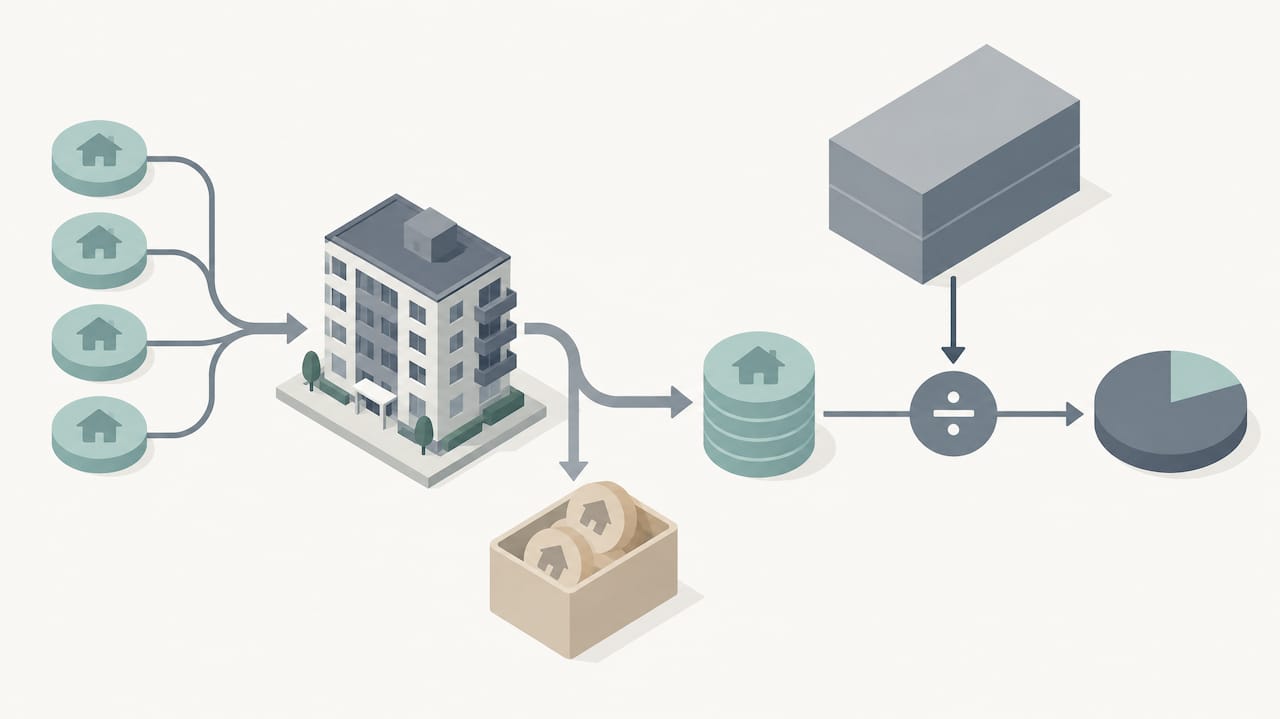
The formula itself is simple: cap rate equals net operating income divided by purchase price. The work is in getting NOI right, and that’s where most investors trip up.
- Start with gross rental income, including parking, storage, or laundry income where it applies.
- Subtract a vacancy allowance, modelled conservatively rather than at zero.
- Subtract operating expenses: property tax, insurance, utilities you cover, property management fees, and routine repairs.
- Exclude mortgage principal and interest, since cap rate measures the property’s performance before financing.
- Keep capital improvements separate from current expenses: a new roof or major renovation is recovered through capital cost allowance (CCA) rather than deducted in full the year you pay for it.
Say a condo near Friday Harbour costs around $650,000 and generates about $34,000 in gross annual rent. After applying a vacancy allowance, operating expenses, and management fees, NOI lands in a low single-digit percentage range. Divide that by the purchase price and you get a cap rate near the lower end of the local market range, a realistic figure for that segment rather than the higher cap rate some seller pro formas might promise.
Optimistic assumptions make almost any property look like a good deal on paper.*
Local drivers that move cap rates in Innisfil
Toronto commuters and weekend-home buyers have pushed demand into Innisfil for years, and that demand shows up as higher prices relative to rent, which pulls cap rates down. Friday Harbour’s marina, golf, and resort amenities add a further premium that buyers pay for lifestyle rather than pure yield. On the supply side, new units first occupied after November 15, 2018 are exempt from Ontario’s rent control rules, which gives landlords more room to raise rents over time, a trade-off that can mean a lower starting cap rate in exchange for stronger long-term rent growth.
- Toronto commuter and lifestyle demand: pushes prices up faster than rents, compressing cap rates.
- Friday Harbour amenities: add a price premium that doesn’t always translate into proportional rent.
- Post-2018 rent control exemption: supports faster rent growth on newer units, offsetting lower initial yields over several years.
- Bank of Canada rate direction: lower borrowing costs tend to support higher prices and tighter cap rates, while rate increases typically push the other way.
Where to find current, verifiable cap-rate data for Innisfil
No single source publishes an “Innisfil cap rate,” so building a credible estimate means combining a few official sources. CMHC’s rental market tables for the Barrie census subdivision are the closest available proxy for vacancy and average rent trends in our area. CREA and the MLS® HPI give you price-side benchmarks, and recent figures show Ontario expected to be the only province with higher annual home sales in 2026, with price growth staying modest rather than fast. Local sold listings fill in the gap with actual achieved rents and sale prices for comparable units.
- CMHC rental tables: vacancy and rent trends for the Barrie area, used as an Innisfil proxy.
- CREA and MLS® HPI: benchmark prices and forecasts for price-side comparisons.
- Local sold and rented listings: the most direct evidence of what a specific property type actually earns.
Be cautious of a seller’s “pro forma” cap rate quoted without a rent roll or expense history to back it up.
| Data source | What it tells you |
|---|---|
| CMHC rental market tables | Vacancy rates and average rent trends for the Barrie area |
| CREA / MLS® HPI | Benchmark resale prices and provincial forecasts |
| Local sold and leased listings | Actual achieved rents and sale prices for comparable units |
Tax and expense considerations that change your effective cap rate
A headline cap rate ignores taxes entirely, and that gap matters more than most first-time investors expect. The CRA draws a firm line between current expenses, which you deduct the year you pay them, and capital expenditures, which get recovered gradually through capital cost allowance. Misclassifying a major renovation as a current repair is one of the most common errors we see, and it can trigger a reassessment.
- Current expenses (repairs, routine maintenance) reduce taxable rental income immediately.
- Capital expenditures (new roof, major system replacements) are deducted gradually through CCA, subject to the half-year rule in the year of acquisition.
- Short-term rentals carry their own CCA and deductibility nuances worth reviewing with an accountant before you buy.
A conservative, tax-aware cash-flow model is far more useful than the headline cap rate alone, since CRA’s rules on deductible and non-deductible expenses directly change what you actually keep.
Using cap rate in a buy or hold decision: a practical checklist
A cap rate is a starting point, not a verdict. Before you make an offer, stress-test the number against documents the seller should be able to produce.
- Request a full rent roll showing current rents, lease start dates, and any arrears.
- Ask for 12 to 24 months of expense history, not an estimated or projected figure.
- Confirm whether units are subject to Ontario rent control or exempt as post-2018 construction.
- Validate comparable sales and rents independently rather than relying only on the listing agent’s figures.
- Run a sensitivity check: what happens to your cap rate if rent comes in 5 to 10% lower than projected, or if an unexpected repair runs 10 to 15% over budget.
- Estimate management, insurance, and condo fees separately, since these vary significantly between a Friday Harbour condo and an inland single-family rental.
Pro Tip: If a 10% rent shortfall or a single unplanned repair would wipe out your projected return, the deal is priced too tight for comfort.
What I tell my clients about cap rates in Friday Harbour and Innisfil
What most buyers don’t realize is that the lowest cap rate on paper isn’t automatically the wrong deal. A Friday Harbour condo might yield less than an inland rental, but it often comes with stronger appreciation potential and far less tenant turnover if you choose a long-term renter over short-term guests. I’ve walked clients through both paths: one bought a waterfront unit accepting a lower initial yield for ease of management and resale appeal, while another chose an inland duplex for stronger day-one cash flow and accepted more hands-on management. Neither choice was wrong. What matters is matching the number to your own goals, not chasing the highest yield on a spreadsheet. For more on how this trade-off plays out locally, see our Innisfil real estate market overview.
— Felix
Get a personalized cap-rate analysis for your Innisfil investment
Running these numbers on a real listing takes more than a formula. It takes current comparables, an accurate rent roll, and someone who knows which Innisfil buildings are exempt from rent control and which Friday Harbour units carry hidden condo costs that eat into NOI. Tailored market analysis, MLS-backed listing alerts, and negotiation support built around the numbers that actually matter to your return, not just the asking price are available.
- Tailored cap-rate modelling using current local rent and sale data rather than generic averages.
- Direct access to Friday Harbour inventory, including exclusive listings before they reach the general market.
- Negotiation support grounded in comparable sales, not the seller’s pro forma.
If you’re weighing a purchase in Innisfil or Friday Harbour, visit the main site to explore available options or browse current Friday Harbour condos for sale.
This article is general information, not a substitute for advice from a qualified financial advisor. Consult a qualified financial professional about your own circumstances before acting on anything here.
FAQ
What is the cap rate in Vancouver?
We focus on Innisfil and the Friday Harbour market, so we don’t track Vancouver cap rates directly. Vancouver’s much higher price-to-rent ratio typically produces lower cap rates than Innisfil, but you’d want a Vancouver-specific source to confirm current figures.
What is a 7.5% cap rate?
In Innisfil, a cap rate that high would be unusual for waterfront or new-build condos and more plausible for an inland single-family rental with below-market acquisition cost.
Are house prices falling in Ontario?
Ontario price growth has stayed modest rather than negative heading into 2026, with CREA’s forecast expecting Ontario to be the only province with higher annual home sales this year. That points to a market recovering in volume rather than one in broad price decline.
What is the next five-year forecast for real estate in Canada?
National forecasts point to gradual sales recovery with price growth that varies significantly by province, and CREA’s most recent outlook reflects ongoing uncertainty tied to tariffs and broader economic conditions. We recommend checking CREA’s updated forecasts periodically rather than relying on a single long-range figure.
How do I calculate cap rate for a rental property?
Divide the property’s annual net operating income by its purchase price, after subtracting a vacancy allowance and operating expenses but before mortgage payments. We walk through a full worked example, including how to separate current expenses from capital improvements under CRA rules, earlier in this guide.
Sources
- CREA revises resale housing market forecast
- CMHC — Historical rental market statistics (Barrie)
- Canada
- Renting in Ontario: Your rights