An Ontario title search is a review of the land registry records for one property. It confirms who the registered owner is, how the land is legally described and which registered interests, such as mortgages, liens and easements, affect it. Anyone can order one for a fee through Ontario’s electronic land registration system, but in a purchase your real estate lawyer normally runs it for you and explains it.
I am Karin Rotem. In my Toronto and Innisfil files, including Friday Harbour, the title search is the quiet step that decides whether a closing is smooth. Here is what it shows, how to run one, what it costs and where its limits are.
TL;DR
- A title search shows the registered owner, legal description, Property Identification Number (PIN) and registered interests such as mortgages, liens and easements.
- You can search by PIN, address, instrument number or map in OnLand. Address searches sometimes fail, so keep the PIN handy.
- The first parcel register page costs about $36.50 to $37.10 and each extra page $2.56. Registered documents are about $3 plus HST each.
- It does not show a property’s physical condition, unpermitted work or exact boundaries. A survey, inspection and off-title searches cover those.
- In a purchase, your lawyer does the search and the final check before closing.
What a title search tells you
Ontario’s land registry holds the official records of property ownership and legal interests, including mortgages, transfers and leases. A title search reads those records for one parcel and gives you a clear picture of its legal standing.
The main document is the parcel register. According to a Teranet explanation of parcel registers, it can show:
- the PIN and property description
- the legal homeowners, plus the type and percentage of ownership
- easements
- transfer history
- registered mortgages and liens
The instruments table in the register lists each registered document with its date and instrument number. A transfer entry names the parties and shows the purchase price. The underlying document can go further, with addresses for service, the parties’ relationship, lawyers and the land transfer tax paid.
What most buyers don’t realize is how useful the transfer history is. It tells you when the property last changed hands and for how much, which is a helpful reference point when we talk about pricing.
Registry or Land Titles: why the system matters
Ontario runs two land registration systems, and which one your property sits in changes how the search works.
- Registry system. The older system. The buyer has to trace historical deeds to build a chain of title, and title is not guaranteed. Establishing a sufficient chain usually means reviewing instruments for at least 40 years, according to Dentons.
- Land Titles system. The registered owner holds a title guaranteed by the province, with limited exceptions. The parcel register is the key evidence. Most Ontario land has now been converted to Land Titles.
There is one practical difference worth knowing. Under the Land Titles Act, section 51(1) says no adverse right can be acquired against the registered owner by any length of possession or prescription. In the Registry system, adverse possession claims were possible, which is why the two systems are treated so differently when boundaries are in question.
In modern residential deals, title insurance has largely replaced the need for a deep historical search in the Registry system. It supplements the title search and does not eliminate it.
How to run an Ontario title search yourself
Ontario says self-searches of land registry records are available for a fee. There is no free official route to the parcel register. The records are in OnLand, and you do not need to be a lawyer to use it.
- Open the property search in OnLand. Select the Land Registry Office (LRO) that covers the property’s location. Documents are registered in the office for that geographic area, so the wrong office returns nothing.
- Choose Property and search by PIN, address, instrument number or map, as the OnLand help centre describes.
- Enter the requester information and submit.
- Request the parcel register from the results.
- Pull registered documents separately. In the Documents section, search by LRO and instrument number.
If the address search finds nothing
This trips people up. Address information is not mandatory in the land registration records, so an address search can fail even when the property is registered. The PIN and legal description are what identify a property.
Try these in order:
- the PIN, which appears on the tax bill, the listing package or an earlier title document
- the owner’s name
- the assessment roll number
- a map search
- a check that you selected the correct LRO
The first place I look is the PIN. Ask your agent or lawyer for it and you skip the guesswork.
What a title search costs in Ontario
Fees are set by the province and collected with a service charge. The fee bulletin effective November 3, 2025 lists the first parcel register page at $36.50: a $9.55 statutory fee, a $23.85 ELRSA fee and $3.10 HST. Each additional page is $2.56.
Teraview, the platform used by licensed professionals, lists the first page at $37.10, made up of a $9.70 statutory fee, a $24.25 ELRSA fee and $3.15 in taxes. Additional pages are also $2.56. The small gap comes from how each source presents the charge, so confirm the figure on the screen when you order.
| Item | Typical cost | Source |
|---|---|---|
| First parcel register page | $36.50 (bulletin) or $37.10 (Teraview listing) | Ontario fee bulletin, Teraview |
| Each additional page | $2.56 | Same sources |
| Adjacent parcel register, first page | $13.15 | Teraview |
| Online document viewing | $3.39 per document | Teraview |
| Registered instrument in OnLand | $3 plus HST per document | Casey and Moss |
A few details on how the fee works. Ontario defines a search as inspecting the index or register pages for a parcel. The fee applies per parcel and covers its current and previous registers, but not adjoining parcels or a search on a later day. Prices can change, so check the current schedule before you order.
If a lawyer runs the search for your purchase, the search is normally part of the legal work, with disbursements itemized on your statement. For the full picture of what else lands on closing day, see our guide to what closing costs include in Ontario and our explainer on Ontario land transfer tax.
Do you need a lawyer for a title search?
Legally, no. Practically, for a purchase, yes. Ontario warns that the records can be complex, that ServiceOntario cannot explain them, and suggests contacting a lawyer, title searcher or surveyor for help.
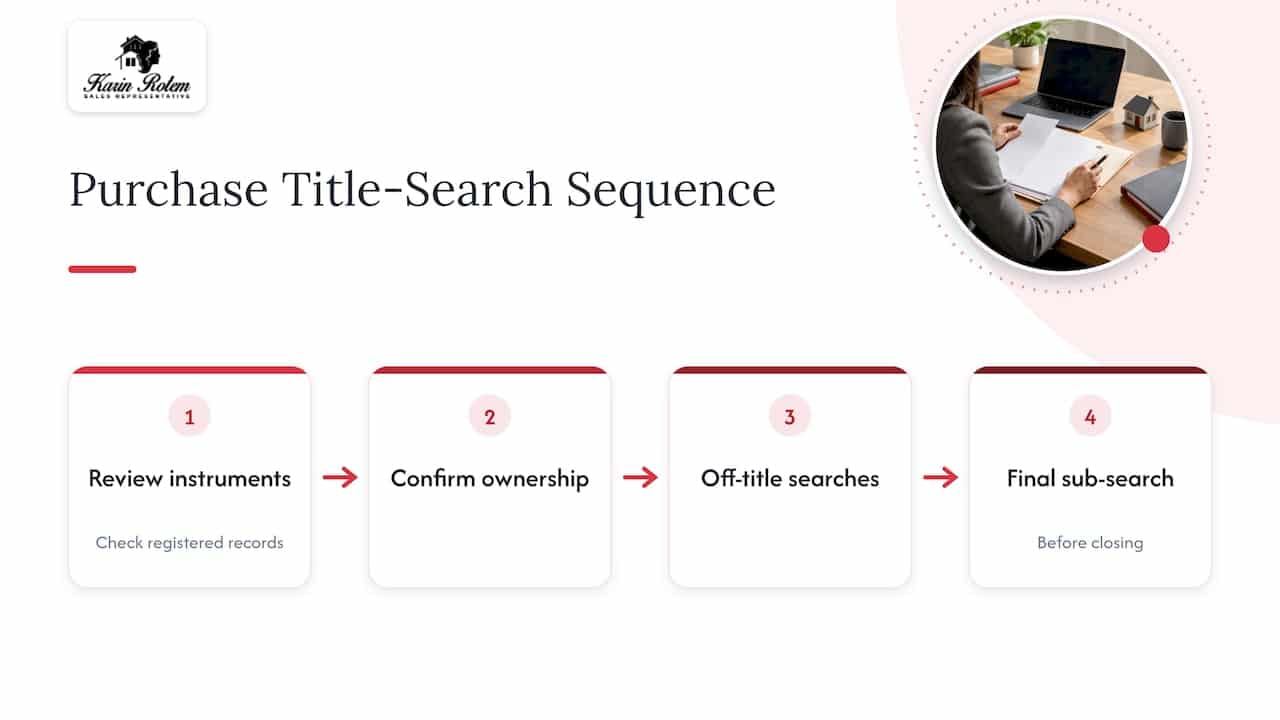
In a purchase the buyer’s lawyer reviews the registered instruments, confirms ownership, performs a final sub-search and orders off-title searches. The sub-search matters because it catches anything registered between the first search and closing.
What I tell my clients: look at the parcel register yourself if you are curious. It is a good way to see the mortgage and transfer history. But let your lawyer interpret it, because a short line in the instruments table can carry real consequences.
What a title search cannot tell you
This is where buyers get surprised. A title search is a legal record check. It is not a promise that a property has no risk. According to one Ontario real estate practice, it does not confirm:
- the physical condition of the property
- whether every renovation was properly completed
- whether every municipal concern shows on the register
- the exact location of fences, sheds or additions
Another gap: off-title matters such as property tax certificates, work orders, water and utility arrears and building-permit status need separate searches.
Two more points that matter in practice:
- Summaries only. A title search gives a summary of each registered interest. To understand the full terms of an easement, covenant or charge, you may need a copy of the registered document. If the register shows an easement, read about right-of-way easements in Ontario so you know what to ask.
- Legal title is not the whole story. The land registry records who can sign, mortgage and transfer the property. It does not show who holds an equitable or beneficial interest in its value. That comes up when one person funds a purchase and another is on title, for example a parent helping a child or unmarried partners where only one is registered. If a seller’s situation looks like that, tell your lawyer early.
Boundaries are the other classic gap. Title tells you what is registered, not where the fence sits. A current survey answers that, and our piece on what a property survey settles that title insurance cannot walks through it.
Reading the results: a quick checklist
When a lawyer sends you the parcel register or a summary, these are the lines I look at with clients:
- Registered owners match the seller. Every name on the agreement should match the names on title.
- Legal description and PIN match the listing and the agreement of purchase and sale.
- Mortgages and liens. They should be discharged on closing from the seller’s proceeds. Ask your lawyer how that will happen.
- Easements. Note who benefits and what they allow, such as utility access or a shared driveway.
- Recent transfers. A quick resale or an unusual transfer between related people is worth a conversation with your lawyer.
- Notices or restrictions that you do not understand. Ask for the underlying document.
Sellers have a part in this too. Clean, well-organized disclosure helps a deal hold together, and our seller disclosure checklist for Ontario covers what to have ready.
When a title search matters most for waterfront and resort purchases
Waterfront and lifestyle properties around Lake Simcoe, Innisfil and Friday Harbour tend to carry more layers than a typical suburban house: easements, shoreline allowances, shared amenities and, in some cases, unusual ownership structures. I would never assume any of these are simple.
Two examples of what to bring up with your lawyer:
- A shoreline property with a road allowance in front. The title may not tell the whole story about who controls the water’s edge. Our guide to the 66 foot shore road allowance in Ontario explains the timeline and costs.
- A fractional or shared arrangement. The way ownership is registered affects your rights and exit. Read fractional ownership in Ontario before you commit.
For broader waterfront due diligence, including shoreline, permits and insurance, see our guide to buying on Lake Simcoe.
Our perspective
We treat the title search as a tool for making decisions, not a box to tick. When we work with buyers in Innisfil, Friday Harbour and Toronto, we want the title questions answered before the conditions come off, because that is when you still have leverage.
What we see matter most is the order of work. We confirm the PIN and legal description early, we ask your lawyer to flag easements, liens and unusual ownership, and we line the title findings up with the survey and inspection. A clean register tells you the legal record is in order. It does not tell you the fence is in the right place or the renovation was permitted, so we build those checks into the timeline.
Our approach is high-touch and practical. If something on title does not fit your goals, whether you plan to live there, rent it short term or hold it as an investment, we say so plainly and help you decide before you are committed. That is how we aim to help buyers close with confidence and sellers present a clean file.
Felix
Working with us on your purchase or sale
If you are looking at Friday Harbour, we can walk you through available condos for sale in Friday Harbour and the current Harbour listings for sale, then coordinate with your lawyer so the title, survey and inspection work lines up. For Toronto and the GTA, start at karinrotem.com and tell us what you are trying to achieve. If you are budgeting, our mortgage and affordability calculators are a good first step.
FAQ
Can I search an Ontario land title for free?
Not through the official records. Ontario says self-searches of land registry records are available for a fee. Expect to pay for the parcel register, and separately for any registered documents you want to read.
How much does a title search cost in Ontario?
The first parcel register page is $36.50 under the fee bulletin effective November 3, 2025, or $37.10 as listed by Teraview. Each additional page is $2.56, and registered documents cost about $3 plus HST each. Fees can change, so confirm the current amount when you order.
What is the easiest way to find out who owns a property?
Search OnLand by PIN, address or map in the correct Land Registry Office and request the parcel register. It lists the legal owners. If the address search fails, use the PIN or the owner’s name, since addresses are not mandatory in the records.
Does a title search replace a home inspection or survey?
No. A title search checks legal records. It does not confirm physical condition, permitted renovations or the exact location of fences and additions. A home inspection, a survey and off-title searches fill those gaps.
Do I still need a title search if I have title insurance?
Yes. Title insurance has largely replaced deep historical searches in the Registry system and reduced the depth needed in Land Titles, but it supplements the search rather than eliminating it. Your lawyer will advise how both fit your purchase.
Sources
- Land Registry, ontario.ca
- Property Search, OnLand Help Centre
- Can’t Find a Property by Address?, Teranet Commercial Solutions
- Teraview Pricing
- Land Titles Act, Registry Act, Electronic Land Registration fee bulletin, ontario.ca
- Fees for Service, Definitions of Service, ontario.ca
- Land Titles Act, R.S.O. 1990, c. L.5, ontario.ca
- Prudent Property Search: The Value of a Parcel Register, Teranet
- A Walk-Through of Parcel Registers, Casey and Moss LLP
- What is a title search?, Ownright Blog
- What Is A Real Estate Title Search? Ontario Purchase Timing
- Title Search Canada, Property Ownership Records
- Beneficial Ownership Disputes in Ontario, ME Law
- Title Search, Lamba Law
- Doing business in Canada: Land ownership and development, Dentons
- Understanding the Ontario Land Registry Office (Part Two)