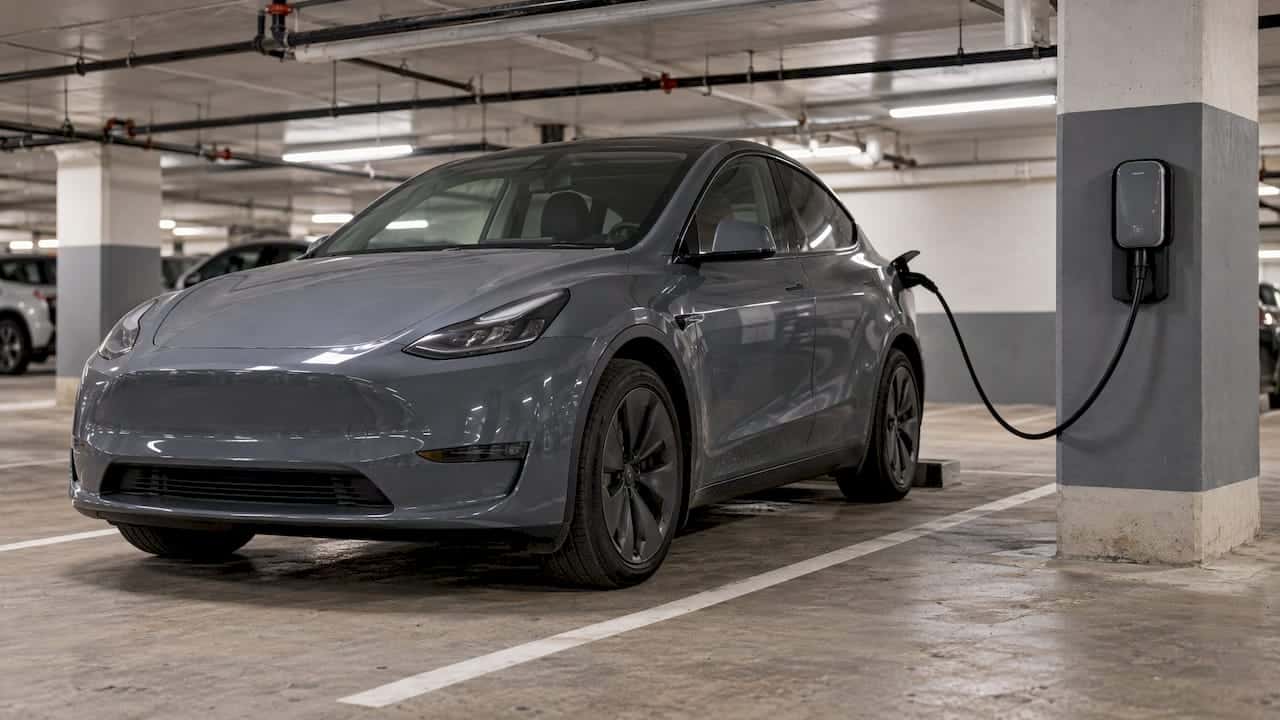
Yes, you can charge an electric vehicle in a Canadian condo, but whether you can do it easily depends on three things you can check before you buy: who owns your parking stall, what the building’s governing documents say, and how much spare electrical capacity the building has. What I tell my clients is to settle those questions before the offer, not after the keys, because a retrofit costs far more than a stall that is already set up. In Friday Harbour and across Innisfil and Toronto, our team helps buyers read those documents and ask the right questions while there is still time to negotiate.
TL;DR
- Before you buy, confirm whether your stall is deeded (owned) or common element, and whether the declaration, bylaws or rules say anything about EV charging.
- In Ontario, the Condominium Act, 1998 sets out a process for an owner to request approval to install a charging system, and a separate one for the corporation to install shared charging.
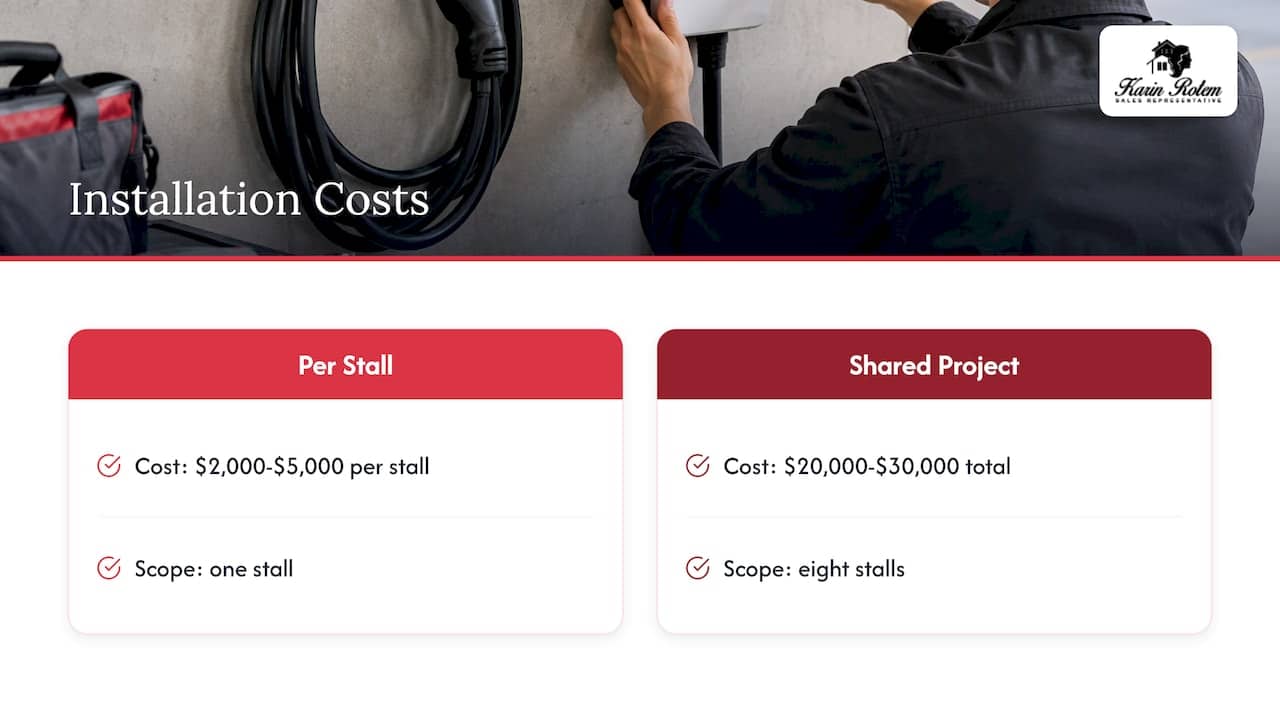
- Budget roughly $2,000 to $5,000 per stall for an installation, plus engineering and legal costs, according to Canadian installer guidance. Building-wide projects can reach $20,000 to $30,000 for eight stalls.
- Natural Resources Canada funding for multi-unit buildings can cover up to 50% of project costs, so shared projects often cost less than they first appear.
- Plan for 10 to 16 weeks from request to a working charger once board approval and scheduling are included.
Why condo charging is different from a house
In a detached home you own the driveway, the panel and the wall. You hire an electrician and you are done. In a condo, almost nothing you need is yours alone. The parking stall may be owned by you or may be common property. The electrical room belongs to the corporation. The wiring path from the meter to your stall crosses walls, ceilings and shared space that every owner has a stake in.
That is why the Condominium Authority of Ontario’s guide on EV charging systems says an installation must not contravene the corporation’s declaration, bylaws or rules, and that a building’s electrical infrastructure and future needs should be assessed first. It also makes the point that one approach does not fit every building. A 1990s mid-rise with a modest electrical service is a different project from a recent tower built with extra capacity.
For a buyer, this means the question “does this condo allow EV charging?” has no single answer. It has an answer for this building, this stall and this board.
What to check before you make an offer
Here is the order I walk through with buyers who drive an EV, or who expect to within the next few years.
1. Is your parking stall deeded or common element?
A deeded stall is part of your unit. A common element stall is usually assigned to you for exclusive use but owned by the corporation. That difference affects who can approve work, who pays, and what happens to the charger when you sell. Guidance from Clean Energy Canada’s condo EV readiness report tells buyers and owners to confirm stall ownership and review governing documents for EV-specific bylaws before planning anything.
If you are looking at Friday Harbour, our guide to parking options for condo owners at Friday Harbour explains how parking is arranged there, which is the starting point for any charging conversation.
2. What do the declaration, bylaws and rules say?
Some buildings already have an EV policy. Others say nothing, which is a different situation from saying no. Ask your agent to pull every governing document and read the parking, electrical and common element sections. In Ontario you will also want to read the status certificate, which summarizes the corporation’s finances and certain legal matters. I cover that in what a status certificate is and why it matters.
3. Is there electrical capacity?
This is the question most buyers do not think to ask. A building’s service has a ceiling. Every Level 2 charger draws serious power, and several running at night can add up quickly. An electrical load study, ideally based on a full year of peak data, is described in a US condo EV charging toolkit as critical for knowing whether existing infrastructure can support new demand. You will not commission one as a buyer, but you can ask the property manager whether the board has had one done or has discussed charging at all.
4. Has the board talked about EV charging, and what happened?
Board minutes are one of the most revealing documents in a condo purchase. If owners asked for charging two years ago and the board quietly shelved it, you want to know. If the board commissioned a study and set aside money, that is a good sign. Residents surveys are a common way to measure demand: CALeVIP’s planning guidance suggests surveying residents to understand both current EV use and expected future demand.
5. What does the reserve fund look like?
A building that has underfunded its reserve fund will struggle to pay for any shared electrical upgrade, and it may come back to owners with a levy. I explain how reserve fund studies work in our Ontario reserve fund study checklist, and how levies hit buyers in our guide to condo special assessments in Ontario.
How approval works in Ontario
Ontario is the province where I work, so I will be specific here. The Condominium Act, 1998 sets out, in section 98 and in sections 24.3 to 24.6 of Ontario Regulation 48/01, a process for both corporations and owners to get approval to install electric vehicle charging systems. In plain terms, there are two routes:
- The owner route. You submit a request to the board to install a charger for your own use. The process sets out what the request must contain and how the corporation responds.
- The corporation route. The board plans a shared system on the common elements. In some cases it can proceed without a formal vote of the owners after sending a notice, depending on how many owners object.
The details, such as timelines and what the agreement must cover, are worth reading in the regulation itself or with a condo lawyer before you sign anything. If you are already an owner and thinking of a request, talk to a lawyer who works with condominium corporations. They draft and register the agreement that governs the charger.
Other provinces differ. British Columbia’s Strata Property Act, for example, includes right-to-charge provisions that, following 2023 amendments, require an approval process for owners to install charging at their own cost. As of September 2025 there is no federal requirement in Canada to make new buildings EV ready, though section 86 of the Canadian Electrical Code covers the safety requirements for charging installations. Do not assume what you read about one province applies to another.
Permits and inspection
Every province requires an electrical permit for a 240V circuit. An electrician normally pulls the permit, and inspections are mandatory in most provinces. In a condo, the permit does not replace board approval. You need both.
Private versus shared charging
There are two basic setups, and your building may have either, both, or neither.
| Private (in-suite or stall-mounted) | Shared (building-managed) | |
|---|---|---|
| Who it serves | One owner | Multiple residents |
| Typical wiring | A dedicated circuit to one stall | Shared infrastructure with load management |
| Who usually pays to install | The owner, unless otherwise agreed | The corporation, as a common expense |
| Billing | Often tied to the owner’s own metering arrangement | Usually per session through an app |
| Best fit | Deeded stall close to a power source | Buildings with several drivers or limited capacity |
The Condominium Authority of Ontario notes that, unless otherwise agreed, the owner pays installation costs and may also be responsible for electricity and maintenance, while systems installed by the corporation are common expenses shared by owners.
That last point matters when you buy. If the building already has shared charging paid for through the common expenses, ask what it cost and how users are billed. Modern shared systems commonly use app-based billing where residents pay per session, which avoids one resident subsidizing another’s electricity. Clean Energy Canada’s report adds that shared charging infrastructure is often revenue-neutral or revenue-positive for the building once amortized.
What it costs
Costs split into two groups: the physical installation and the soft costs that surprise people.
Installation
Canadian installer guidance puts a realistic range at $2,000 to $5,000 per stall, depending on distance from the panel, any needed upgrades and load management. Long cable runs through a parkade are where the price climbs. The same source estimates that a building-wide project of eight stalls with shared load management can realistically run $20,000 to $30,000, which may be partly offset by government funding.
Soft costs
Ontario condo guidance lists professional and legal costs that owners often overlook: an engineering report of around $1,000 and legal registration of the charger against the unit’s title at $300 to $500. Add the permit and any board fees, and the real figure for a single-owner request is higher than the hardware quote suggests.
Funding
Natural Resources Canada’s Zero Emission Vehicle Infrastructure Program funds multi-unit residential buildings, covering up to 50% of total project costs up to set maximums, for example $5,000 per Level 2 connector. Programs change, so check the current terms on the official page before a board budgets around it. This is one more reason a coordinated, building-wide project usually beats several owners each doing their own retrofit.
A worked example
Say you buy a deeded stall in a mid-rise and want your own charger. A plausible budget, using the figures above, looks like this:
- Installation: $2,000 to $5,000
- Engineering report: about $1,000
- Legal registration against title: $300 to $500
That is roughly $3,300 to $6,500 before any panel upgrade, and it excludes ongoing electricity. If the same building did a shared project instead, your share would be a fraction of a larger bill, and some of it may be covered by funding. I am not saying one is always cheaper. I am saying you should find out which path the building is on before you spend.
How long it takes
Expect a timeline measured in months, not days. One Ontario installer estimates condo installations take 10 to 16 weeks once board approval and scheduling are factored in. A board that meets quarterly can add weeks on its own. If you are moving in and need to charge from day one, plan for a gap and know where you will charge in the meantime.
Natural Resources Canada notes that administrative layers and complex technical requirements in multi-unit buildings are a real barrier, and that clear, early communication between boards, residents and professional advisors helps. That matches what I see: the projects that go smoothly are the ones where the conversation started early.
What most buyers don’t realize
Most buyers treat EV charging as a gadget to sort out after moving in. The ones who do best treat it as a property feature, like a locker or an ensuite. A deeded stall near an electrical room, in a building with spare capacity and a cooperative board, is worth more to an EV driver than a slightly bigger kitchen. And if you are buying as an investor, charging access can matter to the tenants or guests you hope to attract.
It also helps to think about resale. A stall already approved and wired for charging removes a hurdle for the next buyer, and a building known for a sensible EV policy is easier to sell into.
Condo hotel and resort-style buildings
If you are looking at a resort-style community, the rules around parking and ownership can look different again. Units in a condo hotel arrangement, for example, may come with their own governing structure, which I explain in our buyer’s guide to condo hotel units. Amenities at the luxury end also vary widely, and our guide to luxury condo amenities in Ontario shows what to look for beyond the pool and gym.
Perspective
We approach EV charging the same way we approach every condo purchase: as a question about the building, not just the unit. Our clients in Friday Harbour, Innisfil and Toronto are often moving from a house to a condo or buying a weekend retreat, and many already drive electric. They want to know on day one whether they can plug in.
That is why we pull the declaration, bylaws, rules, board minutes and status certificate early, and read them with charging in mind. We look at who owns the stall, what the building has said about EV policy, and whether the reserve fund can carry a shared electrical project. Then we help you weigh that against price, location and lifestyle, and use it in negotiation where it matters.
Our team’s depth in Friday Harbour and Innisfil, and our work across the GTA, means we can compare how different buildings handle parking and amenities, and point you to the ones that fit how you live. A charger is a small part of a home. A building that supports how you live is the larger part.
Felix
Finding a condo that fits how you drive and live
If you are searching for a condo or waterfront home and charging matters to you, tell us before we start viewing. We will build it into the search criteria and the document review. You can browse Friday Harbour condos for sale or get in touch through our main site for a search tailored to your goals, whether that is a primary residence, a weekend retreat or an investment property.
FAQ
Can a condo board refuse my EV charger request in Ontario?
The Condominium Act, 1998 and Ontario Regulation 48/01 set out a process for owner requests, so a board has to follow defined steps rather than simply ignore you. Any installation also still has to meet the corporation’s governing documents and electrical safety requirements. Read the regulation or speak with a condo lawyer before you submit a request.
Who pays for electricity when I charge at my condo?
Unless otherwise agreed, the owner pays installation costs and may also be responsible for electricity and maintenance, according to the Condominium Authority of Ontario. In shared systems, per-session app billing is common, so each driver pays for what they use. Ask what arrangement your building has.
How much does it cost to install an EV charger in a condo?
Canadian installer guidance suggests roughly $2,000 to $5,000 per stall, plus an engineering report of about $1,000 and legal registration of $300 to $500 in Ontario. Panel upgrades or long cable runs raise the total. Government funding may offset part of a building-wide project.
Do I need a permit to install a condo EV charger?
Yes. Every province requires an electrical permit for a 240V circuit, and an electrician usually handles it, with inspections mandatory in most provinces. In a condo you also need approval under the building’s governing documents.
What should I check before buying a condo if I drive an EV?
Confirm whether your stall is deeded or common element, read the declaration, bylaws and rules for EV provisions, and ask whether the board has assessed electrical capacity. Review board minutes and the reserve fund as well, since shared electrical work depends on them.
Sources
- CAO Guide on Electric Vehicle Charging Systems
- Electric Vehicle Charging System Regulations and Installations
- Make Your Condo EV Ready, Clean Energy Canada
- Make Your Condo EV Ready, Plug’n Drive edition
- Electric Vehicle Charging Toolkit for Existing Condos
- Planning Your EV Charging Installation, CALeVIP
- Zero Emission Vehicle Infrastructure Program, Natural Resources Canada
- Zero Emission Vehicle Infrastructure Program overview
- Level 2 EV Charger Installation: Real Costs in Canada
- EV Charging in a Condo or Apartment in Canada
- EV Charging Stations in Ontario Condos: A Board’s Guide
- Condo EV Charger Installation in Ottawa vs Houses