
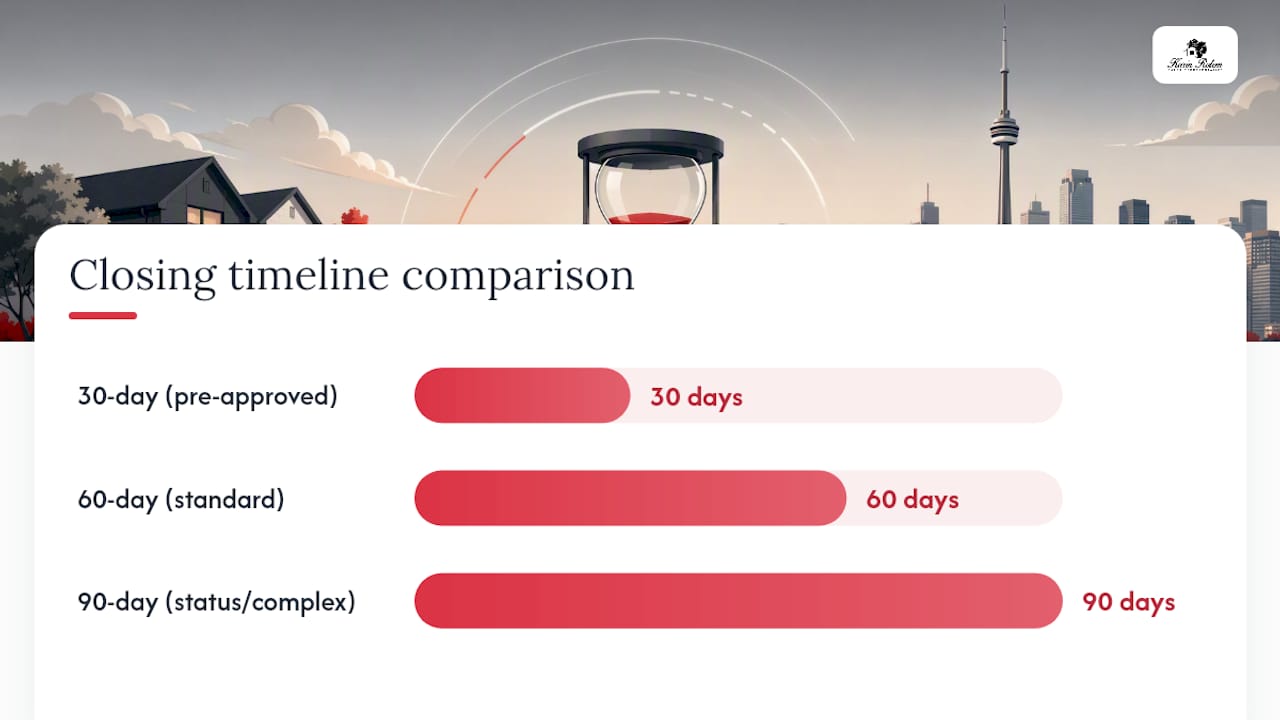
Most resale closings in Ontario run 30 to 90 days from accepted offer to key handover, with 60 days the most common window. Keys typically arrive after your lawyer completes Teraview registration, commonly in the afternoon on closing day itself. You control more of that timeline than most buyers realize: full mortgage approval before you offer, prompt ID and document delivery, and a signing appointment booked 1 to 3 days ahead all keep your file on schedule.
TL;DR:
- Most resale closings in Ontario take around 60 days, with the timeline largely dictated by lender approval, title searches, and final preparations.
- Closing day procedures include wire transfers, registration through Teraview, and afternoon key handover, making early morning moves unnecessary.
- Common delays stem from slow lender underwriting, title issues, condo certificate problems, and chain dependencies, all of which can be mitigated with proper pre-approval and timely documentation.
- Buyers should accelerate their process by securing full mortgage approval before making an offer and confirming payout letters early to avoid last-minute holdups.
- Scheduling signing appointments 1 to 3 days before closing and avoiding early morning move-ins ensure a smooth transfer of ownership.
Stage-by-stage: how a typical Ontario closing timeline unfolds
I tell every client the same thing when they ask “how long will this actually take?” There’s no single answer, but there is a predictable rhythm. Here’s what a standard 60‑day file looks like, stage by stage.
Day 0: Accepted offer and deposit. The Agreement of Purchase and Sale gets signed, the deposit moves to the listing brokerage’s trust account, and both sides’ lawyers get notified. This is the moment the clock actually starts.
Days 1 to 10: The conditional period. Financing and home inspection conditions typically need to be satisfied within this window. If you’re buying a condo, this is also when your agent should order the status certificate, since a review can take about a week and sometimes reveals issues that affect your decision to firm up.
Days 5 to 15: Title search and lawyer due diligence. Your lawyer’s office opens the file and begins the title search, typically completed within 5 to 10 business days. This is also when payout letters get ordered from the seller’s existing mortgage lender, confirming exactly what’s owed and when those funds need to be available.
Days 15 to 45: The quiet middle. This is the stretch clients worry about most because nothing visible seems to be happening. In reality, your lender is underwriting the file, your lawyer is reviewing title results, and paperwork is moving between offices. Silence here is normal, not a red flag.
Days 45 to 58: Final preparation. Your lawyer prepares the statement of adjustments, which reconciles prepaid property taxes, utility credits, and other closing-day math between buyer and seller. Somewhere in this stretch, your signing appointment gets booked, typically 1 to 3 days before the actual closing date.
Day 59 or 60: Closing. Mortgage funds get advanced, the transfer is registered through Teraview, and keys change hands once registration and funds transfer are complete.
A 30‑day closing compresses all of the above into a much tighter window, and it only works smoothly when the buyer already has full mortgage approval in hand before making the offer. A 90‑day closing usually reflects a condo purchase awaiting a status certificate resolution, a complex financing situation, or a seller who needs extra time to find their next home. Neither extreme is unusual. What matters is knowing which one you’re actually in.
What happens on closing day: the legal and financial sequence explained
Closing day looks calm from the outside and genuinely mechanical from the inside. Here’s the actual sequence:
- Mortgage funds are requested and advanced. Your lender wires funds to your lawyer’s trust account, usually against a same-day cut-off time set by the bank. Miss that cut-off and the whole day can slip.
- Lawyers exchange documents and confirm funds have cleared. Your lawyer and the seller’s lawyer verify that all money, including your down payment and mortgage proceeds, is sitting where it needs to be.
- The transfer is registered through Teraview, Ontario’s electronic land registration system. This is the legal moment ownership actually changes hands, and it can’t happen until funds are confirmed.
- The seller’s lawyer confirms receipt of funds to release keys, which is why possession commonly lands in the afternoon rather than first thing in the morning.
- Keys are released, usually coordinated between the two real estate agents once both lawyers give the all-clear.
Pro Tip: Don’t book movers or utility hookups for early morning on closing day. Mid‑to‑late afternoon possession is the norm, not the exception, and treating it as a guaranteed 9 a.m. handover is one of the most common scheduling mistakes I see.
On the morning of closing, buyers should have identification ready, remaining funds wired to their lawyer’s trust account (never handed over as a personal cheque), and a phone that’s actually answered. Sellers should have the property vacant, keys and garage remotes gathered, and any agreed-upon items left behind as promised. Understanding what your lawyer actually does at closing helps both sides know who to call when a question comes up midday.
Common causes of Ontario closing delays and how to avoid them
Delays cluster around a handful of predictable culprits, and almost all of them are avoidable with the right prep.
- Lender slowdowns. Underwriting can stall if income documents, appraisals, or condition confirmations arrive late. Get full mortgage approval before you make an offer, not after.
- Documentation errors. A legal name that doesn’t match across your offer, mortgage, and identification can hold up registration. Confirm your legal name matches your government ID and provide two pieces of valid identification to your lawyer early.
- Title or municipal issues. Outstanding liens, work orders, or survey discrepancies can surface during the search, which typically wraps up within 5 to 10 business days but occasionally needs longer to resolve.
- Condo status certificate problems. Special assessments, reserve fund shortfalls, or pending litigation disclosed in the certificate can push a 60‑day expectation toward 90 or beyond.
- Chain closings. When your sale depends on someone else’s purchase closing on time, one delay upstream cascades through every file in the chain. Extensions and holdbacks are the usual negotiating tools when this happens, and a repair holdback can also buy time when a seller hasn’t fully vacated or finished agreed repairs.
Client responsiveness is one of the few variables you actually control in all of this. Order payout statements 10 to 14 days ahead, schedule your signing appointment 2 to 3 days before closing, and confirm your bank’s wire cut-off time well in advance.
Pro Tip: If you’re buying and selling at the same time, ask both lawyers to confirm a firm registration order in writing. It’s a small step that prevents a lot of same-day panic.
Your Ontario closing checklist: who does what, and when
- Day 0 to 5: Deposit is delivered, the Agreement of Purchase and Sale goes to your lawyer, and (for condos) your agent orders the status certificate.
- Days 5 to 15: Secure full mortgage approval if you haven’t already, submit two pieces of ID to your lawyer, and confirm your lawyer has ordered payout letters from the lender being discharged.
- 1 to 3 days before closing: Attend your signing appointment, review the statement of adjustments line by line, wire remaining funds to your lawyer’s trust account, and book your final walkthrough.
- Closing day: Stay reachable by phone, confirm how and where keys will be handed off, and avoid scheduling movers or contractors before early afternoon.
- After closing: Keep your lawyer’s final reporting letter and registered documents in a safe, easy-to-find place. You’ll need them at tax time and if you ever refinance.
Reviewing what closing costs actually include before your signing appointment also means fewer surprises when you see the final adjustment figures.
What I tell my clients about staying on schedule
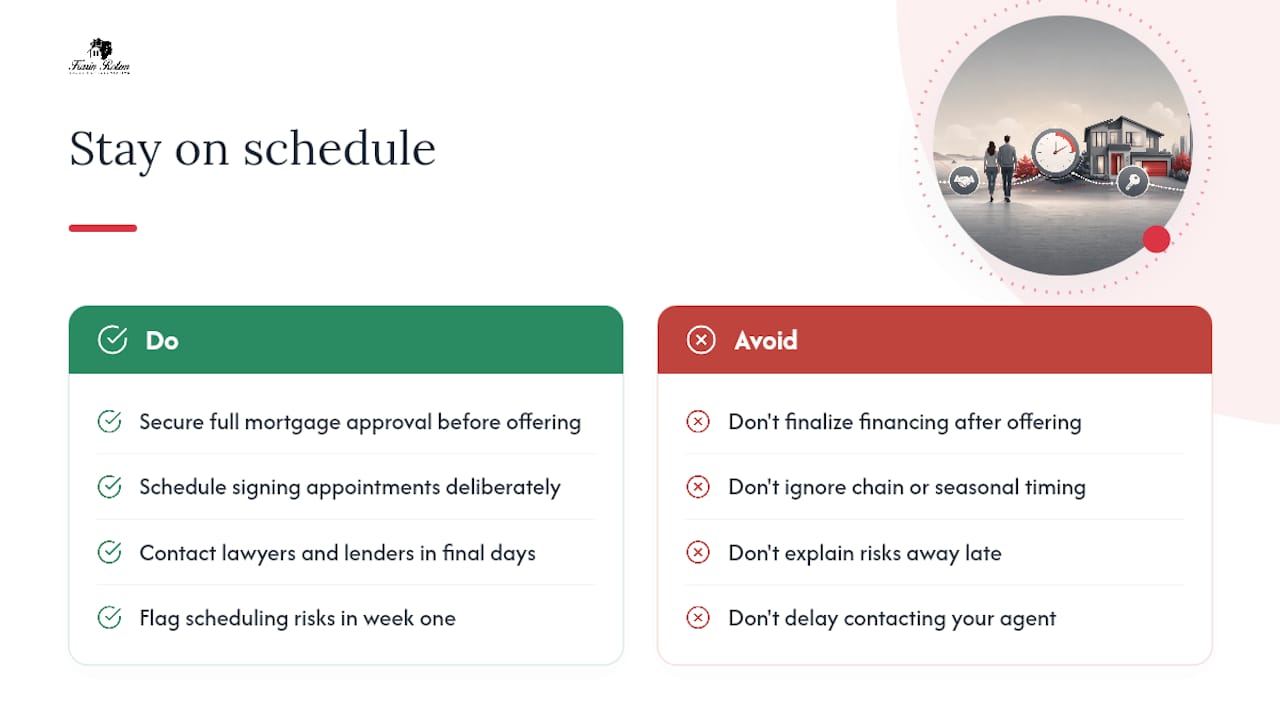
What most buyers don’t realize is that the biggest lever they have isn’t legal, it’s financial readiness. Clients who walk into an offer with full mortgage approval already secured close faster and with far less stress than those still finalizing financing after the fact. That’s the single behaviour I push hardest on.
Our team schedules signing appointments deliberately, and we stay in direct contact with lawyers and lenders in the days leading up to closing so nothing surfaces as a last-minute surprise. In Friday Harbour and around the Toronto edge, chain closings and seasonal peak weekends around long weekends and school-year transitions add real timing risk, and knowing that in advance changes how we structure offers and closing dates. If you’re navigating a purchase or sale here, we’d rather flag a scheduling risk in week one than explain it away in week eight. You can reach our team through Karin Rotem Real Estate to talk through your specific timeline before you write an offer.
— Felix
Where to verify these timelines yourself
For readers who want to go straight to primary explanations, Bussey Ainsworth’s closing day breakdown and Mills & Mills’ lawyer explainer both walk through the legal sequence in detail. For condo-specific timing, Insight Law’s overview of Ontario closings covers status certificate review periods.
Sources
- How long does a real estate closing take in Ontario? | Ownright Blog
- What happens on closing day in Ontario? | Bussey Ainsworth
- What happens on closing day in Ontario? A lawyer explains
- Real estate closing process Ontario: Vikram Sharma Law
FAQ
How long does it take to close a house in Ontario?
Most residential closings take 30 to 90 days from accepted offer to key handover, with 60 days being the most typical window for resale properties.
What is the 3-day rule for closing?
There’s no formal “3-day rule” in Ontario, but lawyers commonly schedule the signing appointment 1 to 3 days before the actual closing date to finalize the statement of adjustments and confirm funds are ready.
Can I move in on closing day in Ontario?
Yes, but plan for an afternoon possession rather than a morning one, since keys are typically released only after Teraview registration is confirmed, which often lands mid‑to‑late afternoon.
What takes the longest when closing on a house?
Lender underwriting and the quiet middle stretch of the timeline, roughly days 15 to 45, tend to take the longest and are largely invisible to buyers and sellers, though condo status certificate issues and chain closings can extend things further.