
The mortgage stress test asks one question: could you still make your payments if rates were higher than the rate you signed for? In Canada, a bank qualifies you at the greater of your contract rate plus 2 percentage points or 5.25%, then checks that payment against your income and debts. You never pay that higher rate. It only sets the maximum you can borrow, and that maximum is what decides which condos, homes or waterfront properties are realistically in your range.
What I tell my clients in Toronto, Innisfil and Friday Harbour is simple: run the stress test on your own numbers before you fall in love with a listing, not after.
TL;DR
- The qualifying rate is the greater of your contract rate plus 2% or 5.25%, per OSFI’s published rule. It sets how much you can borrow, not what you pay.
- Banks apply it to insured and uninsured mortgages. Straight switches at renewal between federally regulated lenders, with no increase in amount or amortization, are not expected to be stress tested.
- Your debt ratios matter as much as the rate: gross debt service generally stays at or under 39% of gross household income, and only 50% of condo fees count in that calculation.
- OSFI reviews the rule at least once a year, so check the live figure before you apply.
- For second homes and investment properties, how your income and any rental income are counted can change your budget more than the test rate does.
What the stress test is and why it exists
The formal name is the minimum qualifying rate (MQR). OSFI, the federal regulator that supervises Canadian banks, says the test is designed to build resilience against shocks such as higher rates, reduced income and increased expenses, which in turn reduces delinquency and default. OSFI’s own 2023 explanation notes that the current formula dates from the 2021 adjustment: contract rate plus 2%, or 5.25%, whichever is higher.
Two terms are worth knowing:
- Contract rate: the interest rate your lender actually offers you and that you pay after closing.
- Qualifying rate: the higher, hypothetical rate used only to calculate whether you are approved and for how much.
The Financial Consumer Agency of Canada (FCAC) is clear that the qualifying rate is used to calculate the qualifying payment and is not the rate you pay after closing. That distinction matters. Many buyers hear “stress test” and assume their real payment will jump. It will not.
Who has to pass it
The short version: if you borrow from a bank, you will be tested. FCAC says federally regulated lenders such as banks require the stress test, while other lenders may choose to. The same guidance says it applies to both insured mortgages (where you put down less than 20% and the mortgage is insured) and uninsured ones.
Provincially regulated credit unions and other lenders outside the federal system do not have to use this specific federal test, though many apply their own affordability checks. Whatever the lender, you still need to show you can carry the loan.
Renewals and switching lenders
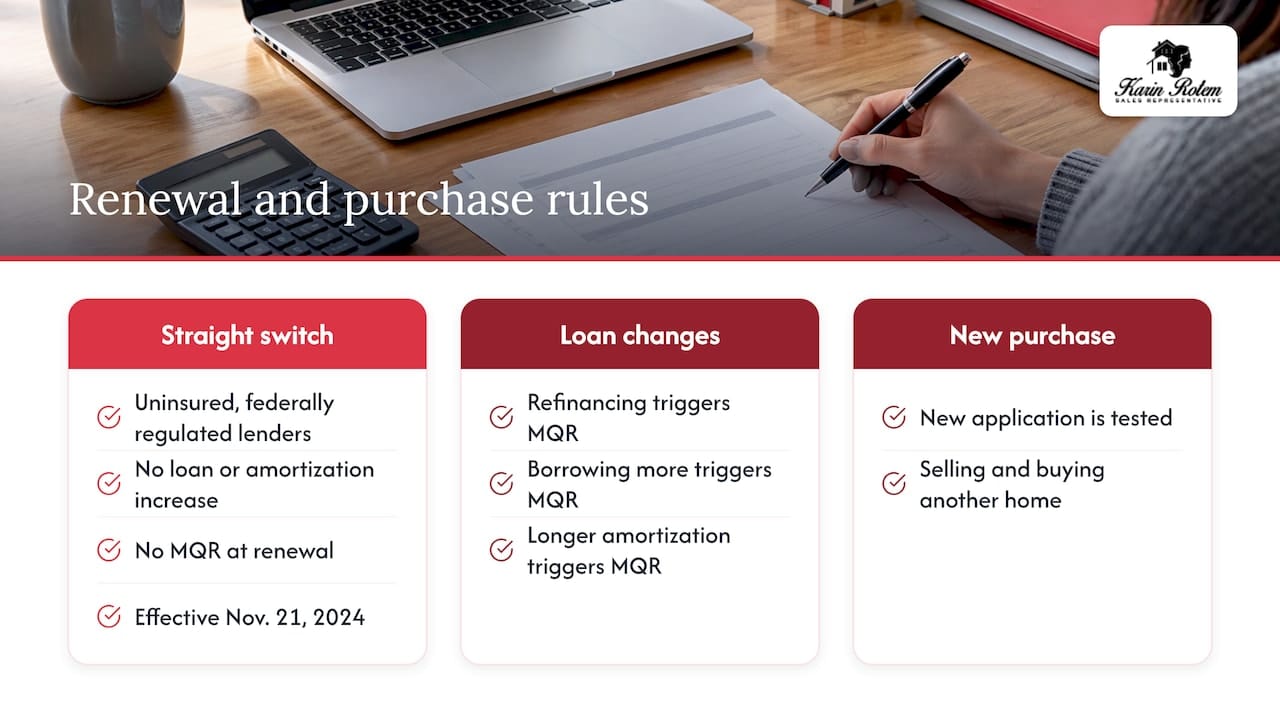
If you already own, renewal rules matter. OSFI does not expect lenders to apply the MQR to uninsured straight switches at renewal between federally regulated lenders when neither the loan amount nor the amortization period increases. The change took effect on November 21, 2024. If you are refinancing, borrowing more or stretching the amortization, plan on being tested.
If you are selling one home and buying another, the new purchase is a new application, so it is tested. How your current mortgage moves with you is a separate question, covered in our guide to mortgage portability in Toronto and Innisfil.
How the qualifying rate works: a worked example
Take a $600,000 mortgage on a 25-year amortization.
| Contract rate | Qualifying rate | Why |
|---|---|---|
| 4.50% | 6.50% | Contract rate plus 2% is higher than 5.25% |
| 4.00% | 6.00% | Contract rate plus 2% is higher than 5.25% |
| 3.00% | 5.25% | 3.00% + 2% is 5.00%, so the 5.25% floor applies |
On a 4.50% contract rate, the monthly payment on $600,000 over 25 years (using Canadian semi-annual compounding) is about $3,321. At the 6.50% qualifying rate, the same loan is about $4,019 a month. That is roughly 21% higher, and it is the payment your income and debts must support on paper.
Turn it around and you see the effect on purchasing power. If your income only supports a qualifying payment of $3,321 a month, then at a 6.50% qualifying rate the loan you can be approved for is about $496,000, not $600,000. The test does not change what you pay. It lowers the ceiling by about $100,000 in this example.
These are illustrations of the arithmetic, not offers or today’s rates. Mortgage rates move constantly with lender pricing and bond markets, so use the rate on your actual quote. Our mortgage and affordability calculators let you try different rates and prices.
Your income and debts decide the rest
The qualifying rate is only half of the test. FCAC says lenders look at your income before taxes, expenses, debts, credit history and score, and amortization period when deciding what you can afford. Two ratios do most of the work:
- Gross debt service (GDS): your housing costs as a share of gross household income. FCAC says it should generally not exceed 39%. Housing costs include the mortgage payment, property taxes, heating and 50% of applicable condominium fees.
- Total debt service (TDS): the same housing costs plus all your other debt payments, such as car loans, credit cards and lines of credit. CMHC’s fact sheet gives 39% GDS and 44% TDS as the thresholds for insured applications, calculated using the greater of the contract rate plus 2% or 5.25%.
In practice the stress-tested payment and these ceilings work together. A lower rate on its own does not make you a stronger applicant if your other debts push your TDS over the line.
Why condo fees matter in Friday Harbour
Most of the condo buyers I work with at Friday Harbour are comparing maintenance fees as closely as price. The good news is that only 50% of applicable condo fees count in the GDS calculation, according to FCAC. Fees still reduce your cash flow in real life, so I look at both views: what the lender counts and what you actually pay each month.
What most buyers don’t realize is that a unit with higher fees and a lower price can qualify differently from a pricier unit with lower fees. Ask for the fee schedule early and put it in the calculation from day one.
What has changed, and what hasn’t
The rule you are tested under today is the one OSFI publishes: the greater of the contract rate plus 2 percentage points or 5.25%, where 2% is the buffer and 5.25% is the floor. OSFI reviews the floor and buffer at least annually, using data from financial institutions and indicators of housing-market and economic vulnerability, in consultation with Finance Canada and the Bank of Canada.
Two practical points follow:
- The formula has been stable since 2021, and the notable change since late 2024 is the relaxed rule for straight switches at renewal.
- OSFI also keeps limits on how many uninsured mortgages banks can extend above 4.5 times a borrower’s income. That is a bank-level limit, but it is one more reason a high loan relative to income can be harder to place.
Because the rule is reviewed every year, always confirm the current qualifying rate on OSFI’s page or with your lender before you make an offer.
How the stress test affects different kinds of buyers
Toronto professionals buying a waterfront second home
Your income is usually strong, but your existing mortgage, HELOC and car payments all count toward TDS. A second property adds a second set of housing costs to the calculation. Before you shop, work out your down payment as well. Our guide on the down payment for a second home explains what to expect.
Investors planning rental income
Lenders do not simply add the full rent to your income. How much of it they count, and how they treat it in GDS and TDS, shapes your budget. I walk through that in how lenders count rental income. If you plan to use a resort-style property as a short-term rental, raise it with your lender at the pre-approval stage rather than after you have an accepted offer.
Families relocating from Toronto
You may be selling a Toronto home and buying in Innisfil, often with the sale and purchase timed close together. Your new qualifying payment is based on the new mortgage, so the equity from your sale and the size of the new loan decide whether you pass comfortably. Our guide to selling your Toronto home and buying in Innisfil covers the timeline. If you own now and are weighing which move comes first, the buy-first or sell-first checklist helps.
International and non-resident buyers
Lenders set their own terms for buyers who live outside Canada, and income documentation, down payment and the type of lender can all differ. Our non-resident mortgage guide for Ontario lays out the options.
Sellers
If you are selling in Innisfil, the stress test matters to you indirectly: it limits what your buyer can borrow. A buyer who has already been tested and pre-approved is a stronger offer than one who has not. When I price a listing, I think about the buyer pool that can actually qualify at that price.
How to prepare before you apply
You cannot change the formula, but you can change the inputs. Here is the routine I walk clients through.
- Check your credit report. FCAC’s advice is to order your credit report before shopping and make sure it has no errors. A mistake you fix now is cheaper than a delay mid-purchase.
- List every debt payment. Include credit cards, car loans, student loans and lines of credit. These feed directly into TDS.
- Reduce what you can. Paying down a car loan or a revolving balance lowers your monthly obligations and can raise your borrowing limit more than you would expect.
- Run the numbers at the qualifying rate, not the quoted rate. Use the greater of your rate plus 2% or 5.25%. Our calculators help.
- Add property tax, heating and condo fees. These are part of the GDS formula. For condos, include 50% of the fee for the lender’s view and the full fee for your own budget.
- Get a pre-approval before you shop seriously. It tells you the number the lender will actually stand behind.
- Think about your offer conditions. Whether to include a financing condition depends on how firm your approval is. I cover that in should you include a financing condition in Ontario.
One more trade-off to consider: choosing a longer amortization lowers the monthly payment used in the test and can increase the amount you qualify for, but it raises the total interest over the life of the loan. I want clients to make that choice deliberately, not just to clear the test.
Our perspective
What I tell buyers is that the stress test is not a verdict on whether you can afford a home. It is a planning number. The sooner you know it, the sooner you can shop in the right range, in the right building, with the right conditions in your offer.
In Friday Harbour and Innisfil I see the same pattern: buyers who start with a clear qualifying number negotiate with confidence. They know what the monthly fees do to their ratios, they know which units fit, and they do not lose a good property to a financing surprise. Our team’s focus is local, so we can match your qualifying range to what is genuinely available in the community and tell you honestly when a property is a stretch.
For investors and second-home buyers, we go one step further and look at how the property will be used, because that shapes how a lender sees it. A waterfront condo that works as a weekend retreat may need a different plan than one you intend to rent.
Felix
Ready to match your budget to a property?
Once you know your qualifying range, the next step is seeing what fits it. Browse Friday Harbour condos for sale to see what’s on the market, or visit the Karin Rotem home page to talk through buying, selling or investing in Toronto, Innisfil and Friday Harbour. We’ll help you line up your numbers with the right listings and the right strategy for your goals.
FAQ
Does the stress test raise the interest rate I pay?
No. The qualifying rate is used only to calculate whether you can be approved and for how much. After closing you pay your contract rate, as FCAC’s mortgage qualifier tool explains.
Do I need to pass the stress test if I put 20% down?
Yes, if you borrow from a bank. FCAC says the test applies to both insured and uninsured mortgages at federally regulated lenders. A larger down payment helps by reducing the loan, which lowers the qualifying payment.
Do I need to be stress tested when I renew?
Generally not for a straight switch between federally regulated lenders on an uninsured mortgage, if you do not increase the amount or the amortization. OSFI’s guidance sets that expectation. A refinance or a larger loan is treated differently.
What is the minimum qualifying rate in 2026?
OSFI’s published formula is the greater of your contract rate plus 2 percentage points or 5.25%. OSFI reviews the floor and buffer at least annually, so check OSFI’s page for the current figure before you apply.
How can I improve my chances of passing?
Start with your credit report, then list and reduce your debts, since both feed directly into your debt ratios. FCAC advises ordering your credit report and correcting any errors before you shop.
Sources
- Minimum qualifying rate for uninsured mortgages, OSFI
- The importance of sound residential mortgage underwriting, OSFI
- Preparing to get a mortgage, Financial Consumer Agency of Canada
- Mortgage Qualifier Tool, Financial Consumer Agency of Canada
- Mortgage Loan Insurance, CMHC Purchase fact sheet
- Homeowners who switch lenders at mortgage renewal will no longer face the stress test, The Globe and Mail
- OSFI keeps limits on residential mortgages, The Logic