
Yes: Ontario condo corporations must obtain a reserve fund study that meets the standards set out in O. Reg. 48/01, and once the board receives it, the clock starts running. The board has 120 days to review the findings, must propose a funding plan, and needs to notify owners and send a copy to the auditor before implementing any changes to contributions.
TL;DR:
- Reserve fund studies must be reviewed by the condo board within 120 days of completion, with a funding plan proposed and owner notification before implementing contribution changes.
- Studies must be conducted by licensed professionals like engineers or certified technologists, with valid insurance and signatures, and typically require updating every three years.
- A comprehensive (Class 1) study includes a full inspection and is required within one year of registration; shorter updates (Class 2 and 3) rely on visual or desk reviews.
- The study’s 30-year funding projection should include all components costing over $500 expected to need major repair within the period; a 45-year horizon is recommended for long-term planning.
- Underfunded reserves often lead to special assessments, and boards should ensure contributions keep pace with study recommendations to avoid compliance issues and safeguard resale value.
Why Ontario requires reserve fund studies and who benefits
The Condominium Act, 1998 exists to stop corporations from getting caught flat footed when the roof, the elevator, or the parking garage needs major work. Reserve funds are legally separate from operating funds, and that separation matters. Operating money pays for the landscaping contract and the superintendent’s salary. Reserve money pays for the capital items that only come due once every decade or three, but cost a fortune when they do.
The financial logic protects both current owners and future buyers. Nobody wants to buy into a building where the last owner enjoyed low fees for years while the roof quietly aged past its useful life.
- Reserve funds cover major repair or replacement of common elements, not routine maintenance.
- Components expected to need work within 30 years and costing $500 or more must be tracked in the component inventory.
- Smoothing capital costs across decades avoids the shock of a sudden six-figure bill landing on one year’s budget.
Who can conduct a reserve fund study and what credentials to check
O. Reg. 48/01 restricts this work to a defined list of prescribed professionals. That includes professional engineers, certified engineering technologists, and members of organizations like the Canadian Institute of Quantity Surveyors (CIQS), the Appraisal Institute of Canada (AIC), and the Real Estate Institute of Canada (REIC), each recognized under the reserve fund guidelines from the Condominium Authority of Ontario (CAO).
The provider must also carry liability insurance that stays valid at the time of the study and for at least three years afterward, and the completed study must carry the provider’s signature. A board that skips verification here is taking on risk it doesn’t need to.
- Ask for a current certificate of insurance, not just a verbal assurance.
- Request sample reports from similar buildings, ideally ones with comparable age and component mix.
- Call references and ask specifically how the provider handled assumption changes mid-project.
Pro Tip: Put the insurance and signature requirement in writing as part of your engagement letter. It gives the board a paper trail if a dispute ever comes up later over who is accountable for the numbers.
Study types and timing: class 1, class 2 and class 3 explained
Ontario recognizes three classes of reserve fund study, and the class dictates how deep the provider has to dig.
- Class 1, comprehensive study. Full site inspection, complete physical and financial review. Required within one year of a new corporation’s registration.
- Class 2, updated study with site inspection. A shorter walkthrough confirms condition changes without redoing the entire analysis from scratch.
- Class 3, updated study without site inspection. A desk review that adjusts the financial model for inflation, interest, and spending since the last study, per O. Reg. 48/01.
Corporations must update the study at least every three years, and most buildings settle into a rhythm of class 1, then class 3, then class 2, repeating on a three-year cycle. Some boards push their provider toward a longer projection window than the legal minimum, and for good reason, which the next section explains.
What a reserve fund study must include
Every compliant study has two halves, and both need to hold up to scrutiny.
The physical analysis inventories every common-element component expected to need major repair or replacement within the study period, alongside a visual condition assessment of each one. The financial analysis projects a recommended funding plan forward at least 30 years, factoring in assumed inflation, interest earned on reserve investments, opening and closing fund balances, and the annual contribution the corporation should be collecting to stay solvent.
Thirty years is the legal floor for the projection window, not the ceiling engineers recommend.
Professional engineers frequently advise boards to request a 45-year horizon instead of the bare statutory minimum, since some structural components (building envelopes, underground garages) don’t reach end of life within three decades but still need to appear in long-range planning.
- Component threshold: items costing $500 or more that will need major work within the study period get included.
- Financial assumptions should be stated explicitly, not buried in a footnote.
- A longer horizon costs a little more upfront but catches capital needs a 30-year window can entirely miss.
Board duties and deadlines after receiving a reserve fund study
Getting the report is the easy part. What happens next is where boards run into trouble if they’re not tracking dates carefully.
- Review the study within a few months of receiving it and propose a plan for future funding under section 94(8) of the Act.
- Send owners a notice promptly after approving the plan, summarizing the study’s findings and the proposed contribution changes, per the CAO’s reserve fund guide.
- Deliver a copy of that notice to the corporation’s auditor when it goes to owners.
- After a reasonable notice period, implement the plan, coordinating the new contribution level with the annual budget cycle.
Miss any one of these steps and the corporation risks an owner complaint, or worse, an audit finding that flags non-compliance.
Funding strategies, cash-flow modelling and risks of underfunding
Cash-flow modelling is how the financial analysis turns a list of aging components into a dollar figure owners actually pay each month. The model spreads the projected cost of every future repair across the years leading up to it, so the corporation isn’t scrambling to raise a lump sum the year the parking garage membrane finally fails.
Auditors check this work carefully. They confirm that budgeted contributions actually land in the reserve fund, that the fund stays invested in eligible instruments like GICs or money market funds, and that interest earned stays inside the fund rather than drifting into operating accounts, a point the accounting guidance from Insight CPA covers in detail.
- Underfunded reserves usually surface as special assessments when a big-ticket repair can’t wait any longer.
- A qualified audit opinion is a red flag that tells prospective buyers something is off with reserve management.
- Owners who feel a board mismanaged the fund can escalate complaints to the Condominium Authority Tribunal (CAT).
Pro Tip: If your last three years of contributions haven’t kept pace with the study’s recommended annual amount, don’t wait for the next mandatory review to raise fees. Catching up early costs less than catching up during an emergency.
Practical checklist for boards: documents to prepare and questions to ask
A board that shows up organized gets a faster, more accurate study, and usually a lower invoice too.
- Gather maintenance logs, service contracts, warranties, the last two reserve fund studies, and recent audited financial statements.
- Ask the provider directly what inflation and interest rate assumptions they’re using, and whether those track recent Ontario construction cost trends.
- Confirm the recommended study horizon (30 versus 45 years) before the engagement starts, not after the draft lands.
- Watch for red flags: an unsigned report, no insurance certificate on file, or vague language around component condition instead of specific findings.
If a draft report is missing any of these, request a revision before the board approves it. A signature and an insurance certificate aren’t paperwork formalities. They’re what makes the study legally usable.
What I tell my condo-board clients in Ontario
What I tell my board clients is this: a steady, predictable contribution increase almost always beats waiting and absorbing a special assessment later. Buyers notice reserve fund health now more than they used to, and a well-funded reserve shows up in resale confidence. I’ve seen boards near Innisfil raise fees modestly two years running and avoid the assessment their neighbours got hit with.
— Felix
How Karin Rotem helps you read the numbers before you buy or sell
A reserve fund study tells you whether a building is financially healthy, but interpreting what that means for your purchase or sale is a different skill entirely. That’s where I come in. I’m not the professional who prepares the study, but I am the person who helps you understand what it means for the deal in front of you, whether you’re buying into Friday Harbour or evaluating a resale unit anywhere across Toronto and Innisfil.
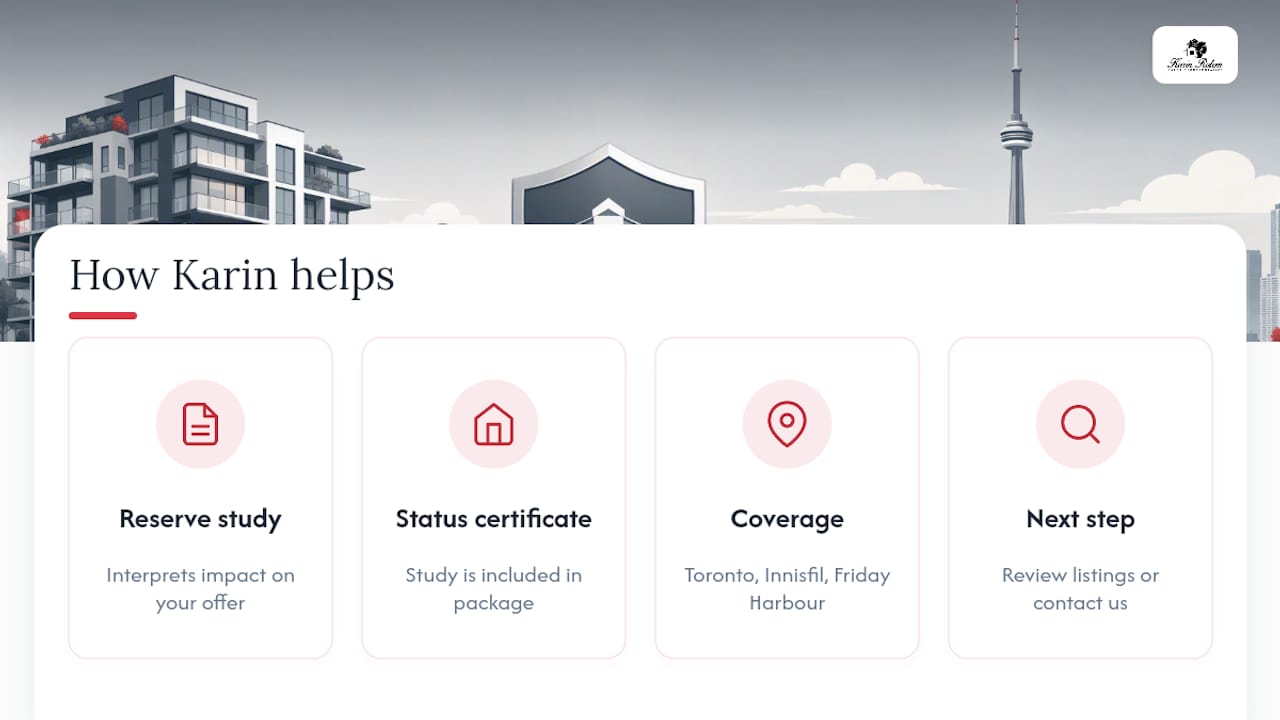
What most buyers don’t realize is that a status certificate package includes the reserve fund study, and the numbers inside it can change your negotiating position entirely. If you’re weighing a purchase and want a second set of eyes on what the reserve fund health actually means for your offer, review our current listings or reach out and we’ll walk through the specific building together. You can also read more about how status certificates tie into this before you make an offer.
Sources
- Reserve Funds and Reserve Fund Studies – Condo Authority
- O. Reg. 48/01 — Reserve fund study requirements
- PEO guideline for engineers conducting reserve fund studies
- Reserve fund study accounting in Ontario 2026 — Insight CPA
FAQ
How often are reserve fund studies required in Ontario?
At least every three years, though the class of study (comprehensive, updated with inspection, or updated without inspection) rotates depending on the corporation’s cycle and timing since registration.
What is the purpose of a reserve fund study?
It ensures a condo corporation sets aside enough money, projected over at least 30 years, to cover major repair and replacement of common elements without relying on emergency special assessments.
How long is a reserve fund study valid for?
A study typically informs funding decisions for up to three years, after which an updated or comprehensive study is legally required to keep the corporation compliant.
How much should a condo reserve fund be in Ontario?
There’s no fixed dollar minimum. The required amount is whatever the study’s cash-flow model recommends based on the building’s component inventory, age, and projected repair costs over the study period.