
Buying luxury waterfront property in Ontario is one of the most rewarding investments you can make, but international buyers frequently underestimate just how layered and demanding the process truly is. Many arrive focused on finding the right property, only to discover that additional tax, regulatory, and mortgage hurdles exist far beyond the standard purchase process. A missed exemption, a delayed wire transfer, or an overlooked compliance requirement can cost you not just money but the property itself. This guide walks you through exactly how an experienced Canadian realtor protects your interests, simplifies complexity, and keeps your purchase moving forward at every stage.
Key Takeaways
| Point | Details |
|---|---|
| Expert navigation required | International buyers in Ontario need a realtor to guide them through complex taxes, regulations, and fast-paced transactions. |
| Compliance is layered | Federal and Ontario rules often overlap, demanding close realtor and lawyer coordination for every luxury purchase. |
| Speed is critical | In luxury markets, being prepared for deposit and documentation timelines can make or break your offer. |
| Financing challenges unique | Non-resident buyers face stricter deposit, mortgage, and funding requirements that realtors help manage. |
| Exemption reviews matter | Each buyer’s eligibility for tax and rule exemptions must be carefully checked—one missed detail can be costly. |
Key roles of Canadian realtors for international buyers
With the context set, let’s unpack exactly what a Canadian realtor does for international buyers pursuing Ontario luxury waterfront properties.
Most people think of a realtor as someone who unlocks doors and writes offers. For international buyers, the role is far more substantial. Licensed agents function as search, negotiation, and legal coordination professionals, with a significantly expanded scope when non-residents are involved. Every stage of the transaction carries nuances that a locally experienced agent will anticipate well before they become problems.
Here is how that plays out across a typical purchase sequence:
-
Property search and shortlisting. Your realtor filters listings based on zoning, waterfront access rules, and community restrictions that may limit short-term rental income or foreign ownership. This is especially important in communities like Friday Harbour in Innisfil, where lifestyle amenities and property types vary considerably. Our step-by-step buying guide covers how this process unfolds specifically for condo buyers.
-
Pre-offer compliance screening. Before submitting any offer, your realtor reviews whether the property is subject to foreign buyer restrictions, checks strata or condominium rules, and coordinates a preliminary tax review with your real estate lawyer.
-
Offer structuring for non-residents. Offers for international buyers often need specific clauses related to deposit timelines, conditions for legal review, and acknowledgment of non-resident obligations. A poorly worded offer can expose you to penalties or create unenforceable conditions.
-
Negotiation with cultural and jurisdictional awareness. Your realtor serves as your advocate in all price and condition negotiations, understanding both Canadian market norms and the seller’s expectations, which may differ dramatically from what you are accustomed to in your home country.
-
Closing coordination. Your realtor liaisons directly with lawyers, mortgage brokers, and financial institutions to ensure that every compliance checkpoint is met before the transaction closes.
“An experienced Canadian realtor does not just find you a property. They manage a process that, for international buyers, involves legal, financial, and regulatory dimensions most buyers only discover after something goes wrong.”
Pro Tip: In competitive markets like Toronto and Innisfil, properties can receive multiple offers within 48 hours of listing. International buyers should have their deposit funds accessible and convertible before they begin actively viewing properties. Waiting until an offer is accepted to arrange international wire transfers is one of the most common and costly mistakes we see.
Navigating Ontario’s taxes and regulations for non-residents
Now that you know the realtor’s essential roles, understanding Ontario’s layered compliance is critical for smooth transactions.

Ontario’s regulatory landscape for non-resident buyers operates on two distinct levels: federal and provincial. These are not interchangeable, and being exempt from one does not guarantee exemption from the other. This is a critical point that many buyers miss until they receive an unexpected tax bill.
Ontario buyers may face a 25% Non-Resident Speculation Tax (NRST), alongside federal foreign buyer bans that carry their own exemption frameworks. Each operates under different eligibility criteria, and exemptions must be formally reviewed and documented, not simply assumed.
Here is a summary of the major tax obligations international buyers should understand:
| Tax or restriction | Who it applies to | Rate | Key exemptions |
|---|---|---|---|
| Non-Resident Speculation Tax (NRST) | Non-Canadian citizens and non-permanent residents purchasing in Ontario | 25% of purchase price | Canadian citizens, permanent residents, certain work permit holders, nominees |
| Federal Foreign Buyer Ban | Non-citizens purchasing residential property in Canada | Prohibition (not a tax) | Work permit holders, refugee claimants, certain international students |
| Land Transfer Tax (provincial) | All Ontario buyers | Graduated, up to 2.5% | First-time buyers (partial rebate) |
| Municipal Land Transfer Tax (Toronto) | All buyers in Toronto | Graduated, up to 2.5% | First-time buyers (partial rebate) |
| Withholding tax on resale (if non-resident seller) | Non-resident sellers, not buyers | 25% withheld from proceeds | Applies at time of sale, not purchase |
Understanding where you fall within this table is not something you should attempt without professional guidance. Your realtor and lawyer will work together to review your residency status, visa category, and purchase intent to identify which obligations apply and whether any exemptions are available. Our article on foreign buyer requirements provides additional detail on how this works specifically for Friday Harbour purchasers.
Key exemptions your realtor and lawyer will assess:
- Work permit holders may qualify for an NRST exemption if the permit meets specific duration and status requirements.
- Nominees under the Ontario Immigrant Nominee Programme are generally exempt from NRST.
- Refugee claimants and protected persons may qualify under federal exceptions.
- Spouses of Canadian citizens or permanent residents can trigger exemption eligibility depending on how title is structured.
Understanding what your lawyer does at Ontario home closing helps clarify how the legal and realtor roles divide this work effectively.
Pro Tip: Exemption eligibility is not one-size-fits-all. Two buyers with seemingly similar circumstances can have completely different NRST outcomes based on visa type, purchase intent, and how ownership is registered. Always have your exemption status reviewed in writing before submitting an offer.
How realtors help with deposits, financing, and documentation
Beyond legal barriers, money and paperwork issues can make or break a luxury purchase.
International buyers face a set of financial hurdles that domestic buyers simply do not encounter. The pace of a competitive Ontario luxury transaction leaves very little room for error, and your realtor’s ability to anticipate and pre-empt these challenges directly affects your chances of securing the property you want.
Understanding deposit expectations
International buyers often face deposits of 2% to 5% of the purchase price, due rapidly after acceptance, and funding delays can cost a deal. On a $2 million waterfront property, that means between $40,000 and $100,000 must be ready to transfer, often within 24 to 48 hours of offer acceptance.
| Scenario | Deposit expected | Typical timeline |
|---|---|---|
| Standard domestic buyer | 2–3% of purchase price | 24–48 hours post-acceptance |
| International buyer in competitive market | 3–5% of purchase price | 24 hours or less in multiple offer situations |
| Pre-construction purchase (Friday Harbour condos) | Structured in stages | First stage within 24–48 hours; further stages over 90–180 days |
| Resale luxury property (Toronto or Innisfil) | 5%+ in highly competitive listings | Often same-day in firm offer scenarios |
Your realtor will advise you exactly what deposit amount positions your offer competitively and work with you in advance to ensure your funds are positioned correctly.
Financing as a non-resident buyer
Canadian banks apply stricter lending criteria to non-resident purchasers. Expect lower loan-to-value ratios, meaning larger down payments are required. Some lenders require a minimum of 35% down for non-residents, and income verification from a foreign employer can be complicated. Our mortgage tips for international buyers provide a detailed breakdown, and you can review your financing options for non-residents to understand which lenders specialise in cross-border situations.
Common documentation gaps your realtor will help you address:
- Foreign income verification letters from your employer or accountant, translated if necessary.
- Bank statements from overseas institutions, often requiring certified translations.
- Valid government-issued identification from your country of residence.
- Proof of landed status, visa documentation, or immigration status in Canada.
- Tax identification numbers from both Canada and your home country.
Use our affordability calculators to establish a realistic budget that accounts for NRST, land transfer taxes, legal fees, and the larger down payments typically required.
Pro Tip: Initiate your international wire transfer at least five to seven business days before you expect to need the funds. Currency conversion timing, compliance holds from your home bank, and Canadian bank processing windows can all add days to the process. Having funds already in a Canadian account before your offer is accepted removes one of the biggest risks to your deal.
Coordinating the closing: How realtors and lawyers ensure compliance
Finally, let’s see how everything comes together when closing your Ontario purchase.
The period between offer acceptance and closing day is where the most complex work happens, and where the most risk concentrates. Agents coordinate with lawyers for legal review and structuring of compliant deals for non-residents, and the efficiency of that coordination determines whether your closing proceeds smoothly or stalls.
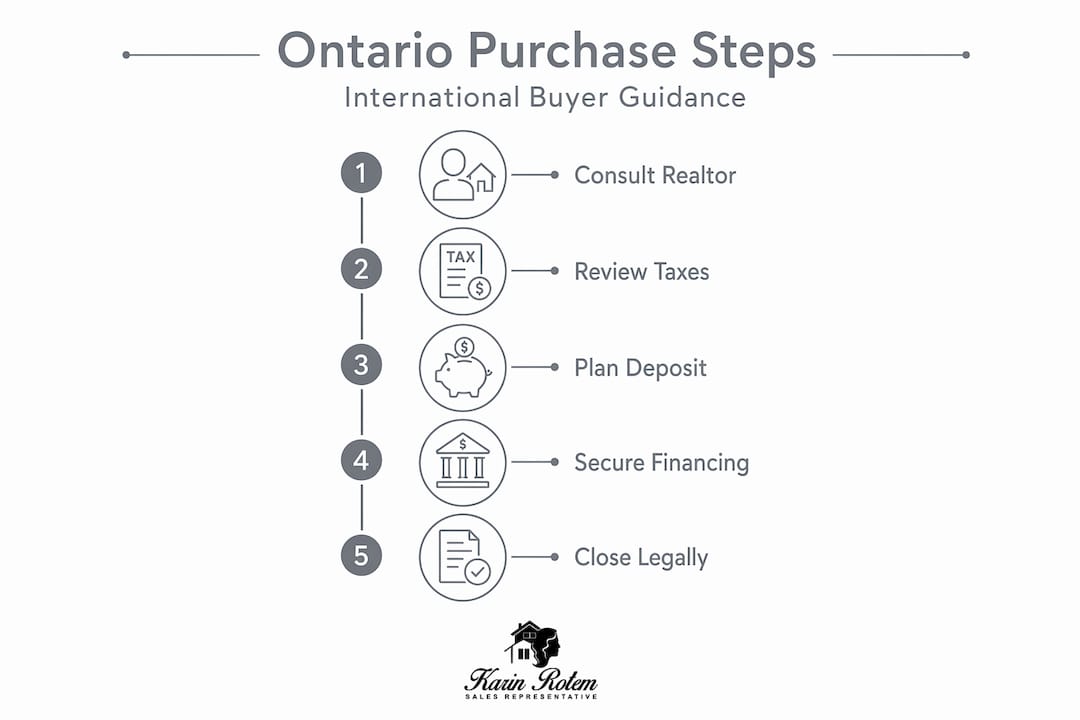
Here is the sequence from accepted offer to closing day for an international buyer:
- Offer acceptance. The signed agreement of purchase and sale is exchanged. Your deposit must be delivered within the timeline specified in the offer.
- Lawyer engagement. Your realtor immediately connects you with a real estate lawyer experienced in non-resident transactions. Title searches begin.
- Condition period (if applicable). Conditions for financing, home inspection, and lawyer review are common. Your lawyer reviews the agreement for compliance with NRST obligations, federal restrictions, and title clarity.
- Exemption documentation. If you qualify for NRST exemption, your lawyer prepares the required statutory declarations and submits them properly. Timing matters here.
- Mortgage commitment. Your lender issues a formal mortgage commitment letter based on the accepted offer and your documentation package.
- Status certificate review (for condominiums). Your lawyer reviews the status certificate, which includes information on reserve funds, special assessments, and condo corporation rules.
- Closing funds preparation. Your lawyer calculates the exact amount required for closing, including land transfer taxes, legal fees, and any adjustments. Your realtor confirms all conditions are met.
- Closing day. Title transfers, mortgage registers, and your realtor confirms key delivery.
“Compliance at closing is not just about having the right paperwork. It is about having completed each step in the right order, with the right professionals involved at each stage. One missed step can delay or void a transaction entirely.”
Key documents your realtor and lawyer will track:
- Agreement of purchase and sale (reviewed for non-resident compliance clauses)
- Title search results and title insurance policy
- Statutory declaration for NRST exemption, if applicable
- Mortgage commitment letter and lender instructions
- Status certificate (for condo purchases)
- Transfer of land document, properly registered with Ontario Land Registry
It bears repeating that federal exemptions do not automatically remove Ontario NRST liability. Both layers must be explicitly reviewed by your realtor and lawyer, working together. More detail on what your lawyer does at closing helps clarify exactly where legal and real estate expertise intersect.
What most guides miss about buying luxury waterfront homes as an international client
Most resources for international buyers focus heavily on regulations, taxes, and legal technicalities. That information matters deeply, but in my experience working with international clients across Toronto and Innisfil, the buyers who lose their dream properties rarely do so because they failed a compliance test. They lose because they were not operationally ready when the right property appeared.
Luxury waterfront markets move fast. Friday Harbour properties, in particular, attract buyers from across Canada, the United States, and internationally, and desirable listings do not sit on the market waiting for you to arrange a bank transfer. I have seen buyers who had done all their legal homework lose a property simply because their funds were still clearing when a competing offer arrived.
The real advantage of an experienced realtor in this market is not just compliance knowledge. It is process timing and pre-emptive preparation. The best approach I recommend to international clients is to treat the entire documentation and funding preparation process as something that happens before you find the property, not after. That means:
- Having your lawyer engaged and briefed on your residency status before you begin viewing properties.
- Having funds converted and positioned in a Canadian account, or at minimum having the wire transfer process tested with a small transaction.
- Having your mortgage pre-approval completed, including all foreign income documentation, so no time is lost after offer acceptance.
- Reviewing your NRST exemption eligibility formally before, not during, an active transaction.
For buyers crossing from the United States, the process has additional nuances that our U.S. buyer cross-border guide addresses in detail.
In high-end markets like Friday Harbour and Toronto’s waterfront, the buyers who succeed are not necessarily the ones with the largest budgets. They are the ones who are most prepared to move decisively when the right property presents itself. An experienced realtor running a deal-first strategy ensures that when the moment comes, everything is in place.
Your next step: Navigating the Ontario luxury market with an expert
Buying luxury waterfront property as an international buyer in Ontario is entirely achievable, and it can be a genuinely rewarding process when you have the right team guiding every step. At Karin Rotem’s team, we specialise in exactly this kind of cross-border, high-value transaction, with deep knowledge of Toronto’s urban waterfront and the lifestyle communities of Innisfil and Friday Harbour. We understand the compliance layers, the funding timelines, and what it takes to position your offer competitively in fast-moving markets.
Explore our exclusive Ontario properties to see what is currently available, or visit our Friday Harbour luxury homes page to learn more about one of Ontario’s most sought-after waterfront communities. We would love to walk you through what your buying journey looks like, from first search to closing day.
Frequently asked questions
Do international buyers pay extra taxes for Ontario waterfront homes?
Yes, most non-resident buyers must pay Ontario’s 25% NRST unless exemptions are formally reviewed and confirmed by your lawyer and realtor.
How much is a typical deposit for international luxury buyers in Ontario?
Deposits commonly range from 2% to 5% of the purchase price and are due within 24 to 48 hours of acceptance, so international buyers should have funds accessible before viewing properties.
Can a Canadian realtor help with NRST and foreign buyer ban exemptions?
Yes, experienced realtors coordinate with lawyers to review exemptions and structure compliant offers, ensuring each layer of federal and provincial obligation is addressed correctly.
What legal documents must international buyers prepare?
International buyers need valid identification, proof of funds, foreign income verification, mortgage commitments, and tax documentation; documentation gaps can delay deals, so advance preparation with a lawyer-realtor team is essential.
Does the federal foreign buyer ban override all Ontario rules?
No. Federal exemptions do not automatically remove Ontario’s NRST liability, meaning both must be reviewed separately and explicitly for each buyer’s situation.