
Buying a waterfront property in Toronto or Innisfil is not the same as buying a standard home in any other neighbourhood. The stakes are simply higher. You are dealing with a more complex set of legal rights, a thinner market with fewer comparable sales, and property values that can shift significantly based on factors most buyers never consider. Local expertise helps buyers and investors avoid costly mistakes and improves deal outcomes through better guidance on negotiations, contracts, and process management. This guide will show you exactly how targeted, hyper-local knowledge saves both money and stress when you are pursuing a waterfront purchase.
Key Takeaways
| Point | Details |
|---|---|
| Local agents minimise risk | They protect buyers from costly mistakes by managing complex negotiations and uncovering local property risks. |
| Waterfront expertise adds value | Specialised agents understand unique valuation factors like shoreline and riparian rights that generalists miss. |
| Smart choices drive better deals | Validating true local credentials leads to better outcomes and maximised investment returns. |
| Comparison—and proof—matters | Don’t settle for vague promises; demand local agent evidence to secure your waterfront investment. |
What sets local real estate agents apart
Not all real estate agents are created equal, and nowhere is that gap more visible than in waterfront markets. A generalist agent from outside the area may have strong sales skills and a pleasant personality, but they are working with incomplete information. In a market like Friday Harbour or the Innisfil waterfront corridor, incomplete information is expensive.
Using a local agent means you gain access to a professional who knows which streets flood in spring, which docks are privately owned versus shared, and which listings have been sitting because of a hidden issue rather than a fair price. That kind of insight simply cannot be learned from a weekend visit or a quick review of the MLS database.
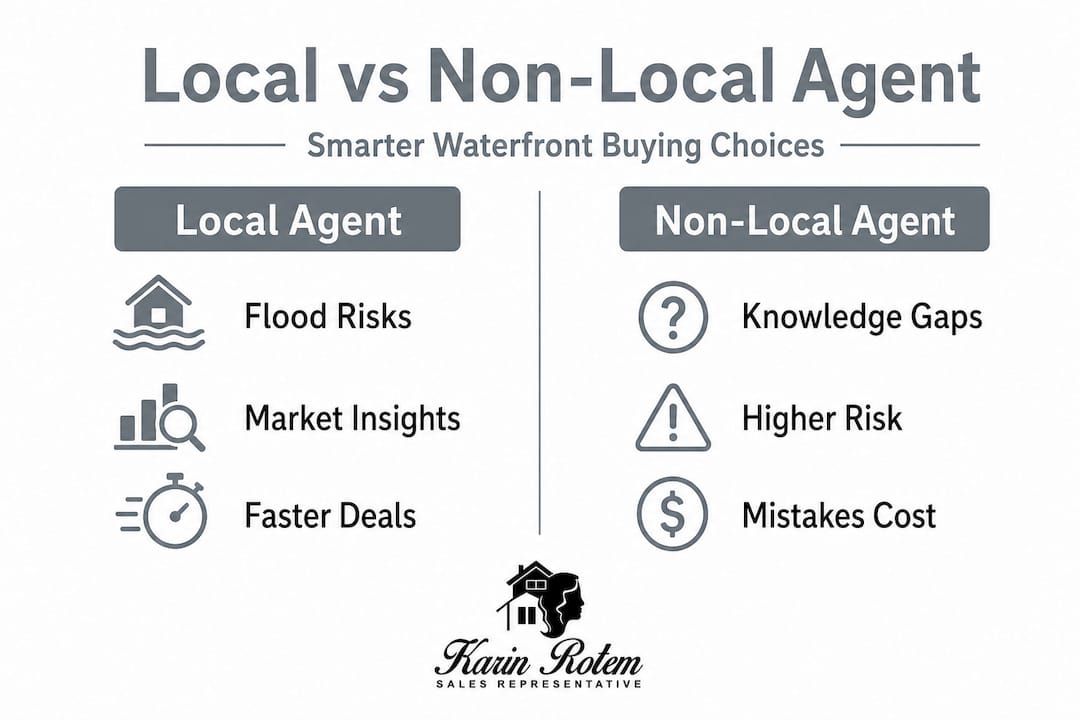
Here is a direct comparison of what separates local agents from out-of-area generalists in the Toronto and Innisfil waterfront context:
| Factor | Local waterfront agent | Out-of-area generalist |
|---|---|---|
| Knowledge of riparian rights | Detailed and current | Limited or absent |
| Access to off-market listings | Strong, through community ties | Minimal |
| Comparable sales data | Waterfront-specific comps | General neighbourhood data |
| Contractor and appraiser network | Established and vetted | Improvised or non-existent |
| Seasonal demand awareness | Firsthand experience | Theoretical at best |
| Negotiation leverage | Backed by hyper-local data | Based on broad market trends |
The advantages of working with a genuine local expert extend well beyond the transaction itself. Here is what a strong local agent brings to the table:
- Off-market access: Many waterfront properties in Innisfil and Toronto change hands before they are ever publicly listed. Local agents hear about these opportunities through community relationships and professional networks.
- Faster issue resolution: When a title concern, survey discrepancy, or inspection finding surfaces, a local agent already knows the right professionals to call and can move quickly.
- Accurate pricing intelligence: Waterfront comps are scarce. A local agent knows how to weight the few available sales correctly, rather than relying on inland properties that skew the numbers.
- Community credibility: Sellers and their agents often respond more favourably to offers from buyers represented by known, respected local professionals.
Pro Tip: Ask any prospective agent to show you their last five closed transactions in the specific waterfront community you are targeting. Not just the city, not just the region. The exact community. If they cannot produce those examples, keep looking.
Local expertise consistently improves deal outcomes, and that improvement is most pronounced in thin, specialised markets where every detail counts.
Navigating waterfront property risks and valuation
Waterfront properties carry a category of risk that most buyers have never encountered before. Understanding these risks is not optional. It is the foundation of a sound purchase decision.

The most significant valuation factors unique to waterfront properties include:
| Valuation factor | Waterfront properties (Innisfil/Toronto) | Non-waterfront properties |
|---|---|---|
| Riparian rights | Critical, legally complex, varies by lot | Not applicable |
| View and access premium | Can add 20% to 40% to value | Minimal or no premium |
| Shoreline quality | Sandy vs. rocky vs. weedy affects value significantly | Not applicable |
| Seasonal demand | Strong spring/summer peaks, winter softness | Relatively stable year-round |
| Supply scarcity | Very limited, especially on Lake Simcoe | More abundant inventory |
| Winterisation requirements | Dock removal, pipe insulation, access roads | Standard maintenance only |
Waterfront property valuation requires specialised work that explicitly accounts for riparian rights, view and access premiums, shoreline scarcity, and seasonal demand. These are capabilities that local agents can help coordinate, connecting you with appraisers who understand the specific economics of the Innisfil and Toronto waterfront markets.
“What outsiders miss is that two properties sitting side by side on the same lake can differ in value by hundreds of thousands of dollars based on shoreline quality, dock rights, and orientation. That is not something you see in the listing photos.”
Here are the steps a skilled local agent takes to protect your purchase:
- Verify riparian rights in full. Riparian rights govern your legal access to the water, your ability to build or maintain a dock, and your rights to the shoreline itself. A local agent will confirm these rights are clearly documented before you make an offer.
- Commission an independent appraisal. Especially in a thin market, the listing price may not reflect true value. A local agent will connect you with an appraiser who specialises in waterfront properties and uses property-type-specific comparable sales.
- Review the full property history. Shoreline erosion, past flooding, dock removal orders, and environmental restrictions all appear in property history. A local agent knows where to look and what to flag.
- Assess seasonal access and winterisation. Some waterfront properties become difficult or impossible to access in winter. A local agent will walk you through the practical realities of year-round ownership before you commit.
- Evaluate the immediate shoreline. Sandy, clean shorelines command a premium. Rocky or heavily weeded shorelines affect both enjoyment and resale value. Your agent should walk the waterfront with you and interpret what they see.
Pro Tip: Even a small difference in shoreline quality matters more than most buyers realise. A property with 20 metres of clean, sandy shoreline can outperform a neighbouring property with 30 metres of rocky, unusable frontage. The numbers on paper look similar. The experience and the resale value are not.
Understanding waterfront investment factors specific to Friday Harbour and the broader Innisfil market will help you ask the right questions and interpret the answers correctly. You can also explore top waterfront listings to see how these factors play out in real properties currently available.
The homebuyer and investor advantage: Outperforming the market with local guidance
Once you understand the risks, the next question is straightforward. How does working with a local expert actually improve your outcome? The answer is both practical and measurable.
Here is what local guidance delivers for buyers and investors in the Toronto and Innisfil waterfront market:
- Access to accurate comparable sales: Waterfront comps are rare. A local agent knows which past sales are genuinely comparable and which ones should be excluded because of differences in shoreline quality, dock rights, or seasonal access.
- Correct price negotiation: Armed with real data, your agent can negotiate from a position of strength. Overpaying for a waterfront property is easy when you are working with incomplete information. Underbidding and losing a competitive deal is equally costly.
- Catching rights restrictions early: Zoning bylaws, environmental protection rules, and shoreline development restrictions can limit what you are allowed to do with a property. A local agent identifies these restrictions before you are legally committed.
- Post-sale support: The relationship does not end at closing. A local agent can connect you with property managers, seasonal maintenance contractors, and rental management services if you are treating the property as an investment.
In practical terms, local guidance produces three consistent outcomes for buyers and investors:
- Fewer surprises after closing. Buyers who work with genuine local experts are far less likely to discover problems after the sale that should have been caught during due diligence. This includes issues like disputed dock rights, surprise environmental assessments, or incorrect property boundaries.
- Winning competitive deals. In a thin waterfront market, the difference between a winning and losing offer often comes down to how the offer is structured, not just the price. A local agent knows the seller’s priorities, the listing agent’s preferences, and the conditions that are standard versus unusual in that specific community.
- Stronger investment performance. For investors, local guidance means understanding which properties have the strongest rental potential, which ones are eligible for short-term rental programmes, and which ones carry restrictions that would limit income generation.
Waterfront property valuation research confirms that in thin markets where few waterfront sales occur, small differences between similar properties, including shoreline quality, access, winterisation, and unique rights, can dominate results. This is precisely why local expertise needs to be validated against property-type-specific comparables and independent appraisal methodologies.
Consider a real scenario from the Innisfil market. Two similar condos at Friday Harbour were listed within weeks of each other at comparable prices. One had a clear, unobstructed lake view and confirmed dock access. The other had a partial view and a shared dock arrangement with ambiguous rights documentation. A buyer working with a local agent identified the distinction immediately and made a stronger, faster offer on the superior property. The buyer without local representation submitted offers on both, lost the better one, and later discovered the dock rights issue on the second property after the sale had closed.
Comparing Friday Harbour vs. other communities can also help you understand why the community’s specific structure, amenities, and governance make local expertise especially valuable there.
Choosing and validating your local real estate expert
Knowing that local expertise matters is only useful if you can actually identify and select an agent who genuinely has it. Here is how to do that with confidence.
Steps to vet a local waterfront agent:
- Ask for recent, property-type-specific transactions. Request a list of waterfront sales they have completed in the past 12 to 24 months, specifically in the community or shoreline corridor you are targeting. Volume matters, but relevance matters more.
- Confirm appraiser connections. A genuine local expert will have established relationships with appraisers who specialise in waterfront properties. Ask who they work with and why.
- Assess community involvement. Agents who are genuinely embedded in a community attend local events, know the condo board members, and understand the governance structures. This knowledge protects you in ways that are hard to quantify but easy to feel.
- Check references from similar buyers. Ask for references specifically from clients who purchased waterfront properties in the same area. Generic references from satisfied clients in other property types do not tell you what you need to know.
- Test their knowledge directly. Ask them to explain the riparian rights framework for a specific property you are considering, or to walk you through how they would establish value in a thin market. Their answer will tell you everything.
Red flags that signal a non-local or inexperienced agent:
- They cannot name specific comparable waterfront sales from the past year without looking them up on the spot.
- They are unfamiliar with the local condo corporation rules, shoreline regulations, or dock licensing requirements.
- They describe their experience in broad geographic terms rather than specific communities.
- They have no established relationships with local waterfront appraisers, inspectors, or legal professionals.
- They cannot explain how seasonal demand affects pricing in the specific market you are entering.
What buyers value in Friday Harbour and similar communities goes beyond square footage and finishes. Understanding those priorities is part of what separates a true local expert from a well-meaning generalist.
Local expertise reduces process and pricing errors, and waterfront-specific validation against property-type-specific comparables is the standard you should hold your agent to before signing a buyer representation agreement.
Local expertise: The uncomfortable truth most buyers overlook
Here is something I see consistently, and it is worth saying plainly. Most buyers choose their real estate agent based on personality. They meet someone personable, feel comfortable, and sign on. That is a reasonable instinct in most markets. In waterfront real estate, it is a gamble.
Personality is not expertise. An agent who has spent years selling detached homes in a nearby inland neighbourhood may be charming, hardworking, and genuinely motivated to help you. But if they have never navigated a riparian rights dispute, never worked with a waterfront appraiser, and never managed the seasonal complexity of a Lake Simcoe purchase, they are learning on your file. That is not a position you want to be in when you are committing to a purchase in the hundreds of thousands or millions of dollars.
The label “local agent” is also not enough on its own. A hyper-local agent with a strong track record of inland condo sales is not the same as a waterfront specialist. The geography overlaps. The expertise does not. You need to push past the label and ask for proof.
I encourage every buyer I work with to challenge my credentials before we begin. Ask me for recent waterfront transactions. Ask me how I establish value when comparable sales are scarce. Ask me what I have caught during due diligence that saved a client from a costly mistake. If an agent cannot answer those questions with specifics, that tells you something important.
True peace of mind in a waterfront purchase does not come from trusting that your agent knows what they are doing. It comes from having verified it. The local investment advice that actually protects you is grounded in demonstrated, property-type-specific experience, not general enthusiasm.
Find your Toronto or Innisfil waterfront expert
Working with the right local agent is the single most important decision you will make in a waterfront purchase. It shapes everything from the properties you see to the price you pay to the protections you have after closing. At Karin Rotem Real Estate, we bring deep, hands-on expertise in the Toronto and Innisfil waterfront markets, with a particular focus on Friday Harbour. Whether you are a first-time buyer stepping into a waterfront lifestyle or a seasoned investor looking to maximise returns, we provide the guidance, the data, and the negotiation strength to help you succeed. Explore our Friday Harbour condo guide to understand your options, review Friday Harbour waterfront rentals if income generation is part of your plan, and reach out to Karin Rotem Real Estate to start a conversation with a team that knows this market from the inside out.
Frequently asked questions
What are the biggest risks when buying a waterfront property without a local agent?
Without a local agent, you risk misjudging property value, overlooking legal complexities like riparian rights, and missing shoreline or seasonal issues that specialised valuation work would otherwise surface. These oversights can lead to significant financial losses after closing.
How do local real estate agents access better deals in Toronto and Innisfil?
Local agents leverage established community networks and knowledge of off-market opportunities, giving buyers a competitive edge that improves deal outcomes through stronger negotiations and faster process management.
What questions should I ask to verify a potential agent’s local expertise?
Ask for recent waterfront-specific comparable sales, their approach to value in thin markets, and their relationships with local appraisers. Waterfront expertise should be validated against property-type-specific comps, not general market knowledge.
Is it more expensive to hire a local real estate agent for waterfront properties?
Commission structures for local agents are typically the same as those for non-local agents, but their specialised knowledge can save you considerably more by preventing overpriced purchases, missed risks, and costly post-sale surprises.
Recommended
- Should I Use a Real Estate Agent to Sell My Friday Harbour Property? – Karin Rotem Real Estate Agent
- What Are Buyers Looking for in Friday Harbour Homes? – Karin Rotem Real Estate Agent
- The Best Waterfront Condos in Friday Harbour: A Buyer’s Guide – Karin Rotem Real Estate Agent
- Booking Direct vs. Through Agents: Renting in Friday Harbour – Karin Rotem Real Estate Agent