
Foreign buyer rules in Ontario real estate are governed by two separate legal frameworks: the federal Prohibition on the Purchase of Residential Property by Non-Canadians Act and Ontario’s Non-Resident Speculation Tax (NRST), with Toronto adding its own Municipal Non-Resident Speculation Tax (MNRST) effective January 1, 2025. Together, these layers determine whether you can legally purchase a home in Ontario and how much extra tax you will pay at closing. What I tell every international client from the start is this: eligibility and tax cost are two completely different questions, and confusing them is the most expensive mistake a foreign buyer can make.
What federal laws regulate foreign ownership of residential property in Ontario?
The federal Prohibition on the Purchase of Residential Property by Non-Canadians Act is the first gate every foreign buyer must pass. This law restricts non-Canadians from purchasing residential real estate in Canada, and it remains in effect until at least January 1, 2027. The restriction applies to detached homes, semi-detached homes, condominiums, and other residential dwellings. Recreational or commercial properties fall outside its scope, which is why some foreign investors focus on those categories instead.
Not every foreign national is blocked. The federal law includes specific exemptions that allow certain non-Canadians to purchase residential property:
- Work permit holders who have worked full-time in Canada for at least 183 days in the preceding calendar year and have not previously purchased under this exemption
- International students enrolled at a designated learning institution, purchasing a property valued under $500,000 and meeting specific enrolment and residency conditions
- Protected persons under the Immigration and Refugee Protection Act, including refugees
- Spouses or common-law partners of Canadian citizens or permanent residents, provided the purchase is made jointly
What most buyers don’t realise is that federal eligibility does not remove provincial or municipal tax obligations. A work permit holder who qualifies to purchase under federal law may still owe Ontario’s 25% NRST at closing. These are parallel systems, not a single approval process. Understanding that distinction early saves clients from serious financial surprises. For a detailed breakdown of how Canadian realtors guide international buyers through both federal and provincial requirements, that resource is worth reviewing before you proceed.
How do Ontario’s NRST and Toronto’s MNRST affect foreign buyers?
Once federal eligibility is confirmed, the tax question becomes the central planning challenge. Ontario’s NRST applies at 25% on the purchase price of residential property bought by a foreign national anywhere in the province, a rate that has been in place province-wide since October 24, 2022. This tax is statutory under Ontario’s Land Transfer Tax Act and is calculated on the full purchase price, not just the land value.

Toronto adds another layer. Effective January 1, 2025, the City of Toronto imposes a 10% Municipal NRST on foreign purchasers of residential property within city limits. This applies to detached homes, condominiums, and townhouses. The MNRST stacks directly on top of the provincial NRST, creating a combined foreign-buyer speculation tax burden of 35% in Toronto before regular land transfer taxes are even calculated.
| Tax | Rate | Where it applies | When it applies |
|---|---|---|---|
| Ontario NRST | 25% | Province-wide | All closings since Oct. 24, 2022 |
| Toronto MNRST | 10% | City of Toronto only | Closings on or after Jan. 1, 2025 |
| Ontario Land Transfer Tax | Varies by price | Province-wide | All residential purchases |
| Toronto Land Transfer Tax | Varies by price | City of Toronto only | All Toronto residential purchases |
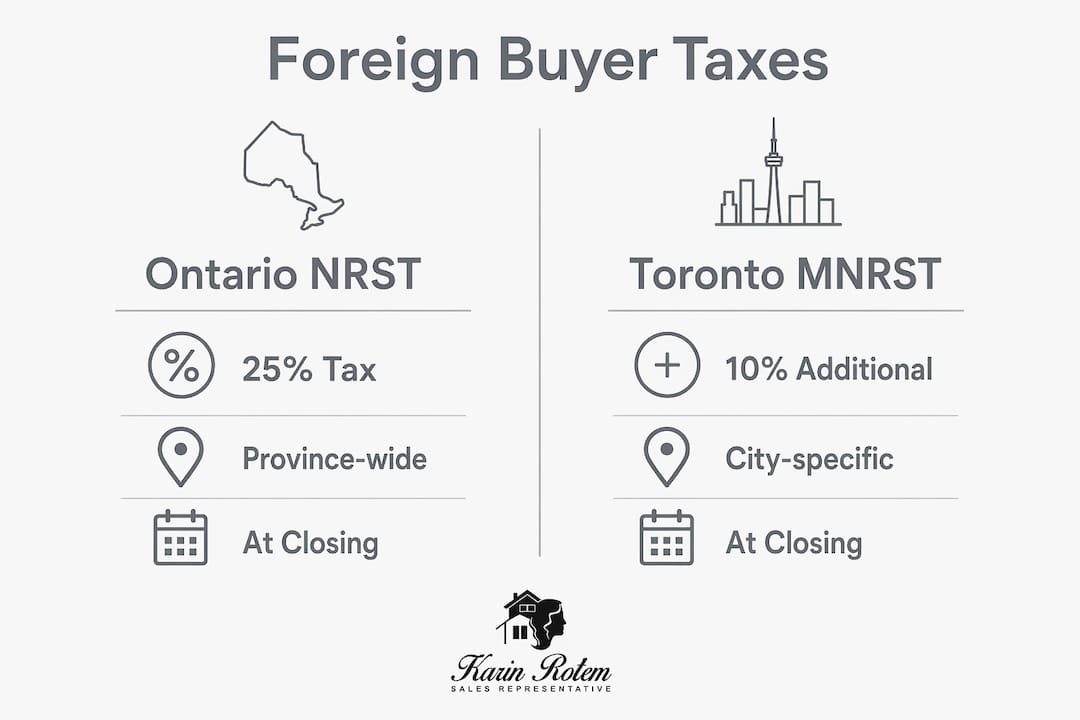
The combined 35% speculation tax in Toronto, stacked on top of regular land transfer taxes, means a foreign buyer purchasing a $1,000,000 condo in Toronto could face over $400,000 in combined taxes at closing. That figure is not a deterrent for every buyer, but it must be factored into every budget before an offer is made.
One detail that catches buyers off guard: both taxes must be paid in cash at closing and cannot be rolled into a mortgage. This demands careful liquidity planning well before the closing date.
Pro Tip: If you are purchasing a pre-construction condo in Toronto, the tax laws that apply are those in effect on your closing date, not your agreement signing date. A deal signed before January 1, 2025 but closing after that date is subject to the MNRST with no grandfathering.
What exemptions and rebates can reduce or avoid the foreign buyer tax in Ontario?
The NRST is not always final. Ontario Regulation 182/17 provides five categories of exemptions, and a separate rebate programme exists for buyers who later qualify. Understanding the difference between an exemption (which prevents the tax from applying) and a rebate (which recovers tax already paid) is critical.
The primary NRST exemptions available to foreign buyers include:
- Ontario Immigrant Nominee Programme (OINP) nominees: A foreign national nominated under the OINP is exempt from NRST, provided they occupy the property as their principal residence.
- Protected persons: Individuals recognised as protected persons under the Immigration and Refugee Protection Act qualify for a full exemption.
- Spousal exemption: A foreign national purchasing jointly with a Canadian citizen or permanent resident spouse or common-law partner may qualify for an exemption, subject to occupancy conditions.
For all exemptions tied to occupancy, the 60-day principal residence requirement is a hard deadline. The buyer must move into the property as their principal residence within 60 days of the registration date. Missing this window can disqualify the exemption entirely, even if all other conditions are met.
For buyers who pay the NRST at closing and later become permanent residents, a rebate is available. The rebate application requires that the buyer obtain permanent residency within four years of the purchase date and that the property has been used as their principal residence throughout. Rebates are discretionary, not automatic. The Ontario Ministry of Finance reviews each application, and incomplete documentation is the most common reason for rejection.
Pro Tip: Start gathering documentation from day one. Utility bills, lease agreements, and government correspondence addressed to the property are all useful evidence of principal residence occupancy. Waiting until the rebate application deadline to compile this record is a mistake I have seen cost clients their full refund.
How can foreign buyers practically navigate an Ontario property purchase?
Successful foreign real estate transactions in Ontario require treating federal eligibility and provincial tax planning as two separate, sequential steps. Skipping the sequence creates the most common and costly errors.
-
Confirm federal eligibility first. Before making any offer, verify your status under the Prohibition on the Purchase of Residential Property by Non-Canadians Act. Work with a real estate lawyer to confirm whether you qualify under an exemption category. This step is non-negotiable.
-
Calculate your full tax obligation. Once eligibility is confirmed, calculate the NRST, MNRST (if purchasing in Toronto), Ontario Land Transfer Tax, and Toronto Land Transfer Tax. Use a mortgage and affordability calculator to model total closing costs, not just the purchase price.
-
Secure liquid funds for closing. Both the NRST and MNRST must be paid in cash at closing. Arrange for these funds to be available and accessible well before your closing date. Lenders will not cover these amounts.
-
Assess exemption eligibility before signing. If you believe you qualify for an NRST exemption, confirm this with your lawyer before signing an agreement of purchase and sale. Applying for an exemption after the fact is possible but more complicated.
-
Track your occupancy timeline. If your exemption or rebate depends on principal residence occupancy, mark the 60-day deadline on your calendar from the moment you receive keys. Begin collecting documentation immediately.
“Buyers need to separate federal eligibility from provincial and municipal tax considerations to avoid transaction failures or unexpected tax obligations. Planning should address the timing of closing, cash requirements for taxes, and document compliance for rebates.”
For buyers considering properties outside Toronto, including waterfront communities like Friday Harbour in Innisfil, the NRST still applies but the MNRST does not. That distinction alone can represent a 10% difference in tax cost on the same purchase price. It is a factor worth weighing seriously when comparing Toronto condos to lifestyle properties in other parts of Ontario. You can read more about what non-residents should know about purchasing in communities like Friday Harbour.
Key takeaways
Foreign buyers in Ontario face a layered compliance structure where federal eligibility, provincial NRST, and Toronto’s MNRST must each be addressed separately and in sequence before closing.
| Point | Details |
|---|---|
| Federal ban applies until 2027 | Most non-Canadians cannot purchase residential property in Canada without qualifying under a specific exemption. |
| Ontario NRST is 25% province-wide | This tax applies to all residential purchases by foreign nationals anywhere in Ontario since October 2022. |
| Toronto adds 10% MNRST on top | Foreign buyers in Toronto face a combined 35% speculation tax, payable in cash at closing. |
| Exemptions require strict compliance | Principal residence occupancy within 60 days of registration is a hard condition for most NRST exemptions. |
| Rebates are discretionary, not automatic | Permanent residency within four years and documented principal residence use are required to recover NRST paid at closing. |
What I’ve learned advising foreign buyers in Ontario
What I tell my clients is that the biggest risk is not the tax itself. It is the assumption that one approval covers everything. I have worked with buyers who confirmed federal eligibility, made an offer, and then discovered at the lawyer’s office that they had not budgeted for the NRST. That is a very stressful conversation to have two weeks before closing.
Toronto’s MNRST, introduced in 2025, changed the calculus for a lot of international investors I work with. A 10% additional tax on a $900,000 condo is $90,000 in cash, due at closing, on top of everything else. Some clients have shifted their focus to Innisfil and the Friday Harbour community as a result, where the NRST still applies but the municipal layer does not. That is not always the right choice, but it is a real trade-off worth discussing.
The rebate programme sounds appealing, and it genuinely is for buyers who plan to become permanent residents. But I have seen applications rejected because clients could not prove continuous principal residence occupancy. They had the receipts and the intent, but not the paper trail. Start documenting from day one.
My honest advice: engage a real estate lawyer and a knowledgeable realtor before you begin your search, not after you find a property you love. The rules are manageable when you plan for them. They are painful when you discover them at the last minute.
— Karin Rotem
Work with Karinrotem to buy property in Ontario as a foreign national
Karinrotem works directly with international clients buying residential and investment properties across Toronto and Innisfil, including the Friday Harbour community. Our team understands the full compliance picture, from federal eligibility to NRST planning and closing documentation, and we guide you through every step with clarity and precision. We help you identify properties that fit your goals while keeping your tax exposure in clear view from the start. Browse our available Ontario properties to see what is currently on the market, or explore Friday Harbour waterfront listings if lifestyle-driven investment is your priority. Reach out to our team directly for a personalised consultation.
FAQ
Can a foreign national legally buy a home in Ontario right now?
Most foreign nationals cannot purchase residential property in Ontario due to the federal Prohibition on the Purchase of Residential Property by Non-Canadians Act, which remains in effect until at least January 1, 2027. Specific exemptions exist for qualifying work permit holders, international students, and protected persons.
How much is the foreign buyer tax in Ontario in 2026?
Ontario’s NRST is 25% of the purchase price province-wide, and Toronto adds a further 10% MNRST, bringing the combined speculation tax to 35% for purchases within Toronto city limits.
Can I get a refund on the Ontario NRST after I buy?
Yes, a rebate is available if you become a permanent resident within four years of purchase and have used the property as your principal residence throughout. Rebates are discretionary and require thorough documentation.
Does the NRST apply to properties outside Toronto?
The Ontario NRST applies province-wide to all residential purchases by foreign nationals. Toronto’s 10% MNRST applies only within city limits, so properties in communities like Friday Harbour in Innisfil are subject to the 25% NRST but not the additional municipal tax.
When must the NRST and MNRST be paid?
Both taxes must be paid in cash at closing and cannot be financed through a mortgage. Buyers must have sufficient liquid funds available before their closing date to avoid deal failures.