
Yes, you can get mortgage financing in Ontario as a non-resident or temporary resident — but the rules are meaningfully different from what Canadian residents face. Expect a minimum down payment generally higher than typical resident financing, no access to mortgage default insurance, and a documentation process that takes longer than most buyers anticipate. Here is what to do first:
- Pre-check your purchase eligibility. The federal foreign-buyer rules restrict some non-Canadians from buying residential property, but exemptions exist. Confirm your status before making an offer.
- Contact a specialist broker or a bank programme like Scotiabank StartRight. Not all lenders offer non-resident financing, and a broker with access to multiple lenders will find options a single bank cannot.
The three trade-offs to plan for upfront: a larger down payment than residents pay, no mortgage default insurance to protect the lender (which is why lenders demand more equity), and a documentation package that must meet Canadian underwriting standards even when your income is earned abroad.
Who qualifies as a non-resident or temporary resident for mortgage purposes?
Lenders and the federal government use different definitions, and confusing the two is one of the most common mistakes I see. The Prohibition on the Purchase of Residential Property by Non-Canadians Act determines who can buy; lender guidelines determine who can borrow. You need to satisfy both.
For mortgage purposes, lenders generally sort buyers into four categories:
- Non-tax residents: Canadian citizens or permanent residents who earn income and pay taxes outside Canada. Lenders treat these files similarly to foreign nationals — higher down payments, stricter provenance checks.
- Temporary residents with a valid work or study permit: Often the most favourable category. Work-permit holders with Canadian employment income and at least 12 months remaining on their permit can sometimes qualify for 20% down at major banks.
- Visitors with no Canadian status: The most restricted category. Most major banks will not lend to visitors at all; alternative lenders or private channels are usually the only route.
- Canadian citizens living abroad: Treated as non-tax residents for mortgage purposes if income is earned and taxed outside Canada.
What most buyers don’t realise is that the federal foreign-buyer rules include carve-outs for certain work-permit holders and for commercial or larger multi-unit properties. Confirming your exemption status early prevents wasted offers and legal complications.
What lenders typically require from non-resident borrowers
The central barrier is not the interest rate. Mortgage default insurance from CMHC, Sagen, or Canada Guaranty is generally unavailable to non-tax residents, which forces lenders to cap financing at 65%–80% loan-to-value. That is why the down payment requirement is higher — the lender carries the full risk.

Down payment and loan-to-value
| Borrower profile | Typical minimum down payment | Mortgage default insurance available? |
|---|---|---|
| Temporary resident (work permit, Canadian income) | 20% | Sometimes, with conditions |
| Non-tax resident (income earned abroad) | 35% | Generally no |
| Visitor / no Canadian status | 35%+ | No |
| Canadian citizen living abroad | 35% | Generally no |
Most specialist brokers cite 35% down as the standard for non-resident purchase files, with some bank programmes allowing 20% for specific work-permit profiles.
Documentation checklist
Lenders require everything a resident borrower provides, plus more:
- Passport and immigration documents (work permit, study permit, or visa)
- Foreign tax returns for the past two years, translated into English or French by an accredited translator
- Employment letter confirming salary, position, and length of service
- Six to twelve months of bank statements from your home-country account
- International credit report or a reference letter from your foreign bank
- Proof of down payment funds, traceable for 30–90 days in a Canadian bank account
- Disclosure of all other real estate owned, with supporting documents
For foreign income, lenders want the same verification they would expect from a Canadian employee: pay stubs, an employer letter on company letterhead, and bank statements showing consistent deposits. When employment letters are in another language, certified document authentication through an apostille service can speed up the lender’s review considerably.
Pro Tip: The single most common reason non-resident files collapse at the last minute is funds provenance. Wire your down payment to a Canadian account at least 90 days before your target closing date. A same-day transfer from a foreign account on closing day is a near-automatic refusal.
Where to get a mortgage: major banks, brokers, and alternative lenders
Not all lenders offer financing for non-residents, and the ones that do have very different appetites depending on your profile.
| Lender type | Min. down payment | Who they serve | Default insurance | Rate vs. resident | Max amortization | Speed |
|---|---|---|---|---|---|---|
| Major bank (e.g. StartRight) | 20%–35% | Temporary residents, work-permit holders | Sometimes (20% down, work permit) | Slightly higher | 25 years | 4–8 weeks |
| Mortgage broker (specialist) | 20%–35% | All non-resident profiles | Depends on lender | Varies by lender | Up to 30 years (some lenders) | 3–6 weeks |
| Alternative lender / MIC | 35%+ | Complex files, foreign income, no Canadian credit | No | Notably higher | 25–30 years | 2–4 weeks |
Scotiabank StartRight
Scotiabank’s StartRight programme is one of the few named bank programmes explicitly designed for temporary residents, newcomers, and international workers. It offers a structured documentation pathway and is a practical first call for work-permit holders with Canadian employment income. The programme’s eligibility criteria are specific, so confirming your permit type and duration before applying saves time.
Mortgage brokers
Brokers are often the most practical route for non-resident files. A specialist broker has access to a wide network of lenders, including those comfortable with foreign income and international credit references. They package your documentation to match each lender’s underwriting appetite — something a single bank’s branch cannot do. True North Mortgage is one nationally recognised broker that handles non-resident files and can walk you through what is available for your specific profile.
Alternative lenders and MICs
When major banks decline a file, experienced brokers pursue alternative lenders or Mortgage Investment Corporations that accept foreign income and international credit references. Approval odds improve, but expect a higher interest rate and stricter terms. This channel works best as a short-term bridge while you build Canadian credit or residency status.
How to apply: step-by-step process and realistic timeline
Application steps
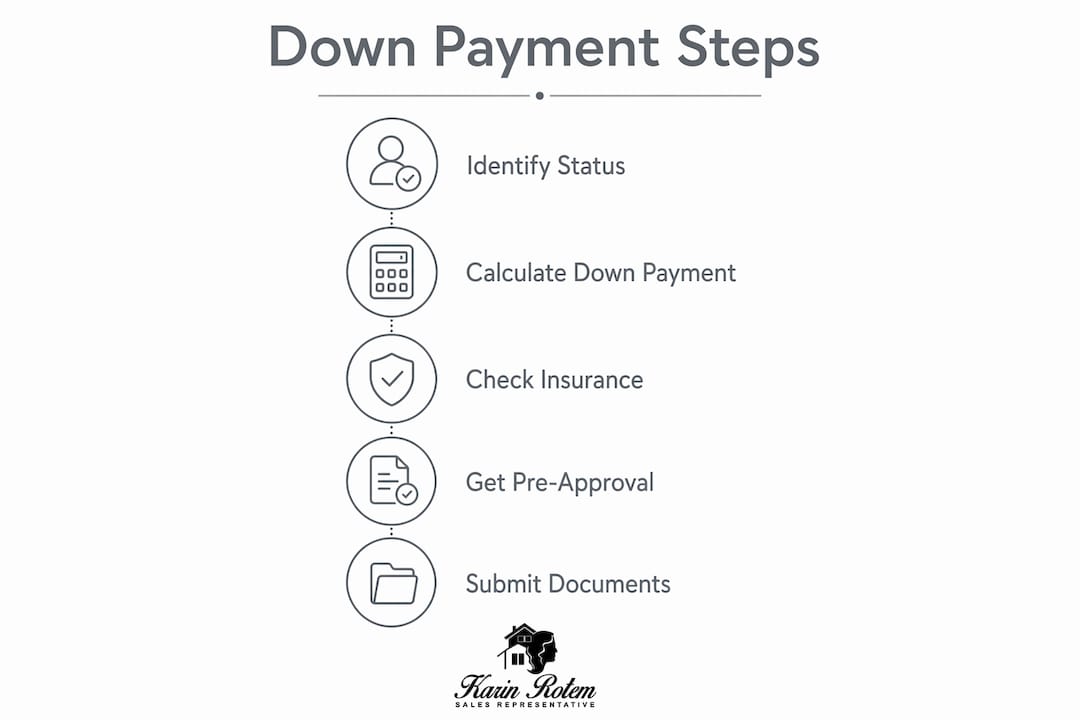
- Confirm purchase eligibility. Verify your immigration status against the federal foreign-buyer rules and Ontario’s NRST exemptions before making any offer.
- Choose your lender channel. Decide between a bank programme, a specialist broker, or an alternative lender based on your profile.
- Assemble your documentation package. Gather translated tax returns, employment letters, bank statements, and immigration documents.
- Transfer funds to a Canadian account. Move your down payment at least 90 days before your target closing date to satisfy provenance requirements.
- Get pre-approval. Submit your full package for a conditional pre-approval. Expect lender questions and possible requests for additional documents.
- Make an offer and obtain conditional approval. Once your offer is accepted, the lender completes full underwriting.
- Engage a Canadian lawyer. A local real estate lawyer handles title searches, NRST calculations, and closing documents. Remote signing has limitations — confirm with your lawyer whether you need to be physically present.
- Close. Pay remaining closing costs, sign documents, and receive title.
Typical timeline
| Stage | Typical duration | Common delays |
|---|---|---|
| Eligibility pre-check | 1–3 days | Unclear permit status |
| Documentation assembly | 2–6 weeks | Translation, apostille, foreign bank delays |
| Canadian account hold period | 30–90 days | Must run concurrently with other steps |
| Pre-approval | 1–2 weeks | Incomplete foreign income docs |
| Conditional approval | 1–2 weeks | Appraisal, additional lender questions |
| Lawyer / title work and closing | 2–4 weeks | NRST filing, remote signing logistics |
The role of a Canadian realtor in coordinating lawyers, brokers, and closing logistics is significant for remote buyers. Having one point of contact who knows all the players reduces the chance of a missed deadline.
Taxes and extra costs you must budget for
Non-Resident Speculation Tax (NRST)
Ontario’s NRST is 25% of the purchase price for foreign nationals buying residential property in designated regions of the province. It is payable at closing. Exemptions and refunds exist — for example, if you obtain permanent residency within a specified period after closing — but the process requires a formal application. Budget for the full 25% at closing and treat any refund as a bonus, not a certainty.
Other one-time closing costs
- Land transfer tax: Ontario charges a provincial land transfer tax; Toronto buyers pay an additional municipal land transfer tax on top.
- Legal fees: Typically $1,500–$3,000 for a standard purchase, higher for complex non-resident files.
- Title insurance: Usually $200–$400, strongly recommended.
- Appraisal and inspection: Lenders often require an independent appraisal for non-resident files; budget $400–$600.
- Currency exchange and wire fees: Exchange rate movement can materially alter the effective cost of your down payment. Consider a forward contract or a timed transfer through a foreign-exchange specialist to reduce slippage.
A full breakdown of what closing costs include in Ontario is worth reviewing before you finalise your budget.
Ongoing costs
Property taxes, home insurance (often higher for non-resident-owned properties), and property management fees if you are not local all add to the carrying cost. If you rent the property, Canadian tax law requires you to report rental income, and a non-resident withholding tax may apply. Confirm the specifics with a Canadian tax adviser — this article is general information, not tax or legal advice.
What I tell my clients: on-the-ground advice for buyers from abroad
Most of the clients I work with who are buying from abroad make one of three mistakes: they assume the federal foreign-buyer ban prohibits their purchase entirely (it often does not), they underestimate the NRST and arrive at closing short on funds, or they wire money to a Canadian account two weeks before closing instead of three months before.
What I ask clients to bring to our first call:
- Confirmation of immigration status and permit expiry date
- Two years of foreign tax returns (translated if needed)
- Three months of bank statements showing the down payment funds
- A clear answer on intended use: owner-occupied, vacation property, or rental
Toronto vs. Friday Harbour / Innisfil: lender appetite differs by market. For a Toronto condo purchase, major banks with temporary-resident programmes are a realistic first call, especially for work-permit holders with Canadian employment income. For a Friday Harbour waterfront property or an Innisfil lifestyle purchase, lender appetite is more selective — recreational properties sometimes face additional scrutiny — and a specialist broker is almost always the better starting point.
Pro Tip: If you are buying a Friday Harbour property as a non-resident investor, confirm with your broker upfront whether the lender will treat it as owner-occupied or investment. That classification changes the down payment requirement and the rate.
Key takeaways
Non-residents and temporary residents can finance property in Ontario, but the absence of mortgage default insurance is the defining constraint — it forces higher equity requirements and stricter documentation across every lender type.
| Point | Details |
|---|---|
| Down payment reality | Expect 20%–35% minimum; 35% is standard for non-tax residents and most non-resident files. |
| No default insurance | Mortgage default insurance is generally unavailable to non-tax residents, which is why lenders require more equity. |
| Funds provenance | Transfer your down payment to a Canadian account at least 90 days before closing to satisfy anti-money-laundering checks. |
| Use a specialist broker | Brokers access lenders comfortable with foreign income; major banks alone rarely cover all non-resident profiles. |
| Confirm eligibility early | Check federal purchase rules and Ontario NRST exemptions before making an offer — not after. |
| Karinrotem’s role | Karinrotem’s team handles eligibility pre-checks, broker introductions, and local closing coordination for non-resident buyers in Toronto, Innisfil, and Friday Harbour. |
A local advisor’s perspective: when to buy now and when to wait
The question I get most often is not “can I get a mortgage?” It is “should I buy now or wait until my situation changes?” My honest answer depends on three things: your cash position, your permit timeline, and your intended use.
Buy now if: you have 35% down plus closing costs in liquid, traceable funds; your work permit has at least 18–24 months remaining; and you plan to occupy or actively manage the property. A strong cash position compensates for the absence of default insurance, and owner-occupied files get better lender treatment than investor files.
Pause if: your permit is expiring within 12 months and renewal is uncertain, your income is difficult to verify to Canadian standards, or your down payment funds are not yet in a Canadian account. Buying on non-resident terms with a weak file means paying a higher rate and accepting less favourable conditions — sometimes it is worth waiting six months to build Canadian credit or convert to permanent residency first.
The trade-off between buying now on non-resident terms versus waiting for resident pricing is real. A 35% down payment on a $900,000 property is $315,000 in cash upfront. If waiting 12 months means qualifying with 20% down and a lower rate, the math often favours patience. The benefits of owning a second home in Ontario are genuine — but only when the financing structure supports the long-term plan.
How Karin Rotem’s team supports non-resident buyers
Buying property in Ontario from abroad involves more moving parts than a typical purchase: federal eligibility checks, NRST calculations, foreign document preparation, and coordinating a Canadian lawyer and broker across time zones. Karinrotem’s team handles that coordination so you are not managing it alone.
When you reach out, here is what you can expect:
- An eligibility review based on your immigration status and intended property use
- A documentation checklist tailored to your lender channel
- Introductions to specialist mortgage brokers and real estate lawyers experienced with non-resident files
- Local market guidance for Toronto, Innisfil, and Friday Harbour, including which property types attract the best lender appetite
- Remote signing guidance and closing support
Whether you are looking at a Toronto condo, a Friday Harbour waterfront property, or an Innisfil lifestyle home, the team’s role is to make the process clear and the outcome predictable. Browse our current properties to see what is available, or reach out directly to start with an eligibility review.
Authoritative sources and where to read the official rules
Use these primary sources to verify rules for your specific situation:
- Federal purchase eligibility: Prohibition on the Purchase of Residential Property by Non-Canadians Act — start here to confirm whether your immigration status permits a purchase.
- Ontario NRST rules and exemptions: Ontario Ministry of Finance — search “Non-Resident Speculation Tax” for current rates, designated regions, and refund procedures.
- Lender programme details: Scotiabank StartRight programme page for temporary-resident mortgage pathways; TD and CIBC newcomer mortgage pages for work-permit holder options.
- Broker explainers: MortgageKW and specialist broker sites for practical non-resident file guidance.
- Local Ontario context: Karinrotem’s non-resident property purchase guide covers property types, legal considerations, and local market nuances.
A Canadian real estate lawyer and a specialist mortgage broker should review the specifics of your file before you make an offer. Rules change, exemptions are fact-specific, and the cost of a wrong assumption at closing is high.
FAQ
Can a non-resident get a mortgage in Ontario?
Yes, with conditions. Non-residents and temporary residents can access mortgage financing in Ontario, but expect a minimum 20%–35% down payment, with 35% as the standard for most non-resident files, no mortgage default insurance, and stricter documentation requirements than Canadian residents face.
What is the minimum down payment for a non-resident mortgage in Ontario?
Work-permit holders with Canadian employment income may qualify for 20% down through certain bank programmes. Most non-tax residents and visitors are required to provide at least 35% down from their own funds, with no gifted amounts permitted.
Does Ontario’s Non-Resident Speculation Tax apply to all foreign buyers?
Ontario’s NRST is a substantial provincial tax applicable to some foreign nationals buying residential property in designated regions. Exemptions exist for certain work-permit holders and other qualifying situations, but the tax is payable at closing unless an exemption is confirmed in advance.
How long does it take to get a non-resident mortgage approved in Ontario?
The full process typically takes 8 weeks or more from documentation assembly to closing, with the 30–90 day Canadian account hold period for funds provenance running concurrently. Complex files or incomplete foreign documentation are the most common sources of delay.
Do I need a Canadian co-signer for a non-resident mortgage?
Not always, but lenders may request one when the file is borderline — for example, when foreign income is difficult to verify or when the borrower has no Canadian credit history. A strong down payment and well-documented income often eliminate the need for a co-signer.