
Lifestyle-driven real estate is defined as property selected primarily for the experiences, community, and daily routines it enables, rather than for location alone or conventional metrics like bedroom count and square footage. In the industry, this approach is also called amenity-led or experiential property buying, and it has reshaped how buyers across Canada and the United States evaluate homes. Remote and hybrid work have accelerated this shift, freeing buyers from commute-driven location constraints and allowing personal well-being, community fit, and outdoor access to move to the top of the priority list. If you are considering a waterfront property in Innisfil, a condo at Friday Harbour, or any community-focused home, understanding this market will help you make a far more confident decision.
What is lifestyle-driven real estate?
Lifestyle-driven real estate is the practice of choosing a home based on how well it supports your daily life, values, and long-term goals rather than purely on resale metrics. Buying a home is increasingly seen as “buying a backdrop for your life”, where community vibe and shared values weigh as heavily as physical features. This is a meaningful departure from the traditional model, where buyers ranked properties by proximity to employment hubs, school ratings, and lot size.
The core appeal is personal fit. A waterfront property at Friday Harbour in Innisfil, Ontario, for example, is not simply a home near water. It is access to a marina, walking trails, fitness facilities, and a social community, all of which shape how you spend your mornings, weekends, and retirement years. That experiential dimension is what separates lifestyle-oriented property from a conventional purchase.

Why are buyers choosing lifestyle properties now?
The rise of remote and hybrid work is the single biggest driver. When you no longer need to live within 45 minutes of a downtown office, your criteria change entirely. Remote work has elevated lifestyle as the primary factor in real estate decisions, shifting focus toward surroundings, wellness, and community connection.
Survey data from 2026 reinforces this trend clearly:
- 75% of lifestyle-focused buyers prefer single-family properties, typically between 1,500 and 2,500 sq ft, prioritising manageable size over sprawl.
- 40% target homes priced between $250,000 and $500,000, with 34% in the $500,000 to $750,000 range.
- Beach communities rank as the most desired location type, followed by lakefront and golf-course communities.
- 45% of buyers are interested in active-adult or 55+ communities, reflecting a significant demographic shift toward retirement-oriented lifestyle living.
- Nearly 60% expect to pay cash for their next home, which signals that lifestyle buyers tend to be financially established and deliberate.
That cash-buyer statistic matters. It tells you that lifestyle-driven buyers are not impulse purchasers. They have done their research, and they know what they want. What they often struggle with is translating a feeling into a specific property decision, which is why 92% begin their search online but 38% still express uncertainty about their final choice, the highest indecision rate in five years.
How does lifestyle real estate differ from traditional real estate?
Traditional real estate prioritises location, lot size, bedroom count, and proximity to employment or schools. Lifestyle-oriented property buying prioritises how a home supports your daily routine, your sense of community, and your physical and emotional well-being. The difference is not just philosophical. It changes what you look at during a showing, what questions you ask, and what trade-offs you are willing to accept.
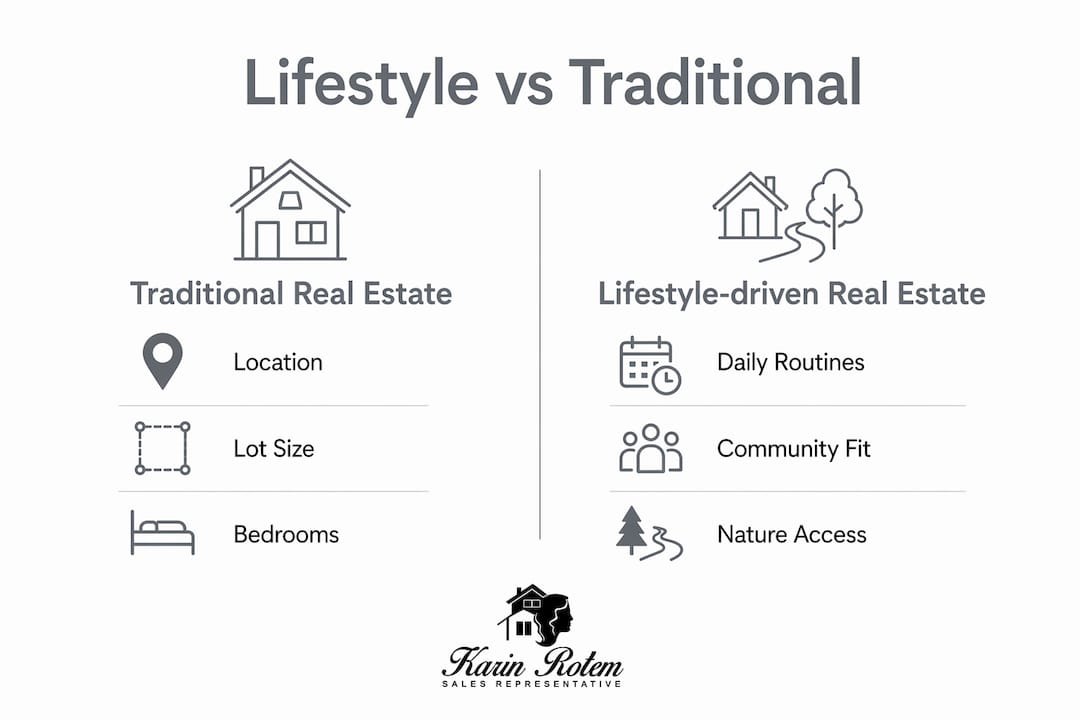
Modern buyers prioritise how properties support daily routines and connection to nature rather than just square footage or postal code. This means a 1,800 sq ft condo with direct lake access, a spa-style bathroom, and a rooftop terrace can outperform a 3,000 sq ft suburban home in buyer appeal, even at a higher price per square foot.
| Criteria | Traditional real estate | Lifestyle-driven real estate |
|---|---|---|
| Primary value driver | Location, size, school district | Community fit, daily experience, amenities |
| Key property features | Bedrooms, bathrooms, lot size | Flex spaces, outdoor zones, wellness features |
| Buyer question | “How far is it from work?” | “Does this support how I want to live?” |
| Marketing focus | Specs and comparables | Lifestyle narrative and community story |
| Decision driver | Rational and financial | Rational, emotional, and experiential |
Pro Tip: When viewing a lifestyle property, spend time outside the unit or home. Walk the trails, visit the amenity spaces, and talk to a neighbour if you can. The community experience is part of what you are buying, and no floor plan communicates that.
Marketing has shifted accordingly. Sellers who ignore lifestyle criteria and focus only on specs miss the buyers who are most motivated and financially ready. At Karinrotem, we approach listings for communities like Friday Harbour with a lifestyle narrative first, because that is what attracts the right buyer quickly. You can see how this plays out in practice by reviewing our approach to waterfront listing exposure.
What types of lifestyle properties are most sought after?
Waterfront homes and condos are the clearest expression of lifestyle-driven real estate. They offer a combination of natural beauty, recreational access, and community that is difficult to replicate in any other property type. Friday Harbour in Innisfil is a strong local example: a master-planned waterfront resort community with a full-service marina, beach club, fitness centre, restaurants, and year-round programming. Buyers there are not just purchasing square footage. They are purchasing a way of life.
Beyond waterfront, the most sought-after lifestyle property categories include:
- Active-adult and 55+ communities: Designed around social connection, low-maintenance living, and wellness programming. Demand is growing as the baby boomer generation reaches retirement age.
- Master-planned communities: Offer trails, pools, fitness centres, and social spaces within a single development. The appeal is convenience and community density.
- Golf-course and recreational communities: Attract buyers who want a sport or hobby embedded in their daily environment.
- Urban walkability-focused condos: Appeal to buyers who want restaurant access, cultural venues, and transit within walking distance as their lifestyle infrastructure.
Functional outdoor environments such as private trails, recreational zones, and cultivated garden spaces are critical amenities in this market. Privacy through thoughtful landscaping and smart home placement ranks as a top priority for buyers who want both community access and personal retreat. Interior features that signal lifestyle value include flex office spaces, spa-like bathrooms, open-concept entertaining areas, and energy-efficient systems.
| Property type | Core lifestyle appeal | Typical buyer profile |
|---|---|---|
| Waterfront home or condo | Nature access, recreation, community | Families, retirees, investors |
| Active-adult community | Social connection, low maintenance | 55+ buyers, downsizers |
| Master-planned community | Amenity density, safety, programming | Families, remote workers |
| Urban walkable condo | Convenience, culture, transit | Young professionals, empty nesters |
How to align your lifestyle priorities with real estate choices
What I tell my clients before we start any search is this: define your lifestyle before you define your property. Without that clarity, you will spend months viewing homes that look right but feel wrong. Here is a practical framework for getting it right.
-
Build your Lifestyle DNA profile. Identifying your core lifestyle pillars prevents mismatched purchases. Write down your non-negotiables across three categories: community (do you want neighbours you interact with daily, or privacy?), wellness (do you need water access, trails, or a gym?), and sustainability (do energy costs and environmental impact matter to your decision?).
-
Translate priorities into property features. Community priorities translate to HOA-managed amenities, shared spaces, and programmed events. Wellness priorities translate to proximity to water, trails, or fitness facilities. Sustainability priorities translate to high energy efficiency ratings and solar-ready construction, which also reduce long-term utility costs.
-
Prioritise flex spaces. Flex spaces enhance adaptability over time, supporting evolving family or work needs. A room that functions as a home office today may become a guest suite or hobby space in five years. This is especially relevant for buyers at Friday Harbour who may use a property seasonally at first and then transition to full-time residence.
-
Use technology to narrow your search. AI-assisted property search tools can match lifestyle needs to listings more accurately than keyword searches alone, reducing the time you spend on properties that do not fit. Pairing technology with a local agent who understands the community gives you both efficiency and context.
-
Evaluate long-term suitability. Ask whether the property still works if your household grows, if a family member needs accessibility features, or if you shift from part-time to full-time residence. Lifestyle fit is not just about today.
Pro Tip: Before committing to a community, visit on a weekday and a weekend. The energy, noise level, and activity patterns are often very different, and both matter to how you will actually experience living there.
Understanding what buyers are already looking for in communities like Friday Harbour can also sharpen your own criteria. Our guide on Friday Harbour buyer preferences covers the specific features that drive decisions in that market.
What challenges and trade-offs should buyers expect?
Lifestyle-driven real estate comes with real trade-offs, and I would rather you know them upfront than discover them after closing.
- Higher acquisition costs. Waterfront and amenity-rich properties carry a premium. That premium reflects genuine value, but it requires honest budgeting. Maintenance fees in condo communities like Friday Harbour cover amenities, but they are a recurring cost that affects your carrying expenses.
- Decision complexity. The 38% indecision rate among lifestyle buyers is the highest in five years. When you are buying a feeling as much as a property, it is harder to know when you have found the right one. A clear Lifestyle DNA profile, as described above, is the most effective antidote.
- Community vetting. Not all master-planned or resort communities deliver on their promise. Research the builder’s track record, review the reserve fund status, and read the status certificate carefully before purchasing in any condo or HOA community.
- Privacy versus community balance. Some buyers discover after moving in that a community is either more social than they wanted or less connected than they expected. Visiting at different times and speaking with current residents is the only reliable way to assess this before purchase.
- Sustainability costs upfront. Energy-efficient features and solar-ready construction add to purchase price, though they reduce utility costs over time. Weigh the upfront premium against your expected tenure in the property.
Key takeaways
Lifestyle-driven real estate succeeds when buyers define their personal priorities first and then match properties to those priorities, rather than the reverse.
| Point | Details |
|---|---|
| Define lifestyle before searching | Build a Lifestyle DNA profile covering community, wellness, and sustainability before viewing properties. |
| Waterfront leads lifestyle demand | Beach, lakefront, and golf communities are the top three location preferences among lifestyle buyers. |
| Flex spaces add long-term value | Adaptable rooms support changing family and work needs, making them a sound investment in lifestyle properties. |
| Indecision is a real risk | 38% of lifestyle buyers report uncertainty about their final choice; clear priorities reduce this significantly. |
| Community vetting is non-negotiable | Review reserve funds, builder reputation, and HOA terms before committing to any amenity-rich community. |
What I have learned from working in lifestyle markets
What most buyers do not realise is that lifestyle real estate is not a category of property. It is a category of decision-making. I have worked with clients who toured a dozen waterfront condos and felt nothing, then walked into a Friday Harbour unit and knew within ten minutes. The difference was never the finishes or the view. It was whether the community matched how they actually wanted to spend their time.
The mistake I see most often is buyers who prioritise aesthetics over function. A stunning kitchen matters less than whether the building has a dock, a trail, or a social programme that fits your life. I always ask clients to describe a perfect Tuesday morning, not a perfect Saturday. Tuesday is when you live in a place. Saturday is when you visit it.
Local market knowledge also matters more in lifestyle real estate than in traditional transactions. Friday Harbour, for example, has specific rules around short-term rentals, seasonal access, and marina slip allocation that directly affect how you can use and enjoy the property. A buyer’s agent who does not know those details cannot properly advise you on fit. That local depth is exactly what Karinrotem brings to every consultation.
— Karin Rotem
Find your lifestyle property with Karinrotem
If you are ready to move from research to action, Karinrotem specialises in exactly this market. Our team has deep experience matching buyers with waterfront and community-focused properties across Toronto and Innisfil, with particular expertise in Friday Harbour. We understand the local nuances that affect lifestyle fit, from marina access and HOA terms to seasonal versus full-time residency considerations. Browse our curated property listings or explore the Friday Harbour community in detail. When you are ready to talk through your priorities, we are here to help you find a home that fits your life, not just your budget.
FAQ
What does lifestyle-driven real estate mean?
Lifestyle-driven real estate refers to properties chosen primarily for the experiences, community, and daily routines they support, rather than for traditional criteria like location or square footage. The focus is on personal well-being, community fit, and how a home enables the life you want to live.
Are waterfront properties considered lifestyle real estate?
Waterfront properties are among the clearest examples of lifestyle real estate because they offer recreational access, natural surroundings, and community amenities that directly shape daily life. Beach, lakefront, and golf-course communities consistently rank as the top location preferences among lifestyle-focused buyers.
How do I know if a lifestyle community is right for me?
Visit the community at different times of the week, speak with current residents, and review the HOA or condo corporation’s reserve fund and rules. Defining your core lifestyle priorities before you search, covering community, wellness, and sustainability, helps you evaluate fit objectively rather than emotionally.
Do lifestyle properties cost more than traditional homes?
Lifestyle properties, particularly waterfront and amenity-rich communities, typically carry a price premium that reflects the experiences and infrastructure they provide. Ongoing costs like maintenance fees also apply in condo communities, so factor those into your total cost of ownership before committing.
What is a Lifestyle DNA profile in real estate?
A Lifestyle DNA profile is a personal framework that defines your core lifestyle pillars, including community preferences, wellness needs, and sustainability values, to guide your property search. It helps prevent mismatched purchases by translating how you want to live into specific, searchable property features.