
The Barrie region is the most practical relocation choice for Toronto professionals who want lower housing costs, a four-season outdoor lifestyle, and a realistic path back to the city when work demands it. Average home prices in Barrie sit around $730,000, roughly 30 to 40% below Toronto, and total monthly savings for families making the move can reach $1,000 to $2,000 or more. Add GO Transit access to Union Station, ski hills within 20 minutes, and a city ranked second-best in Canada for livability in 2026, and the case for why Toronto professionals choose the Barrie region becomes clear and specific.
Why Toronto professionals choose the Barrie region for housing
The financial gap between Toronto and Barrie real estate is the single most compelling reason professionals make the move. With average home prices around $730,000 in Barrie compared to well over $1 million in Toronto, the difference is not marginal. It is the difference between renting indefinitely and owning a detached home with a backyard.
The rental market tells a similar story. A one-bedroom apartment in Barrie starts at approximately $1,850 per month, a figure that buys considerably more space and often a better-quality building than the equivalent in Toronto’s core. For professionals who have been priced out of ownership in the GTA, Barrie offers a genuine path to building equity rather than paying someone else’s mortgage.

The table below compares key housing and cost-of-living figures between the two cities to give you a concrete picture.
| Category | Barrie | Toronto |
|---|---|---|
| Average home price | ~$730,000 | ~$1,100,000+ |
| 1-bedroom rent (monthly) | ~$1,850 | ~$2,400+ |
| Estimated monthly savings | Up to $2,000+ | Baseline |
| Commute to Union Station | ~1h 45m by GO Train | N/A |
Pro Tip: If you are comparing mortgage payments rather than list prices, factor in Barrie’s lower property taxes as well. The combined monthly cost difference between a comparable Barrie home and a Toronto condo is often larger than the purchase price gap suggests.
What this affordability means in practice is financial breathing room. Professionals who relocate to Barrie frequently report being able to save for the first time in years, fund their children’s education, or invest in a second property. That shift in financial position is not a minor lifestyle upgrade. It is a structural change in long-term wealth building.
What lifestyle benefits draw professionals to Barrie?
Barrie ranked second-best city to live in across Canada in 2026, scoring highly on financial stability, safety, and local livability. That ranking reflects something real that my clients describe consistently: Barrie feels like a city that works for people rather than against them.
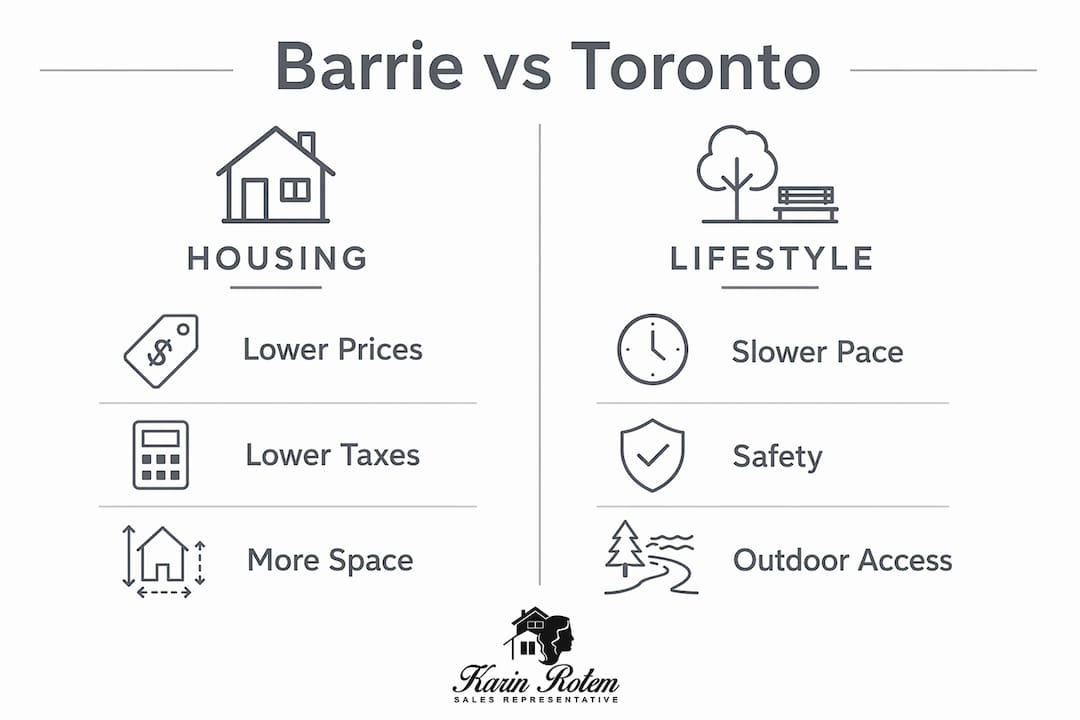
The outdoor lifestyle is the feature that surprises Toronto professionals most. Ski hills at Horseshoe Resort and Mount St. Louis Moonstone are within 20 minutes of the city. Kempenfelt Bay offers waterfront access for boating, paddleboarding, and beach days in summer. Trails for cycling and hiking are woven through the city rather than requiring a weekend drive to access them.
Here is what professionals consistently tell me they gain after moving from Toronto:
- Space. A home office, a garage, a yard. The physical room to separate work from life.
- Safety. Barrie’s crime rates are significantly lower than Toronto’s, and that changes how families move through their daily routines.
- Community. Smaller city scale means you recognise your neighbours, your kids’ teachers, and your local business owners.
- Over 180 local attractions, including arts venues, farmers’ markets, and waterfront events that make weekends genuinely enjoyable rather than logistically exhausting.
“Barrie offers a rare four-season lifestyle balance with quick access to outdoor recreation impossible to replicate in Toronto’s density.” — CompassNews, 2026
The pace is different, and that difference is the point. Toronto professionals who move to Barrie are not retreating from ambition. They are choosing to spend their non-working hours differently, and Barrie makes that choice easy.
How does the Toronto to Barrie commute actually work?
The GO Transit Barrie Line runs direct service to Union Station, with a trip time of approximately 1 hour 40 minutes to 1 hour 50 minutes and a one-way fare of roughly $16 to $18. Metrolinx is actively expanding all-day service on this corridor, which will improve frequency and make the schedule more flexible for professionals who do not work standard nine-to-five hours.
Driving via Highway 400 takes between 75 minutes and two hours depending on traffic and the time of day. The honest reality is that southbound Highway 400 during morning rush hour can be punishing, and professionals who drive five days a week often find the commute unsustainable within six to twelve months.
What actually works, based on what I see with my clients, is a hybrid model. Here is how the commute looks in practice:
- Two to three days per week in Toronto by GO Train or car, with the remainder working remotely from Barrie.
- Off-peak driving on days when flexibility allows, cutting the drive to 75 to 90 minutes.
- South Barrie neighbourhoods for buyers who prioritise commute convenience, given their closer proximity to GO stations and Highway 400 on-ramps.
- Carpooling or park-and-ride options at Barrie South GO station to reduce both cost and driving fatigue.
Pro Tip: Before committing to a Barrie address, map your actual office days against the GO Train schedule. The Friday Harbour commute breakdown on the Karinrotem website gives a realistic picture of travel times from the lakeshore corridor specifically.
The commuting decision depends on schedule flexibility, travel costs, and how often you genuinely need to be in Toronto. Professionals who are honest about that number before they move tend to be the ones who stay happily in Barrie for years.
What employment opportunities exist for professionals in Barrie?
Barrie’s local economy is more diversified than most Toronto professionals expect. The city is not a bedroom community that depends entirely on GTA employment. It has its own growing job market across several sectors that can support a full career transition or reduce your reliance on Toronto-based work over time.
Key employers and sectors include:
- Healthcare. Royal Victoria Regional Health Centre is one of the largest employers in the region, with ongoing demand for medical professionals, administrators, and support staff.
- Education. Georgian College draws educators, administrators, and support professionals, and the broader school board system is a significant local employer.
- Military. CFB Borden, located just outside Barrie, supports a range of civilian and contractor roles tied to defence and logistics.
- Technology. A growing cluster of tech firms and remote-friendly employers has established a presence in Barrie, supported by Georgian College’s tech programmes.
- Construction and trades. Barrie’s rapid population growth has created sustained demand for skilled trades and construction management professionals.
- Retail and services. The city’s expanding commercial base supports management, marketing, and operations roles across national and regional brands.
Barrie’s growing employment sectors reduce the need for daily Toronto commuting by giving professionals genuine local options. For those who do maintain Toronto-based roles, the hybrid work model means Barrie’s local economy functions as a complement rather than a replacement.
What should professionals know about Barrie’s real estate market?
Barrie’s real estate market is not uniform. Population growth has created distinct neighbourhood profiles, and choosing the right area depends on whether you are prioritising commute access, waterfront lifestyle, family amenities, or investment potential.
| Neighbourhood type | Best for | Key features |
|---|---|---|
| South Barrie | Commuters | Close to GO station, Highway 400 access, newer builds |
| Waterfront and lakeshore | Lifestyle buyers | Kempenfelt Bay access, premium pricing, strong resale |
| East and north Barrie | Families | Established schools, larger lots, quieter streets |
| New developments | Investors | Pre-construction pricing, modern finishes, rental demand |
The waterfront corridor commands a premium, but it also holds value well. Professionals buying near Kempenfelt Bay or in communities like Friday Harbour are purchasing into a lifestyle-driven market where demand from GTA buyers remains consistent. That consistency matters for long-term investment performance.
New developments in south and east Barrie offer entry points at lower price points, with the trade-off being less character and longer timelines to established community feel. What I tell my clients is to decide what they are optimising for first. Commute ease, lifestyle, family infrastructure, and investment return each point to a different part of the city.
Pro Tip: Reviewing sold homes in Barrie over the past 12 months gives you a realistic picture of what properties actually transact for, not just what they are listed at. That gap matters when you are making an offer.
Infrastructure is the one area where Barrie’s growth has created friction. Roads, schools, and transit in newer subdivisions are still catching up to population levels. That is a short-term consideration for buyers, but it is worth factoring into your timeline if you have school-age children or depend on local transit.
Key takeaways
Toronto professionals who move to Barrie gain the most when they combine housing affordability with a hybrid work schedule and a genuine commitment to the outdoor lifestyle the city offers.
| Point | Details |
|---|---|
| Housing affordability | Barrie home prices are 30 to 40% lower than Toronto, with monthly savings up to $2,000 for families. |
| Commute realism | The GO Train takes roughly 1h 45m to Union Station; two to three days per week is the sustainable commute pattern. |
| Lifestyle ranking | Barrie ranked second-best city in Canada in 2026 for safety, livability, and access to outdoor recreation. |
| Local employment | Key sectors including healthcare, education, technology, and CFB Borden reduce dependence on Toronto-based work. |
| Neighbourhood choice | South Barrie suits commuters; waterfront areas suit lifestyle buyers and investors with a long-term horizon. |
My honest read on the Barrie decision
What I have observed working with Toronto professionals over many years is that the ones who thrive in Barrie are the ones who were honest with themselves before they moved. They knew they were going into the office two days a week, not five. They wanted a ski hill they would actually use, not just a talking point. They had done the mortgage math and understood that owning in Barrie was not a consolation prize. It was a better financial position.
The professionals who struggle are the ones who underestimate commute frequency. If your role genuinely requires five days a week in downtown Toronto, the daily commute reality will wear you down within a year. That is not a knock on Barrie. It is a function of distance and time.
What I find compelling about Barrie right now is the combination of a maturing city and a still-accessible price point. The lifestyle infrastructure, the arts scene, the waterfront, the ski hills. These are not future promises. They exist today. But the pricing has not yet caught up to what the city actually offers, which means professionals buying now are getting in before that gap closes. I have seen this pattern in other markets, and it does not last indefinitely.
Barrie is the right move for hybrid workers, outdoor lifestyle seekers, and professionals who want to build equity rather than pay Toronto rent. For daily commuters, the honest answer is that it is a harder fit, and I would rather tell you that now than after you have signed a purchase agreement.
— Felix
Explore Barrie and Friday Harbour with Karinrotem
If you are a Toronto professional weighing a move to the Barrie region, the Karinrotem team brings direct experience with both markets. We work with buyers relocating from Toronto to Innisfil and Barrie, and we specialise in waterfront and lifestyle-driven properties including Friday Harbour luxury properties, one of the region’s most sought-after communities. Whether you are looking for a primary residence, a weekend retreat, or an income-generating investment, we can help you find the right fit. You can also explore our full property listings to see what is currently available across the Barrie corridor. Reach out to Karin directly for a no-pressure conversation about your options.
FAQ
How much cheaper is housing in Barrie than Toronto?
Barrie’s average home price is approximately $730,000, which is 30 to 40% lower than comparable properties in Toronto. Families who relocate can save between $1,000 and $2,000 per month across housing, childcare, and transport costs.
How long does the GO Train take from Barrie to Toronto?
The GO Transit Barrie Line takes approximately 1 hour 40 minutes to 1 hour 50 minutes to Union Station, with a one-way fare of roughly $16 to $18. Metrolinx is expanding all-day service on this line to improve frequency.
Is daily commuting from Barrie to Toronto realistic?
Daily five-day commuting from Barrie is generally not sustainable long-term and often leads to burnout. Most professionals who live in Barrie and work in Toronto manage the commute on a hybrid schedule of two to three days per week.
What neighbourhoods in Barrie suit Toronto professionals best?
South Barrie suits commuters due to its proximity to GO stations and Highway 400. Waterfront and lakeshore areas near Kempenfelt Bay appeal to lifestyle buyers and investors seeking strong long-term resale value.
What industries are hiring in Barrie for relocating professionals?
Barrie’s key employment sectors include healthcare at Royal Victoria Regional Health Centre, education at Georgian College, technology, construction, and civilian roles connected to CFB Borden. These sectors support professionals who want to reduce or eliminate their Toronto commute over time.