
A pre-construction deposit structure is a series of staged payments, each due at a set milestone, that together form your total deposit before your mortgage funds at final closing. According to market guides, that total typically lands between 15% and 20% of the purchase price, paid over 12–24 months.
Three protections every Canadian buyer should confirm before signing:
- Trust account holding: deposits must be held by the vendor’s lawyer in trust, not used by the developer for operating costs.
- Provincial warranty coverage: in Ontario, Tarion’s pre-possession program covers deposit refunds up to specified limits; BC and Quebec have parallel programmes under BC Housing and the Garantie de construction résidentielle (GCR).
- Cooling-off rights: Ontario condo buyers have a 10-day rescission period after signing; the Condominium Authority of Ontario (CAO) recommends reviewing the disclosure statement carefully before that window closes.
Key takeaways
| Point | Details |
|---|---|
| Deposits are staged, not lump sum | Typical schedules spread 15%–20% across 4–5 instalments over 12–24 months. |
| Trust-account holding is mandatory | Deposits must be held by the vendor’s lawyer in trust, not by the developer directly. |
| Provincial protections vary | Ontario uses Tarion and the Condominium Act; BC and Quebec have separate warranty bodies with different limits. |
| Register with Tarion within 45 days | Late registration in Ontario reduces maximum deposit coverage under Tarion’s pre-possession programme. |
| Plan for interim occupancy costs | Occupancy fees before registration add to your cashflow needs beyond the deposit schedule itself. |
How do staged pre-construction deposit payments actually work?
The legal foundation is the Agreement of Purchase and Sale (APS), which sets out every payment date, the exact dollar amount or percentage due, and the consequences of missing a payment. Developers draft these schedules carefully, and what looks like a buyer-friendly payment plan is also a financing tool for the project itself. Accumulated deposits help developers demonstrate buyer commitment to their construction lenders, which is often a condition of securing a project loan.
Administratively, the first payment is almost always a bank draft or certified cheque, handed over at signing. Subsequent instalments are typically post-dated cheques or wire transfers, submitted at signing and cashed on the contractual dates. WealthNorth’s buyer guide notes this distinction clearly: the bank draft is the only payment made in real time; everything else is pre-arranged.
Missing a payment date is not a minor administrative slip. Under most APS agreements, a missed instalment gives the vendor the legal right to terminate the contract and, in some cases, retain the deposits already paid. That is a material risk buyers often underestimate.
Pro Tip: Set calendar reminders for every post-dated cheque date the moment you sign. Your lawyer should have copies of all payment dates, but the responsibility to fund those cheques sits with you.
Market conditions also affect how rigid these schedules are. In a slower market, developers may offer extended intervals or reduced upfront percentages to attract buyers. Government housing supply initiatives, such as the federal-City of Toronto partnership to add rental supply, can shift local inventory levels and, in turn, change how much negotiating room buyers have on deposit terms.
What do typical pre-construction deposit schedules look like?
NerdWallet Canada’s new-build guide illustrates the most common milestone structure: $5,000 on signing, 5% at 30 days, 5% at 90 days, 5% at 180 days, and a final 5% at occupancy, for a total deposit of roughly 20% before the mortgage funds the remaining 80%.
Developers and markets vary considerably. Some offer a shorter schedule with larger early payments; others spread instalments across 24 months with a smaller signing amount to ease early cashflow.
The table below shows three common schedule types expressed as percentages of the purchase price for a unit priced around $700,000, so you can see the relative commitments at each stage without unsupported exact dollar amounts.
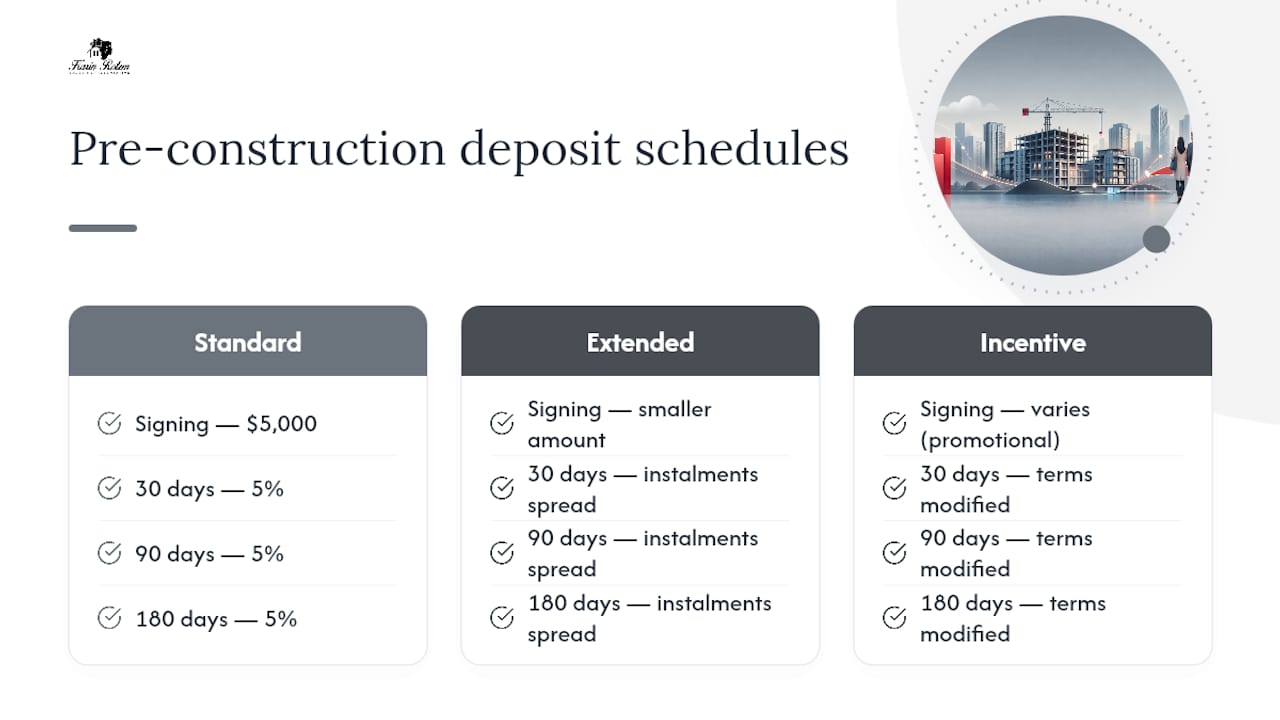
The standard schedule is the most common in the Toronto and Innisfil markets. The extended version appears more often in BC and some Atlantic markets, where developers spread payments to broaden their buyer pool. Incentive schedules are promotional tools, usually offered on slower-selling units or in softer market conditions. CondoTrend’s 2025 analysis confirms that market heat and developer inventory strongly influence how negotiable these terms are.
For a pre-construction condo purchase, understanding which schedule type you are being offered, and why, is the first step to evaluating whether the terms are reasonable.
How does deposit protection differ across Ontario, BC, and Quebec?
Provincial rules vary significantly, and the protection you have depends entirely on where the project is registered.
Ontario
Ontario has the most detailed framework. Under the Condominium Act, funds received by a builder for a condo project must be held in trust. The CAO’s guidance on pre-construction condos explains that buyers have a 10-day cooling-off period after signing, during which they can rescind without penalty. Buyers should review the disclosure statement during that window, paying close attention to the tentative occupancy date and any conditions that allow the developer to cancel.
Tarion’s coverage-before-you-close programme provides statutory deposit protection for new-home and condo purchasers, with coverage limits and conditions tied to the sale price. Critically, Tarion advises buyers to register within a 45-day window to qualify for maximum deposit coverage. Late registration places claims under a separate fund with sub-limits, which can materially reduce what you recover if the project fails.
- Cooling-off period: 10 days from signing
- Trust-account holding: mandatory under the Condominium Act
- Tarion registration: 45-day window for maximum coverage
- Coverage limits: tied to sale price and registration timing
British Columbia
BC buyers are protected under the BC Housing Homeowner Protection Office framework and the provincial New Home Warranty programme. Staged deposits are treated similarly to Ontario in that they must be held in trust, but the warranty body, coverage limits, and registration processes differ. Buyers purchasing in BC should confirm the specific deposit protection limits with their lawyer before signing, as the amounts and conditions are not identical to Tarion’s.

Quebec
Quebec operates under the Garantie de construction résidentielle (GCR), which covers new residential construction and includes provisions for deposit protection. GCR coverage applies to contracts with accredited contractors and has its own registration and claim procedures. Buyers in Quebec should verify that their developer is GCR-accredited before committing any funds.
Other provinces
In provinces without a dedicated new-home warranty body comparable to Tarion or GCR, deposit protection may rely primarily on trust-account rules and general contract law. Always confirm local warranty and trust obligations with a real estate lawyer before signing in any jurisdiction.
Where are your deposits held, and why does it matter?
Deposits should never go directly into the developer’s operating account. By statute in Ontario and by standard practice across most Canadian provinces, deposits are held in the vendor’s lawyer’s trust account until conditions are met for their release, typically at final closing or upon specific contractual milestones.
This matters for one practical reason: if the developer becomes insolvent before the project completes, deposits held in trust are legally segregated from the developer’s general assets. That segregation is what makes recovery possible, though the process can be slow and is not guaranteed to be complete. Deposits that were released from trust early, or that were never placed in trust at all, are far harder to recover.
What to verify on your purchase paperwork:
- The APS should name the specific trust account and the solicitor holding the funds.
- Ask for the solicitor’s contact information and confirm the trust account details in writing.
- Understand the release conditions: when and under what circumstances can the developer access those funds before closing?
Ontario’s Condominium Act framework and Tarion’s pre-possession coverage both reinforce the trust-account requirement, but buyers should not assume compliance without checking the documents themselves.
What happens if the developer cancels or becomes insolvent?
Project failures fall into three broad categories, each with different outcomes for your deposit.
- Developer insolvency: deposits held in trust are protected from general creditors, but recovery depends on the trust account balance, the warranty body’s coverage limits, and how quickly you file a claim. Tarion’s 45-day registration window is particularly relevant here.
- Developer-initiated cancellation: developers can cancel a project under specific APS conditions, such as failing to reach a sales threshold or secure financing. In these cases, deposits are generally returned in full with interest, but the timeline varies.
- Buyer rescission: if you rescind within the cooling-off period, your deposit is returned. Outside that window, rescission is treated as a breach and you risk forfeiting deposits already paid.
Practical refund mechanics depend on the warranty body involved. Tarion processes claims under its pre-possession programme with defined timelines; GCR and BC Housing have parallel but distinct procedures. For any claim, you will need:
- A copy of the signed APS with all deposit schedules
- Proof of each payment (bank drafts, wire transfer confirmations, cancelled cheques)
- Any written communication from the developer about delays or cancellation
- Your Tarion or GCR registration confirmation
Realistic expectations: refunds through warranty bodies can take months. Having all documentation organised from day one shortens that process considerably.
How do deposits affect your mortgage and cashflow before closing?
Every deposit payment comes out of your pocket before your mortgage exists. The mortgage funds only at final closing, when the unit is registered and title transfers. That gap, which can span two to four years on a typical pre-construction timeline, means you are saving for staged deposit payments while simultaneously preparing for a mortgage application.
Interim occupancy adds another layer. When a building is substantially complete but not yet registered, you may be allowed to move in and pay occupancy fees to the developer. These fees cover the developer’s carrying costs (interest on the construction loan, property taxes, and estimated maintenance) but do not reduce your purchase price or build equity. Credit Resources’ pre-construction guide notes that buyers often underestimate these costs, which can run for several months before registration and final closing.

At final closing, your lender will want to confirm that your total deposit, plus the mortgage amount, equals the purchase price. If your financial situation has changed since signing, such as a job change or a higher stress-test rate, you may face qualification challenges. Some buyers need bridge financing to cover the gap between deposit payments and mortgage funding.
Pro Tip: Talk to a mortgage broker the moment you sign an APS, not six months before closing. Locking in a rate hold and confirming your qualification early gives you time to adjust if your circumstances change. For Friday Harbour and Innisfil buyers, financing specifics for condo purchases in that market are worth reviewing separately.
What should you ask before signing a deposit schedule?
A deposit schedule is negotiable more often than buyers realise, especially in a slower market. Before you sign, work through these questions with your agent and lawyer.
- Who holds the deposits? Get the name of the vendor’s solicitor and the trust account details in writing.
- What are the exact trigger dates? Confirm whether payments are calendar-date driven or milestone driven, and what happens if a milestone is delayed.
- What is the registration deadline for warranty coverage? For Ontario buyers, confirm the Tarion 45-day window and who is responsible for filing.
- What happens if the developer delays occupancy? Ask for the APS language on delay compensation and whether deposits earn interest during extended timelines.
- What are the cancellation conditions? Understand exactly which conditions allow the developer to cancel and what the refund process looks like.
- Can the final 5% move to occupancy? In softer markets, this is often negotiable and meaningfully improves your cashflow in the final year before closing.
- Are post-dated cheques the only option? Some developers accept wire transfers, which are easier to manage and provide a cleaner paper trail.
These are not automatic deal-breakers, but they warrant a direct conversation with the developer and a careful review by your lawyer.
For income property investors, the cashflow implications of a front-loaded deposit schedule can affect your overall investment return, so modelling the full deposit timeline against your projected rental income is worth doing before you commit.
What I tell my clients about deposit schedules
Every week I work with buyers in Toronto, Innisfil, and Friday Harbour who are evaluating pre-construction offers, and the deposit schedule is almost always the part of the APS they have read the least carefully. What I tell them is simple: the schedule is not just a payment plan. It is a legal commitment with real consequences for missing a date, and it tells you a great deal about how the developer is financing the project.
One scenario I see regularly: a buyer signs a pre-construction agreement in a hot market, then faces a job change or rate increase 18 months later. The deposit schedule keeps running regardless. Having a contingency fund equal to at least one additional instalment, beyond what the schedule requires, is the kind of buffer that turns a stressful situation into a manageable one.
For buyers considering Ontario seller disclosure requirements, the same discipline applies on the pre-construction side: read every document before the cooling-off period expires, not after.
Should you proceed, or pause and get advice first?
Standard deposit schedules work well for buyers who have secure financing, a stable income, and a genuine contingency fund. Investors with clear cashflow projections and buyers prioritising a brand-new unit in a specific building also tend to navigate these structures comfortably, provided they have done the due diligence on trust-account holding and provincial warranty coverage.
None of those conditions make a pre-construction purchase wrong, but they do make the terms worth negotiating before you sign.
An experienced agent can often move the final instalment to occupancy, extend the interval between payments, or flag APS clauses that are unusual for the market. That conversation costs nothing and can save you thousands.
If you are evaluating a pre-construction unit and want to see what is currently available, browse current properties to get a sense of what deposit structures look like across active listings in Toronto, Innisfil, and Friday Harbour.
Sources
These are the primary official resources to verify deposit protections, trust-account obligations, and registration deadlines before you sign.
- Pre-construction Condos – Condominium Authority of Ontario
- Tarion
- Pre-Construction Condo Buying in Canada: Risks and Financing – Credit Resources
- How to buy a new build home – NerdWallet Canada
Tarion’s 45-day registration window is the single most time-sensitive protection in Ontario. Missing it does not eliminate coverage, but it does reduce the maximum amount recoverable under the pre-possession programme.
This article is general information, not a substitute for advice from a qualified financial advisor. Consult a qualified financial professional about your own circumstances before acting on anything here.
FAQ
What is a deposit in pre-construction real estate?
Each payment is due at a contractual milestone set out in the Agreement of Purchase and Sale.
What is the pre-construction payment structure in Canada?
The most common structure starts with a small amount on signing (often $5,000), followed by several 5% instalments at 30, 90, and 180 days, with a final 5% due at occupancy, as outlined in NerdWallet Canada’s new-build guide.
Are pre-construction condos cheaper than resale?
Not necessarily. Pre-construction pricing reflects future value and often includes premiums for new construction, HST, and development levies. The deposit structure spreads your upfront cash over time, but the total purchase price is not automatically lower than comparable resale units.
Do you pay a deposit on a new build in Canada?
Yes. New-build purchases in Canada require a deposit paid in staged instalments before closing. The deposit is held in the vendor’s lawyer’s trust account and is separate from your mortgage, which funds only at final registration and title transfer.
How are deposits protected if a developer cancels a project?
In Ontario, deposits are protected under Tarion’s pre-possession programme up to specified limits, provided you register within the 45-day window. BC and Quebec have parallel protections under their respective warranty bodies. Deposits held in trust are legally segregated from the developer’s assets, which supports recovery even in insolvency.