
Currency exchange is the process of converting one country’s money into another, and for international property buyers, it is often the single largest variable affecting the true cost of a real estate purchase. The role of currency exchange in a real estate purchase goes well beyond a simple conversion calculation. Exchange rates shift between the day you make an offer and the day you close, and those shifts can add or erase tens of thousands of dollars from your budget. What I tell my clients who are buying across borders is this: currency risk management is a primary acquisition strategy, not an afterthought you address after price negotiation. Whether you are purchasing a waterfront condo at Friday Harbour in Innisfil, Ontario, or a vacation property abroad, understanding foreign exchange (FX) risk is as important as understanding the property itself.
How do currency exchange rates directly impact real estate purchase costs?
The currency exchange impact on real estate becomes most visible during the conveyancing period, which is the window between signing an agreement of purchase and sale and the closing date. This period can span 30 to 90 days or longer for luxury and waterfront properties. During that time, exchange rates move constantly, and even modest shifts carry serious financial weight.
Consider a concrete example. A currency rate change from 3.6 to 2.9 NIS per U.S. dollar caused a $337,000 drop in purchasing power on a $1 million property. That loss had nothing to do with the property’s price or the negotiation. It was entirely driven by the exchange rate moving against the buyer. No amount of skilled negotiation could have recovered that gap.
The mechanics work like this for a Canadian buyer purchasing in U.S. dollars or for a U.S. buyer purchasing in Canadian dollars:
- Rate at offer: The buyer calculates affordability based on the exchange rate the day they sign.
- Rate at closing: If the rate has moved unfavourably by even 2–3%, the buyer pays more in their home currency for the exact same property.
- Bank spreads: Major retail banks apply wider spreads on currency conversions than specialist brokers do, adding a hidden cost on top of the rate movement.
- Wire transfer timing: The exact moment funds are converted and sent can affect the final amount received by the seller’s lawyer.
A 2–3% shift in exchange rates during conveyancing can exceed typical legal costs. That means currency movement can cost you more than your real estate lawyer’s fees. Most buyers focus intensely on legal and inspection costs while leaving FX exposure completely unmanaged.
Pro Tip: Ask your real estate lawyer for the expected closing date as early as possible. The sooner you know the timeline, the sooner you can lock in a rate and remove the uncertainty from your budget.
What strategies can buyers use to manage currency risk in property transactions?
Managing FX exposure in a real estate transaction is not complicated, but it does require deliberate action. The good news is that several proven tools exist specifically for this purpose.
-
Use a forward contract. Forward contracts lock in an exchange rate up to 12 months in advance. You agree on a rate today, and regardless of where the market moves before closing, you pay that agreed rate. For a Friday Harbour buyer converting U.S. dollars to Canadian dollars, this removes the single biggest financial unknown from the transaction.
-
Work with a specialist currency broker. Specialist currency brokers offer significantly better exchange rates than major retail banks. On a $250,000 transaction, the savings from using a specialist versus a bank can range from $2,500 to $6,000. That is real money that stays in your pocket without any additional negotiation on the property price.
-
Set a contingency reserve. Budget a 3–5% buffer above expected transaction costs and stress-test your numbers against a 10–15% currency fluctuation. This is not pessimism. It is the kind of financial planning that protects you if rates move sharply before your forward contract is in place.
-
Set rate alerts. Most currency platforms and specialist brokers allow you to set target rate alerts. When the rate reaches your preferred level, you act immediately rather than waiting and hoping.
-
Coordinate with your real estate agent and lawyer. Timing the currency conversion to align with the closing date requires communication between your FX provider, your lawyer, and your agent. A missed wire deadline can delay closing and cost you additional conversion fees.
What most buyers overlook is that a favourable price negotiation can be completely offset by an adverse currency move during closing. Saving $15,000 on the purchase price means nothing if the exchange rate costs you $20,000 more by closing day.
Pro Tip: Engage a specialist currency broker at the same time you engage your real estate lawyer. The two processes should run in parallel, not sequentially.
How do ongoing currency fluctuations affect total ownership costs?
The currency conversion for property buying does not end at closing. For international buyers, foreign property ownership costs like property taxes, condominium maintenance fees, and insurance premiums are paid in local currency. This means your FX exposure continues for as long as you own the property.

For a U.S. buyer who owns a waterfront condo at Friday Harbour, every annual property tax payment and monthly maintenance fee is a currency conversion event. If the Canadian dollar strengthens against the U.S. dollar over a five-year period, those recurring costs rise in U.S. dollar terms even if the fees themselves stay flat in Canadian dollars.
The key ongoing risks to plan for include:
- Property taxes: Assessed and payable in Canadian dollars, subject to annual rate changes and FX movement.
- Condominium maintenance fees: Fixed in local currency but variable in your home currency depending on the exchange rate at time of payment.
- Rental income currency mismatch: If you rent your vacation property and collect income in Canadian dollars but your mortgage or living expenses are in U.S. dollars, your net income fluctuates with the exchange rate even when occupancy stays constant.
- Renovation and repair costs: Any capital expenditure on the property is priced in local currency, adding another layer of FX exposure.
Currency risk persists long after closing, affecting taxes, fees, and maintenance for the life of your ownership. Buyers who plan only for the transaction itself are consistently surprised by how much FX movement affects their annual carrying costs. For income properties at Ontario resorts, this multi-year FX exposure belongs in every investment model from day one.
How does currency exchange compare to property appreciation in investment returns?
This is the question most investors do not ask until it is too late. The standard assumption is that property appreciation drives investment returns. For domestic buyers, that is largely true. For international buyers, the picture is more complex.
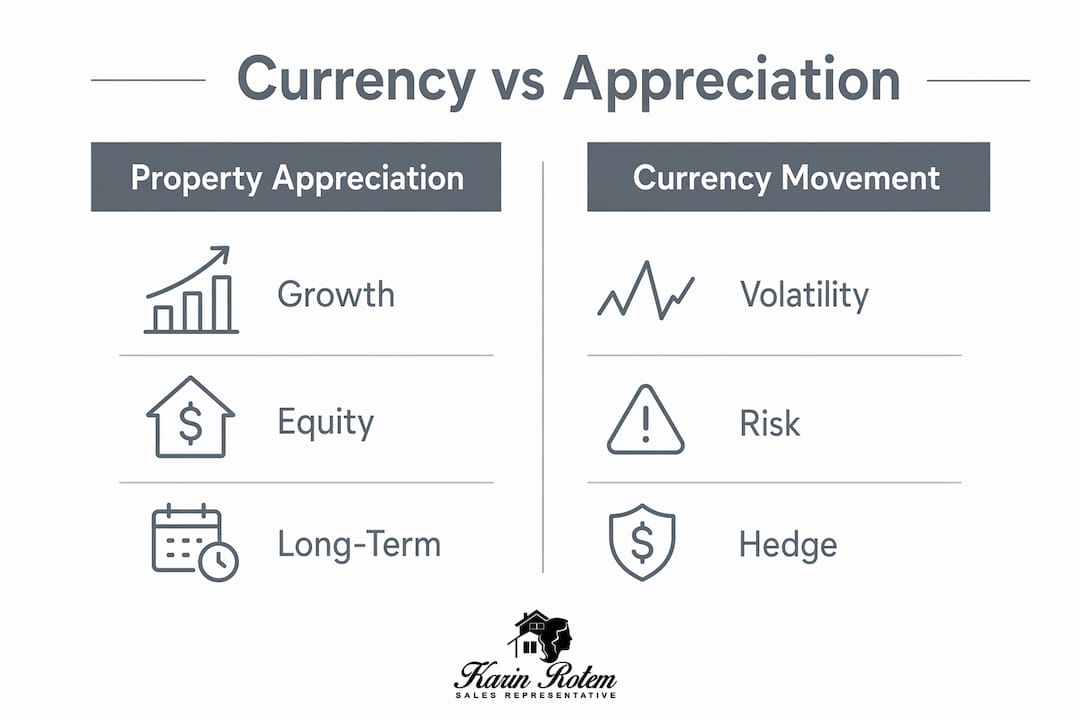
Foreign buyers effectively bundle two assets: the real estate itself and a multi-year speculative position on the currency. In some markets, currency movement is the dominant driver of total return, outweighing property price appreciation entirely.
| Scenario | Property appreciation | Currency movement | Net return impact |
|---|---|---|---|
| Canadian buyer, Canadian property | 8% gain | None | 8% gain |
| U.S. buyer, Canadian property, USD strengthens 10% | 8% gain | 10% loss on conversion | Near breakeven |
| U.S. buyer, Canadian property, CAD strengthens 10% | 8% gain | 10% gain on conversion | 18% effective gain |
| International buyer, property flat | 0% gain | 15% favourable FX move | 15% effective gain |
The table makes the point clearly. A U.S. buyer purchasing a Friday Harbour waterfront property during a period when the Canadian dollar weakens significantly against the U.S. dollar can achieve strong returns even if the property itself appreciates modestly. The reverse is equally true. A property that gains 8% in Canadian dollar terms can deliver a net loss to a U.S. buyer if the exchange rate moves 10% against them over the same period.
Owning international real estate can act as a currency hedge, generating revenue in a foreign currency and providing diversification that domestic assets cannot replicate. For buyers who understand this dynamic, the foreign buyer rules in Ontario and the currency exposure are both part of the investment thesis, not obstacles to it.
For a deeper look at how currency fits into the broader risk picture for luxury buyers, the property investment risks guide from Living on the Côte d’Azur covers FX alongside other key considerations for cross-border acquisitions.
Key takeaways
Currency exchange is the most underestimated cost variable in international real estate transactions, and managing it proactively is the difference between a profitable purchase and an expensive surprise.
| Point | Details |
|---|---|
| FX risk starts at offer, not closing | Exchange rates move between signing and closing, often costing more than legal fees. |
| Forward contracts remove uncertainty | Locking in a rate up to 12 months ahead protects your budget regardless of market movement. |
| Specialist brokers outperform banks | Using a currency specialist instead of a retail bank can save $2,500–$6,000 on a $250,000 transaction. |
| Ownership costs carry ongoing FX exposure | Property taxes, maintenance fees, and repairs are paid in local currency for the life of ownership. |
| Currency can outweigh property appreciation | For international buyers, FX movement often determines total return more than the property’s price gain. |
What I have learned about currency risk at Friday Harbour and beyond
I have worked with U.S. buyers, overseas investors, and Canadians purchasing internationally, and the pattern is consistent. Currency is the last thing most buyers think about and the first thing that surprises them at closing.
What most buyers do not realise is how quickly the timeline compresses. You find a property you love at Friday Harbour, you make an offer, and suddenly you have 60 days to coordinate a mortgage, a lawyer, an inspection, and a currency conversion. If you have not already spoken to a specialist FX provider, you are scrambling at exactly the wrong moment.
My honest recommendation is to treat the currency conversation the same way you treat the financing conversation: start it before you make an offer. Know your rate threshold. Know whether a forward contract makes sense for your timeline. Know what a 5% adverse move would do to your budget. That preparation takes one phone call with a specialist broker, and it can save you more than any other single step in the transaction.
For cross-border buyers at Friday Harbour, I also recommend building the FX buffer into your offer strategy. If your budget is $900,000 Canadian, do not offer at the absolute ceiling. Leave room for the rate to move against you between offer and closing. That discipline has saved my clients real money, and it keeps the transaction from becoming stressful in the final weeks.
The buyers who handle this best are the ones who view the currency component as part of the investment decision, not a technicality to sort out later. They ask better questions, they close with fewer surprises, and they are far more satisfied with the outcome.
— Felix
Explore Friday Harbour waterfront properties with expert guidance
If you are considering a waterfront or vacation property purchase and currency exchange is part of your planning, Karinrotem is here to help you think through every layer of the transaction. The Friday Harbour luxury waterfront community in Innisfil, Ontario, attracts buyers from across Canada and internationally, and Karinrotem’s team has deep experience guiding cross-border buyers through the full process, including the currency considerations that most agents overlook. Whether you are a U.S. buyer converting dollars or a Canadian investor evaluating total return, we provide the local expertise and practical guidance you need to make a confident, informed decision. Explore current listings and reach out to discuss your goals.
FAQ
How does currency exchange affect a real estate purchase price?
Currency exchange affects the true cost of a property by changing how much of your home currency is required to complete the purchase. A 2–3% shift in exchange rates during conveyancing can exceed typical legal costs, making FX management as important as price negotiation.
What is a forward contract in real estate currency exchange?
A forward contract is an agreement with a currency provider to lock in a specific exchange rate for a future transaction. It can be arranged up to 12 months in advance, protecting buyers from rate movements between offer and closing.
Should I use a bank or a specialist broker for currency conversion?
Specialist currency brokers consistently offer better rates than retail banks by applying tighter spreads. On a $250,000 transaction, the difference can save a buyer between $2,500 and $6,000 compared to converting through a major bank.
Does currency risk end after I close on a property?
No. Currency risk persists for the full period of ownership because property taxes, maintenance fees, and repair costs are paid in the local currency. International buyers should plan for multi-year FX exposure, not just the initial transaction.
How much of a currency buffer should I include in my budget?
Experts recommend setting a contingency reserve of 3–5% above expected transaction costs and stress-testing your budget against a 10–15% currency fluctuation to account for unpredictable rate movements.