
A condo hotel unit is a privately owned condominium inside a professionally operated hotel, giving you title to your unit while the hotel manages rentals, housekeeping, and guest services on your behalf. This ownership model, also called a “condotel” in the industry, blends real estate investment with hospitality operations in a way that few other property types can match. You hold a fee simple deed, you can use the unit personally, and you can place it into the hotel’s rental programme when you are away. For Canadian buyers eyeing waterfront communities like Friday Harbour in Innisfil or resort destinations across Ontario, understanding how this model works before you sign anything is the difference between a rewarding investment and a costly surprise.
What is a condo hotel unit and how does ownership work?
A condo hotel is legally a condominium building operated as a full-service hotel, with each owner holding a fee simple deed to their individual unit. That means you own your unit outright, the same way you would own any condominium. You are not buying a share in a corporation or a fractional interest. Your name is on title.
What makes the model distinct is the dual-use structure. You have the right to occupy your unit for a set number of days per year, typically defined in your purchase agreement and management contract. For the remaining time, the hotel operator places your unit into a rental pool alongside other owners’ units and manages bookings, check-in, housekeeping, and guest services. The hotel brand handles the guest experience. You collect a share of the revenue.

Condo hotels offer larger unit footprints than typical hotel rooms, which improves appeal for families and longer stays. That extra space benefits both your personal use and your rental income potential, since guests booking for a week or more often prefer suite-style accommodations over a standard room.
How condo hotels work: use rights and rental management
Understanding the day-to-day mechanics helps you set realistic expectations before you buy. Here is how the process typically unfolds:
- Purchase and title registration. You buy the unit, register title in your name, and receive a status certificate or equivalent disclosure document outlining the building’s financial health and management structure.
- Signing the rental management agreement. Most condo hotels require owners to enter a rental management agreement with the hotel operator. This agreement governs how your unit is rented, how revenue is split, and how many personal use days you are entitled to each year.
- Personal use scheduling. You book your personal stays through the hotel’s reservation system, often with advance notice requirements. Peak seasons may have restrictions to protect rental revenue for all owners.
- Rental operations. The hotel operator handles all guest-facing activity: marketing, online listings, check-in, housekeeping, and maintenance. You are a passive income participant, not a landlord managing tenants.
- Revenue distribution. At the end of each month or quarter, you receive your share of rental income after management fees and operating costs are deducted.
Pro Tip: Ask to see the rental management agreement before you make an offer. Some agreements lock you in for five to ten years with limited exit options. Knowing the terms upfront protects you from surprises after closing.
Condo hotels operate as businesses with multiple stakeholders, including the developer, the hotel operator, individual owners, and guests. When those interests are aligned, the model works well. When they are not, owners often feel the financial impact first.
What are the financial realities of owning a condo hotel unit?
This is where buyers need to pay close attention. The income potential is real, but so are the costs.
Fees and operating costs
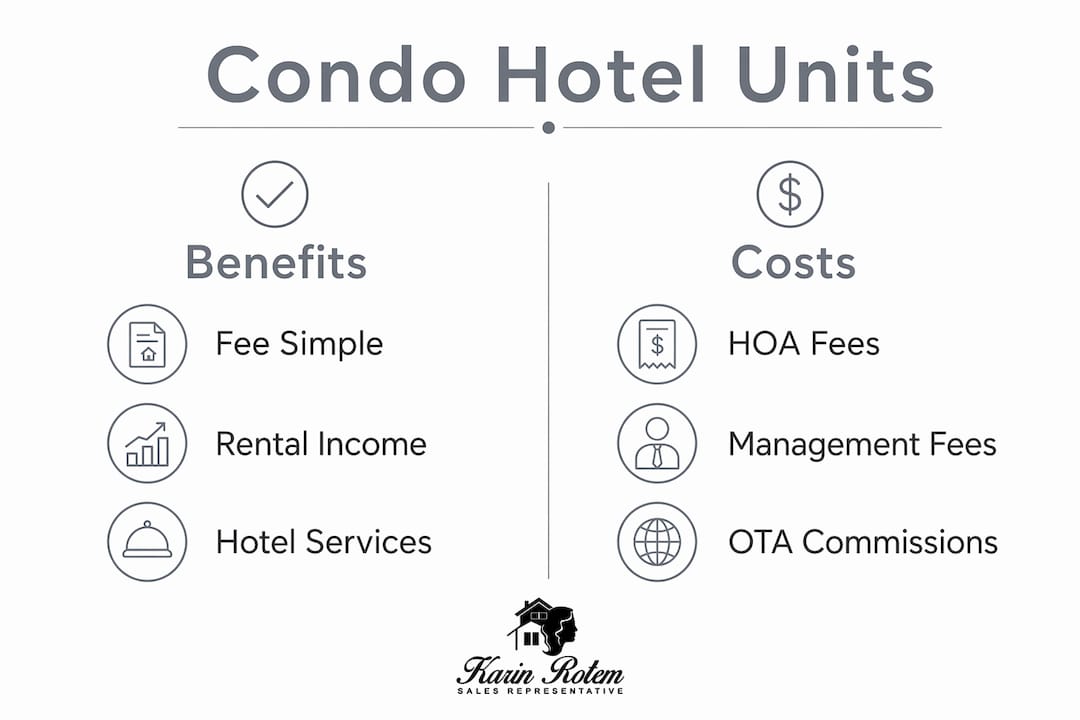
Condo hotels require higher HOA fees than standard condominiums because hotel-level services such as daily housekeeping, front desk staffing, and concierge must be funded. These fees also contribute to reserve accounts for long-term maintenance, which is necessary to keep the property competitive in the hospitality market. Expect monthly fees that are noticeably higher than what you would pay in a comparable residential condo.
You can review how Friday Harbour condo fees are structured to get a concrete sense of what hotel-level services add to your monthly carrying costs.
Rental revenue and management fees
Management fees typically consume 30–40% of gross rental revenue. That is a significant deduction before you see a dollar of income. On a unit generating $3,000 per month in gross rental revenue, you could be paying $900–$1,200 in management fees alone, before HOA fees, property taxes, and mortgage costs.
| Revenue scenario | Gross monthly rental | Management fee (35%) | Net before other costs |
|---|---|---|---|
| Conservative | $2,000 | $700 | $1,300 |
| Moderate | $3,500 | $1,225 | $2,275 |
| Strong market | $5,000 | $1,750 | $3,250 |
In major tourist markets like Miami, condo hotels average 75% occupancy with annual returns of 6–8%, influenced by location and management quality. Canadian resort markets vary, and returns depend heavily on the hotel brand, seasonal demand, and how well the operator manages direct bookings versus third-party platforms.
OTA commissions can reach 15% of each booking when the hotel relies heavily on platforms like Booking.com or Expedia. That commission comes out of gross revenue before the management fee split, further reducing your net income. Hotels that cultivate direct bookings and repeat guest programmes deliver meaningfully better returns to owners.
Pro Tip: Ask the hotel operator for a breakdown of direct bookings versus OTA bookings over the past 12 months. A property where more than 60% of bookings come through OTAs is leaving significant income on the table.
Mortgage financing
Condo hotel financing is more complex than securing a mortgage on a standard condo, with a significant share of transactions facing delays or refusals due to the hybrid ownership and short-term rental structure. Many lenders treat condotels as commercial properties rather than residential ones, which affects down payment requirements and interest rates. Plan for a larger down payment and consult a mortgage broker experienced with investment properties before you make an offer.
Condo hotel vs. traditional condo and timeshare: what is the difference?
Buyers often compare these three ownership models. Each serves a different goal.
| Feature | Condo hotel | Traditional condo | Timeshare |
|---|---|---|---|
| Ownership type | Fee simple deed | Fee simple deed | Fractional or right-to-use |
| Personal use | Limited by rental agreement | Unrestricted | Fixed weeks or points |
| Rental income | Yes, through hotel programme | Self-managed or restricted | Rarely available |
| Management | Professional hotel operator | Condo corporation | Resort management company |
| HOA fees | High (hotel services included) | Moderate | Included in annual fees |
| Resale market | Limited but exists | Active | Very limited |
A traditional condo gives you full personal use flexibility and a more active resale market, but you manage rentals yourself or hire a property manager. A timeshare gives you guaranteed access for specific periods but almost no income opportunity and a notoriously weak resale market. A condo hotel sits between the two: you own the asset, you earn rental income passively, but you give up some personal use flexibility and pay higher fees for the privilege.
The benefits of condo hotels are most compelling for buyers who want a vacation property that partially pays for itself, without the work of being a landlord.
What should you know before investing in a condo hotel unit?
Practical due diligence separates buyers who thrive in this model from those who regret it.
- Assess the hotel operator’s track record. The operator’s reputation and management standards directly determine your rental income and property value. Rental income is unpredictable and heavily dependent on hotel brand quality, location, and service standards. A weak operator in a strong location still underperforms.
- Choose operational over pre-construction where possible. Buying an operational condo hotel lowers risk because you can review actual occupancy data, guest reviews, and management performance before committing. Pre-construction purchases carry the additional risk that projected returns may never materialise.
- Understand your personal use restrictions. Some agreements limit personal use to off-peak periods. If your goal is to use the property during summer weekends or holiday weeks, confirm that the agreement allows it.
- Review the reserve fund. A well-funded reserve account signals that the building is maintained to hotel standards. A depleted reserve is a warning sign of deferred maintenance and future special assessments.
- Align your investment horizon. Condo hotels are not short-term flips. The model rewards patient investors who hold through seasonal cycles and benefit from long-term appreciation alongside rental income.
Pro Tip: Before buying, request two to three years of audited financial statements from the hotel operator. If they cannot provide them, treat that as a red flag.
For a detailed look at risk factors specific to resort condos in the Ontario market, that resource walks through the most common pitfalls buyers encounter.
Key takeaways
A condo hotel unit delivers real estate ownership with passive rental income, but only when you understand the fee structure, management quality, and personal use restrictions before you buy.
| Point | Details |
|---|---|
| Ownership is fee simple | You hold a registered deed to your unit, the same as any condominium purchase. |
| Management fees reduce net income | Expect 30–40% of gross rental revenue to go to the hotel operator before you see returns. |
| Financing is more complex | Lenders often treat condotels as commercial properties, requiring larger down payments and specialist mortgage advice. |
| Operational properties carry less risk | Buying an existing, operating condo hotel lets you verify actual performance data before committing. |
| Personal use is limited | Rental agreements restrict when you can occupy your unit, so confirm peak-season access before signing. |
What I tell my clients about condo hotels
What most buyers don’t realise is that a condo hotel unit is not a passive investment in the way a GIC or index fund is passive. You own a piece of a hospitality business. The hotel’s reputation, its booking strategy, and its management team all affect your monthly cheque. I have worked with clients who bought into beautifully located properties and were disappointed because the operator was mediocre. I have also worked with clients who bought into less glamorous buildings with exceptional operators and consistently outperformed their projections.
The buyers who do best in this model are those who treat the hotel operator selection as seriously as they treat the unit itself. Ask hard questions. Request financial statements. Talk to existing owners if you can. A strong operator in a good location is the combination you are looking for.
I am also honest with clients about personal use. If you are buying primarily to enjoy the property yourself and the rental income is a bonus, a condo hotel can be a wonderful fit, especially in a community like Friday Harbour where the lifestyle is genuinely exceptional. But if you are counting on rental income to carry the mortgage, you need conservative projections and a clear-eyed view of what the management fees and HOA costs will leave you with each month.
The timing question comes up often too. Buying into an established resort community with a proven track record is a very different proposition from buying pre-construction in an unproven market. I always recommend the former when the option exists.
— Felix
Ready to explore condo hotel opportunities in Ontario?
If you are considering a condo hotel unit or a resort-style property near Toronto, Karinrotem’s team has the local expertise to guide you through every step. We specialise in waterfront and lifestyle-driven real estate, with deep knowledge of communities like Friday Harbour in Innisfil. Whether you are looking for a personal retreat, an income-generating investment, or both, we can help you evaluate your options with clear, honest advice. Browse current Friday Harbour listings or explore the full range of Ontario resort income properties to find the right fit for your goals. Reach out to Karinrotem directly for a personalised conversation about what this ownership model could look like for you.
FAQ
What is a condotel and how does it differ from a regular condo?
A condotel is a condominium unit inside a professionally managed hotel, where the owner holds a fee simple deed but participates in a hotel rental programme. A regular condo gives you unrestricted personal use and no built-in rental management structure.
How much of my rental income goes to the hotel operator?
Management fees typically take 30–40% of gross rental revenue, which significantly reduces your net income compared to self-managed rentals.
Can I get a mortgage on a condo hotel unit in Canada?
Financing a condo hotel is more complex than a standard residential mortgage. Many lenders classify condotels as commercial properties, which means larger down payments and higher rates. Working with a mortgage broker experienced in investment properties is strongly recommended.
Is buying a pre-construction condo hotel riskier than buying an existing one?
Yes. Purchasing an operational condo hotel lets you review real occupancy data and management performance before you commit. Pre-construction purchases rely on projected returns that may not materialise.
How many days per year can I personally use a condo hotel unit?
Personal use days vary by property and rental management agreement, but most agreements define a set number of days and may restrict use during peak rental seasons. Always confirm your personal use entitlements before signing.