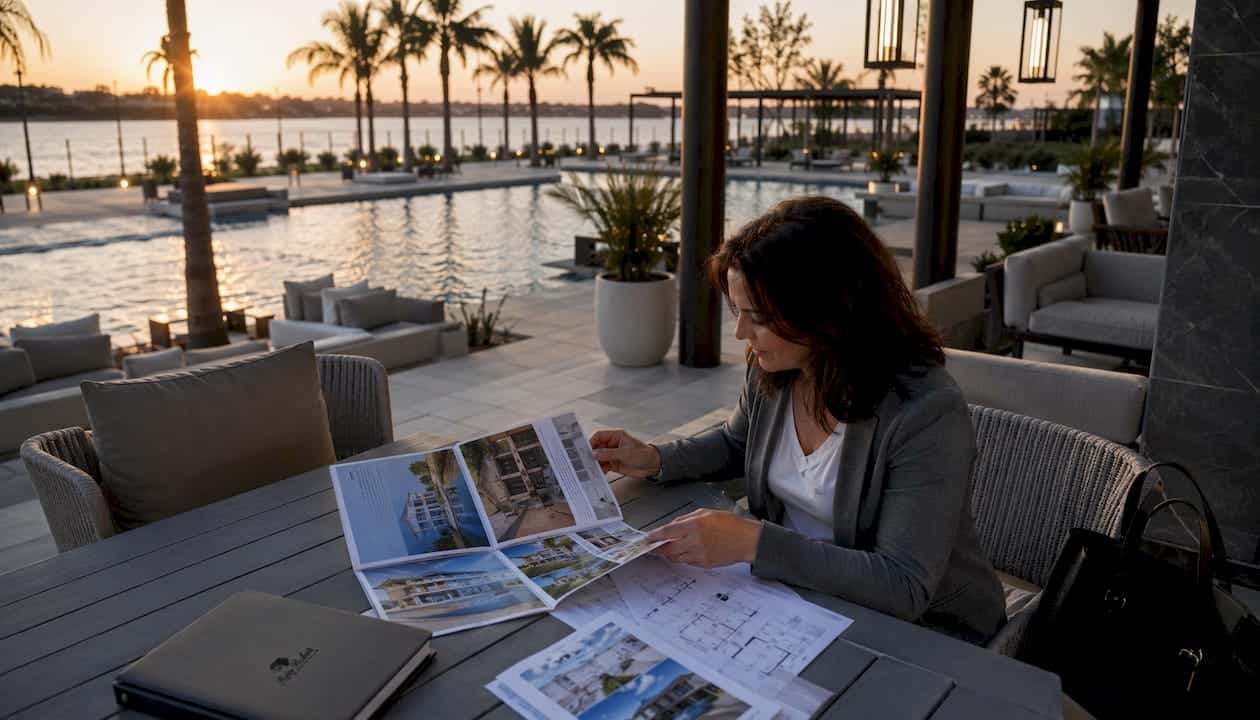
Resort-style amenities raise rental rates and stabilise seasonal income. Properties with pools, hot tubs, waterfront access, and clubhouse facilities command measurably higher average daily rates (ADRs) and fill more nights across the shoulder season. GTA Airbnb data shows pools and hot tubs significantly increase revenue compared to comparable listings without these amenities. At Friday Harbour on Lake Simcoe, community-level amenities including a marina, private beach club, and pools position properties for year-round demand that a standard Innisfil cottage simply cannot match.
The core mechanisms are straightforward:
- Premium pricing: Guests pay more for an experience they cannot replicate at home.
- Higher occupancy: Amenity-rich listings attract more searches and convert at higher rates on Airbnb and Vrbo.
- Shoulder-season stability: Indoor amenities and hot tubs extend bookable weeks beyond the summer peak.
- Better reviews: Guests who feel the property delivered a resort experience leave higher ratings, which compounds future booking performance.
- Longer stays: Families and groups booking for a full experience tend to stay longer, reducing turnover costs.
Resort amenities shift a property from “a place to sleep” into “the destination itself” — and guests price that difference into what they are willing to pay.
Which amenities actually move rental income, and why
Not every upgrade pays equally. Here is how the main amenity categories rank by typical revenue impact, based on market data from the GTA and comparable Canadian resort markets.
Pools deliver the highest RevPAR boost among all amenities, often allowing properties to price 20–30% above local averages when positioned as a luxury retreat. The catch: installation and maintenance costs are substantial, and the revenue is concentrated in summer months.
Hot tubs and saunas are the most reliable high-ROI amenity for Canadian climates. Hot tubs and saunas command 25–30% higher nightly rates and RevPAR lifts up to 34% in some markets. Unlike pools, they generate bookings in winter, making them a genuine season-extension tool.
Waterfront access functions as a location amenity rather than an installed feature, but its effect on ADR is significant. Properties with private dock access or direct lake frontage attract a different buyer pool entirely.
Indoor amenities (game rooms, home theatres, saunas) stabilise occupancy across seasons more reliably than outdoor-only features. A rainy July weekend does not cancel a booking when the property has a games room.
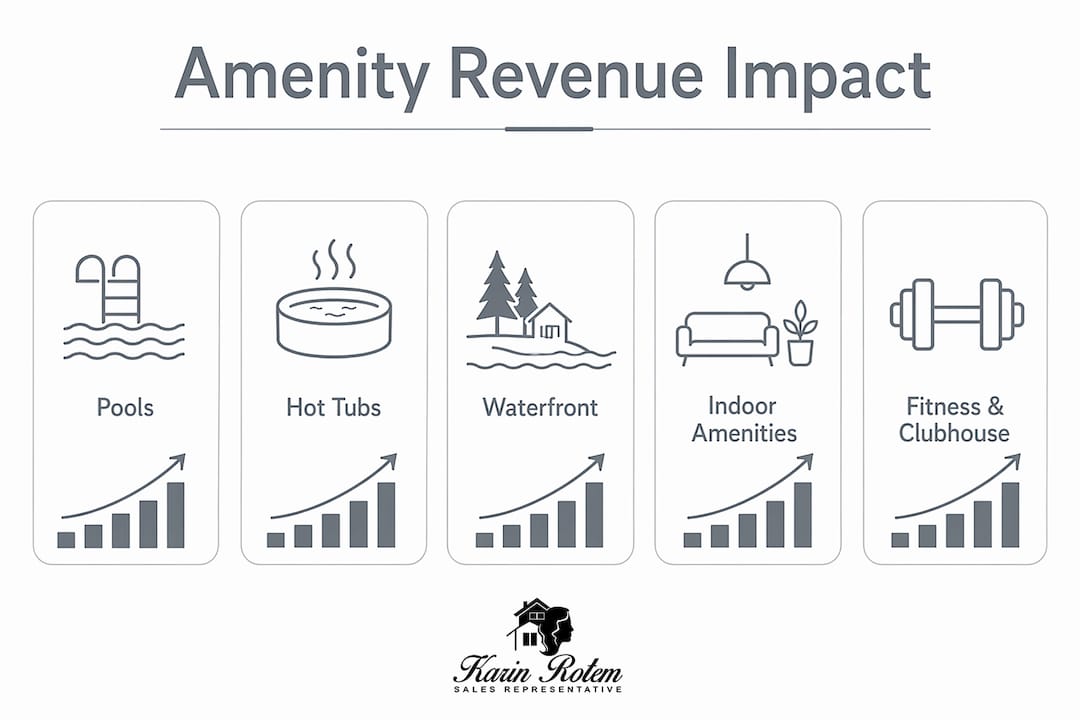
Fitness facilities and clubhouse access matter most in resort communities like Friday Harbour, where community-level amenities substitute for in-unit ones. Buyers here are purchasing access to a lifestyle infrastructure, not just square footage.
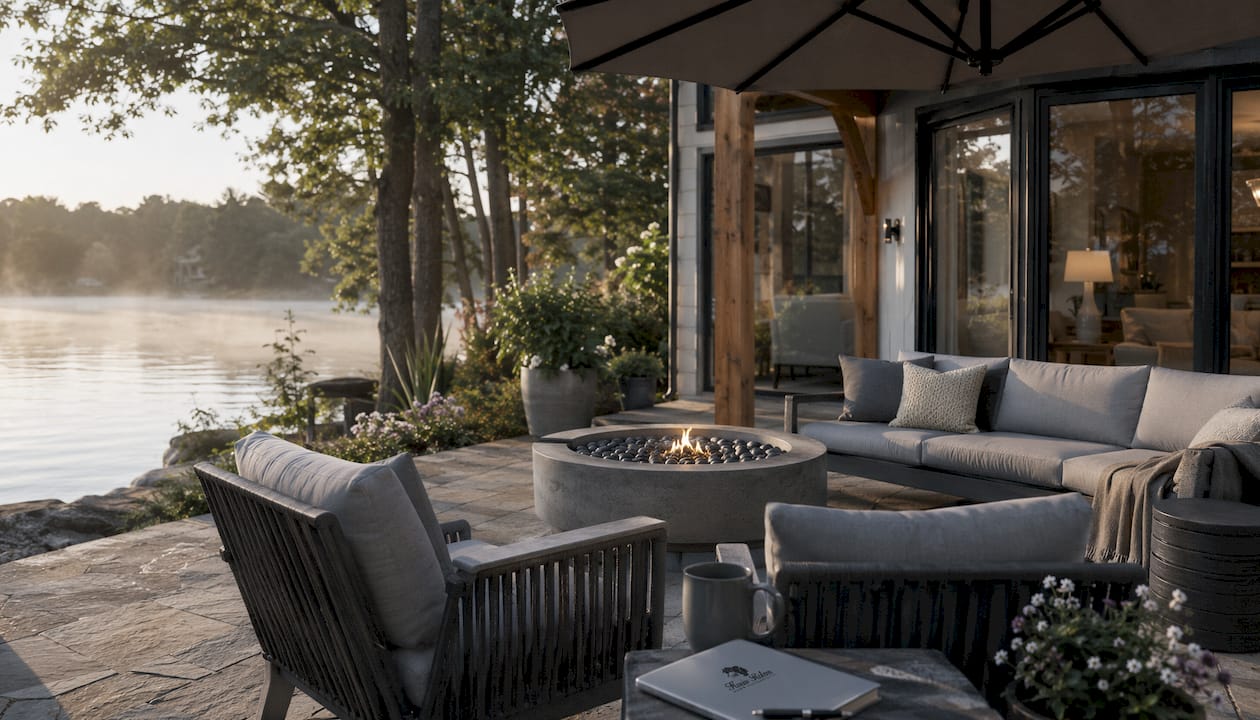
Outdoor living features (fire pits, covered decks, outdoor kitchens) extend usable hours per day and photograph well, which directly affects click-through rates on listing platforms.
Functional convenience features (dedicated parking, high-speed Wi-Fi, in-unit laundry) often yield higher ROI in tighter markets than large, high-maintenance amenities. For a Toronto condo investor, reliable Wi-Fi and parking may outperform a shared rooftop hot tub.
How amenities change your booking numbers
ADR (average daily rate) is what you charge per night. Occupancy is the percentage of available nights booked. RevPAR (revenue per available room/night) multiplies the two and is the most useful single metric for comparing properties. Length of stay affects both revenue per booking and your cleaning and turnover costs.
| Amenity | Typical ADR uplift | Occupancy / seasonality effect | Length-of-stay effect |
|---|---|---|---|
| Pool | 20–30% above market | Strong summer; limited winter | Groups book longer stays |
| Hot tub | 15–30% above market | Year-round; strongest in winter | Moderate positive |
| Waterfront access | Varies; significant premium | Strong summer; shoulder-season appeal | Longer stays for families |
| Indoor amenities (game room, sauna) | 20–30% | Stabilises shoulder and winter | Positive for groups |
| Outdoor living (fire pit, deck) | 5–15% | Extends shoulder season | Minimal direct effect |
| Convenience (Wi-Fi, parking, laundry) | — | Year-round booking consistency | Repeat-guest driver |
Innisfil waterfront properties show summer gross revenues commonly 30–50% higher than winter. That gap is exactly what indoor amenities and hot tubs help close. A property with only a pool earns most of its income in an eight-week window. Add a hot tub and a sauna, and October through March becomes genuinely bookable.
Why marketing and pricing are what actually capture amenity value
An amenity that guests cannot see in your listing photos might as well not exist. Professional photography and staging directly lift click-through rates and booking conversions for amenity-rich properties. The hot tub shot at dusk, the pool at golden hour, the fire pit with Muskoka chairs — these images are what move a browser to a booker on Airbnb or Vrbo.
Dynamic pricing is the second half of the equation. High-intensity dynamic pricing delivers a 51% revenue boost over static pricing for GTA properties. Tools like PriceLabs or Wheelhouse adjust your rates daily based on local demand signals, competing listings, and upcoming events. A static rate set in January will leave significant money on the table during a long weekend in July.
What most owners miss: they install the amenity, take their own photos on a cloudy afternoon, and set a flat rate. The amenity is real; the revenue capture is not. Well-presented properties consistently outperform peers in both ADR and occupancy in competitive markets, regardless of whether the underlying amenity is superior.
Pro Tip: Before spending on a new amenity, invest in professional photography and dynamic pricing for your current listing. You may find the revenue gap closes without a single capital dollar spent.
For a practical operational checklist, the short-term rental management guide covers listing optimisation and pricing tools in detail.
Costs, insurance, and regulatory checks for Ontario owners
Before marketing any resort-style amenity, confirm these items. Getting them wrong is expensive.
Installation and ongoing costs to budget:
- Pool: installation $50,000–$100,000+; annual maintenance, chemicals, and winterising $3,000–$8,000
- Hot tub: installation $5,000–$15,000; annual maintenance and chemicals $1,000–$2,500
- Seasonal care, cleaning between bookings, and utility increases apply to all water features
Insurance considerations:
- Pools and hot tubs increase liability exposure and typically require an endorsement on your short-term rental policy
- Standard homeowner policies do not cover commercial short-term rental activity; a dedicated STR policy or landlord policy with STR rider is required
- Condo corporations may prohibit in-unit hot tubs entirely or require board approval
Ontario regulatory checklist:
- Confirm your municipality’s short-term rental bylaw (Toronto, Innisfil, and Barrie each have distinct rules)
- Obtain any required STR licence or registration number before listing
- Check building permits for any structural addition (deck, pool, hot tub pad)
- For waterfront properties: confirm shoreline and septic setback rules with the Lake Simcoe Region Conservation Authority
- Review your condo declaration and rules before installing or marketing any amenity
Before you list a hot tub or pool as a feature, confirm your insurance endorsement is in place and your condo or municipal rules permit short-term rental use. One missed step can void your coverage or trigger a bylaw fine.
The short-term rental income property checklist covers the full compliance sequence for Ontario owners.
A simple ROI framework to decide if an amenity pays off
The core formula: (Incremental ADR uplift × Expected occupied nights) − Incremental annual operating cost = Incremental net operating income (NOI). Divide installation cost by incremental NOI to get your payback period in years.
| Variable | Hot tub example | Pool example |
|---|---|---|
| Installation cost | $50,000–$100,000+ | $75,000 |
| Annual maintenance | $1,000–$2,500 | $5,000 |
| ADR uplift (conservative) | 25–30% higher nightly rates | 20–30% above local averages |
| Incremental gross revenue | $3,000–$8,000 | $3,000–$8,000 |
| Incremental NOI | $3,000 | ($1,000) |
| Payback period | roughly three years | Negative at these assumptions |
The pool example turns positive only with higher occupancy, a larger base ADR, or a longer season. The hot tub pays back in roughly three years at conservative assumptions and generates positive NOI from year four onward.
Pro Tip: Run your model at 50% marketing capture rate — meaning only half the theoretical ADR uplift is realised through your listing. That is a conservative but realistic baseline for a new amenity install before your listing is fully optimised.
For portfolio-level modelling across multiple resort properties, the resort community portfolio guide covers scaling considerations.
How amenities shape Friday Harbour and Innisfil waterfront listings
Friday Harbour is a 365-day resort community on Lake Simcoe with a marina, award-winning golf, a private beach club, pools, and recreational trails. This means that for investors, the community-level amenity package substitutes for in-unit amenities in a way that is unusual in the Ontario market. A Friday Harbour condo without a private pool still competes as a resort property because guests are buying access to the broader infrastructure.
What I tell my clients about Friday Harbour:
- Marina and beach club access are the headline amenities that justify premium ADRs; these are the features guests search for and photograph
- Year-round programming at the resort means shoulder-season bookings are more achievable here than at a standard Innisfil cottage
- In-unit hot tubs remain a meaningful differentiator even within Friday Harbour, because private beats shared for most guests
- Condo rules vary by building: some Friday Harbour buildings permit short-term rentals; others restrict them. Confirm before you buy for income purposes.
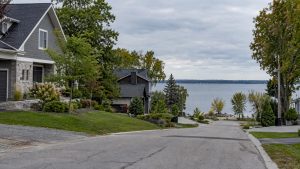
Innisfil waterfront properties show strong seasonal income patterns, with summer revenues commonly 30–50% higher than winter. Friday Harbour’s year-round amenity base narrows that gap more than a comparable property on a quieter stretch of Lake Simcoe. For buyers weighing waterfront property types near Toronto, that seasonality difference is a material factor in annual income projections.
Key takeaways
Resort amenities raise rental rates by increasing perceived guest value, extending the bookable season, and improving listing performance on platforms like Airbnb and Vrbo.
| Point | Details |
|---|---|
| Pools and hot tubs lead revenue impact | Pools can lift ADR 20–30%; hot tubs deliver 15–30% higher nightly rates and year-round bookings. |
| Marketing captures the value | Dynamic pricing and professional photography are required to convert amenity features into actual revenue. |
| Indoor amenities stabilise income | Hot tubs, saunas, and game rooms reduce the summer-only revenue concentration that affects most Innisfil properties. |
| ROI depends on operating costs | A hot tub typically pays back in roughly three years; a pool requires higher occupancy and ADR to break even. |
| Karinrotem guides local decisions | The Karin Rotem team provides Friday Harbour expertise, ROI modelling, and listing guidance for Toronto and Innisfil investors. |
My perspective on amenities and rental value in Toronto and Innisfil
What I tell my clients most often is this: the amenity is not the investment. The decision to buy the right property in the right community is the investment. A hot tub in the wrong building, or in a municipality that restricts short-term rentals, earns nothing.
The clients I see make the best returns are not necessarily the ones who spent the most on upgrades. They are the ones who confirmed STR permissions before closing, hired a photographer before their first listing went live, and set up dynamic pricing in the first week. The amenity gave them the rate ceiling; the operations captured it.
Friday Harbour is a genuine case where community amenities justify a price premium that holds across seasons. But even there, I advise clients to verify their specific building’s condo rules before assuming rental income is possible. Two buildings on the same street can have entirely different policies.
When a client asks whether to add a pool, my honest answer is usually: run the numbers first, and make sure your listing is fully optimised before you spend $75,000. Most of the time, better photography and dynamic pricing close half the gap at a fraction of the cost.
How Karinrotem can help you act on this
If you are evaluating an income property in Innisfil, Friday Harbour, or the greater Toronto area, the Karin Rotem team offers the local market knowledge and investor-focused guidance to make that decision confidently. We can walk you through a customised ROI model for a specific property, review which amenities are permitted under the relevant condo or municipal rules, and connect you with the right listing strategy from day one.
Whether you are buying your first Friday Harbour property or expanding a short-term rental portfolio, reach out to discuss your goals. You can also browse current listings to see how amenity-equipped properties are priced in today’s market.
Useful sources and links for regulations, market data, and further reading
- Canadian Real Estate Wealth — Seasonal Income Renovations: ADR and RevPAR uplift data for pools, hot tubs, and saunas in Canadian cottage markets.
- Nurture Stays — GTA Airbnb Data: Revenue analysis for 296 GTA listings; pool and hot tub premium data.
- Aion Appraisals — Innisfil Investment Analysis: Local seasonality data and income normalisation guidance for Innisfil waterfront properties.
- Friday Harbour Resort — CondoTrend: Overview of Friday Harbour community amenities and year-round positioning.
- OwnInAZ — Listing Photography Best Practices: Photography and staging guidance applicable to amenity-rich short-term rental listings.
- HydeawayStay — Canmore STR Investment Analysis: Dynamic pricing, marketing capture rates, and operational best practices for resort-market STRs.
- Airbtics — Canada STR Market Report 2025: National supply growth and revenue trends for Canadian short-term rental markets.
- Town of Innisfil — Short-Term Rental Licensing: Confirm current STR licensing requirements and bylaw rules directly with the municipality.
- Lake Simcoe Region Conservation Authority: Shoreline and setback rules relevant to waterfront property additions.
FAQ
Do resort amenities always increase rental rates?
Not automatically. Amenities raise your rate ceiling, but professional photography and dynamic pricing are required to capture that potential. A poorly presented listing with a hot tub will often underperform a well-marketed listing without one.
Which amenity gives the best return for an Innisfil property?
A hot tub is typically the strongest single investment for Ontario cottage and waterfront properties. It delivers 15–30% higher nightly rates, extends bookings into the shoulder and winter seasons, and costs far less to install and maintain than a pool.
Do Friday Harbour properties allow short-term rentals?
STR permissions vary by building within Friday Harbour. Some buildings permit short-term rentals; others restrict them through condo declarations. Always confirm the specific building’s rules before purchasing for income purposes.
How does dynamic pricing affect amenity revenue capture?
Dynamic pricing tools like PriceLabs or Wheelhouse adjust your nightly rate based on real-time demand, local events, and competitor listings. GTA data shows dynamic pricing delivers a 51% revenue boost over static pricing, making it one of the highest-return operational decisions an owner can make.
What should I check before listing a pool or hot tub on Airbnb or Vrbo?
Confirm your insurance policy includes a short-term rental endorsement covering water features, verify your municipality’s STR bylaw and licensing requirements, and review your condo declaration if applicable. Missing any of these steps can void your coverage or result in a bylaw fine.