Title insurance protects your legal ownership and financial equity from hidden title problems that existed before your closing date. The role of title insurance in home buying comes down to one practical reality: a title search can miss things, and when it does, you need a policy that covers the gap. Here is what every buyer should know before signing:
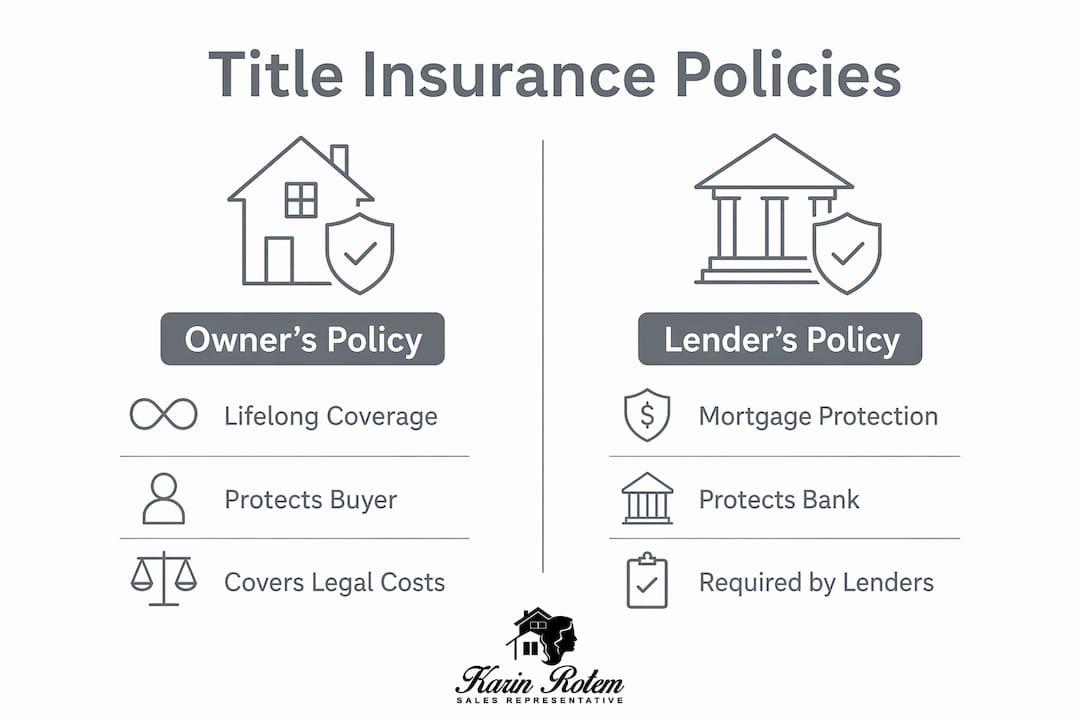
- Lender’s policy: Required by nearly all mortgage lenders in Canada as a condition of financing. It protects the bank, not you.
- Owner’s policy: Optional, but it protects your equity and covers your legal costs if a title problem surfaces after closing.
- One-time premium: Paid at closing, no annual renewals.
- My advice to every client: Ask your lawyer by name to order an owner’s policy. Many lawyers default to arranging only the lender’s policy unless you explicitly request otherwise.
If a fraudulent mortgage is registered against your property and you have only a lender’s policy, the bank is compensated. You are left to fund your own legal defence, which in complex title fraud cases can exceed $20,000.
What does ‘title’ mean and how does title insurance work in Canada?
“Title” is your legal right to own and use a piece of land. When you buy a home, title transfers to you through a closing process handled by your lawyer or notary, who registers the transfer at the provincial land titles office. That registration is the public record of your ownership.
Your lawyer conducts a title search before closing, reviewing public records to confirm the seller has clean, transferable ownership. The problem is that public records are not perfect. A recording error, a missing heir from a decades-old estate, or a forged signature on a past transfer can exist in the chain of title without appearing in any search. Title insurance is the second layer of defence that captures those hidden risks.
A real example: A homeowner in Ontario discovers, two years after closing, that a sibling of the previous owner claims an interest in the property through an old estate that was never properly wound up. Without title insurance, the homeowner funds the legal fight personally. With an owner’s policy, the insurer steps in, covers legal costs, and resolves the claim.
Unlike home insurance, which covers future events like fire or flood, title insurance covers past, undiscovered problems that already existed at the time of purchase. The premium is a one-time cost at closing, and coverage on an owner’s policy lasts as long as you own the property.

Owner’s policy versus lender’s policy: what is the real difference?
Understanding this distinction is the most practical thing a buyer can do before closing.
Lender’s title insurance
The lender’s policy protects your mortgage lender’s financial interest in the property. Most lenders require it as a financing condition. Coverage is tied to the outstanding mortgage balance, so it declines as you pay down the loan. When the mortgage is discharged, the lender’s policy ends. If you refinance with a new lender, a new lender’s policy is typically required.
Owner’s title insurance
An owner’s policy protects you for as long as you own the property, regardless of your mortgage balance. It covers title fraud, undisclosed liens, survey errors, zoning non-compliance, and your legal costs to defend ownership. Coverage does not shrink over time. Many policies also extend protection to your heirs if they inherit the property.

What happens when title fraud occurs with only a lender’s policy? The bank recovers its loss. You do not. The legal costs to restore your title come out of your own pocket.
Typical cost shape: The one-time premium for a combined lender and owner policy is often only modestly more than a lender-only policy. An owner’s policy typically adds a modest incremental cost to the base premium, while a new survey can cost thousands of dollars.
Pro Tip: Before your closing appointment, call or email your lawyer and ask directly: “Have you ordered an owner’s title insurance policy for me, not just the lender’s policy?” That one question can save you from a very expensive gap in coverage.
- Owner’s policy: covers you, lasts as long as you own the property, covers legal defence costs.
- Lender’s policy: covers the bank, declines with the mortgage balance, ends at discharge.
- Cost difference: modest one-time increment for owner’s coverage versus potentially significant legal exposure without it.
What does title insurance cover, and what does it exclude?
Typical coverages
| Risk | What title insurance typically does |
|---|---|
| Title fraud or forgery | Covers legal costs and financial losses to restore your ownership |
| Undisclosed liens or mortgages | Pays off or defends against claims from the previous owner’s creditors |
| Missing heirs or estate claims | Covers legal defence and any settlement costs |
| Errors in public records | Corrects or compensates for registration mistakes |
| Survey or boundary defects | Covers encroachments or boundary disputes that pre-date your purchase |
| Unpaid property taxes or utility liens | Protects against claims registered before closing |
| Undisclosed easements | Covers losses from easements not revealed in the title search |
| Unpaid condo common fees | Protects against arrears registered against the unit before closing |
Insurers will sometimes “insure over” minor defects, such as a small encroachment or a missing building permit for an older deck, to keep the closing on schedule. This is a practical benefit that can speed up your closing without requiring the seller to resolve every minor irregularity first.
Common exclusions buyers must know
What title insurance does not cover is just as important as what it does. A regulator-backed summary makes this clear: construction quality issues and environmental hazards like underground oil tanks are outside the scope of title insurance. Read your policy’s exclusions before closing.
Typical exclusions include:
- Construction defects or poor workmanship (covered by home warranty or inspection, not title insurance)
- Environmental contamination, including old oil tanks or soil issues
- Defects the buyer creates after purchase
- Zoning or planning violations that arise after the purchase date
- Routine home-condition issues that a home inspection would catch
The practical takeaway: title insurance and a home inspection for condo purchases or any residential property serve different purposes. One protects your legal ownership; the other assesses physical condition. You need both.
Do you need title insurance, and when should you buy it?
Title insurance is not legally mandatory for residential buyers in Canada. Provincial regulators, including FSRA in Ontario and the Autorité des marchés financiers in Québec, do not require it by law. That said, most mortgage lenders require a lender’s policy as a financing condition, so in practice, you will be buying one regardless.
The real question is whether to add an owner’s policy on top of the lender’s policy.
What I tell my clients: Owner’s title insurance is most valuable when the property has a long history, an older survey, or any uncertainty about past permits or ownership. For a brand-new build with a clean title history, the risk is lower. For an older home, an estate sale, or a waterfront cottage with decades of informal use, the owner’s policy is one of the best small investments you can make at closing.
Scenarios where an owner’s policy is strongly recommended:
- Older homes with multiple past owners or complex estate histories
- Properties sold through an estate or power of attorney
- Homes with no recent survey or where the survey predates major renovations
- Condo purchases, where common fee arrears or shared-space disputes can create title complications
- Properties with unpermitted additions or municipal permit uncertainty
Timing: Your lawyer or notary orders the policy during the closing process. The premium appears as a line item on your closing costs statement and is paid at closing. You do not need to arrange it independently; your lawyer handles the paperwork with the insurer.
How to buy title insurance in Canada and how claims work
How the policy is ordered
- Your lawyer or notary contacts a title insurer (major Canadian providers include FCT and Stewart Title) and provides property details, purchase price, and mortgage information.
- The insurer reviews the title search results and issues a commitment to insure.
- The premium is calculated based on property value and province, typically $200–$500 for most Canadian properties, though it can reach $1,000 in higher-value markets like Toronto.
- The premium appears on your closing statement. You pay it once, at closing, alongside your other closing costs.
- Your lawyer delivers the policy to you after closing. Keep it with your other closing documents.
Title insurance can also remove the need for a new survey in many transactions, saving buyers the cost and delay of commissioning one. If you plan to build a fence or add a structure, however, a survey is still the only way to precisely establish your boundaries.
How to make a claim
The claims process follows a clear sequence:
- Discover the defect. You or your lawyer identify a title problem, such as an unknown lien, a fraud registration, or a boundary dispute.
- Notify the insurer promptly. Contact your title insurer directly or have your lawyer do so. Delays in notification can complicate a claim.
- Provide documentation. The insurer will ask for your policy, closing documents, and any evidence of the defect or claim against you.
- Insurer investigates. The insurer reviews the claim, may engage its own legal counsel, and determines coverage.
- Resolution. The insurer either resolves the defect (by paying off a lien, defending a lawsuit, or clearing a fraudulent registration) or compensates you for a covered financial loss.
Legal defence coverage is one of the most underappreciated benefits. The insurer’s lawyers handle the fight, not yours.
Practical advice: what I tell my clients at closing about title insurance
The paperwork at closing moves fast, and title insurance is easy to overlook. Here is how to stay on top of it.
Questions to ask your lawyer before closing
- “Have you ordered an owner’s title insurance policy for me, separate from the lender’s policy?”
- “What insurer are you using, and what does the policy cover?”
- “Are there any title issues you are insuring over rather than resolving? What are they?”
- “Will I receive a copy of the policy after closing, and where should I keep it?”
- “Is there anything in the title search that would make you recommend a new survey?”
How I coordinate this with my clients
As your realtor, I flag the title insurance question early in the closing process and follow up with your lawyer to confirm an owner’s policy has been ordered. I also make sure you receive a copy of the policy with your closing package, not just the lender’s documents.
The trade-off is straightforward: the incremental cost of an owner’s policy is modest at closing. The cost of clearing a fraudulent title registration or defending an estate claim without insurance is not. For older homes, estate sales, and waterfront properties near Toronto with older surveys and informal histories, I consider owner’s coverage non-negotiable.
- Confirm owner’s policy is ordered, not assumed.
- Get a copy of the policy and store it with your deed and closing documents.
- Ask about any issues being “insured over” so you understand what the policy is covering.
- If you plan to build or fence, ask whether a survey is still needed despite the insurance.
Key takeaways
Owner’s title insurance protects your legal ownership and covers your legal costs; the lender’s policy only protects the bank, making an owner’s policy the smarter choice for buyers who want real peace of mind.
| Point | Details |
|---|---|
| Owner’s vs lender’s policy | The lender’s policy protects the bank; only an owner’s policy protects your equity and legal costs. |
| Not legally mandatory | Title insurance is not required by law in Canada, but lenders require a lender’s policy as a financing condition. |
| One-time premium | The premium is paid once at closing, typically $200–$500, and owner’s coverage adds a modest increment. |
| When it matters most | Older homes, estate sales, condo purchases, and properties with no recent survey carry the highest title risk. |
| Karinrotem’s advice | Ask your lawyer directly to order an owner’s policy; Karinrotem’s team confirms this step for every buyer they represent. |
A realtor’s honest take on title insurance
There is a gap between what buyers assume and what actually happens at closing. Most buyers I work with assume their lawyer is automatically ordering the best possible coverage. The reality is that lawyers are focused on getting the deal closed, and the owner’s policy is an optional add-on that requires the buyer to ask for it.
In Toronto closings, I see title fraud risks more often than buyers expect, particularly with properties that have changed hands multiple times or carry older mortgages that were not cleanly discharged. In Innisfil and around Friday Harbour, the risk profile shifts toward older waterfront cottages with unpermitted additions, surveys from the 1980s, and informal easements that were never properly registered. An owner’s policy on those properties is not a formality; it is genuine protection.
The conventional wisdom says title insurance is “just another closing cost.” I disagree. For the incremental premium, you are buying the insurer’s legal team and financial backing if something goes wrong. That is a trade worth making on almost every purchase, and it is especially worth making when the property has any history at all.
My advice: treat the owner’s policy as a standard part of your closing checklist, not an optional extra. Ask for it by name, keep the policy document, and know your insurer’s claims number before you need it.
How my team helps you through the closing process
Buying a home in Toronto or Innisfil involves more moving parts than most buyers anticipate, and title insurance is one detail that can slip through the cracks without the right guidance. My team at Karinrotem coordinates directly with your lawyer and lender throughout the closing process, including confirming that an owner’s title insurance policy has been ordered on your behalf.
We provide a closing checklist tailored to your property type, flag any title concerns that come up during the transaction, and make sure you leave closing with a complete set of documents, including your title policy. Whether you are purchasing a primary home in Toronto, a vacation property near Innisfil, or a waterfront property at Friday Harbour, we handle the coordination so nothing falls through the cracks. Reach out to our team to get your personalised closing checklist and discuss any title questions specific to your property.
Authoritative Canadian sources and further reading
- Financial Consumer Agency of Canada (canada.ca): Federal overview of home insurance types, including title insurance, with plain-language explanations for consumers.
- WOWA.ca title insurance guide: Detailed breakdown of Canadian title insurance costs, coverage, and provincial variations.
- FCT (First Canadian Title): One of Canada’s major title insurers; their blog covers owner’s policy benefits in depth.
- Scotiabank title insurance explainer: Bank-level consumer guidance on how title insurance differs from home insurance.
- Autorité des marchés financiers (AMF), Québec: Québec’s financial regulator explains title insurance coverage and exclusions for consumers.
- Mills & Mills LLP: Ontario law firm perspective on when title insurance is necessary and what it covers.
- WealthNorth title insurance guide: Practical Canadian guide covering costs, coverage comparisons, and practitioner advice.
Check your province’s land titles office or insurance regulator for province-specific rules. Ontario buyers can consult FSRA; Alberta buyers should note that lawyers are not required to discuss owner’s title insurance options with clients, making it especially important to ask proactively.
FAQ
Is title insurance mandatory in Canada?
Title insurance is not legally required for buyers in Canada, but most mortgage lenders require a lender’s policy as a condition of financing.
What does title insurance cover for a homeowner?
An owner’s policy covers title fraud, undisclosed liens, missing heir claims, survey errors, errors in public records, and your legal costs to defend ownership, for as long as you own the property.
How much does title insurance cost in Canada?
The one-time premium typically ranges from $200–$500 for most Canadian properties, though it can reach $1,000 in higher-value markets like Toronto. An owner’s policy adds a modest increment on top of the lender’s policy premium.
Does title insurance replace the need for a home inspection?
No. Title insurance protects your legal ownership against hidden title defects; a home inspection assesses the physical condition of the property. You need both, as they cover entirely different risks.
How do I make a title insurance claim?
Notify your insurer as soon as you discover a title problem, provide your policy and closing documents, and the insurer will investigate and either resolve the defect or compensate you for a covered loss, as outlined by DCMLaw’s claims guidance.