
An assignment sale is when the original buyer of a pre-construction unit sells their purchase contract to someone else before the unit closes. The original buyer is the assignor; the new buyer stepping into their place is the assignee. No title changes hands yet — what transfers is the right to complete the purchase under the existing Agreement of Purchase and Sale (APS). If you’re looking at an assignment right now, your first two moves are simple: read the assignment clause in the APS, and get a lawyer who handles pre-construction assignments regularly.
What does an assignment sale mean in plain language?
An assignment sale transfers the assignor’s contractual rights under the APS to the assignee before the unit is registered or title is transferred. The assignee literally steps into the original buyer’s shoes and takes on all obligations to the builder from that point forward.

This is different from a standard resale, where a registered title changes hands. In an assignment, the unit often doesn’t even exist yet as a legal entity on title.
Key terms to know:
- Assignor: The original buyer who signed the APS with the builder and now wants to exit.
- Assignee: The new buyer who pays the assignor and takes over the contract.
- Lift: The profit the assignor earns above their original purchase price.
- APS (Agreement of Purchase and Sale): The original contract between the buyer and the builder.
- Builder consent: Written approval from the developer allowing the assignment to proceed.
A quick scenario: You sign an APS in 2022 for a pre-construction condo at a certain price. By 2024, comparable units are selling for higher prices. You need to relocate. You find an assignee willing to pay a higher amount. They reimburse your deposits, pay you the difference in price (the lift), and take over your contract. They close with the builder when the unit registers.
The ability to assign depends entirely on the language in your APS. If the clause is restrictive or silent, you may not be able to assign without the builder’s written consent — or at all.

How does an assignment sale work in Ontario, step by step?
Pre-construction timelines commonly span 2–5 years between signing and occupancy. That’s a long time for life to change — which is exactly why assignment demand exists.
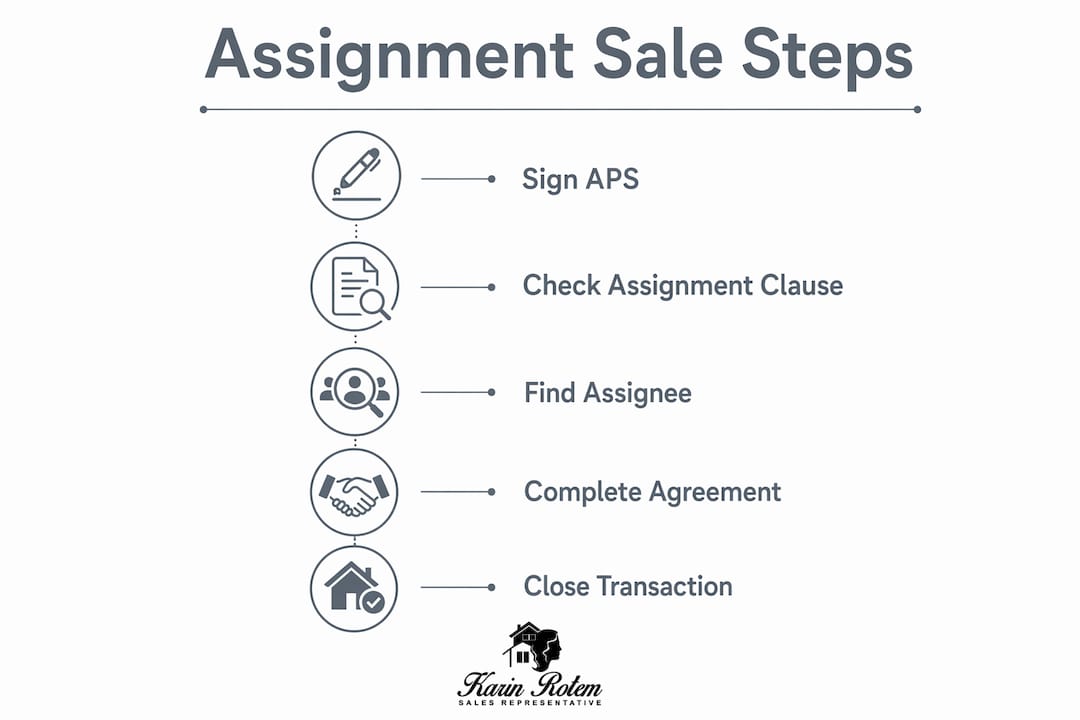
Here’s the typical sequence:
- Review your APS assignment clause. Confirm whether assignment is permitted, whether builder consent is required, and what the assignment fee will be.
- Find an assignee. Work with an agent experienced in assignments to locate a qualified buyer through assignment marketplaces, agent networks, or MLS listings flagged for assignment like those supported by real estate photo editing for agents.
- Negotiate the assignment price. Agree on the lift amount, how deposits are structured, and any conditions.
- Request builder consent. Submit a formal request to the developer. Most builders charge an assignment fee, typically an amount that varies depending on the project.
- Execute the assignment agreement. Both parties sign a formal assignment agreement — not just the standard OREA Form 150. A lawyer should draft custom schedules to address deposit security, closing conditions, and liability.
- Assignee pays deposits and lift. At signing of the assignment agreement, the assignee typically reimburses the assignor’s deposits and pays the lift (or a portion of it), with the remainder at final closing.
- Assignee closes with the builder. On the final closing date, the assignee completes the purchase directly with the developer. The assignor is generally out of the picture — unless they haven’t received a written release.
Where assignors stay exposed:
- If the builder hasn’t issued a formal written release, the assignor can remain liable if the assignee fails to close.
- Profit from the lift is typically not received until final closing, meaning the assignor’s money is tied up until then.
Why do people use assignment sales?
Assignment sales serve a real purpose for both sides of the transaction. The question is whether the timing and terms make sense for your specific situation.
For assignors (sellers):
- Exit without penalty. Life changes — job relocations, family shifts, financial pressure — can make it impossible to close. Assignment lets you exit the contract rather than default on it.
- Capture market appreciation. If the market has moved since you signed, the lift can represent meaningful profit.
- Recover deposits. At minimum, you get your deposits back. In a rising market, you get considerably more.
For assignees (buyers):
- Access to sold-out projects. Many desirable buildings sell out quickly. Assignment is often the only way in.
- Potential pricing advantage. In a softening market, assignors motivated to exit may accept a price below current new-build pricing.
- Shorter wait. If the project is near completion, the assignee may be months away from occupancy rather than years.
Situations where assignment makes sense:
- An investor who bought pre-construction as a flip and wants to realize gains before closing.
- A buyer who relocated out of province before their unit registered.
- Someone who can no longer qualify for the mortgage they expected when they signed.
Pro Tip: If you’re an assignee considering a unit in a lifestyle community like Friday Harbour, check the buyer rules specific to that community before you sign anything — some developments have restrictions that affect your ability to rent or resell after closing.
What are the main risks in an Ontario assignment sale?
Assignment sales sit at the intersection of builder contract law, tax law, and closing risk. What looks like a clean exit can get complicated fast.
Key risks to understand:
- Builder refusal. The developer can decline to consent, especially if the APS requires it. Some builders restrict assignments entirely to protect their own sales program.
- Ongoing liability for the assignor. Without a formal written release from the builder, the assignor remains on the hook if the assignee defaults at closing. This is one of the most misunderstood risks in the process.
- Assignee financing failure. The assignee may be unable to secure a mortgage by closing day. Lenders treat assignment purchases differently from standard resales, and appraisals on pre-construction units can come in below the agreed price.
- Market movement. If the market drops between the assignment signing and final closing, the assignee may walk away, leaving the assignor scrambling.
- HST rebate clawbacks. If the builder priced the unit assuming the buyer would qualify for the HST new housing rebate, and CRA determines the property was purchased as an investment, that rebate can be clawed back at closing.
Pro Tip: Insist on the assignee’s deposits being held in trust and use a conditional assignment agreement that protects you if the assignee can’t fund closing. A standard form alone won’t give you this protection.
Tax and HST implications you need to understand
This is where most buyers get caught off guard. The CRA generally treats profit from an assignment sale as taxable business income, not a capital gain — particularly when the original purchase was investment-driven. That distinction matters because business income is taxed at your full marginal rate, while capital gains receive preferential treatment.
HST adds another layer. The assignment transaction itself may be subject to HST on the profit or on the full transaction value, depending on how CRA characterises the deal.
| Tax issue | What it means for you |
|---|---|
| Business income vs. capital gain | CRA often treats assignment profit as business income, taxed at your marginal rate |
| HST on the assignment | HST may apply to the lift amount or the full price — get CRA guidance or consult an accountant |
| HST new housing rebate clawback | If CRA deems the purchase investment-driven, the rebate can be clawed back at closing |
| Builder rebate assumptions | Many builders price units assuming the buyer qualifies for the rebate — verify this in your APS |
The HST new housing rebate clawback can reach up to about $24,000 in some cases, according to Nanda & Associate Lawyers. That’s a notable closing-day liability that many assignees don’t see coming.
The Canada Revenue Agency publishes specific guidance on the assignment of a purchase and sale agreement for a new house or condominium unit — this is the primary source to review with your accountant before you proceed.
What I tell my clients: Don’t assume your tax situation mirrors someone else’s. The CRA’s treatment depends on your original intent, how long you held the contract, and whether you’ve done this before. Get a tax professional involved early, not after the assignment agreement is signed.
This article is general information, not tax or legal advice. Confirm your specific situation with a qualified accountant and a real estate lawyer before proceeding.
Legal checklist: what to verify before you sign
Relying on a standard form without custom legal schedules can lead to unforeseen costs and exposure. Here’s what to have your lawyer review:
Professionals you need:
- A real estate lawyer experienced specifically in pre-construction assignments (not just general real estate).
- A mortgage broker who has arranged financing for assignment purchases before.
- A real estate agent who regularly handles assignment transactions and knows the builder’s consent process.
Contract points to verify:
- Assignment clause language: Does the APS permit assignment? Is builder consent required? What are the conditions?
- Builder consent process: How long does it take? What documentation is required?
- Assignment fee: How much, and in what form does the builder require payment?
- Release wording: Does the builder’s consent include a formal written release of the assignor? If not, negotiate for one.
- Deposit security: Are the assignee’s deposits held in trust? What happens if the assignee defaults?
- Side agreements: Are there any representations or warranties in the original APS that the assignee needs to honour?
Questions to bring to your first lawyer meeting:
- Does this APS allow assignment without consent, or is consent mandatory?
- What does the builder’s standard assignment fee cover, and is it negotiable?
- Will the builder issue a written release of my obligations at the time of assignment?
- What custom schedules should be added to the assignment agreement to protect me?
How to find assignment listings in Ontario
Assignment listings don’t always appear on MLS the way standard resales do. Knowing where to look gives you a real advantage.
Where to find assignment listings:
- Assignment-specific marketplaces: Several online platforms in Ontario aggregate pre-construction assignment listings from agents and developers.
- Agent networks: Many assignments are handled off-market through agent-to-agent referrals. An agent who specialises in assignments will have access to inventory that never hits a public portal.
- MLS with assignment flag: Some assignments are listed on MLS; search for listings that specify “assignment sale” in the remarks.
- Social media and community groups: Facebook groups and real estate forums often surface assignment opportunities, though due diligence is critical here.
- Direct builder inquiry: Some builders maintain a list of assignors looking to exit — worth asking.
Buying steps for assignees:
- Confirm the full APS terms, not just the price. You’re inheriting every obligation in that contract.
- Verify the deposit history. How much has the assignor paid, and is it fully documented?
- Check builder consent status. Has it been requested? What are the conditions?
- Arrange financing early. Lenders treat assignment purchases differently, and some won’t lend on unregistered units.
- Negotiate the lift structure and deposit reimbursement timing carefully. Protect yourself with a conditional assignment agreement that addresses assignee default.
For buyers considering waterfront investment properties near Toronto, assignment can be an efficient entry point into a sold-out project — but only when the legal and financial groundwork is solid.
Key takeaways
An assignment sale transfers contractual rights, not title — and the tax, legal, and financing implications make it a transaction that requires specialist guidance at every step.
| Point | Details |
|---|---|
| Check your APS first | The assignment clause controls whether you can assign at all and what builder consent is required. |
| Assignor liability persists | Without a written release from the builder, you remain liable if the assignee defaults at closing. |
| HST rebate clawback risk | CRA can claw back the HST new housing rebate if the purchase is deemed investment-driven. |
| Tax treatment is complex | Assignment profits are often taxed as business income, not capital gains — get an accountant involved early. |
| Karinrotem guides both sides | Working with an assignment-experienced agent like Karin Rotem helps you find listings, negotiate lift, and coordinate the legal and tax professionals you need. |
What I actually tell my clients about assignment sales
Most people come to me thinking an assignment is a straightforward exit. It can be — but only when the contract language, tax exposure, and release wording are all handled properly from the start.
What I see most often: an investor who bought a pre-construction unit in Toronto or Innisfil, the market shifted, and now they want out before closing. The instinct is to find a buyer fast and move on. The problem is that “fast” in an assignment context can mean skipping the release negotiation, which leaves the original buyer exposed for months or years after they thought they were done.
The scenarios where I genuinely recommend assignment: a client relocating for work who can’t close, an investor who bought at a strong price and wants to capture the lift rather than hold through occupancy, or a buyer who simply can no longer qualify for the mortgage. In those cases, assignment is the right tool.
Where I advise against it: when the tax exposure on business income would eat most of the lift, when the builder’s assignment fee is punitive, or when the assignee’s financing looks shaky. A conditional assignment agreement with deposits held in trust is non-negotiable in my practice — standard forms without custom schedules leave too much unprotected.
The Friday Harbour market adds another layer. Units there have specific community rules and resale timelines that affect how an assignment plays out. Local knowledge matters here more than it does in a generic downtown Toronto condo tower.
Working with Karinrotem on your assignment transaction
If you’re weighing an assignment sale — whether you’re looking to exit a pre-construction contract or step into one — Karinrotem’s team brings the local market knowledge and professional network to make it work. Karin Rotem and her team help clients find assignment listings, negotiate lift and deposit terms, and coordinate with the assignment-experienced lawyers and accountants the transaction requires. That coordination matters: an assignment that closes cleanly is one where the legal, tax, and financing pieces were aligned from day one, not patched together at the last minute.
Browse current property listings to see what’s available in Toronto and Innisfil, or reach out directly to talk through your specific situation.
Useful sources and recommended reading
Before your first meeting with a lawyer or accountant, review these primary sources:
- Canada Revenue Agency — Assignment of a Purchase and Sale Agreement: The CRA’s own guidance on HST treatment for assignment transactions. Bring this to your accountant meeting.
- Tarion Warranty Corporation: Ontario’s new home warranty authority. Relevant for understanding what warranties transfer (or don’t) through an assignment.
- Merovitz Potechin LLP — Assignment of Residential Real Estate Transactions: A detailed legal series on how assignment works in Ontario, covering APS language and consent mechanics.
- Nanda & Associate Lawyers — Assignment Sale Lawyer Brampton: Practical guidance on HST exposure, rebate clawbacks, and the risks of standard-form agreements.
- Wolf Law — Hidden Risks of Assigning a Pre-Construction Home: Focused specifically on assignor liability and the importance of written releases.
Bring these links to your first professional meeting. They give your lawyer and accountant a clear picture of the issues you’ve already identified — and that saves time.
FAQ
What does an assignment sale mean in real estate?
An assignment sale is the transfer of a buyer’s rights under an Agreement of Purchase and Sale to a new buyer before the property closes and title is registered. The new buyer (assignee) takes over the contract and completes the purchase with the builder.
Is it a good idea to buy an assignment sale?
It can be, particularly for accessing sold-out projects or negotiating a motivated seller’s price. The key risks are financing complexity, potential HST adjustments, and inheriting all obligations in the original APS — so thorough due diligence and a specialist lawyer are non-negotiable.
Do you pay capital gains on an assignment sale in Canada?
Not necessarily. The CRA generally treats assignment profits as business income, not capital gains, especially when the original purchase was investment-driven. This means the profit is taxed at your full marginal rate. Consult a tax professional for your specific situation.
How does an assignment sale work in Ontario?
The assignor finds a buyer, negotiates the lift and deposit terms, obtains builder consent, and both parties sign an assignment agreement. The assignee then closes directly with the builder on the final closing date. The assignor should obtain a written release from the builder to avoid ongoing liability.