A real estate commission structure is the framework that determines how agents and brokerages earn their fees from a property transaction. In Canada, total commissions typically range from 4% to 6% of the final sale price, split between the listing agent and the buyer’s agent. Understanding what is a real estate commission structure matters more than ever in 2026, because regulatory changes introduced in 2024 shifted how those fees are negotiated and who is responsible for paying them. Whether you are buying, selling, or investing in Toronto, Innisfil, or Friday Harbour, knowing how this system works puts you in a far stronger position at the negotiating table.
What is a real estate commission structure and how is it calculated?
The national average total commission sits at approximately 5.7% of the home’s final sale price. On a $500,000 transaction, that equals $28,500 in total commission fees. That number is not arbitrary. It reflects the combined compensation for two agents, two brokerages, and the full cost of marketing, negotiation, and transaction management.
The total commission is typically divided between the listing agent and the buyer’s agent, with each side receiving roughly 2.5% to 3%. What most buyers and sellers do not realise is that the commission does not go directly into the agent’s pocket. Commissions flow to brokerages first, which then distribute a share to the individual agent based on an internal split agreement.

Payment always happens at closing. The commission is deducted from the sale proceeds before the seller receives their net amount. No successful closing means no commission. Agents carry financial risk for every deal that falls through, covering their own marketing and overhead costs without any guarantee of payment.
How brokerage splits work
Brokerage splits vary widely and directly affect how motivated your agent is to close your deal. Common arrangements range from 50/50 splits to 80/20 in favour of the agent, depending on the agent’s experience and the brokerage’s policies. Some brokerages charge a flat monthly fee instead of taking a percentage cut. A newer agent on a 50/50 split earns $7,125 from a $28,500 total commission on a $500,000 sale. A senior agent on an 80/20 split earns $11,400 from the same transaction.
Pro Tip: Ask your agent directly about their brokerage split. An agent keeping a larger share of the commission has a stronger financial incentive to negotiate hard on your behalf.
What are the different types of commission structures?
Traditional percentage-based commissions are the most common model in Canada, but they are not the only option. Understanding the alternatives helps you choose the arrangement that fits your situation.
| Commission type | How it works | Best for | Downside |
|---|---|---|---|
| Percentage-based | Agent earns a set % of the sale price | Most transactions; full-service representation | Higher cost on expensive properties |
| Flat fee | Fixed dollar amount regardless of price | Budget-conscious sellers; simpler transactions | May include fewer services |
| Tiered | Rate changes based on sale price or services | Sellers wanting flexibility by price bracket | Can be complex to calculate |
| Hybrid | Combines a flat fee with a smaller percentage | Sellers wanting cost control with full service | Terms vary widely by agent |
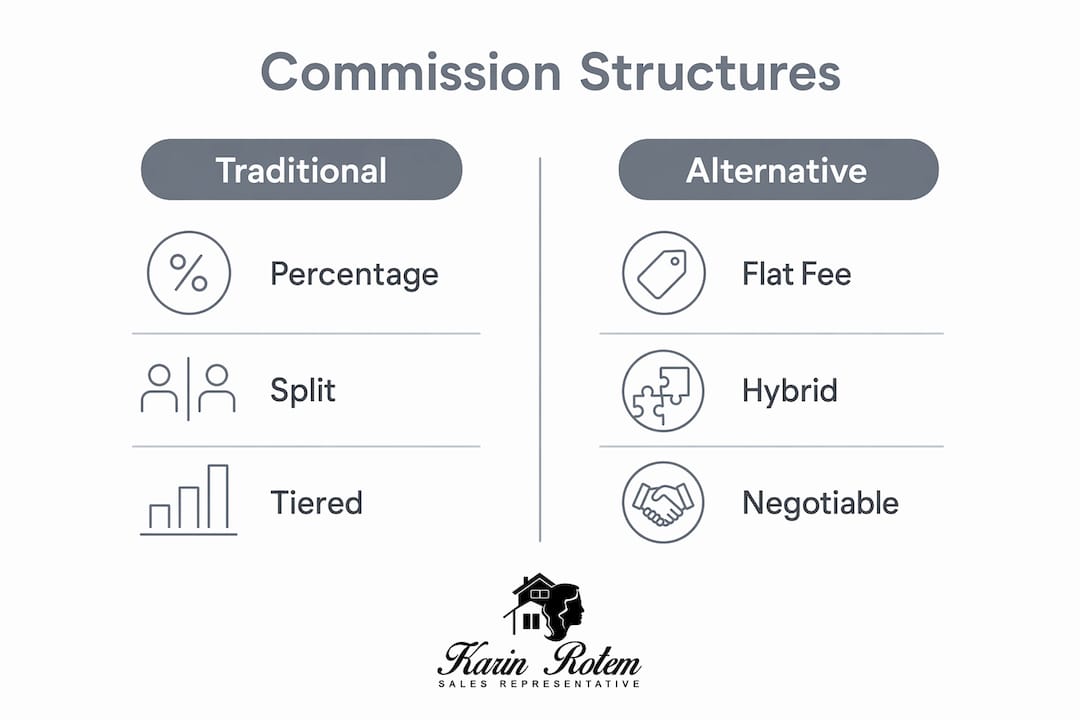
Flat-fee listings typically range from $3,000 to $7,000. That can represent significant savings on a high-value property, but the trade-off is usually reduced service. Many flat-fee arrangements exclude open houses, active buyer outreach, or negotiation support.
Tiered commission models adjust the rate based on the sale price or the scope of services delivered. For example, an agent might charge 5% on the first $500,000 and 3% on anything above that threshold. This model rewards higher sale prices with a lower marginal cost to the seller.
Hybrid structures combine a modest flat fee upfront with a smaller percentage at closing. They appeal to sellers who want some cost certainty without giving up full-service representation. The key is reading the contract carefully to understand exactly what services are included at each stage.
Who pays real estate commissions, and what changed in 2024?
Traditionally, the seller paid the full commission for both agents. That model is shifting. After the August 2024 NAR settlement, buyers became responsible for negotiating and potentially covering their own agent’s fees through a formal buyer-broker agreement.
Here is what that means in practice for buyers and sellers in 2026:
- Sellers may still offer to cover the buyer’s agent commission as a contractual concession, but it is no longer assumed or advertised on MLS listings.
- Buyers must now sign a buyer-broker agreement before touring homes, which specifies the fee arrangement with their agent.
- Gap payments can arise when a seller’s concession is less than the buyer’s agreed agent fee. The buyer covers the difference out of pocket.
- Investors purchasing income properties need to factor potential buyer-agent fees into their acquisition costs from the start.
Sellers who offer buyer-agent compensation should treat it as a competitive advantage, not an obligation. In a slower market, offering to cover the buyer’s agent fee can attract more qualified buyers and reduce days on market. In a hot market, sellers have more room to negotiate that concession away entirely.
Contractual clarity on who pays what is now the single most important protection for both parties. Verbal agreements are not enough. Every commission arrangement must be documented in writing before any offer is made.
Pro Tip: Buyers should read their buyer-broker agreement carefully before signing. Understand the fee, the duration of the agreement, and what happens if the seller does not offer compensation.
How does commission negotiation work in real estate?
Commissions are legally negotiable. No fixed fee is enforced by law, and rigid commission models may violate antitrust regulations. That protection exists for you as a buyer or seller, and you should use it.
Here is a practical approach to negotiating commissions effectively:
- Start the conversation early. Raise commission expectations in your first meeting with any agent, not after you have already committed to working with them.
- Compare service packages. A lower commission rate means nothing if the agent reduces their marketing spend or skips professional photography. Ask what is included.
- Understand the buyer-broker agreement. Buyers must now sign this document before home tours. Review the fee structure, the exclusivity period, and the termination conditions.
- Sellers: think about buyer-agent incentives. Offering a competitive buyer-agent commission can increase showing activity. In a balanced market, this tactic moves properties faster.
- Watch for gap payment risk. If you are a buyer and your agent’s fee exceeds the seller’s concession, you owe the difference. Know your numbers before you make an offer.
- Get everything in writing. Commission negotiation rights are protected, but only documented agreements are enforceable.
One myth worth addressing: many buyers believe their agent is “free” because the seller pays. Post-2024, that assumption can cost you money. The buyer-agent compensation is now a negotiated term, not a guaranteed seller expense. Going into any transaction without understanding this is the most common and costly mistake I see buyers make.
Pro Tip: Sellers negotiating in competitive Toronto or Innisfil markets should consult their agent about offer negotiation strategies before setting a commission structure. The right approach can net more even after fees.
Key takeaways
A real estate commission structure defines how agents and brokerages are paid, and understanding it fully protects both buyers and sellers from unexpected costs and missed negotiation opportunities.
| Point | Details |
|---|---|
| Total commission averages 5.7% | On a $500,000 sale, that equals $28,500 split between listing and buyer’s agents. |
| Commissions flow through brokerages | Agents receive a share based on internal splits, commonly ranging from 50/50 to 80/20. |
| Four main commission models exist | Percentage-based, flat fee, tiered, and hybrid structures each suit different transaction types. |
| Post-2024 buyers carry more responsibility | Buyer-broker agreements now require buyers to negotiate and potentially pay their own agent’s fees. |
| Commissions are always negotiable | No fixed rate is legally enforceable; document every agreed term in writing before proceeding. |
What I tell every client about commissions before we start
What I tell my clients is this: the commission conversation is not awkward. It is necessary. I have seen deals in Toronto and Innisfil where buyers walked into offers without reading their buyer-broker agreements, then faced unexpected gap payments at closing. That is entirely avoidable with one honest conversation upfront.
Post-2024, the rules changed in ways that most buyers have not caught up with yet. Sellers in Friday Harbour, for example, are now making deliberate decisions about whether to offer buyer-agent compensation as a concession. The ones who do it thoughtfully, based on market conditions and days-on-market data, consistently see better outcomes than those who simply follow what their neighbour did.
What most sellers do not realise is that a slightly higher commission offering to the buyer’s agent can generate more competing offers. More offers mean a higher sale price. The net result often favours the seller even after the additional commission cost. That is the kind of trade-off worth understanding before you list.
My honest advice: choose your agent based on their track record, their knowledge of your specific market, and the clarity of their communication. Commission rates matter, but they are one factor among many. An agent who negotiates hard, markets well, and communicates clearly will almost always deliver better value than one who simply quotes the lowest fee.
— Karin Rotem
Working with Karinrotem on your next transaction
Karinrotem works with buyers, sellers, and investors across Toronto, Innisfil, and the Friday Harbour community. Our team guides clients through commission negotiations, buyer-broker agreements, and local market conditions with the kind of specificity that generic advice cannot provide. Whether you are purchasing a primary residence, a weekend property, or an income-generating asset, we help you understand every cost before you commit. Browse our current property listings to see what is available across our core markets, and reach out directly to discuss how commission structures apply to your specific transaction.
FAQ
What is the average real estate commission in Canada?
The national average total commission is approximately 5.7% of the final sale price, typically split between the listing agent and the buyer’s agent at roughly 2.5% to 3% each.
Who pays the real estate agent commission in 2026?
Sellers traditionally pay the full commission, but post-2024 regulatory changes now require buyers to negotiate their own agent’s fees through a buyer-broker agreement, with sellers offering compensation as an optional concession.
Are real estate commissions negotiable?
Yes. Commission rates are legally negotiable in Canada, and no fixed fee is enforceable by law. Both buyers and sellers have the right to negotiate terms before signing any agreement.
What is a buyer-broker agreement?
A buyer-broker agreement is a formal contract between a buyer and their agent that specifies the agent’s fee, the duration of the relationship, and the payment terms. Signing this agreement is now required before home tours in most markets following the 2024 regulatory changes.
What is a flat-fee commission structure?
A flat-fee commission structure charges a fixed dollar amount rather than a percentage of the sale price. Flat-fee listings typically range from $3,000 to $7,000 and usually include fewer services than a full-service percentage-based arrangement.