
Property management in short-term rental (STR) investing is defined as the professional oversight of a rental property’s operations, guest experience, pricing, and maintenance to protect asset value and maximise income. The role of property management in STR investment goes far beyond collecting booking fees. It determines whether your property earns a premium or bleeds money through poor reviews, vacant nights, and deferred repairs. For Canadian investors eyeing markets like Friday Harbour or Ontario resort communities, understanding how management decisions shape returns is the difference between a thriving income property and a costly headache.
What are the key responsibilities of STR property managers?
STR property management requires hospitality, logistics, and revenue expertise that traditional rental management simply does not demand. A long-term rental manager fills a vacancy and collects rent. An STR manager re-sells your property every few days, to a new guest, at a price that shifts daily.
The core responsibilities break down into four areas:
- Dynamic pricing and listing management. Managers use tools like PriceLabs and Guesty PMS to adjust nightly rates based on demand, local events, and competitor availability. Multi-platform distribution across Airbnb, VRBO, and Booking.com keeps visibility high and vacancy low.
- Guest communications. Fast, professional responses to inquiries and issues directly affect review scores. Review scores affect search ranking. Search ranking affects bookings. The chain is direct and unforgiving.
- Cleaning and maintenance coordination. Managers schedule turnovers, vet cleaning crews, and handle repair calls. Industry best practice calls for maintenance reserves of 5–10% of gross revenue to cover routine upkeep without eroding cash flow.
- Compliance and documentation. In Ontario, STR regulations vary by municipality. A good manager tracks licensing requirements, tax remittance obligations, and platform policy changes so you are not caught off guard.
Pro Tip: Ask any prospective manager which property management software they use and how they handle platform algorithm changes. A manager without a clear answer on tech is likely managing reactively, not proactively.
What most investors don’t realise is that the algorithmic dimension of STR success is just as important as the physical property. Listing optimisation for platform search ranks directly affects how many guests even see your property. A manager who treats this seriously treats your income seriously.

How does property management affect STR financial performance?
The financial case for professional management is built on three factors: fee cost, revenue uplift, and time recovery.
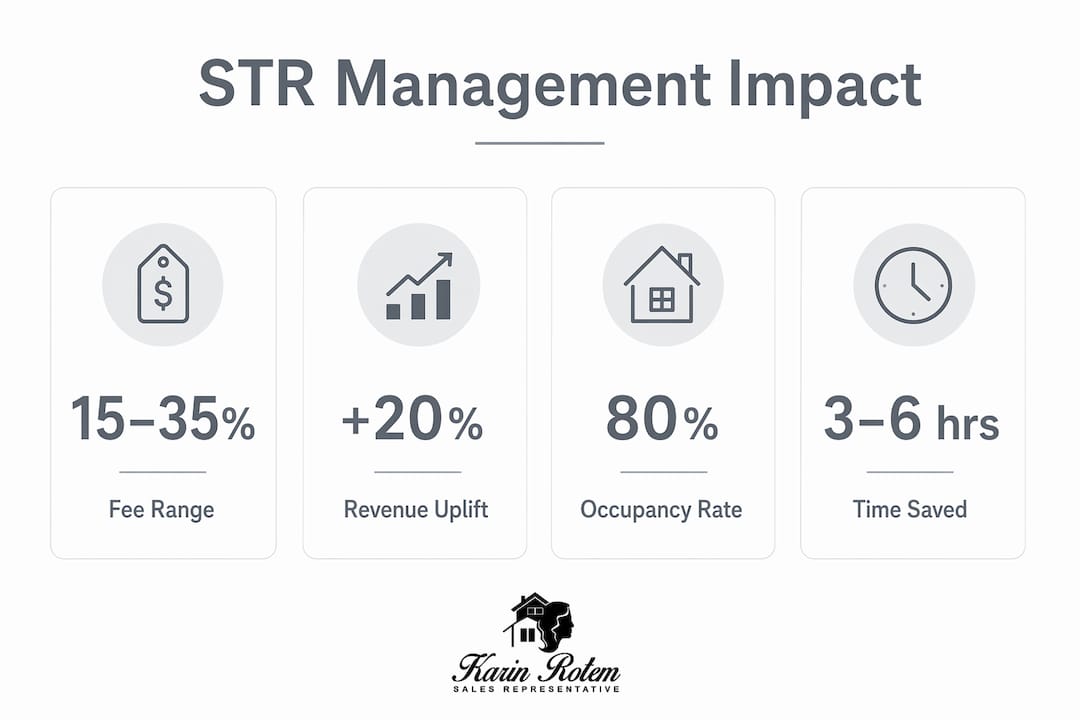
STR management fees typically range from 15% to 35% of gross revenue, with many specialised firms offering flat rates in the 18–25% range. That fee covers listing optimisation, dynamic pricing, guest communications, cleaning coordination, and proactive maintenance. Investors who focus only on the fee percentage miss the revenue side of the equation entirely.
Professional managers improve occupancy and revenue through dynamic pricing and guest satisfaction in ways that self-managed properties rarely match. A property earning $60,000 annually under self-management might generate $72,000 or more under professional management, even after fees. The net result is often higher, not lower.
| Management approach | Owner time per week | Typical fee | Revenue optimisation |
|---|---|---|---|
| Self-managed | 5–15 hours | None | Manual, reactive |
| Co-host arrangement | 2–5 hours | 10–20% | Partial, relationship-dependent |
| Full professional management | Under 1 hour | 15–35% | Dynamic, platform-integrated |
Self-managing an STR requires 5–15 hours weekly per property. Professional managers reduce that to 3–6 hours per month. For investors with careers, families, or multiple properties, that time recovery is not a luxury. It is what makes scaling possible.
Pro Tip: When underwriting an STR acquisition, model your returns using the full management fee, not a self-managed scenario. Conservative underwriting protects you if your circumstances change and you need to hand off operations.
Poor guest satisfaction and high turnover directly reduce revenue. A string of three-star reviews can drop a property from page one to page four on Airbnb within weeks. Professional management reduces that risk by maintaining consistent standards across every stay.
Self-management, co-hosting, or full management: which fits your strategy?
The right management model depends on your goals, your time, and your tax strategy. Each approach carries real trade-offs.
Self-management gives you full control and zero management fees. It works well for investors with one property, flexible schedules, and genuine interest in hospitality operations. The risk is burnout and inconsistency, especially during peak seasons when guest volume spikes.
Co-hosting sits in the middle. A co-host, often a local contact or part-time operator, handles day-to-day tasks for a fee of roughly 10–20%. You retain oversight and stay involved in pricing and major decisions. This model suits investors who want to stay engaged without managing every guest message.
Full professional management makes the most sense when you are scaling a portfolio, live far from the property, or have limited time. The mixed management setup is also worth considering for busy professionals: outsource routine operations while retaining strategic oversight yourself.
The tax dimension adds another layer of complexity. In Canada and the United States, STR investors can access significant tax advantages, but only if they meet material participation tests. Fully outsourcing all management risks failing those tests, which can eliminate deductions that make the investment financially compelling. What I tell my clients is this: you can outsource the work, but you cannot outsource the oversight. Stay involved in pricing decisions, annual planning, and manager performance reviews. That involvement preserves your tax position and keeps the manager accountable.
Key questions to ask before choosing a management model:
- How many hours per week can you realistically commit to this property?
- Do you need to qualify for STR tax benefits that require material participation?
- Is the property within driving distance, or are you managing remotely?
- Are you planning to grow to two or more properties within three years?
Your answers will point clearly toward one of the three models. If you are unsure, our STR income property checklist walks through the financial and operational factors in detail.
How does professional management preserve long-term property value?
An STR property is both an income asset and a physical asset. Poor management erodes both simultaneously. Professional management protects the physical asset through three practices that self-managed investors frequently skip.
Preventive maintenance catches small problems before they become expensive ones. A leaking tap ignored for two weeks becomes water damage. A broken lock ignored for a weekend becomes a safety incident and a one-star review. Professional managers build maintenance schedules and respond to issues between guest stays, not after a complaint.
Furniture and amenity refresh cycles matter more in STRs than in long-term rentals. Scheduled furniture replacement every 3–5 years keeps the property competitive and supports premium pricing. Guests comparing your listing to a freshly renovated competitor will choose the newer-looking space every time. Proactive asset preservation is not an expense. It is a pricing strategy.
Guest experience and review management compound over time. A property with a Superhost designation on Airbnb or a Premier Host badge on VRBO earns meaningfully more per night than an equivalent unlabelled property. Professional managers build toward those designations through consistent cleaning standards, fast communication, and thoughtful amenity curation. That reputation becomes a durable competitive advantage that supports premium pricing year after year.
The importance of property management for long-term value is not just about avoiding problems. It is about building a track record that commands higher rates and attracts better guests.
Key takeaways
Professional STR property management directly increases net returns by combining revenue optimisation, time recovery, and asset preservation into a single operational framework.
| Point | Details |
|---|---|
| Fee range context | Management fees of 15–35% are offset by revenue gains from dynamic pricing and higher occupancy. |
| Time recovery | Professional managers reduce owner involvement from 5–15 hours weekly to 3–6 hours monthly. |
| Tax participation | Investors must retain strategic oversight even when outsourcing daily operations to preserve tax benefits. |
| Asset preservation | Maintenance reserves of 5–10% of gross revenue and furniture refresh every 3–5 years protect long-term value. |
| Management model fit | Self-management, co-hosting, and full management each suit different investor profiles and portfolio sizes. |
What I’ve learned about management and STR investing in Ontario
What most investors get wrong is treating property management as a cost to minimise rather than a lever to pull. I’ve worked with investors at Friday Harbour and across Ontario resort markets who spent months self-managing to save the management fee, only to watch their review scores slip and their nightly rates stagnate. The math rarely works in their favour.
The investors who do best are the ones who vet their managers the way they vet the property itself. They ask about tech stacks, review response times, and how the manager handles a bad guest review. They treat the management relationship as a business partnership, not a service contract. At Friday Harbour specifically, the waterfront lifestyle premium is real, but it only shows up in your income if the property is presented and managed to that standard consistently.
My honest advice: if you are buying an STR as a passive investment, budget for full professional management from day one and build the fee into your underwriting. If you want to be more involved, a co-host arrangement can work well, but only if you are genuinely committed to staying on top of pricing and guest experience. Half-measures in STR management produce half-results. The right property manager is one of the most important decisions you will make after buying the property.
— Felix
How Karinrotem supports STR investors in Ontario
Karinrotem works with investors across Toronto, Innisfil, and the Friday Harbour community to identify properties with strong short-term rental potential. The team brings local market knowledge to every acquisition conversation, including realistic income projections, management cost expectations, and connections to experienced local operators. Whether you are buying your first income property or adding to an existing portfolio, Karinrotem can help you find the right fit. Browse available investment properties or explore income property options at Ontario resorts to see what the current market offers. Reach out directly for a personal consultation on your investment goals.
FAQ
What does an STR property manager actually do?
An STR property manager handles dynamic pricing, guest communications, cleaning coordination, maintenance, and platform listing management. Their role covers every operational task between the investor’s purchase decision and the guest’s checkout.
How much do STR property managers charge in Canada?
STR management fees typically range from 15% to 35% of gross revenue, with specialised firms often charging flat rates of 18–25%. The fee covers listing optimisation, pricing, guest communications, and maintenance coordination.
Can I still get STR tax benefits if I hire a property manager?
Yes, but you must retain material participation in strategic decisions. Fully outsourcing all oversight risks failing the material participation test, which can eliminate key tax deductions available to STR investors.
How does professional management affect occupancy rates?
Professional managers use dynamic pricing tools and multi-platform distribution to improve occupancy and nightly rates above what most self-managed properties achieve. Higher occupancy combined with optimised pricing produces stronger net returns even after management fees.
When does full property management make sense for an STR investor?
Full management makes the most sense when you own multiple properties, live far from the rental, or cannot commit 5–15 hours weekly to operations. It is also the right choice when consistent guest experience and review scores are critical to your income targets.