
What is a vacation rental income split?
A vacation rental income split is the method by which co-owners divide rental earnings according to their legal ownership shares and report those shares individually to the Canada Revenue Agency (CRA). If you own 40% of a Friday Harbour cottage and your partner owns 60%, you each report your respective portion of the net rental income on your personal tax return every year.
What most co-owners don’t realise is that the gross income gets reported differently from the net income. The CRA requires each co-owner to enter the full gross rental income for the entire property on line 12599 of their return, not their proportional share. The split happens at the net income level, after expenses are allocated.
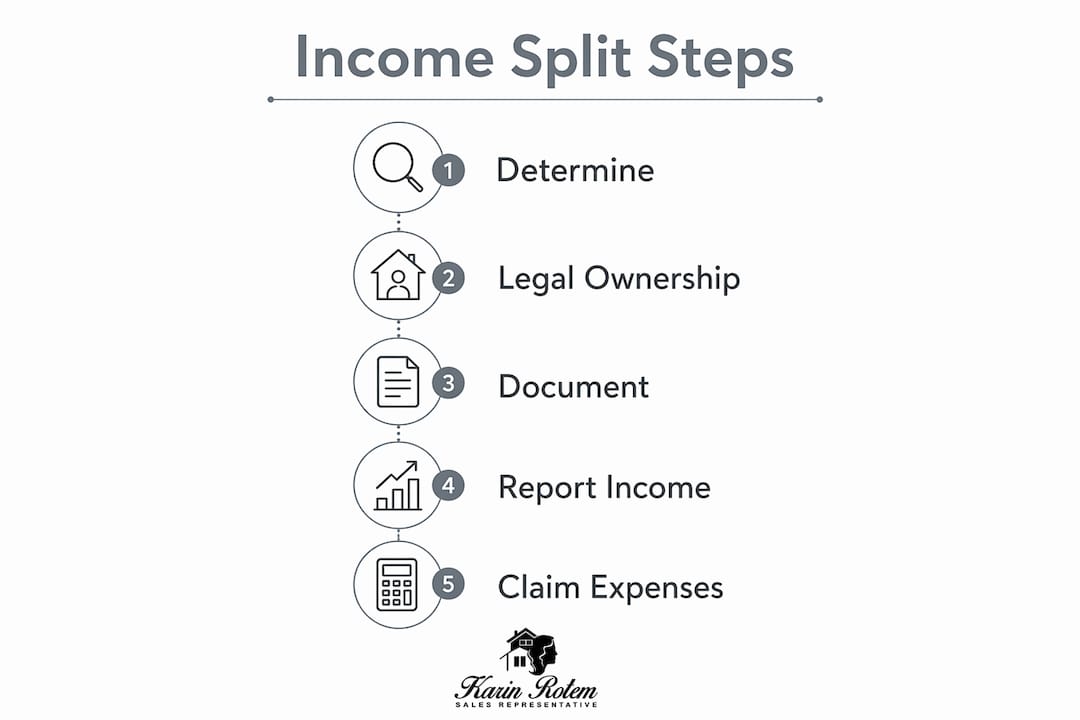
Key tax reporting responsibilities for co-owners:
- Report gross rental income for the whole property on line 12599 of your T1 return
- Complete Form T776 (Statement of Real Estate Rentals), including Part 2 for co-owner details
- Allocate net income and deductible expenses proportionally to your ownership share
- Claim Capital Cost Allowance (CCA) only in proportion to your ownership percentage
- Register for GST/HST if your share of taxable supplies exceeds $30,000 annually
- Maintain the same income split ratio year over year unless ownership formally changes
How rental income is typically split among co-owners
The most common and CRA-compliant approach ties the income split directly to the ownership percentage recorded on the property title or in a written co-ownership agreement. Two people who each own 50% report 50% of the net income. It sounds simple, and it usually is, as long as everyone agrees upfront and documents it properly.

What I tell my clients when they’re buying a vacation property together is to get the ownership percentages right on title from day one. Changing them later is not just a paperwork exercise. Adjusting the income split without a corresponding change in legal ownership creates compliance risks and can trigger deemed dispositions, which means unexpected tax bills.
Common approaches to vacation rental profit sharing:
- Proportional to ownership share: The standard CRA-compliant method, tied directly to the percentage recorded on title
- Fixed dollar allocation: Sometimes used in partnership structures, but must still reflect actual ownership to avoid CRA scrutiny
- Usage-period allocation: Some co-owners split income based on weeks each party uses the property, though this must align with the legal ownership split for tax purposes
- Partnership agreements: A written agreement governing income division, expense responsibilities, and dispute resolution protects all parties if the relationship changes
Formal agreements matter more than most co-owners expect. If one owner decides to stop contributing to expenses or wants to exit the arrangement, a clear written agreement is the difference between a straightforward resolution and a costly legal dispute. For Ontario resort properties like those at Friday Harbour, where values have appreciated considerably, having that documentation in place from the start is worth every dollar spent on a lawyer.
Tax implications of vacation rental income for Canadian co-owners
Rental income from a vacation property is taxable, and the CRA treats it as income from property in most cases. Each co-owner reports their proportional share of net income on their personal return at their marginal tax rate. The collective income and expenses are first calculated on Form T776, then divided.

Allowable deductions
Expenses like cleaning fees, advertising costs, commissions paid to rental platforms, and property management fees are all deductible against rental income. So are a reasonable portion of utilities, insurance, and property taxes. Each co-owner claims their ownership-percentage share of these deductions, not the full amount.
If you rent out a portion of a property you also use personally, you must split expenses between the personal and rental portions. The CRA accepts splits based on square metres or number of rooms. For short-term rental compliance after 2023, non-compliant rentals face restricted deductions under new federal rules.
Capital Cost Allowance
CCA is the tax term for depreciation on your rental property. Co-owners can claim it, but only in proportion to their ownership share, and the decision deserves careful thought. CCA reduces your property’s Adjusted Cost Base (ACB), which increases the taxable capital gain when you eventually sell. Many co-owners claim CCA to reduce income today without realising they’re creating a larger tax bill tomorrow.
You also cannot use CCA to create or increase a rental loss. If your deductible expenses already exceed rental income, CCA cannot push that loss further.
GST/HST obligations
Short-term rentals (under 30 consecutive days) are subject to GST/HST. Once your combined taxable supplies from short-term rental activity exceed $30,000 annually, registration is mandatory. Long-term rentals of 30 days or more are generally exempt. Each co-owner’s registration obligation is assessed individually based on their share of revenue.
Change in use
Converting a personal vacation property to a rental is a significant tax event. The CRA treats it as a deemed disposition at fair market value, meaning you may owe capital gains tax even though you haven’t sold anything. The principal residence exemption can reduce or eliminate this gain in some cases, but co-owners need to assess their individual situations carefully.
| Tax factor | What it means for co-owners | Relevant form or rule |
|---|---|---|
| Gross rental income | Report full property amount on line 12599; do not split | T776, line 12599 |
| Net income split | Divide proportionally by ownership share | T776, Part 2 |
| Allowable deductions | Cleaning, commissions, management fees, utilities | T776, Part 2 |
| Capital Cost Allowance | Claim proportionally; reduces ACB and raises future capital gains | T776, CCA schedule |
| GST/HST registration | Mandatory above the small-supplier threshold in annual taxable short-term rental supplies | GST/HST return |
| Change in use | Triggers deemed disposition at FMV; possible immediate capital gain | CRA change-in-use rules |
| Rental loss | Deductible against other income only if rental activity is sufficiently commercial | CRA rental loss rules |
For a deeper look at how income properties at Ontario resorts are structured and taxed, the ownership model you choose at the outset shapes every one of these outcomes.
What I’ve learned working with co-owners in Ontario’s vacation markets
Co-ownership of a vacation rental sounds straightforward until the first tax season arrives. What I see most often with clients at Friday Harbour and across Innisfil is that the income split was never formally documented. Two friends buy a property together, agree verbally on a 50/50 arrangement, and assume that’s enough. It isn’t. The CRA expects the split to match the legal title, and if it doesn’t, both owners face potential reassessment.
The other common gap is around CCA. Co-owners often claim it because an accountant mentions it reduces this year’s taxable income. What they don’t always hear is that every dollar of CCA claimed reduces the ACB of their share, and that reduction comes back as a larger capital gain at sale. For a property that has appreciated significantly, as many Friday Harbour units have, that deferred tax can be substantial. Understanding the tax planning implications before you claim CCA is the kind of decision that pays off over the long term.
Ownership changes also catch people off guard. If one co-owner buys out another, or if shares are redistributed, that transaction triggers its own tax consequences. The income split must change to match the new title, and both parties need to report accordingly from that point forward.
Pro Tip: Before claiming CCA on a co-owned vacation rental, ask your accountant to model the after-sale tax impact alongside the current-year savings. For properties in appreciating markets like Friday Harbour, the long-term cost of a lower ACB often outweighs the short-term deduction.
If you’re considering a vacation property purchase in Ontario and want to understand how co-ownership structures affect your investment returns, browse the available properties my team works with across the Friday Harbour and Innisfil markets.
Key takeaways
Co-owners of Canadian vacation rentals must report income proportionally to their legal ownership share on Form T776, with GST/HST registration required once short-term rental taxable supplies exceed $30,000 annually.
| Point | Details |
|---|---|
| Income split follows legal ownership | Report net income in exact proportion to your ownership share on title, every year. |
| Gross income is not split | Enter the full property gross rental income on line 12599, not your proportional share. |
| CCA reduces your ACB | Claiming depreciation lowers your Adjusted Cost Base and raises capital gains tax at sale. |
| GST/HST threshold is $30,000 | Short-term rental hosts must register for GST/HST once their annual taxable short-term rental supplies exceed $30,000. |
| Change in use triggers tax | Converting a personal property to rental is a deemed disposition at fair market value. |
FAQ
Can rental income be split between spouses in Canada?
Yes, but the split must match the legal ownership shares recorded on title. Co-owners cannot report differently from their actual ownership percentages to reduce combined tax, and the same ratio must be used consistently each year.
What are the disadvantages of income splitting on a vacation rental?
The main risk is that splitting income incorrectly, meaning in a ratio that doesn’t match legal ownership, can trigger CRA reassessment and penalties. Claiming CCA as part of the split also reduces each owner’s ACB, increasing capital gains tax at sale.
What income qualifies for income splitting in Canada?
Rental income from co-owned property qualifies, but only in proportion to each owner’s legal share. The CRA does not permit co-owners to adjust their reported shares for tax convenience without a corresponding change in the property title.
How does income splitting affect taxes for vacation rental co-owners?
Each co-owner pays tax on their share of net rental income at their personal marginal rate. A co-owner in a lower tax bracket pays less on the same dollar of income, which is why ownership structure matters at the time of purchase, not after.