
Neither cash flow nor appreciation wins outright. Most investors are better served by a hybrid strategy calibrated to their timeline, income needs, and how much risk they can carry through a rate cycle like the one we’re in now.
- Prioritize cash flow if you need income now, have limited reserves, or your job/income is unpredictable.
- Prioritize appreciation if you have a stable income, a 7 to 10 year horizon, and conviction in a specific market’s growth drivers.
If you want the math behind that call, the metrics and worked example sections below break down exactly how each strategy performs over a decade.
Key Takeaways
Most successful real estate investors blend cash flow stability with appreciation upside rather than betting entirely on one strategy.
| Point | Details |
|---|---|
| Calculate cash flow properly | Use gross rent minus vacancy minus expenses for NOI, then subtract debt service for true cash flow. |
| Count principal paydown | It’s an overlooked return bucket that can rival cash flow in total dollar impact over 10 years. |
| Match strategy to timeline | Under 5 years favours cash flow; 7 to 10+ years allows appreciation to compound meaningfully. |
| Location drives outcomes | Gateway markets favour appreciation; secondary Canadian markets often deliver realistic positive cash flow. |
| Work with local expertise | Karin Rotem’s team sources deals and runs rental projections tailored to whichever strategy fits your goals. |
Cash flow vs appreciation: definitions and the exact formulas
Cash flow is what’s left after a property pays for itself. Calculate it in two steps: gross potential rent minus vacancy minus operating expenses gives you net operating income (NOI); NOI minus debt service gives you cash flow. This is the standard formula lenders and analysts use to underwrite a deal.
Appreciation is value growth, driven by local demand, income growth in the area, infrastructure, and scarcity of comparable supply. You convert an annual appreciation rate into projected equity by compounding it against the purchase price over your holding period, not by assuming a flat percentage every year.
To model either honestly, you need:
- Vacancy rate (use a realistic market figure, not zero)
- Operating expense ratio (property tax, insurance, repairs, management)
- Mortgage rate and amortization schedule
- A conservative projected rent growth rate
Mini example: a $500,000 property renting for $2,800/month generates $33,600 in gross rent. Subtract 5% vacancy ($1,680) and $9,000 in operating expenses, and NOI lands at $22,920. If annual debt service is $21,000, cash flow is $1,920 for the year, or $160/month.
What metrics actually tell you about a deal
Cap rate, cash-on-cash return, and debt service coverage ratio (DSCR) each answer a different question, and conflating them is where a lot of investors get burned.
Cap rate is NOI divided by purchase price, and it tells you the unlevered yield before financing enters the picture. In Canada, gateway markets like Toronto and Vancouver typically run 3.5–4.5%, other major urban centres sit around 4.0–5.5%, mid-size cities land at 5–7%, and smaller or Atlantic markets can reach 6–9%.
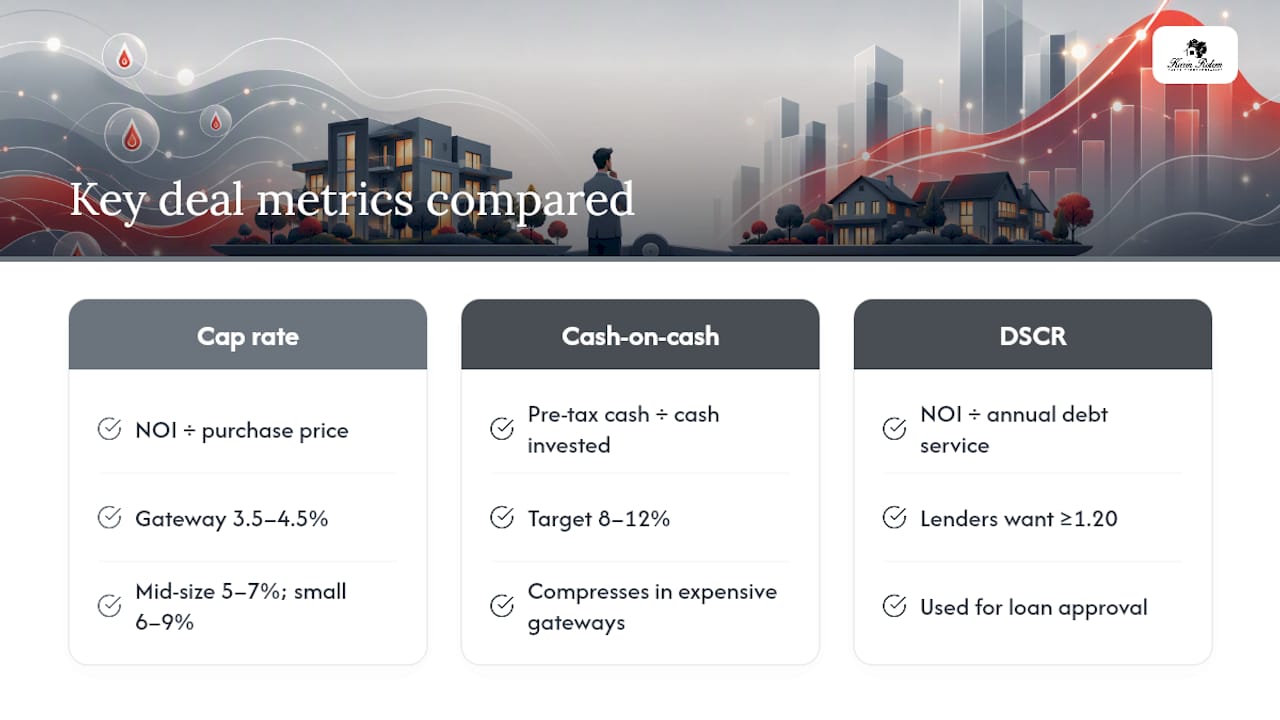
Cash-on-cash return measures annual pre-tax cash flow against the actual cash you put in. Investors chasing income typically target 8 to 12%, though that range compresses in expensive gateway markets where entry prices outrun rents.
DSCR matters because lenders live and die by it. It’s NOI divided by annual debt service, and most lenders want to see 1.20 or higher before approving a loan.
Pro Tip: Principal paydown is the return bucket most investors forget to count. Every mortgage payment quietly builds equity, and over a 10-year hold that paydown can rival your cash flow in total dollar impact.
On the tax side, Canada Revenue Agency rules allow deductible expenses and capital cost allowance (depreciation) that can produce a paper loss even when your property is cash positive. That’s a legitimate planning tool, but confirm the specifics with an accountant before you rely on it.
Who should prioritize cash flow, and who should chase appreciation
Run through five questions before you commit to either camp: What’s your holding timeline? Do you need this property to replace or supplement income today? How stable is your income outside real estate? What reserves do you have if a unit sits vacant for two months? And how much conviction do you have in the specific market’s growth story?

An investor living off rental income needs cash flow now, full stop. A high-earning professional with 10 years of runway can absorb a break-even or slightly negative cash-flow property if the location has strong appreciation fundamentals. A hybrid-minded investor wants both, even if it means accepting a smaller margin on each.
The 2026 rate environment has sharpened this decision considerably. Higher borrowing costs mean many deals now carry negative leverage, where the mortgage rate exceeds the unlevered return, so investors have less room to bank on appreciation covering a cash-flow shortfall.
- Under 5 years: favour cash flow. You need the deal to work on its own without betting on a market cycle.
- 5 to 7 years: a blended approach, weighting toward whichever fundamentals are stronger locally.
- 7 to 10+ years: appreciation can compound meaningfully, provided you can carry the property through rate swings.
A 10-year example: cash flow vs appreciation side by side
Total return breaks into four buckets: cash flow, principal paydown, appreciation, and tax effects. Ignoring any one of them skews the comparison.
- Balanced scenario: a $500,000 property with $150/month positive cash flow, 3% annual appreciation, and a 25-year amortization.
- Appreciation-heavy scenario: a $500,000 property near break-even cash flow, but in a market with 5% average annual appreciation.
Over 10 years, the balanced property generates roughly $18,000 in cumulative cash flow, close to $70,000 in principal paydown, and around $172,000 in appreciation (compounded at 3%) for a levered total near $260,000. The appreciation-heavy property generates closer to $0 to $5,000 in net cash flow, similar principal paydown, but appreciation compounding at 5% pushes value growth past $315,000, for a higher total return but a far bumpier ride if rents dip or rates rise mid-hold.
These numbers are illustrative, not a guarantee. Run your own assumptions against the actual rent roll and financing terms before deciding.
Where cash flow and appreciation actually show up across Canada
Positive monthly cash flow is far more achievable in secondary markets such as Moncton, parts of Saskatchewan, and Windsor/Sarnia, where $200 to $600 a month in positive cash flow is realistic at typical leverage.
- Gateway markets: appreciation-led, cash flow usually negative at 20% down
- Mid-size urban centres: often a workable blend
- Smaller and Atlantic markets: cash flow is the more reliable story
The tactical move right now is looking for value-add opportunities in mid-size markets, where a modest renovation or a legal secondary suite can push a break-even property into positive territory without betting the whole return on appreciation.
Building a hybrid portfolio: what to check before you buy
A due-diligence checklist that actually protects you:
- Verify the real rent roll, not the listing agent’s projected rent
- Pull recent expense statements, not a generic 35% expense-ratio assumption
- Assess near-term capital needs (roof, furnace, windows)
- Compare against genuine recent sales, not asking prices
- Check the local rent growth trajectory over the past three to five years
On acquisition, keep leverage conservative, confirm any secondary suite is legal before counting its rent, and stage value-adds so you’re not overspending to chase a rent bump that doesn’t materialize. A furnished rental strategy can also improve in-place cash flow in the right location.
For sourcing accurate numbers before you commit, a rental income projection is worth doing before you make an offer, and a full income property due-diligence review catches the details a quick walkthrough misses.
What I tell my clients about balancing income and growth
What most buyers don’t realize is that the “right” answer changes the moment their life circumstances do. I worked with an investor who wanted a Friday Harbour property purely for appreciation, then realized a modest positive cash flow gave him the confidence to hold through a slow season. What I tell my clients: set a reserve target before you buy, know your minimum holding period, and pick a market that fits your actual risk tolerance, not the one your friend made money in.
— Felix
How Karin Rotem’s team helps you execute either strategy
Choosing between cash flow and appreciation is only half the work. The harder part is sourcing a property where the numbers actually hold up, then negotiating a price that protects your return. That’s where a local advisor earns her fee: pulling accurate rent comparables, running realistic vacancy and expense assumptions, and knowing which streets in Innisfil or Friday Harbour are quietly outperforming their appreciation potential versus which ones are priced for hype.
Karin Rotem’s team handles sourcing, valuations, rental projections, and negotiation for buyers targeting either strategy, backed by direct market intelligence in Toronto and Innisfil that a spreadsheet alone can’t give you. If you’re ready to see what’s actually available, browse Our Properties and let’s talk about which numbers matter most for your goals.
Sources
- Analyzing investment property opportunities — LendCity
- Cash flow vs appreciation — Valoris Capital Partners
- Cash-flow vs appreciation — TrueCap blog
- Rental expenses you deduct — Canada Revenue Agency
FAQ
Is cash flow or appreciation better for real estate investing?
Neither is universally better. Your timeline, income needs, and risk tolerance determine which strategy, or blend, fits your situation.
How do you calculate cash flow on a rental property?
Subtract vacancy and operating expenses from gross rent to get NOI, then subtract debt service to arrive at cash flow.
Where in Canada can you still find positive cash flow?
Secondary markets like Moncton, parts of Saskatchewan, and Windsor/Sarnia are more likely to produce $200 to $600 monthly positive cash flow than Toronto or Vancouver.
How does principal paydown affect total return?
It builds equity with every mortgage payment and can rival annual cash flow in total dollar contribution over a 10-year hold.