
A repair holdback is money set aside from the sale proceeds and held in a lawyer’s trust account until agreed repairs get finished. It’s negotiated between buyer and seller, not something Ontario law hands you automatically. The single most important move you can make is putting clear holdback terms into the Agreement of Purchase and Sale (APS) rather than scrambling to negotiate one the week of closing.
What I tell my clients constantly: waiting until the final walkthrough to raise a holdback puts you at a serious disadvantage. Here’s what a properly built holdback actually involves:
- Funds are held by either the buyer’s or seller’s lawyer, in trust, until repairs are verified.
- The amount, deadline, and proof required must be spelled out in writing.
- Drafting it into the APS beats a last minute lawyer negotiation, where the seller can simply say no.
Key Takeaways
A repair holdback protects both parties only when the APS spells out the scope, deadline, assessment method, and the lawyer’s authority to act if repairs aren’t finished.
| Point | Details |
|---|---|
| Include it in the APS | Draft holdback terms into the original offer rather than negotiating one at the last minute. |
| Answer the 5 W’s | Define what, who, when, how it’s assessed, and what happens if the seller fails to complete the work. |
| Size it with a buffer | Use the higher contractor estimate plus a 10 to 20 percent contingency to cover surprises. |
| Give the lawyer authority | Without explicit release wording, funds can sit frozen in trust indefinitely. |
| Document everything | Invoices, photos, and completion certificates are what actually gets funds released. |
When and why do buyers use a repair holdback in Ontario?
Holdbacks come up most often after the final walkthrough, when a buyer notices something that wasn’t there during the offer stage. A furnace stops working, a fence gets damaged during the seller’s move, or a promised repair never happened.
Common triggers include:
- Deficiencies spotted at the final walkthrough that weren’t visible earlier.
- Renovation or repair work the seller promised but couldn’t finish before closing.
- Missing documentation, like a Wood Energy Technology Transfer (WETT) certificate or a permit for finished basement work.
- Appliances or systems that fail between the home inspection and possession day.
Parties choose a holdback over delaying closing because closing dates trigger mortgage funding, moving trucks, and often a chain of other transactions. Nobody wants to unwind that over a $2,000 repair. It’s also cheaper than fighting it out after the fact. If a seller refuses to agree and the buyer closes anyway, the buyer’s only real option becomes post-closing litigation or an abatement claim, which is slow and expensive. One clarification worth making here: this is entirely different from statutory construction retainage under Ontario’s Construction Act. That’s a builder-and-contractor issue. This is about two parties to a resale transaction protecting themselves.
How do you draft a holdback clause that actually works?
A holdback clause that doesn’t answer five specific questions is a clause that will end up disputed. Real estate lawyers refer to this as the 5 W’s framework, and skipping any one of them is where most disputes start.
- What. Define the exact scope of work and the standard it must meet. “Fix the deck” invites argument. “Replace the three rotted deck boards on the northeast corner with pressure treated lumber matching existing colour” does not.
- Who. Name who performs the work and who pays for it. If the seller is hiring the contractor, say so. If the buyer can choose their own contractor and bill the holdback, say that too.
- When. Set a firm deadline, including a time of day. In Ontario, factor in winter: exterior work like roofing or asphalt sealing often can’t happen between November and April, so a holdback covering that kind of repair needs a realistic spring completion date, not a fictional 30-day window.
- How to assess. Specify who decides the work is done. That could be the buyer’s sole discretion, a named home inspector, or a defined test (water pressure reading, WETT inspection, electrical panel certification).
- What if not done. Give the lawyer explicit authority to release funds to a named contractor, apply a price abatement, or extend the holdback if the deadline passes without completion.
Pro Tip: Always build in a contingency buffer of 10 to 20 percent above the contractor estimate, and require original invoices addressed to the buyer’s lawyer before any funds move. Without that language, your lawyer may have no legal footing to act.
Who holds the funds and how do lawyers release them?
Either the buyer’s or the seller’s lawyer can hold a repair holdback, though it’s more common for the seller’s lawyer to hold it since the money is being deducted from their client’s proceeds. What matters more than who holds it is the wording that governs how it comes out of trust.
Lawyers take this seriously because giving an undertaking to hold and release funds carries real professional weight. The Law Society of Ontario holds solicitors to strict standards around trust account handling, and a vaguely worded clause can leave a lawyer personally exposed if they release funds incorrectly. That’s exactly why precise wording protects everyone, not just the buyer and seller.
Release typically requires one or more of the following:
- A joint direction letter signed by both parties.
- Contractor invoices and payment receipts.
- Photos showing completed work.
- A certificate of completion or a follow up inspection report.
Without a specific mechanism for proof and a clear instruction to the lawyer, funds can sit frozen in trust indefinitely. Learn more about what your lawyer handles at closing to understand where holdback authority fits into their broader role.
How much should a repair holdback be, and what goes wrong?
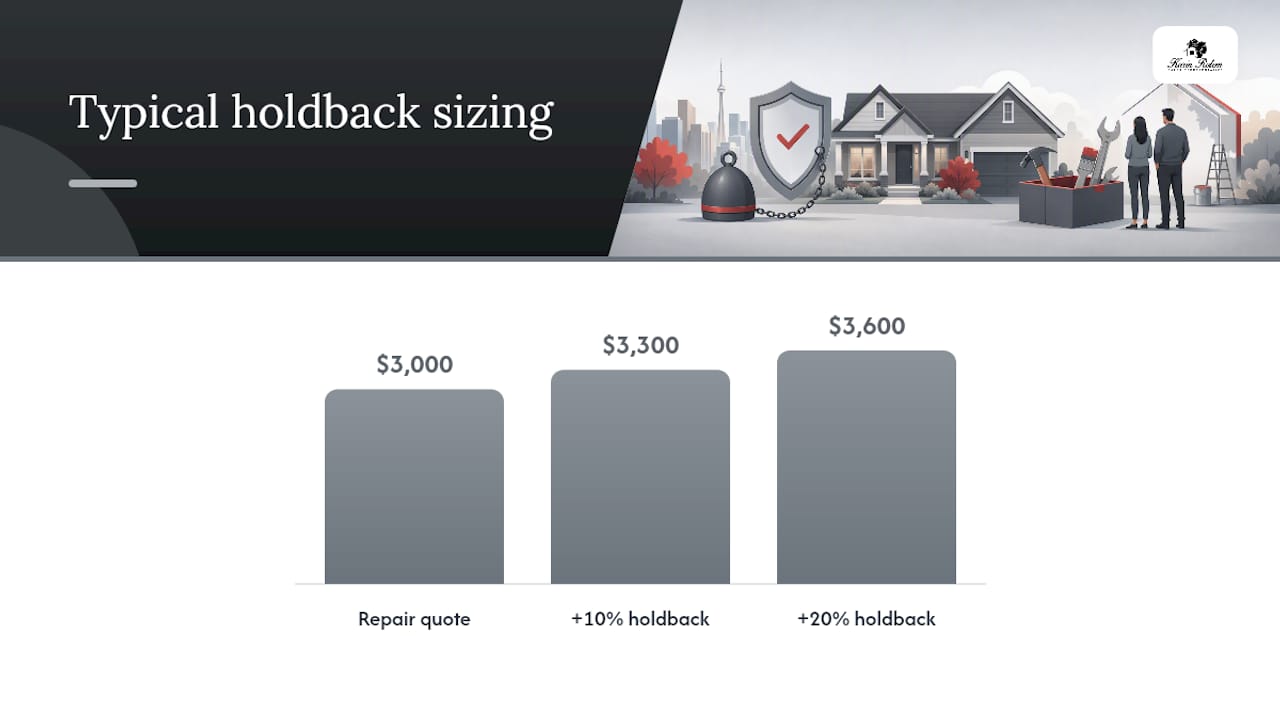
Sizing a holdback correctly avoids two problems: an amount too small to cover the real cost, and an amount so large the seller balks at signing. Ontario practitioners commonly get two contractor estimates, use the higher one, then add 10 to 20 percent for contingency and a small administration allowance. For a $3,000 repair quote, that means holding back closer to $3,600, not a flat $3,000.
The pitfalls that generate the most disputes are consistent across cases:
- Vague scope language that leaves “acceptable” work undefined.
- No firm deadline, so the holdback drags on for months.
- No named assessor, which means neither side agrees the work is actually finished.
- An amount too small to cover the real repair once labour and materials are factored in.
- No clause giving the lawyer authority to release or apply funds without both signatures.
Poorly worded holdback clauses have produced real court disputes where funds sat frozen for months because nobody had authority to move them. When that happens, remedies are limited to Small Claims Court, a price abatement claim, or (if the clause allows it) using the held funds to hire a different contractor outright.
What should buyers, sellers and agents do before closing?
Getting a holdback right is mostly about sequencing. Do these steps in order, and don’t skip the early ones because closing feels far away.
- Buyers: raise concerns the moment you notice them, ideally at the home inspection stage rather than the final walkthrough.
- Buyers: get a written contractor estimate before your lawyer drafts the clause, so the number in the holdback is defensible.
- Sellers: agreeing to a reasonable holdback almost always beats renegotiating price or delaying closing entirely.
- Sellers: collect and forward any invoices or contractor names you already have to speed up the process.
- Agents: put every agreed term in writing immediately, even a quick email, and loop in both lawyers as early as possible.
- Everyone: confirm who verifies the completed work and how proof gets delivered to the lawyer holding the funds.
Pro Tip: If your seller discloses outstanding permits or missing reports before you even get to the APS stage, check Ontario’s seller disclosure requirements so you know what you’re entitled to ask for upfront, before a holdback becomes your only option.
What I tell my clients about holdbacks in Toronto, Innisfil and Friday Harbour
What most buyers don’t realize is how much local seasonality shapes holdback size. I’ve seen Friday Harbour closings where landscaping or dock work simply couldn’t finish before a late fall possession date, so we built in a spring completion deadline with a larger contingency to account for scheduling delays.
Here’s what actually works when I’m negotiating these on a client’s behalf:
- I get contractors on the phone before the lawyers finalize wording, so the estimate in the clause is real, not a guess.
- I coordinate directly with both lawyers to make sure proof requirements (photos, invoices, inspection sign off) are collected the same week work finishes, not months later.
- I tell buyers at the final walkthrough: if something’s wrong, we address it now, in writing, not after keys change hands.
A holdback only works when everyone involved treats the deadline as real.
Where to find more on Ontario holdback practice
For legal detail beyond what’s covered here, these sources go deeper into practice standards and drafting language:
- Understanding holdback clauses in Ontario real estate
- The use of holdbacks in real estate transactions
- Law Society of Ontario real estate practice guidance
- Notaries in Ontario real estate: what buyers must know
Ready to buy or sell with fewer closing surprises?
If you’re buying or selling in Toronto, Innisfil, or Friday Harbour, the best time to plan for a possible holdback is before you ever sign an offer, not after a bad walkthrough. My team works these details into the negotiation from day one, so you’re never scrambling with a lawyer two days before closing. Browse our current listings or reach out directly, and let’s talk through what your specific transaction needs before it becomes a problem.
Editorial take: why holdbacks fail when they’re treated as an afterthought
The research on this topic points to one uncomfortable truth: most holdback disputes aren’t caused by dishonest sellers. They’re caused by clauses written under time pressure, by people who assumed “we’ll sort out the details later” was a plan.
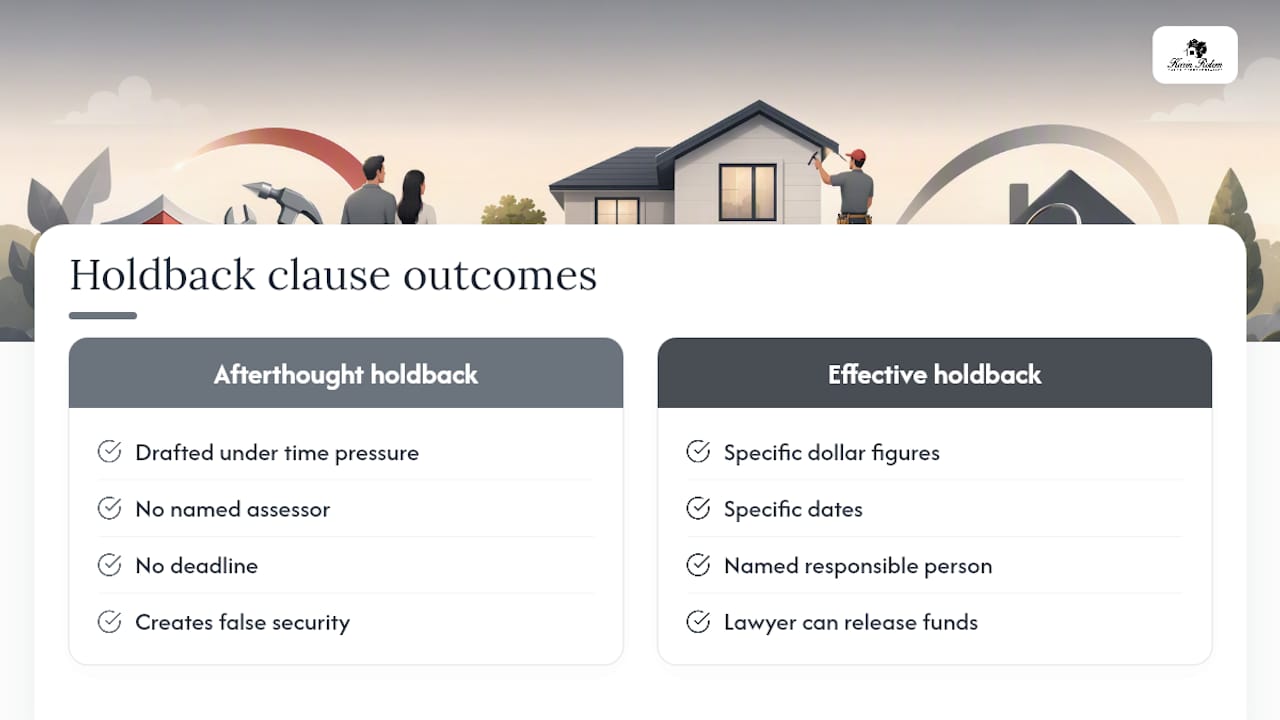
Conventional advice tends to focus on getting a holdback at all, as if the existence of one solves the problem. It doesn’t. A holdback with no named assessor and no deadline is arguably worse than no holdback, because it creates a false sense of security while giving a lawyer no actual authority to act. The clauses that work are boring: specific dollar figures, specific dates, specific people responsible for signing off.
If you take one thing from this article, prioritize the drafting over the negotiation. Getting a seller to agree to a holdback is usually the easy part. Writing language precise enough that your lawyer can actually release or apply those funds without a second negotiation, that’s where deals either hold together or fall apart months later.
— Felix
Sources
- Understanding holdback clauses in Ontario real estate: what buyers and sellers should know
- The use of holdbacks in real estate transactions
- Real estate transactions practice guidance — Law Society of Ontario
- Holdbacks in real estate: what they are & when they’re used
FAQ
Is a repair holdback required by law in Ontario?
No. A holdback is a negotiated arrangement between buyer and seller, not an automatic legal right under Ontario law.
Who holds the money during a repair holdback?
Either the buyer’s or seller’s lawyer can hold the funds in trust, though it’s more common for the seller’s lawyer to hold the money since it comes from their client’s proceeds.
What happens if the seller never completes the repairs?
If the clause gives the lawyer authority to act, funds can be released to a named contractor or applied as a price abatement; without that authority, the buyer’s remedy may be Small Claims Court.
How much should a repair holdback be?
Practitioners typically take the higher of two contractor estimates and add 10 to 20 percent as a contingency buffer.
Can I negotiate a holdback at the final walkthrough?
Yes, but it’s far riskier than including it in the APS, since the seller can simply refuse a last-minute lawyer-negotiated holdback.