
Yes, you can buy waterfront property in Ontario, but the sale price is only part of the deal. Before you sign anything, confirm shoreline ownership through a title search and survey, get the septic and well independently inspected, verify legal access to the property, and check what a conservation authority will let you build. Miss any one of these and you can inherit someone else’s expensive problem.
TL;DR:
- Confirm shoreline ownership through a title search and survey, as many properties retain municipal shore road allowances that could cause legal issues.
- Get septic and well inspections as conditions of your offer to avoid costly replacements or capacity problems that could derail financing or insurance coverage.
- Verify legal access and check conservation authority regulations, since permits and setbacks often restrict development or adding structures like docks.
- Understand flood risk by reviewing floodplain maps and securing flood coverage, as insurance can be limited or expensive on high-risk properties.
- Factor in ongoing costs such as higher property taxes, shoreline maintenance, septic pumping, and potential environmental or shoreline permits before committing.
Buying waterfront Ontario: your pre-offer checklist
What I tell my clients want first is this: waterfront deals move fast, and the properties that look perfect on a Saturday showing often have something buried in the title or septic history that changes the math entirely. Run this checklist before you write an offer, not after.
- Order a title search and request the seller’s survey. Confirm whether the shore road allowance is included and ask your lawyer to review the title at closing for any gaps.
- Make septic and well inspections a condition of your offer. Require a licensed septic specialist’s report and private-lab chemical testing on the well, not just a visual walkthrough.
- Confirm legal access. Is it a municipal road, a private road with a registered easement, or water access only? Ask for road association documents if one exists.
- Check conservation authority mapping and municipal zoning for the parcel. If you’re planning a dock, addition, or short-term rental, confirm it’s actually permitted before you fall in love with the idea.
- Call an insurance broker before you remove conditions. Ask specifically about overland flood endorsement availability, deductibles, and whether the property has ever been declined coverage.
Get through these five in order and you’ll know within a week or two whether the property is worth pursuing.
Who owns the shoreline, and what is a shore road allowance?
What most buyers don’t realize is that owning the cottage doesn’t always mean owning the beach. In many Ontario municipalities, the strip of land between the high water mark and the property line, known as the shore road allowance, was historically reserved by the Crown and later transferred to the township. It’s often still municipal property, even when a dock or boathouse has sat on it for decades.
Riparian rights give you the ability to use the water adjacent to your land, but that’s a use right, not ownership of the shore allowance or the lakebed itself, which is typically Crown land under navigable waters.
- Order an up-to-date survey, especially if any structure sits close to the waterline.
- Ask your lawyer to pull registered plans showing whether the shore allowance was ever conveyed to a previous owner.
- If it wasn’t, most municipalities have a road-closing and purchase process that can take several months and cost several thousand dollars in legal and survey fees.
Pro Tip: Never assume a dock is “grandfathered” just because it’s old. Ask for the paperwork, because a verbal understanding with a past owner doesn’t transfer with the deed.
For a deeper look at what riparian rights actually cover, our guide on riparian rights in Ontario walks through common misconceptions.
Do conservation authorities control what you can build?
In most cases, yes. Conservation authorities regulate development within shoreline buffers, floodplains, and wetlands, and O. Reg. 41/24 sets an inland allowance where dynamic beaches are present, with additional regulated areas depending on the watershed. That regulated area often extends well beyond what a buyer assumes is “waterfront land.”
A conservation authority permit almost always has to be sorted out before a municipal building permit gets issued, and municipal zoning can add its own restrictions on top, including setbacks, lot coverage limits, and tree protection bylaws.
- Bluffs or steep slopes may require a geotechnical study before any addition is approved.
- Sensitive habitat near wetlands can trigger an environmental impact study.
- Approval timelines run anywhere from a few weeks to several months depending on complexity, and pre-consultation with the conservation authority early in your search can surface deal-breaking constraints before you’re financially committed.
If dock or boathouse construction is part of your plan, check our boathouse permit guide for what’s typically involved.
What should a septic and well inspection actually cover?
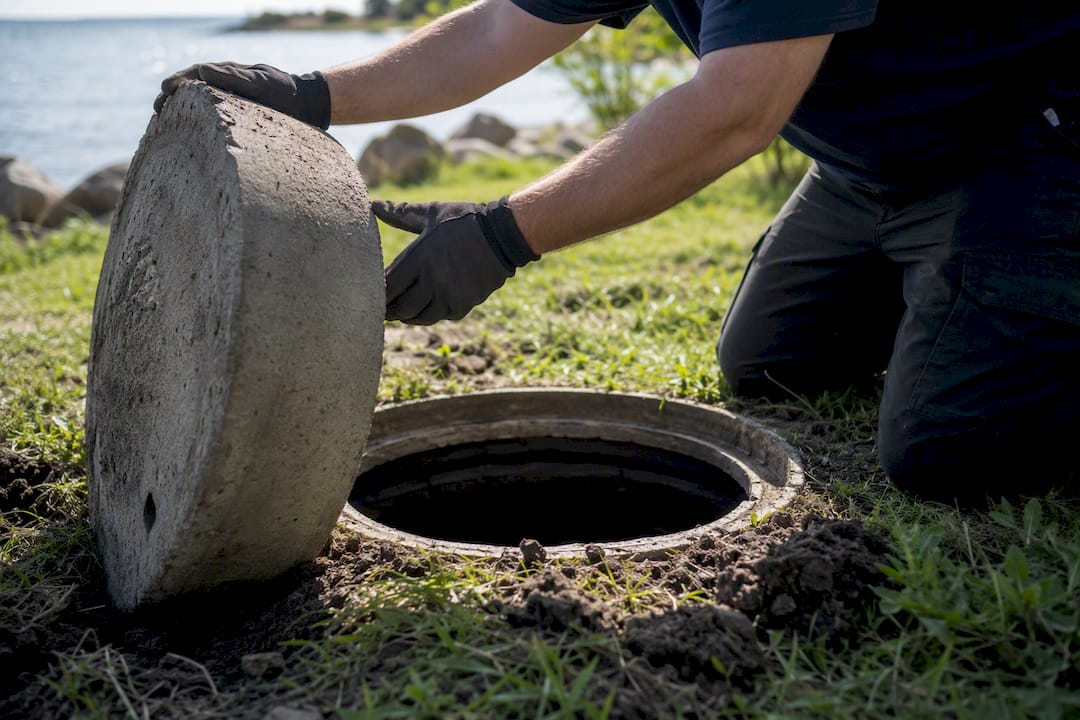
A qualified septic inspection isn’t optional on a waterfront purchase. Septic systems near water are tightly regulated, and a system that’s been fine for a two-bedroom cottage for thirty years may not have the design capacity for the four-bedroom renovation you’re picturing. A Class 4 system that’s undersized or failing can turn into a costly replacement potentially reaching tens of thousands of dollars, and that expense changes how a lender or insurer views the whole deal.
Wells need the same scrutiny. Public Health Ontario runs free bacterial testing on private wells, but chemical and mineral analysis, things like nitrates, arsenic, and hardness, requires a private accredited lab.
- Take at least two water samples over a few weeks rather than relying on a single result.
- Ask the septic inspector directly about the system’s rated capacity versus the number of bedrooms.
- Make both the septic and well results firm conditions of closing, not just information items.
Pro Tip: A “recently pumped” septic tank tells you nothing about the leaching bed’s condition. Ask for the actual inspection report, not just a service receipt.
How does flood risk affect what you’ll pay for insurance?
Flood and erosion aren’t hypothetical risks on Ontario waterfront, they’re recurring ones, and insurers price them accordingly. Map the regulated floodplain for the property with the local conservation authority and compare it against any historical high-water events on that stretch of shoreline; insurers increasingly look at both when they’re underwriting a policy.
Overland flood endorsements are more widely available in Ontario than they were a decade ago, but coverage often comes with deductibles and firm limits, and the highest-risk properties can still be denied standard flood coverage outright.
- Ask your broker for a written quote before you remove financing or insurance conditions, not after.
- Elevating mechanical systems, installing backwater valves, and grading landscaping away from the foundation are practical steps that can improve insurability.
- Provincial planning policy also directs new development away from hazardous flood-prone lands in the first place, which is worth knowing if you’re eyeing a vacant waterfront lot for future construction.
A national flood insurance backstop has been discussed federally but isn’t in place yet, so the private insurance market is what you’re dealing with today.
What kind of road or water access will you actually have?
Access shapes everything from your mortgage approval to your winter routine. There are three common scenarios on Ontario waterfront: a municipally maintained road, a private road with a registered right-of-way and a road association, or water access only, reachable by boat in summer.
Each one carries different financing and insurance implications, and lenders sometimes hesitate on water-access-only properties because emergency services and winter access are limited.
- Ask for the road association agreement, annual fees, and the plowing schedule in writing.
- Confirm the right-of-way is actually registered on title, not just a longstanding neighbourly arrangement.
- If you’re planning to live there year-round, check realistic internet options and, if it matters to you, EV charger installation and rebate availability for the area, since rural infrastructure varies a lot from lot to lot.
What does waterfront ownership cost beyond the purchase price?
Property taxes on waterfront tend to run higher than comparable inland homes because municipal assessments usually apply a waterfront premium, and the municipal tax rate on top of that assessment can compound the gap further.
Then there’s the maintenance calendar that comes with the water itself.
- Dock installation and removal each season, plus periodic repair or replacement.
- Shoreline protection, retaining walls, or armour stone if erosion is active.
- Tree care near the water, particularly where root systems affect bank stability.
- Septic pumping every three to five years, and eventual system replacement.
Contingent costs matter too. A conservation authority permit condition can require an environmental study you didn’t budget for, and insurance riders for flood or wind can push your annual premium noticeably higher than a comparable inland property. Build a cushion into your budget for at least one of these surprises in year one.
How long does the waterfront buying process usually take?
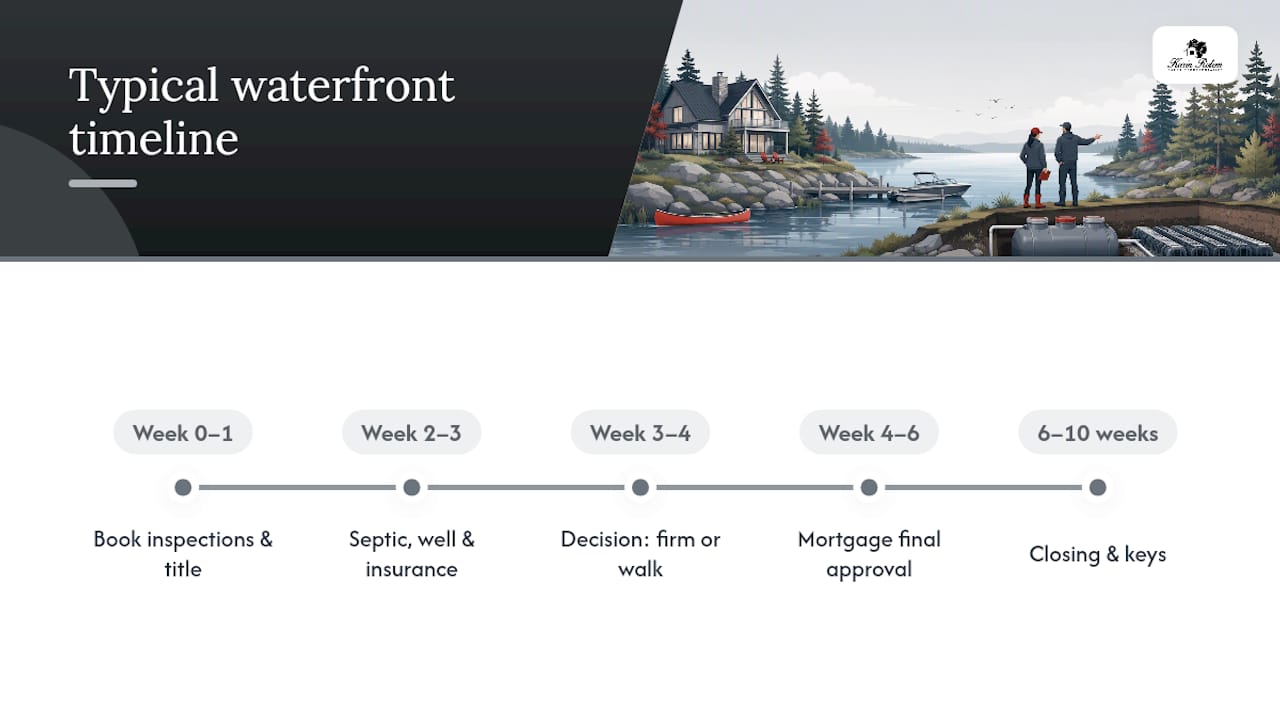
The legal skeleton of a waterfront purchase looks like any other Ontario home sale: an Agreement of Purchase and Sale, a title search, conditions, financing approval, and registration at closing. What changes with waterfront is how much has to happen inside the condition period, because the land-specific issues create most of the extra work.
A realistic timeline looks something like this. In the first week after an accepted offer, you’re booking the septic inspection, well sampling, and survey review, and your lawyer starts the title search. Weeks two and three are usually when lab results come back on the well, the septic report lands, and you get a first read from your insurance broker on flood coverage. If a conservation authority permit is relevant to any planned work, that’s also when a pre-consultation call should happen, since their response times vary by watershed and season.
By week three or four, most buyers are deciding whether to firm up or walk, based on what those reports actually say. Financing conditions typically run parallel to this, with your lender often wanting to see the survey and, in some cases, the septic report before final approval, especially if the property is water access only or on a private road.
Closing itself, once conditions are satisfied, usually takes another two to four weeks, similar to a standard residential closing. All told, budget six to ten weeks from accepted offer to keys in hand for a straightforward waterfront deal, longer if a conservation authority review or a septic replacement negotiation gets involved. Cottage-season listings in June and July tend to move faster because competition is higher, so build in less room to negotiate extended conditions during peak months.
What will buying waterfront in Ontario actually cost you?
Sale price is the headline number, but it’s rarely the number that determines whether the deal makes sense. Start with the purchase price, then layer in what closing actually costs in Ontario: land transfer tax, legal fees, survey costs if one isn’t already on file, and title insurance.
Waterfront-specific due diligence adds its own line items. A septic inspection typically runs a few hundred dollars, well testing another few hundred once you include the private lab chemical panel, and a survey, if the seller doesn’t have a recent one, can run into four figures depending on the property’s size and shoreline length. If a conservation authority pre-consultation or a geotechnical assessment turns out to be necessary, that’s an additional cost most buyers don’t anticipate until they’re already under contract.
Then come the ongoing fees. Property tax with the waterfront assessment premium, home insurance with any flood or wind riders, private road association fees where applicable, and septic pumping every few years. Dock maintenance and eventual replacement, along with shoreline erosion control if the bank is active, round out the annual budget.
None of these individually will break a deal. Stacked together, they can shift a property from “great value” to “tight budget” fairly quickly, which is exactly why I walk clients through a full cost picture before they get emotionally attached to a listing. If you’re weighing a waterfront cottage against a different property type entirely, our breakdown of waterfront property types near Toronto is worth a read before you narrow your search.
What due diligence steps are specific to waterfront properties?
Beyond the standard home inspection, waterfront due diligence has its own checklist, and skipping any part of it is where buyers get burned.
Water quality testing goes further than the well itself if you’re planning to swim or fish off the property. Ask the seller whether the lake or river has had any blue-green algae advisories, and check whether the municipality or a local lake association publishes water quality reports. Shoreline erosion assessment matters just as much, particularly on sand or clay banks. Walk the shoreline at low water if possible, look for exposed roots, leaning trees, or slumping soil, and ask a geotechnical consultant to weigh in if the bank looks unstable.
Dock and structure condition deserves its own look too, separate from the general home inspection, since docks sit in a harsh freeze-thaw environment and deteriorate differently than a house does. Ask when the dock was last serviced and whether it’s a floating, crib, or permanent structure, since each has different maintenance needs and different regulatory treatment.
Finally, confirm boundary markers physically match the survey. Shoreline properties shift over time due to erosion and fill, and a twenty-year-old survey may no longer reflect the current waterline.
What should you ask the seller about the property’s history?
A good listing sheet tells you the square footage. It won’t tell you whether the septic backed up three winters ago or whether the dock washed out in a storm. Ask directly.
Find out how the property has been used, whether it’s been a seasonal cottage or a year-round residence, since that affects everything from insulation quality to septic sizing. Ask about any past flooding, erosion events, or insurance claims tied to water damage, and ask to see the claims history if the seller is willing to share it. Ask when the septic was last pumped and inspected, and whether any repairs or upgrades have been done to it or the well. Ask whether the property has ever been used as a short-term rental, since that can affect both the septic design assumptions and any zoning compliance questions going forward.
Ask, too, whether the seller has ever applied for or been denied a conservation authority permit for work on the property. A denied application is a strong signal about what you might face if you’re planning changes of your own.
How does zoning affect what you can do with waterfront land?
Zoning and conservation authority rules aren’t the same thing, and buyers often confuse them. Zoning is set by the municipality and governs lot coverage, setbacks from the water, building height, and permitted uses, like whether short-term rentals are allowed at all in that zone. Conservation authority regulation sits on top of that and focuses specifically on flood, erosion, and environmental risk within the regulated shoreline buffer.
Provincial planning policy shapes both. The Provincial Policy Statement directs municipalities to steer new development away from hazardous lands adjacent to shorelines, which is part of why some vacant waterfront lots have such limited building envelopes despite generous overall acreage.
Before you buy, request the zoning designation and confirm in writing what it permits, particularly if your plans include an addition, a secondary structure, or rental use. A property that looks like a straightforward building lot can turn out to have a building envelope so constrained by combined zoning and conservation setbacks that your renovation plans simply don’t fit.
How do you negotiate a waterfront deal in your favour?
Negotiating waterfront isn’t the same game as negotiating a downtown condo, because the inspection findings tend to carry more weight than they do in a typical resale.
Use your septic, well, and survey results as leverage, not just as a green light or a red flag. If the septic report shows a system nearing the end of its life, that’s a concrete number you can bring back to the table, not just a vague concern. The same goes for a shore road allowance that was never conveyed. It’s a real cost and a real risk, and it belongs in the price conversation.
Timing matters more here than in urban markets. Listings that go up in early spring, before docks are back in the water and before buyers can see the shoreline properly, often move with less competition than peak summer listings. If you can view a property with binoculars for ice conditions or spring runoff evidence, you’ll see things a July showing hides completely.
Don’t waive conditions to win a bidding war on waterfront. It’s the single most common regret I hear from buyers who skipped septic or survey conditions to make their offer more competitive, and it’s rarely worth the risk on a property type where the hidden costs run into the tens of thousands.
How a local agent makes waterfront buying smarter
What I tell my clients want first, every time, is to treat the title search, the septic and well inspection, and the access confirmation as non-negotiable conditions in the offer itself, not as boxes to tick after the fact. I’ve seen a buyer’s dream cottage turn into a walk-away the moment a septic report showed a system rated for two bedrooms sitting under a four-bedroom addition. That report didn’t just kill the deal, it saved that client a $40,000 mistake.
Our team’s work across Toronto, Innisfil, and Friday Harbour means we’ve walked this exact process dozens of times, and we know which conservation authorities move fast and which ones need six weeks of lead time. That local knowledge is what turns a stressful waterfront purchase into a manageable one.
— Felix
Let Karin Rotem’s team handle the waterfront details for you
Karin Rotem is the alternative to going it alone on a waterfront search, because every listing we bring you already has the shoreline ownership, septic history, and access questions flagged before you ever book a showing. Our team coordinates the survey and title review, connects you with trusted septic and well inspectors, and knows exactly which conservation authority contacts to call for a fast pre-consultation, whether you’re looking in Innisfil, Friday Harbour, or the wider Toronto market.
That local depth also means sharper negotiation. When we know a comparable property nearby had a shore road allowance issue or a septic replacement, we use it, and it shows up in the price you pay. If you’re weighing whether Friday Harbour’s community lifestyle fits your goals, our Friday Harbour community page is a good starting point.
Ready to see what’s actually available and get a clear read on the risks before you commit? Book a consultation with Karin Rotem’s team or ask us to set up listing alerts tailored to the waterfront features that matter most to you.
Sources
For the regulatory detail behind conservation authority permits, read O. Reg. 41/24 directly, it sets out the regulated shoreline distances discussed above. The Provincial Policy Statement’s natural hazards policies explain why municipalities restrict development near flood-prone shorelines. For well testing, contact your regional Public Health Ontario office for free bacterial screening, and pair it with a private lab for chemical analysis. For a broader legal walkthrough of the buying process, this cottage-buying guide is a solid companion to the checklist above.
- Ontario
- Buying a Cottage in Ontario: Guide & Legal Tips
- Building near water in Ontario: a regulatory guide | The Shoreline Journal
FAQ
Can you own the waterfront in Ontario?
You can own waterfront land, but the strip between your cottage and the water, the shore road allowance, is often still municipal property, and the lakebed itself is usually Crown-owned. A title search and survey confirm exactly what’s included in your purchase.
Is waterfront a good investment in Ontario?
Waterfront property has historically held value well and carries strong rental appeal, but returns depend heavily on access, septic and well condition, and insurability, so due diligence directly affects whether it’s a good investment for your situation.
Where is the cheapest waterfront property in Ontario?
Prices vary widely by region and access type, with water-access-only properties and smaller inland lakes generally priced lower than properties on major lakes with municipal road access. A local agent can point you toward specific areas that fit your budget.
Are there waterfront condos for sale in Ontario?
Yes, waterfront condo communities exist across Ontario, including options in the Friday Harbour community near Innisfil, which combines lakefront access with lower-maintenance ownership compared to a traditional cottage.