
A status certificate is the statutory document under section 76 of the Condominium Act that discloses a condo corporation’s financial and legal condition to a prospective buyer. It comes with a package of financial statements, bylaws, and disclosures, and it triggers a 10-day window during which the buyer can review everything and walk away, deposit intact, if something looks wrong. Ontario law also caps the fee at $100 and forces delivery within 10 days of the request.
TL;DR:
- A status certificate package must include the condo’s declaration, bylaws, financial statements, reserve fund info, insurance certificate, agreements, arrears, and litigation disclosures.
- Most delays occur during management transitions or incomplete filings, and if not received within 10 days, a deemed clean certificate automatically applies, offering buyer protection.
- Buyers should scrutinize reserve fund shortfalls, pending assessments, widespread arrears, active litigation, and restrictive bylaws to identify potential risks.
- Early ordering and updating the certificate before closing can prevent surprises, especially when market conditions prompt quick negotiations or decisions.
- In fast-moving markets like Toronto and Innisfil, professional coordination ensures timely review and mitigates delays that could jeopardize the legal review process.
What documents come with a condo status certificate ontario package?
The certificate itself is only the cover page. What actually matters sits in the package behind it, and Ontario regulation spells out exactly what must be included.
Under O. Reg. 48/01 and section 76, the status certificate package must contain:
- The declaration, bylaws, and rules governing the corporation and the unit
- The current fiscal year budget and the most recent audited financial statements
- A reserve fund statement and, where available, the reserve fund study
- A certificate of insurance for the corporation’s policy
- A list of agreements the corporation has entered into (management contracts, leases, shared facility deals)
- Disclosure of any arrears owed by the current owner and any special assessments, past or pending
- Notice of any litigation the corporation is involved in, current or reasonably anticipated
Each document answers a different question. The budget and audited statements tell you whether monthly fees are keeping pace with real costs. The reserve fund statement tells you whether the building has saved enough for a roof replacement or an elevator overhaul, or whether owners are about to get a bill. The list of agreements matters more than most buyers expect. I’ve seen units where the “included” parking spot turned out to be leased separately from the management company, not owned by the unit at all. That detail lives in the agreements list, not on the certificate’s front page, and it’s exactly the kind of thing a lawyer catches and a buyer on their own might miss.
Who orders a status certificate and how does the process work?
Anyone with an interest in the unit can request a status certificate. In practice, the request usually comes from one of three places, and understanding the sequence saves time when you’re on a tight closing schedule.
- The seller or their listing agent orders it early, often when the property first goes on the market, so a current certificate is ready the moment an offer comes in. This is increasingly standard practice, since a stale certificate helps no one.
- The buyer or the buyer’s lawyer requests it after an accepted offer, using the government-mandated form available through the Condominium Authority of Ontario.
- The condominium corporation or its property management company prepares and delivers it, since only the corporation can authorize the official response, whether that’s mailed, couriered, or sent electronically through the management office’s portal.
Most management companies now accept requests by email or through an online portal, which speeds things up considerably compared to the old paper-and-cheque method. As for who pays the $100 fee, that’s negotiable between buyer and seller, though in most resale deals it lands on the buyer since the certificate protects the buyer’s interests.
How long does it take and what does it cost?
The corporation has 10 days from receiving the request and payment to deliver the certificate, and it cannot charge more than $100 for it. That fee cap covers the certificate and its full package, not just a summary page.
Miss the deadline, and the consequences favour the buyer. If a corporation fails to deliver within the 10-day window, it’s deemed to have provided a “clean” certificate, meaning it can’t later come after the new owner for arrears or issues that should have been disclosed, according to the Canadian Condominium Institute. That’s a meaningful protection, but it’s not a strategy. Waiting out a slow management company to force a clean deemed certificate is a gamble, not a plan.
The 10-day period also gives buyers a statutory right to review the certificate and terminate the agreement if they don’t like what they see, provided that right is properly built into the Agreement of Purchase and Sale. In a competitive Toronto or Innisfil market, agents sometimes pressure buyers to waive conditions to make an offer more attractive. This is one condition I tell every client not to give up, no matter how hot the bidding gets.
What red flags should a buyer’s lawyer look for?
A status certificate reads like dry corporate paperwork until you know what to look for. A handful of specific issues tend to change a buyer’s mind, or at least their offer price, more than anything else in the package.
- Reserve fund shortfalls. Compare the reserve fund statement against the reserve fund study’s recommended balance. A gap of tens of thousands of dollars often signals a special assessment is coming.
- Recent or pending special assessments. A one-time levy on top of monthly fees can run into the thousands per unit, and it follows the ownership, not the sale.
- Active litigation. Lawsuits against the corporation, whether from a contractor dispute or an owner grievance, can become a shared financial liability for every unit.
- Widespread arrears. If a large share of owners are behind on fees, the corporation’s ability to fund repairs and insurance premiums is compromised.
- Restrictive or unusual bylaws. Rental caps, pet restrictions, or section 98 agreements tied to a specific unit’s alterations can all limit what you’re actually buying.
Reserve fund underfunding and pending litigation are consistently the two issues that most affect a buyer’s decision, according to condominium law guidance from CCI. A lawyer reviewing the certificate will typically cross-reference the stated common expenses against the budget, check whether the reserve fund study is current (they’re required periodically), and flag any agreement that restricts use of the unit or common elements.
Pro Tip: Never rely on the seller’s verbal assurance that “there’s nothing to worry about” in the certificate. Have your lawyer read the actual document, cross-check it against the reserve fund study, and put any concerns in writing before your review period closes.
What can you do after receiving the status certificate?
Once the certificate and package are in hand, you have real choices, not just a pass or fail decision. The right move depends on what the lawyer’s review turns up.
- Terminate within the review period. If the certificate reveals a serious issue, the statutory right lets you walk away and recover your deposit in full, provided the termination is exercised properly and within the window your APS specifies.
- Negotiate a price adjustment or holdback. For a known, quantifiable issue, like a disclosed special assessment, many lawyers recommend negotiating a holdback or escrow instead of terminating outright. It’s a compromise that keeps the deal alive while protecting the buyer financially.
- Proceed with contractual protections. If the issues are minor, you may choose to close as planned, sometimes with a warranty clause added to the agreement.
- Request an updated certificate close to closing. A certificate only reflects conditions as of its issue date. If weeks pass between review and closing, ask for a fresh one to confirm nothing material has changed.
How can you get a status certificate faster?
Speed matters most when you’re inside a firm closing timeline, and a few practical habits shave real days off the process.
- Ask for electronic delivery rather than mailed paper copies, and confirm the certificate’s issue date the moment it arrives.
- If you’re selling, have your listing agent order a current certificate before the property even hits the market. It removes a delay for every buyer who makes an offer.
- While your lawyer completes the full review, do a quick first pass yourself: check the current common expense amount, the reserve fund balance, and whether any assessment is flagged.
- If a management company charges more than $100 or blows past the 10-day deadline, you have recourse. The corporation is deemed to have delivered a clean certificate past the deadline, and overcharging can be challenged directly with the management office.
Pro Tip: Request the certificate’s issue date in writing before you rely on any figure inside it. A certificate issued two months before your closing date may already be out of step with a newly approved special assessment.
New build versus resale: how status certificates differ
A status certificate for a brand-new condominium tells a very different story than one for a building that’s been standing for 15 years, and buyers who assume otherwise often misread the risk.
New buildings usually haven’t built up a meaningful reserve fund yet, since reserve contributions accumulate over time and the corporation may still be in its first years of operation. The reserve fund study for a new building is often based on projections rather than years of maintenance history, so the numbers carry more uncertainty. New corporations also frequently have fewer bylaws in place, since rules tend to evolve as issues actually arise among residents, and there may be builder warranty periods still active through Tarion that overlap with, but don’t replace, anything in the status certificate.
Older condominiums carry a longer track record, for better or worse. The reserve fund study reflects actual wear on the roof, elevators, and mechanical systems, which makes underfunding easier to spot but also more consequential; a 20-year-old building facing a major capital repair has fewer options than a 3-year-old one. Litigation history is also more likely to show up in an older corporation, simply because more time has passed for disputes to accumulate. Arrears patterns tend to be more established too, giving a clearer read on the financial health of the ownership base as a whole.
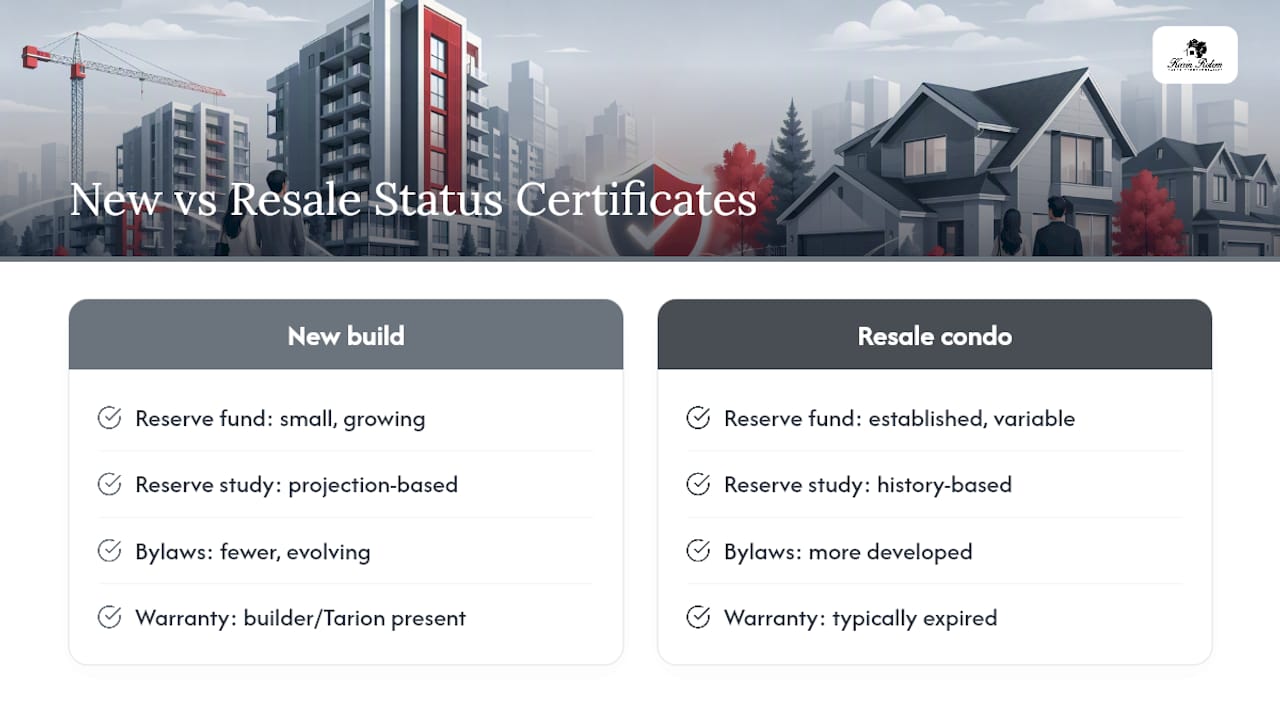
Neither certificate is automatically “safer” to buy into. New builds trade documented history for warranty protection and fresh infrastructure; older buildings trade uncertainty for a track record you can actually verify.
What role does the condo board or management play?
The condominium board and its property manager sit at the centre of the entire certificate process, and their competence, or lack of it, shows up in ways buyers don’t always expect.
The board doesn’t personally draft the certificate. That job typically falls to the property management company, which compiles the financials, bylaws, and disclosures into the prescribed form and signs off on its accuracy under the corporation’s authority. A well-run management office can turn around a request in a few days with electronic delivery. A poorly staffed or transitioning management company is often where delays start, particularly right after a corporation switches property managers, since records and reserve fund studies sometimes lag behind during the handover.
Board decisions also shape what’s actually inside the certificate. A board that’s deferred a needed roof repair for budget reasons creates a reserve fund shortfall that shows up as a red flag. A board that’s approved a special assessment mid-year, but hasn’t yet formally notified all owners, can create a disclosure gap that a sharp lawyer will ask about directly. This is where the corporation’s transparency, or the lack of it, tends to become visible fastest: a board that answers follow-up questions promptly and provides supporting documents beyond the minimum required list is usually running a well-managed building. One that stonewalls requests for clarification is telling you something too, even if it’s not written on the certificate itself.
What does a status certificate actually look like?
The certificate itself is short, typically two or three pages using the government’s prescribed form, and it’s the attachments that carry the real substance.
The front page states the corporation’s legal name, the unit’s legal description, the current common expense contribution for that specific unit, and a series of yes/no disclosures: are there arrears on this unit, is there a special assessment pending, is the corporation party to any litigation, has the reserve fund study been completed within the required timeframe. Each answer points to a supporting document in the package.
Behind that cover page sits the bulk of the paperwork: the declaration and registered bylaws (often 40 to 100 pages depending on the building’s age and amendment history), the current budget with a line-by-line breakdown of expected expenses, the most recent audited financial statement showing actual income and spending against that budget, the reserve fund statement, and copies of the insurance certificate and any material agreements. A well-organized management company tabs or indexes this package clearly. A disorganized one hands over a loose stack of PDFs that takes a lawyer twice as long to review, which is itself a small signal worth noticing.
How do you read the financial figures inside it?
The numbers in a status certificate mean little without context, and a few figures deserve closer attention than the rest.
Start with the common expense contribution listed for the specific unit and compare it against the corporation’s overall budget. If the budget shows expenses rising faster than fee revenue year over year, expect a fee increase or an assessment within the next cycle. Next, look at the reserve fund balance against the reserve fund study’s recommended funding level for the current year; a fund sitting at 50% of the study’s target is a materially different situation than one at 90%. Then check the audited financial statement against the stated budget from the prior year: a corporation that consistently overspends its budget without adjusting fees is often heading toward a special assessment, even if none has been announced yet.

Finally, review the arrears figure. A single unit in arrears is normal. Multiple units, or a dollar figure that represents a meaningful share of annual revenue, suggests the corporation may be carrying cash flow strain that could eventually affect every owner’s fees. None of these figures are disqualifying on their own; they’re context clues that, read together, tell you whether the building is financially stable or quietly heading toward a difficult year.
Why do status certificates get delayed, and what can you do?
Delays happen more often than the 10-day rule suggests, and most trace back to a handful of predictable causes.
Property management transitions are the most common culprit. When a corporation switches management companies, records, reserve fund studies, and financial files sometimes take weeks to fully transfer, leaving the new manager scrambling to assemble an accurate package. Incomplete reserve fund studies cause delays too, particularly in self-managed buildings without dedicated administrative staff. Payment processing hiccups, an uncashed cheque, an unclear request format, or a request sent to the wrong contact, also account for a fair share of holdups.
If a delay pushes past the 10-day statutory window, remember the deemed clean certificate protection applies automatically; you don’t need to fight for it. But that protection doesn’t help you if you’re on a tight closing date and simply need the document in hand. In that case, escalate directly with the property management company in writing, cite the statutory deadline, and loop in your lawyer or agent to apply pressure through professional channels. Sending the request electronically from the outset, and confirming receipt, prevents a large share of these delays before they start.
What I tell my clients about status certificates in in Toronto and Innisfil deals
What most buyers don’t realize is how often a status certificate changes the actual negotiation, not just the paperwork. I’ve had Friday Harbour clients discover a pending special assessment for dock repairs mid-review, which we used to negotiate a price reduction rather than walk away from a unit they genuinely wanted. In older Toronto buildings, reserve fund shortfalls come up often enough that I now ask for the reserve fund study before we even write an offer, not after.
What I tell every client is simple: order it early, get your lawyer reading it the same week, and request a fresh certificate again right before closing if more than a month has passed. My team coordinates that timeline directly with sellers’ agents and closing lawyers so nothing slips through in a fast-moving market.
— Felix
How Karinrotem supports buyers through the status certificate process
Karin Rotem’s team is the local alternative to navigating a status certificate alone: instead of chasing management companies and decoding reserve fund studies yourself, our team orders the certificate, coordinates lawyer review, and negotiates outcomes on your behalf, whether that means a price adjustment, a holdback, or walking away entirely. That coordination matters most in Friday Harbour and Innisfil transactions, where timelines move fast and sellers often expect quick decisions. We’ve guided buyers through exactly these reviews on waterfront and lifestyle properties across the region, and we know which red flags are worth fighting over and which aren’t. If you’re actively looking at a condo purchase and want a team that handles this process alongside you, start with our buyer representation guide to see how we support you from offer to closing.
Sources
- Status Certificates – Condominium Authority of Ontario
- Ontario fact sheet — CMHC
- Purchasing and selling condominium units: the importance of the status certificate — CCI
FAQ
How do I get a status certificate in Ontario?
Submit a written request and payment to the condominium corporation or its property management company using the prescribed form; the corporation must deliver it within 10 days for a fee of no more than $100.
What is a certificate of status in Ontario?
It’s the same document as a status certificate, a statutory disclosure under section 76 of the Condominium Act that summarizes a condo corporation’s financial health, bylaws, reserve fund, insurance, and any arrears or litigation tied to the unit.
What is a status certificate?
A status certificate is a legally required package of documents that reveals a condominium corporation’s budget, audited financials, reserve fund position, and legal disclosures, giving a buyer a 10-day right to review and potentially terminate the purchase.
Who pays for the status certificate in a resale deal?
Payment is negotiable between buyer and seller, though buyers typically cover the $100 fee since the certificate primarily protects their interests during the review period.
Can a status certificate change after it’s issued?
Yes. A certificate only reflects the corporation’s status as of its issue date, so buyers should request an updated one close to closing if significant time has passed since the original was reviewed.