
A deposit and a down payment are not the same thing, but they are not two separate piles of cash either. The deposit is an early instalment of your down payment, paid with your offer and held in trust; the down payment is your total equity, due at closing. Budget for the deposit the moment you write an offer, and keep the rest of your down payment seasoned and traceable so closing day has no surprises.
TL;DR:
- The deposit is a part of the down payment paid early with the offer and held in trust until closing, not an additional cost.
- Lenders require proof of the origin of the entire down payment, often demanding a 90-day paper trail showing funds are properly seasoned.
- Ontario law mandates that brokerages deposit funds into a segregated trust account within five business days of receiving the deposit, with proper documentation essential for buyers.
- Builder deposits differ significantly from resale deposits because they are staged, can be non-refundable, and may include clauses that tie up funds for years if projects stall.
- Buyers should confirm their deposit lands in a proper trust account within the deadline, obtain receipts, and model their total cash needs carefully to avoid shortages at closing.
Deposit vs down payment: the quick facts
Before the details, here’s what actually matters when you’re staring at an Agreement of Purchase and Sale and trying to figure out how much cash you need, and when.
- The deposit is paid with your offer or within 24 hours of acceptance; the down payment balance is due on closing day.
- Your deposit is part of your down payment, not an extra cost stacked on top of it.
- Ontario brokerages must move your deposit into a segregated trust account within five business days.
- Minimum down payment in Canada starts at 5% for homes up to $500,000, then rises in tiers.
- Lenders typically want a 90-day paper trail showing where your down payment funds came from.
- Miss the trust deadline or the seasoning window, and you can stall your own closing.
What is a deposit in a Canadian real estate transaction?
A deposit is the good-faith payment you attach to your offer, proof that you’re serious before the seller takes their home off the market for you. In Ontario, it’s typically delivered with the offer itself or within 24 hours of acceptance, by certified cheque, bank draft, or increasingly, e-transfer.
The deposit doesn’t sit with the seller. It’s held by the listing brokerage in trust, or in some transactions by a real estate lawyer, until closing. Always get a receipt. I tell every client this: a verbal “we received it” from an agent is not documentation, and if a deal ever goes sideways, that receipt is your proof the funds moved when you say they did.
Conditions in your offer, financing, home inspection, status certificate review, are what protect that deposit. If you back out within a valid condition period for a legitimate reason, you’re generally entitled to a refund. Waive your conditions or walk away outside the terms of the agreement, and the seller may have a legal claim to keep it. That distinction is where a lot of buyers get burned, and it’s exactly why a properly drafted financing condition matters more than most people assume when they’re eager to make an offer competitive.
What is a down payment and how lenders treat it in Canada
Your down payment is the equity you bring to the purchase, the portion of the price you’re not financing. It’s due at closing, and it directly reduces the size of the mortgage your lender registers against the property.
Canada sets minimum down payment thresholds in tiers, not a flat rule. You need 5% down on the portion of the price up to $500,000, 10% on the portion between $500,000 and $1.5 million, and 20% on any amount over $1.5 million. On a $700,000 home, that works out to 5% on the first $500,000 plus 10% on the remaining $200,000.
Put down less than 20%, and your mortgage needs default insurance through CMHC, Sagen, or Canada Guaranty. That insurance protects the lender, not you, and the premium gets added to your mortgage balance or paid upfront. It’s a real cost, and it’s one reason the 5% vs 20% decision isn’t purely about what you can scrape together. CMHC’s own premium guidance is worth reading before you assume the minimum down payment is automatically the smart move.
How your deposit becomes part of your down payment
Here’s the funds flow that trips up almost every first-time buyer: your deposit goes from your account into the brokerage’s trust account, then at closing your lawyer receives it along with the rest of your down payment funds, combines everything, and pays the seller. The deposit never leaves the transaction to come back to you separately. It’s applied, not returned and then re-added.
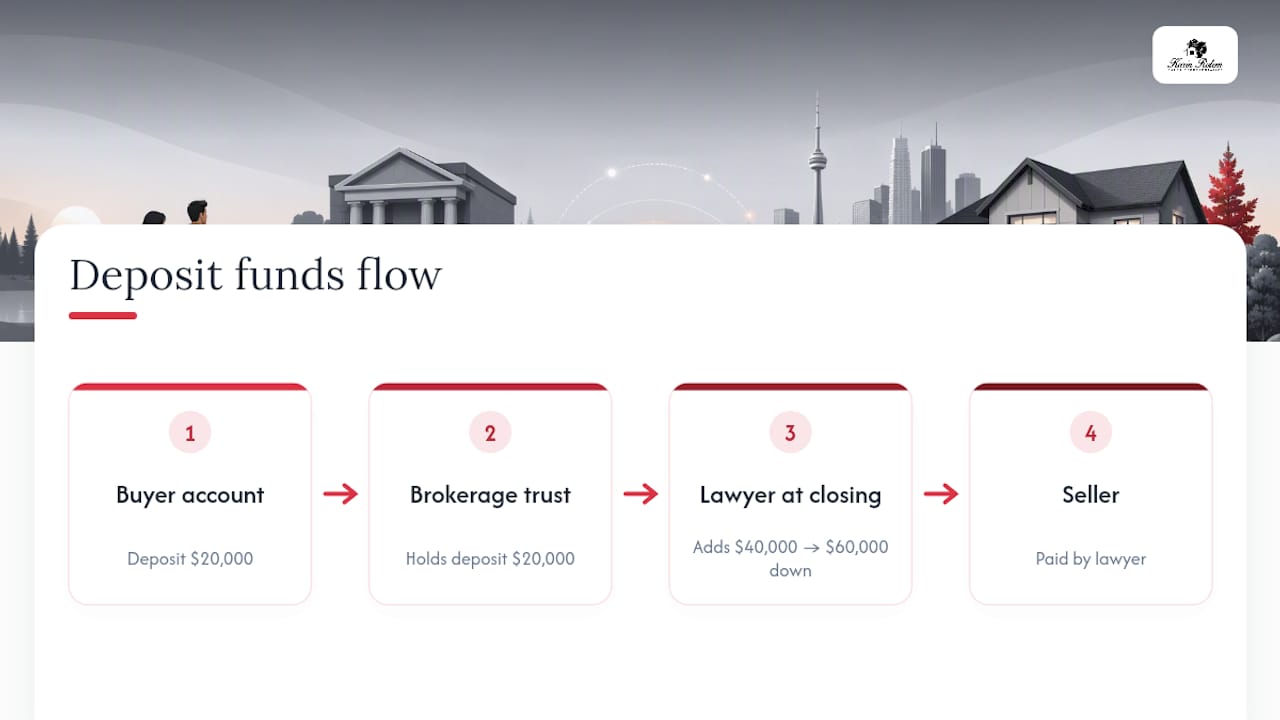
Say you’re buying a $600,000 home with 10% down, that’s $60,000 total. If you put down a $20,000 deposit with your offer, you don’t need $60,000 plus $20,000 at closing. You need the remaining $40,000, plus closing costs like land transfer tax and legal fees.
This is the single most common point of confusion I run into with buyers, and it’s an easy one to fix with a simple worked example before you write an offer. Model the numbers before you’re staring down a closing date. A quick pass through a mortgage and affordability calculator will show you exactly what cash you need in hand versus what’s already accounted for. Confusing “deposit” with “extra money owed” is how buyers end up short at the lawyer’s office, panicking two days before possession.
How much should your deposit be, and what will lenders ask for?
Deposit size isn’t fixed by law, it’s a negotiation tool, and it varies by market; for insights on offer strategy and deposit handling, see the Maine Real Estate Journal – Market notes, town guides, and plain answers about buying and selling in Maine.
Pro Tip: A larger deposit can strengthen your offer in a competitive scenario, but never offer more than you’re prepared to lose if a condition genuinely falls through. Match the deposit to your actual risk tolerance, not to what you think will “win.”
Beyond the deposit, lenders scrutinize where your entire down payment came from. Expect to provide 90 days of bank statements showing the funds sitting in your account, untouched by large unexplained deposits. If part of your down payment is a gift from family, your lender will want a signed gift letter, and in many cases wants those funds to have “seasoned” in your account before closing.
Skip this step, and you can genuinely delay your own mortgage approval. A sudden $30,000 e-transfer two weeks before closing, with no paper trail, is exactly the kind of thing that triggers extra underwriting questions at the worst possible time.
Who holds your deposit, and what happens if something goes wrong
Ontario regulates deposit handling closely, and for good reason. Under the Trust in Real Estate Services Act, enforced by RECO, a brokerage that receives your deposit must place it into a segregated Real Estate Trust Account within five business days of receipt. Business days exclude weekends and statutory holidays, and that money cannot be mixed with the brokerage’s own operating funds.
This rule exists because deposit mishandling has historically been one of the leading causes of regulatory action against brokerages in Ontario. As a buyer, you’re entitled to a receipt confirming your deposit was received and where it’s being held. If your agent or the listing brokerage can’t produce that confirmation promptly, ask your lawyer to follow up in writing. Ontario also maintains a consumer deposit protection framework that can cover buyer losses up to certain limits if a brokerage fails, though the far better protection is simply confirming your funds are in a proper trust account from day one, not sitting in an operating account.
Other provinces have their own versions of this trust obligation, with different timelines and regulatory bodies, but the underlying principle, segregated funds, documented receipt, is consistent across Canada. If you’re buying outside Ontario, ask your agent to walk you through your province’s specific rule before you hand over a cheque.
Builder and pre-construction deposits: why they’re different
Pre-construction deposits don’t behave like resale deposits, and treating them the same is a costly mistake. Builders commonly structure deposits in stages, a portion on signing, more at set intervals over months or even years, so your total exposure grows steadily long before the building exists.
Some of those staged payments can be structured as non-refundable once you pass certain deadlines, and assignment clauses (your right to sell the contract before closing) vary enormously from builder to builder. This is not the place to rely on a standard resale mindset.
Before signing anything, negotiate the deposit schedule if you can, get refund terms in writing, and have a real estate lawyer review any holdback or delay clauses. A deposit that felt reasonable at 5% can become a serious liability if the project stalls and your funds are tied up for years.
How to prepare cash and documentation before you shop
Getting your paperwork in order before you start touring homes saves weeks of stress later. Here’s the sequence I walk clients through:
- Open a dedicated account for your down payment funds and stop moving money in and out of it once you’re within 90 days of house hunting.
- Avoid large, unexplained transfers into that account, lenders flag them and it can delay your approval.
- If any portion is a gift, get the gift letter signed early, don’t wait until your lender asks.
- Keep every deposit receipt from your brokerage, and hand a copy to your lender and lawyer.
- Explore an FHSA or RRSP Home Buyers’ Plan if you qualify, but confirm withdrawal timing works with your closing date.
- Build a closing-cost buffer on top of your down payment for land transfer tax, legal fees, and adjustments.
Pro Tip: Ask your lender exactly which 90-day window they’ll review before you move a dollar. Some count from application date, others from a fixed calendar point, and guessing wrong can cost you time you don’t have.
Common mistakes first-time buyers make
I see the same handful of errors repeatedly, and almost all of them are avoidable with a bit of planning.
- Assuming the deposit is separate from the down payment and arriving at closing short of funds.
- Waiving financing or inspection conditions before the deposit is actually confirmed as received.
- Making a large, undocumented transfer into a down payment account close to the offer date.
- Not requesting a receipt for the deposit, then having no proof if a dispute arises.
- Treating a gift as “just money in the account” instead of getting a proper gift letter early.
Every one of these is a paperwork problem, not a money problem, and paperwork problems are the easiest ones to prevent.
What I tell my clients
In Toronto’s spring market, and especially around Friday Harbour where demand spikes seasonally, I often recommend a stronger deposit over a longer condition period when a buyer is genuinely confident in financing. It signals commitment without weakening their legal protection. What most buyers don’t realize is that deposit receipts need to be carefully tracked against the lawyer’s file to ensure nothing gets lost between brokerage and closing. One client last year had a gift arrive two weeks before possession with no letter attached. We caught it early enough to fix it. Had we not, that closing would have been delayed.
Deposits, down payments, and the law behind each
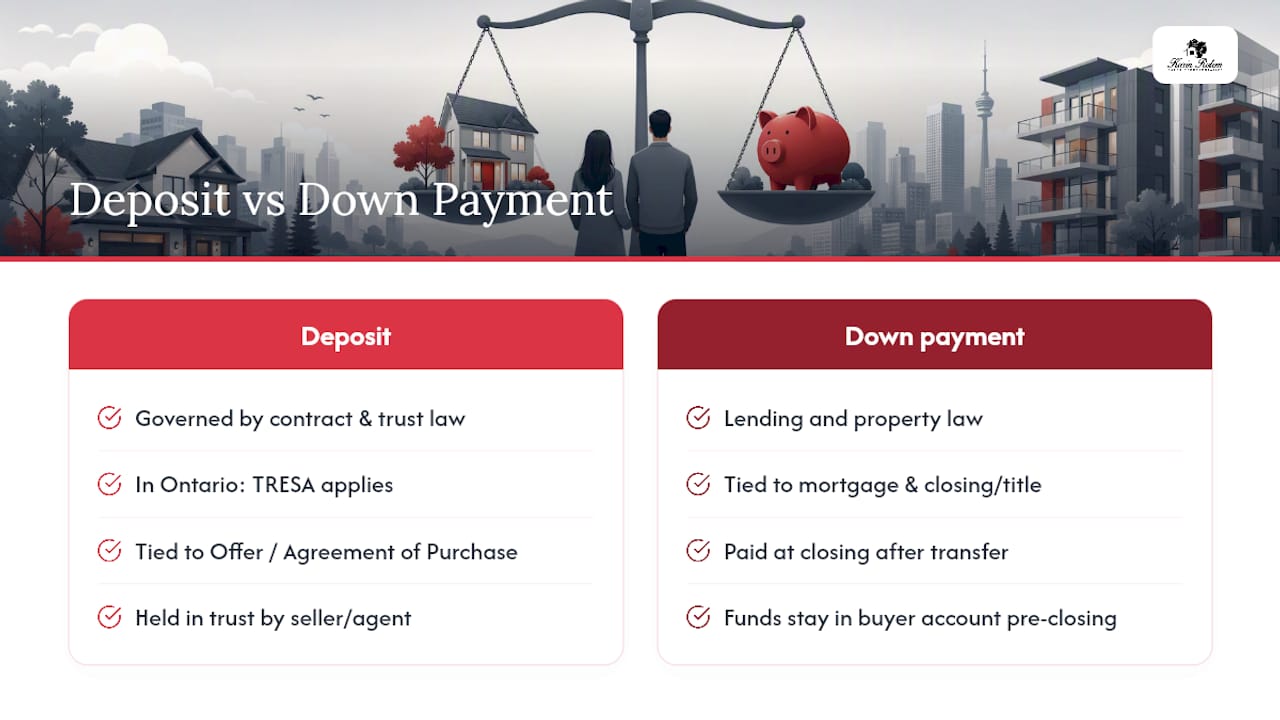
Deposits and down payments carry different legal weight, and understanding that difference protects you. A deposit is a contractual commitment tied specifically to your Agreement of Purchase and Sale. It’s governed by the terms of that contract, provincial trust legislation, and, in Ontario, TRESA. If you breach the agreement without a valid condition to rely on, the seller may have grounds to claim the deposit as damages, and in some cases pursue further legal action if the deposit doesn’t cover their losses.
A down payment, by contrast, is primarily a lending and property law matter. It’s tied to your mortgage agreement and the title transfer at closing, not to the offer contract itself. There’s no independent “forfeiture” risk on a down payment the way there is with a deposit, because by the time you’re paying it, the deal has already closed and ownership has already transferred.
This matters practically. If a deal collapses before closing, your deposit is the money at risk, held in trust and subject to the conditions in your offer. Your down payment funds, still sitting in your own account, are never at risk in the same way because they haven’t moved into the transaction yet. That’s part of why lawyers focus so heavily on getting your conditions and deposit terms right at the offer stage, that’s the moment your money is actually exposed. Buyers who understand this distinction negotiate more carefully, because they know exactly which dollars are vulnerable and when.
How deposits and down payments shape negotiating power
A deposit size sends a signal long before your down payment ever comes up. In a multiple-offer scenario, a buyer offering a $50,000 deposit on a $900,000 home reads as more committed than one offering $10,000, even if both buyers have identical financing in place. Sellers and their agents watch deposit size as a proxy for how serious and how liquid a buyer actually is.
What most buyers don’t realize is that a larger deposit can sometimes do more for an offer than a slightly higher purchase price, particularly when a seller is nervous about a deal falling apart. It’s a lower-risk way to stand out than simply overbidding.
It rarely appears in the offer itself, but agents and sellers often ask about financing strength when deciding between comparable offers.
For sellers, understanding this dynamic works both ways. If you’re negotiating your own sale and comparing offers, don’t just look at price, look at deposit size and financing conditions together, because that combination tells you far more about which buyer will actually get to closing.
Tax implications of deposits and down payments
Neither your deposit nor your down payment is tax-deductible for a primary residence purchase in Canada, and that surprises a lot of first-time buyers who assume any large housing expense comes with some kind of write-off. Down payment funds are simply your own after-tax equity going into the purchase.
Where taxes do enter the picture is in how you accumulate that money. Contributions to a First Home Savings Account or withdrawals under the RRSP Home Buyers’ Plan carry their own tax rules, and timing withdrawals against your closing date matters. Pull funds at the wrong moment and you can create an unnecessary tax event or miss a contribution deadline that would have reduced your taxable income for the year.
Land transfer tax is a separate cost entirely, calculated on the purchase price, not on your deposit or down payment amount, and due at closing alongside your down payment balance. It’s easy to forget when you’re focused on saving for a down payment, but it can add tens of thousands of dollars to what you need on closing day in Toronto specifically, given the added municipal land transfer tax on top of the provincial one.
If any portion of your down payment involves investment income, say you sold stocks to fund it, that transaction itself may trigger capital gains tax, separate from the real estate purchase entirely. That’s worth a conversation with an accountant before you liquidate anything, not after.
The one thing most buyers get backwards
Most advice treats the deposit as a minor detail, a formality you handle and move past. That’s backwards. The deposit is the moment your money is actually at legal risk in a transaction, while the down payment, sitting safely in your account until closing, is comparatively low risk right up until the day you need it.
Where conventional advice falls short is in treating “how much down payment do I need” as the whole question, when “how is my deposit protected, and is it properly documented” deserves equal weight. Buyers who focus only on down payment percentages and ignore deposit mechanics are the ones who end up in disputes.
If you take one thing from this: confirm your deposit lands in a proper trust account within that five-business-day window, get your receipt, and start your 90-day fund seasoning clock the moment you know you’re buying, not after you’ve found the home. Everything else, deposit size, financing structure, negotiation strategy, gets easier once those two fundamentals are locked down.
— Felix
How Karin Rotem helps you get from offer to closing without surprises
Understanding the mechanics of deposits and down payments is one thing. Having someone coordinate the actual paperwork, deposit receipts, lender documentation, lawyer communication, so nothing falls through between offer and possession day, is another. That’s where our team comes in for buyers across Toronto and Innisfil, particularly in the Friday Harbour community where seasonal demand and staged closings make timing especially important.
Real estate professionals can assist you by coordinating with lenders and lawyers to confirm deposit receipts are documented and trust deadlines are met, and help you structure an offer, deposit size, conditions, and timeline that fits your actual cash position rather than a generic template. If you’re weighing a waterfront property, a family home, or an income property and want to understand exactly what cash you’ll need and when, browse our current properties or reach out for a consultation before you write your next offer.
Sources
- Gimme five: The deposit and five business days (OREA)
- Canada
- Understanding down payments and deposits (CREBNow)
FAQ
Is there a difference between a deposit and a down payment?
Yes. The deposit is paid with your offer and held in trust, while the down payment is your total equity due at closing, and the deposit counts toward it rather than sitting on top of it.
Does my deposit get refunded if my deal falls through?
If you withdraw within a valid condition, such as financing or inspection, you’re generally entitled to a full refund from the trust account; walking away outside your agreed conditions puts your deposit at risk of forfeiture.