Enhanced HST relief is available on qualifying new homes in Ontario, with combined federal and provincial rebates reaching a total amount for eligible purchases. The relief applies to agreements signed between April 1, 2026 and March 31, 2027, and the amount you actually receive depends on your home’s price and how the paperwork gets filed. Builders often credit the rebate directly at closing, but you still need to confirm the consent forms and eligibility details yourself.
TL;DR:
- Buyers of homes priced below $1.4 million can expect the full combined rebate of up to $130,000, while those above $1.85 million will only qualify for the existing provincial rebate of $24,000.
- The rebate relies heavily on accurate timing, requiring agreements signed between April 1, 2026, and March 31, 2027, with construction starting or agreements signed within that window.
- Qualification depends on the home being the buyer’s primary residence, purchased from a builder, or built by the owner within the specified period, with rental properties excluded.
- The total rebate amount varies based on purchase price bands and may be reduced or phased out as home prices increase beyond certain thresholds.
- Buyers should confirm rebate credit terms with their builder early, understand the correct forms to file, and consider potential eligibility pitfalls to avoid losing their rebate.
What are the ENHR and ONHAP, and how do they combine?
Ontario’s 13% HST splits into two pieces: 5% federal and 8% provincial. Two separate programs address each piece, and understanding which is which matters more than most buyers realize.
The Ontario enhanced new housing rebate (ENHR) is a temporary top-up to the provincial 8% portion. It applies to homes purchased from a builder under an agreement dated between April 1, 2026 and March 31, 2027, and to owner-built homes where construction starts in that same window. The ENHR can push provincial relief up to a maximum amount, and it’s administered through the Canada Revenue Agency alongside the existing GST/HST new housing rebate.
The Ontario new home affordability payment (ONHAP) covers the other side of the ledger. It’s a provincial top-up worth up to $50,000, designed to mirror the federal 5% portion for qualifying buyers. Add the two together and you get the headline combined rebate figure. But ONHAP isn’t filed through the same channel as ENHR. It’s a separate provincial payment, and the CRA needs your consent to share your rebate application details with the Province of Ontario before it can process it.
Who qualifies, and which home types count?
Eligibility hinges on three things: who’s buying, what kind of home it is, and how it’s being used. Ontario structured the program to cover the most common paths into new construction, but the fine print trips up plenty of buyers.
You generally qualify if you fall into one of these categories:
- You’re purchasing a newly built home directly from a builder under a written agreement of purchase and sale.
- You’re building your own home and construction began within the eligible window.
- You’re buying shares in a housing co-operative where the unit will serve as your primary residence.
Primary residence rules matter here. If the home is meant to be your or a relation’s principal residence, you’re on solid ground. Rental properties follow different rebate mechanics entirely, and mixing the two up is one of the fastest ways to file the wrong form.
First-time buyers sometimes assume their existing federal rebate entitlement stacks endlessly with ENHR. It doesn’t. The provincial 8% portion is capped at $80,000 total, no matter how many rebate programs you’re technically eligible for. If you’re a non-resident buyer navigating these rules alongside other Ontario purchase requirements, it’s worth reviewing how non-resident property purchases intersect with new home eligibility before you sign anything.
How much relief can you actually expect?
The dollar amount you get depends entirely on where your purchase price lands. Ontario built four price bands into the 2026 budget backgrounder, and the difference between bands is steep.
| Purchase price | Relief structure |
|---|---|
| Up to a certain price threshold | Full 13% relief, up to a maximum combined rebate |
| Mid-range price band | Maximum combined rebate maintained |
| Higher price band | Reduced rebate that declines as price rises |
| Above highest price band | Reverts to the prior provincial rebate only |
Pro Tip: Run your own numbers before you assume you’re getting the full $130,000. A home priced at $1.6 million doesn’t qualify for the same relief as one at $1.4 million, and the gap can run into tens of thousands of dollars.
A few real examples make this clearer. A $700,000 home sits comfortably in the first band and can capture the full combined relief. A $1.2 million home still hits the $130,000 ceiling. A $1.7 million home falls into the reduction zone, so the combined rebate shrinks proportionally as the price climbs toward $1.85 million. Cross that $1.85 million line, and you’re back to the older, smaller $24,000 provincial rebate, with no ONHAP top-up at all. The federal GST/HST new housing rebate also factors into these calculations, and any adjustment there reduces the ONHAP amount accordingly.
Which dates and deadlines determine eligibility?
Timing is the part buyers underestimate most. Miss a date, and the rebate can disappear entirely, regardless of how much HST you’d otherwise be entitled to recover.
- Your agreement of purchase and sale with a builder must be signed between April 1, 2026 and March 31, 2027.
- Owner-built homes need construction to start within that same window to qualify for ENHR.
- Construction completion and possession deadlines vary depending on whether the home is your primary residence or an owner-built project, and builders sometimes juggle several deadline combinations across a single development.
Ontario has been explicit that some elements of this relief required federal legislative steps to take full effect, which means deadlines and mechanics can shift as implementation proceeds. Always check the CRA and Ontario pages directly before you finalize a purchase decision based on a specific date.
How do you actually apply for the rebate?
The filing process depends almost entirely on whether your builder handles it for you or leaves it in your hands. Neither route is complicated, but each has its own paperwork trail.
- If your builder agrees to pay or credit the rebate at closing, the builder submits the application on your behalf. You’ll still sign consent forms, but the heavy lifting happens on their end.
- If the builder doesn’t credit the rebate, you file directly using Form GST190 (homes purchased from a builder) with schedule RC7190-ON, or Form GST191 (owner-built homes) with schedule RC7191-ON.
- These forms get mailed to CRA. There’s no electronic filing option for these rebates, which surprises buyers used to doing everything online.
- For ONHAP specifically, you need to consent to CRA sharing your application data with the Province of Ontario. If you skip that consent, you’ll need to submit the required information to the province separately.
- If your builder didn’t credit the rebate, you generally have up to two years from the date of ownership or possession to file your claim.
What mistakes cost buyers their rebate?
Most rebate problems trace back to assumptions, not bad luck. Builders frequently bake the expected rebate into their pricing before you’ve even confirmed you qualify.
- Check your statement of adjustments carefully. If the builder already credited the rebate into your purchase price and you’re later found ineligible, you may be on the hook to repay CRA for that amount.
- An unsigned consent section for ONHAP is a common and entirely preventable delay.
- Filing the wrong form type (GST190 instead of GST191, for instance) sends your application into a holding pattern that can take months to untangle.
- Because filing isn’t digital, a mailed form that arrives late or incomplete can push your claim past processing deadlines.
Pro Tip: Ask your builder’s closing coordinator, in writing, whether the rebate is being credited or whether you’re filing it yourself. Get that answer at the offer stage, not the week before closing.
What should you do at offer, pre-closing, and closing?
A little structure here saves a lot of stress later. Here’s the sequence I walk clients through on every new build purchase:
- Confirm your agreement date falls inside the April 1, 2026 to March 31, 2027 window before you sign anything.
- Ask the builder directly whether they’ll credit the rebate at closing or expect you to file it.
- Prepare and sign GST190 or GST191, along with the matching RC7190-ON or RC7191-ON schedule, well before your closing date.
- Sign the ONHAP consent form so CRA can share your rebate details with the province.
- Loop in your lawyer and mortgage broker early so nobody’s surprised by a rebate adjustment on the statement of adjustments.
- Document expected construction start and completion dates in writing, especially for owner-built or pre-construction purchases.
Pro Tip: If your builder’s timeline has already slipped once before your purchase agreement was signed, ask pointed questions about how that affects your construction deadline. A slipping schedule is often the first sign your eligibility window is at risk.
What I tell my tells clients about HST relief and new home decisions
Here’s what most buyers don’t realize: a $130,000 rebate feels enormous on paper, but it should never be the reason you buy a specific home. I’ve watched buyers stretch into a price band they weren’t comfortable with because the relief made the math look better on a spreadsheet. That’s backwards. The home has to work for your life first.
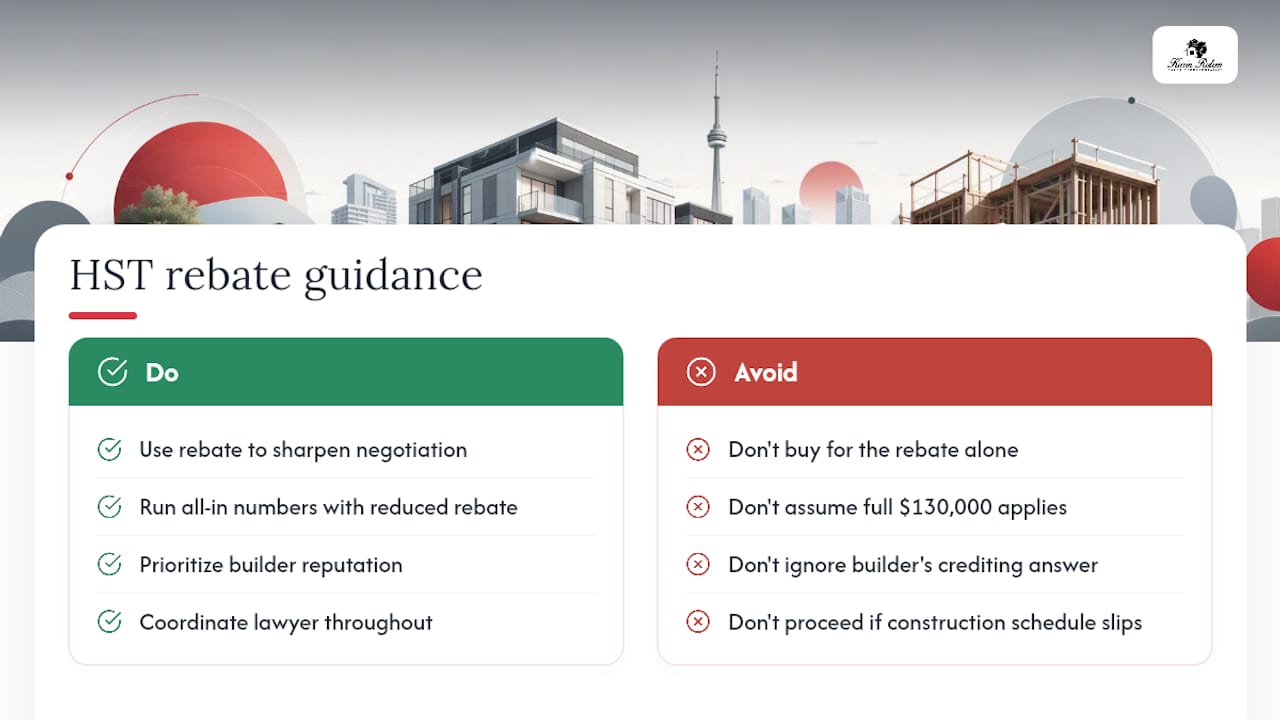
What I do encourage is using the rebate structure to sharpen your negotiation and your affordability math, especially for higher-priced properties. If you’re looking at something in the $1.5 million to $1.85 million range, whether that’s a waterfront property near Friday Harbour or a GTA infill build, you need to run your “all-in” numbers with the reduced rebate baked in, not the full $130,000 you saw in a headline.
My practical priorities with clients are always the same: builder reputation first, realistic construction timelines second, and lawyer coordination running the whole way through. If a builder can’t give you a straight answer about whether they’re crediting the rebate or if their construction schedule keeps sliding closer to the eligibility deadline, that’s a real reason to slow down or walk away. The rebate is a bonus. The home and the builder’s track record are the decision.
— Felix
How Karin Rotem helps you navigate the rebate and the purchase
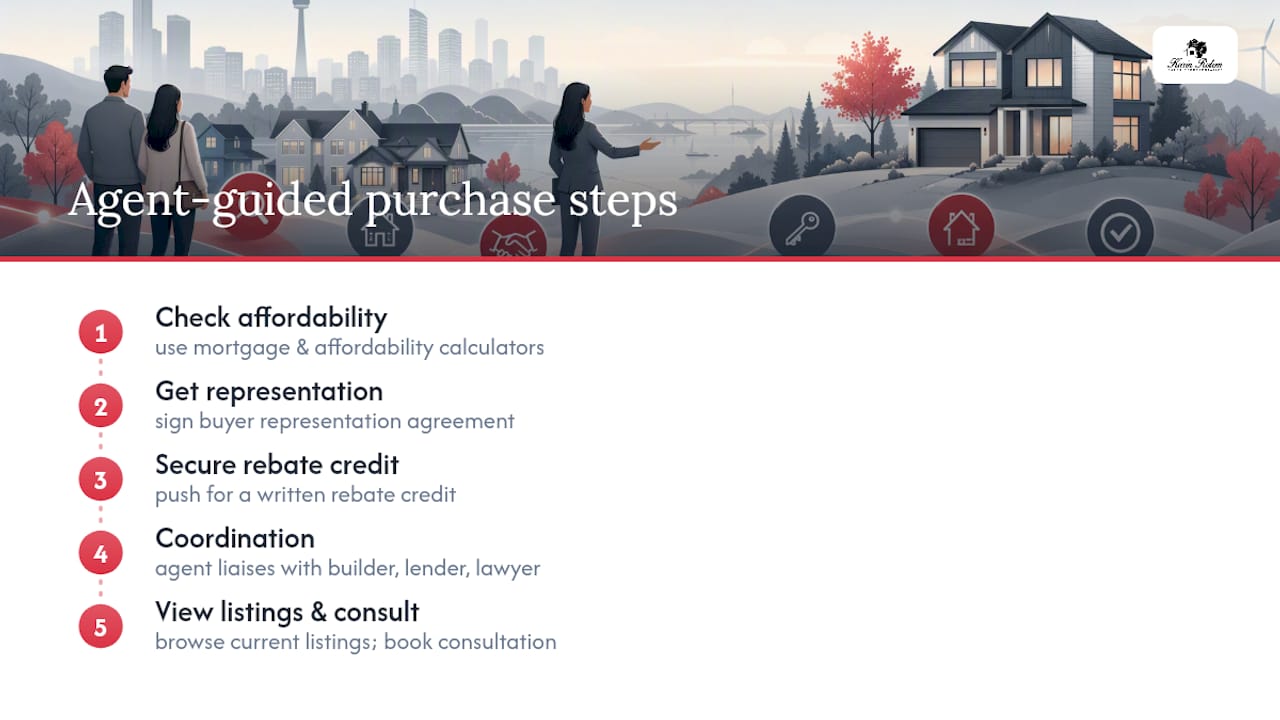
Coordinating a new home purchase in this rebate window means juggling builder paperwork, CRA forms, lender timelines, and your lawyer’s checklist all at once, and that’s exactly where working with a local agent pays off. I sit at the table with builders regularly, which means I know how to push for a clear, written rebate credit on your agreement rather than a vague promise that gets murky at closing.
If you’re weighing a purchase against these price bands, start with our mortgage and affordability calculators to see your true all-in cost once the rebate is factored in properly. From there, a buyer representation agreement means I’m coordinating your builder, your lawyer, and your lender directly, so nothing falls through the cracks between offer and closing. Ready to see what’s currently available? Browse our current listings and book a consultation to run your affordability numbers before you commit to anything.
Official forms and pages to verify before you sign
Confirm every detail directly with primary sources: the ENHR overview, the Ontario budget backgrounder, and CRA’s Guide RC4028 for forms GST190, GST191, RC7190-ON, and RC7191-ON. For technical questions, CRA’s GST/HST Rulings line is 1-800-959-8287. If your builder’s timelines involve real construction cost pressures, this construction cost-saving guide offers useful context on how build costs and schedules interact.
This article is general information, not a substitute for advice from a qualified financial advisor. Consult a qualified financial professional about your own circumstances before acting on anything here.
Sources
FAQ
How do I avoid paying HST on a new home in Ontario?
You can’t avoid HST outright, but the ENHR and ONHAP together can rebate up to $130,000 of the tax on qualifying purchases made under agreements signed between April 1, 2026 and March 31, 2027, depending on your home’s price band.
Is HST being removed entirely from new homes in Ontario?
No. HST still applies to new home purchases; the enhanced relief programs rebate a larger portion of it temporarily rather than eliminating the tax itself.
Who qualifies for the HST rebate on new homes?
Buyers purchasing from a builder, owner-builders whose construction starts within the eligible window, and co-op share buyers using the unit as a primary residence can all qualify, subject to price band limits and proper filing.
What are the key details of the Ontario new home rebate for 2026?
The program combines ENHR (up to $80,000 provincial) and ONHAP (up to $50,000 provincial top-up) for a maximum $130,000 on homes up to $1.5 million, phasing down through $1.85 million and reverting to the older $24,000 rebate above that.