
Toronto buyers pay both the Ontario provincial land transfer tax and the city’s own Municipal Land Transfer Tax (MLTT), and as of April 1, 2026 that municipal bill got steeper for high-value single-family homes under new graduated luxury bands. First-time buyers can still claim up to $8,475 in combined rebates. Scroll down for the calculator link and two worked examples that show exactly what you’d owe.
TL;DR:
- The new luxury property tax bands coming into effect on April 1, 2026 significantly increase land transfer taxes for homes above $3 million, especially on waterfront and single-family properties.
- Buyers should have their lawyer confirm property classification in writing before waiving conditions, as misclassification can lead to higher tax brackets and costs.
- First-time buyers can receive a combined rebate of up to $8,475, but they must claim it at registration to maximize savings and avoid upfront overpayment.
- The Toronto Municipal Land Transfer Tax stacks on top of Ontario’s provincial tax, causing the total transfer cost to roughly double some expectations, especially for high-value properties.
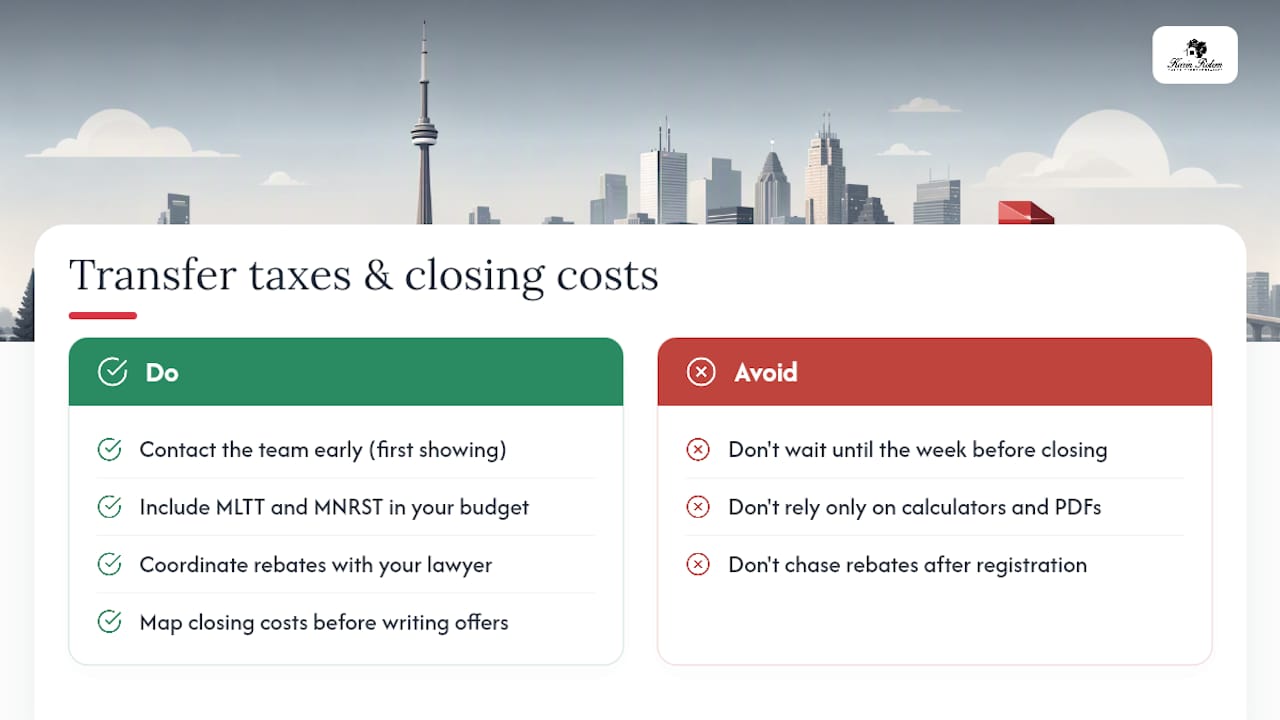
- Building MLTT and rebate considerations into the offer strategy early can prevent surprises at closing and ensure maximum rebate claimability.
Municipal land transfer tax Toronto: a quick calculator and two worked examples
Before running numbers by hand, use the City of Toronto MLTT calculator. Punch in the purchase price, property type, and first-time buyer status, and it returns an estimate. The City is upfront that this tool gives an estimate only, and your lawyer finalizes the actual amount at registration.
Here’s how the math plays out at two different price points:
- $800,000 resale home (not first-time buyer): Provincial LTT lands around $12,475, and municipal MLTT comes in close behind. Combined, reputable calculators peg the total transfer tax bill near double what buyers expect if they only budgeted for one layer of tax.
- $3,500,000 single-family purchase: This is where the April 1, 2026 luxury bands bite. The portion of the price above each new threshold gets taxed at progressively higher municipal rates, pushing the total transfer tax bill well past what a straight percentage calculation would suggest.
Pro Tip: Run the number twice: once assuming you qualify for a first-time buyer rebate, and once assuming you don’t. That gap tells you how much room you actually have to negotiate on price.
What are the current MLTT rates after the April 1, 2026 changes?
By-law 132-2026 rewrote Chapter 760 of the municipal code to add graduated marginal rates for high-value single- or two-family residential properties, effective April 1, 2026.
Here’s how the City’s official marginal rate table breaks down for single- and two-family residences:
Properties under a nominal-value threshold are exempt, and the City charges a modest administration fee on registered transfers plus a separate refund-processing fee if you miss claiming a rebate at registration.
How to calculate combined provincial and municipal land transfer tax
Toronto is one of the only Ontario municipalities layering its own tax on top of the province’s, so the math genuinely runs in two passes. Here’s the sequence your lawyer follows:
- Calculate Ontario provincial LTT using the province’s own marginal brackets, applied to the full purchase price.
- Calculate Toronto MLTT using the municipal brackets above, matched to the correct property type (single-family versus other classes matters).
- Add the two totals, then subtract any rebates you’re eligible for, provincial and municipal, before arriving at the amount payable at registration.
Before you or your lawyer run this, have four things ready: the agreed purchase price, the property type classification, your first-time buyer status, and your residency/citizenship status. Each one changes which bracket, rebate, or surcharge applies.
Pro Tip: Ask your lawyer to confirm the property’s classification in writing before you waive your financing condition. Mixed-use or unusually configured properties sometimes get classified differently than buyers expect, and that changes which municipal bracket applies.
For a deeper walkthrough of how the provincial side of this calculation works on its own, our Ontario land transfer tax guide breaks down the provincial brackets in more detail.
Rebates, exemptions, and the non-resident speculation tax
First-time buyers get real relief here, even with the 2026 rate changes in place. Ontario’s provincial refund tops out at $4,000, and Toronto’s municipal rebate adds up to $4,475, for a combined maximum of $8,475 when you qualify for both.
- You must be at least 18 years old and move into the home as your principal residence within nine months of registration.
- You (and your spouse, if applicable) must never have owned a home anywhere in the world.
- Permanent residents have an 18-month window from closing to file for the provincial refund if citizenship status is pending at registration.
- Claim the rebate directly at registration whenever possible. Claiming it later means paying the full tax upfront and filing a refund application with its own processing fee.
Separately, the city’s Municipal Non-Resident Speculation Tax (MNRST) adds a 10% surcharge on certain residential purchases by non-resident buyers, effective January 1, 2025, stacking on top of MLTT and provincial LTT. Exemptions exist for nominees, protected persons, and spouses of Canadian citizens, but there’s no grandfathering for agreements signed before the tax took effect. If your purchase structure involves a trust, corporation, or non-resident co-buyer, confirm applicability with your lawyer before you firm up.
When do you pay the tax, and who’s responsible?
MLTT and MNRST are payable the moment the conveyance registers on title, which for most closings means the same day possession transfers. Your lawyer calculates the amount, applies any rebates you’re claiming at registration, and remits payment as part of closing. The buyer pays, always, and that responsibility doesn’t shift regardless of what your agreement of purchase and sale says about other costs.
Budget for it separately from your down payment. Land transfer taxes generally can’t be rolled into your mortgage, so that cash needs to be liquid and ready on closing day. For a fuller picture of everything else due at the same time, our closing costs guide for Ontario buyers covers the rest of the bill.
What I tell my tells clients about planning for land transfer tax in Toronto
What I tell my clients is simple: build MLTT into your offer strategy before you fall in love with a property, not after. I’ve watched buyers get to the finish line on a $3.5 million waterfront property and only then realize the luxury bands added tens of thousands of dollars they hadn’t budgeted for.
The luxury bands change how I advise clients on single-family and waterfront purchases specifically. Above the $3 million mark, that marginal jump from 2.5% to 3.5% is exactly why I tell buyers to run their lawyer’s classification check before they remove conditions, not after.
What most buyers don’t realize is that classification disputes (single-family versus other residential use) can shift which bracket applies. Get your lawyer involved early, use our buyer calculators alongside the City’s tool, and claim every rebate at registration.
Why the April 1, 2026 rate change matters more than most buyers assume
Most coverage of this update treats it as a niche concern for mansion buyers. That’s a mistake. The graduated bands recalibrate the entire negotiating dynamic above the $3 million mark, and Toronto’s waterfront and single-family inventory sits disproportionately in that range.
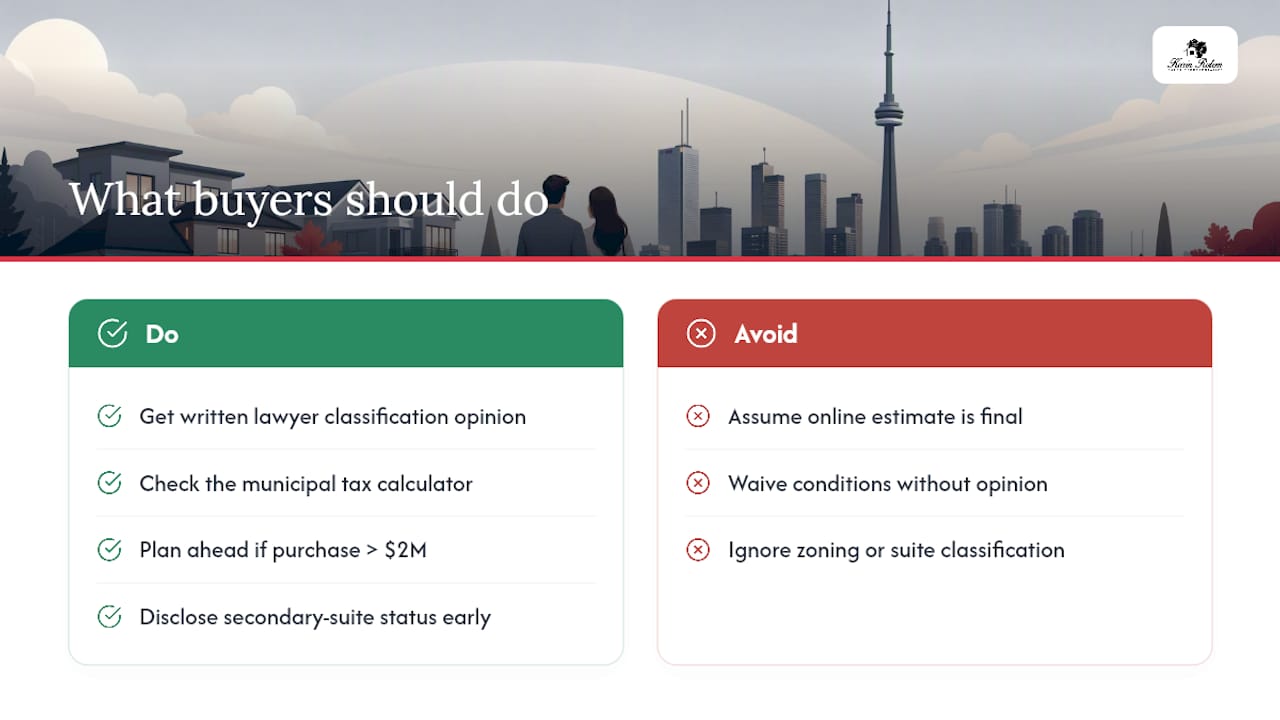
The conventional advice, “check the calculator before you offer,” is fine but incomplete. The bigger risk isn’t miscalculating the tax. It’s misclassifying the property. A single-family home with a legal secondary suite, or a property that straddles residential and mixed-use zoning, can land in a different bracket than buyers assume from a quick online estimate.
My honest read: the rebate system remains generous for first-time buyers relative to the tax burden that’s grown around it, but it rewards buyers who plan ahead and penalizes those who don’t. If you’re transacting above $2 million in this city, get a lawyer’s classification opinion in writing before you waive conditions. That single step protects you more than any spreadsheet.
— Felix
How Karin Rotem’s team helps you handle transfer taxes and closing costs
Karin Rotem’s team is the local alternative to figuring this out alone through a calculator and a stack of government PDFs. We work these numbers into your offer strategy from the first showing, not the week before closing, and we coordinate directly with your lawyer to make sure rebates get claimed at registration instead of chased down afterward.
That matters most on waterfront and single-family purchases where the 2026 luxury bands add real weight to the closing bill. Our team builds MLTT, MNRST exposure, and rebate eligibility into your budget before you write an offer, so there are no surprises at the lawyer’s table.
If you’re actively looking in Toronto, Innisfil, or Friday Harbour, reach out early. Browse our current properties and let’s map out your closing costs before you find “the one.”
Sources
Verify every figure directly at the source: the City of Toronto’s MLTT rate tables and calculator, Ontario’s first-time homebuyer refund guidance, and By-law 132-2026, which enacts the graduated rate bands. For total moving costs beyond taxes, this Ontario moving budget guide is a useful companion.
This article is general information, not a substitute for advice from a qualified financial advisor. Consult a qualified financial professional about your own circumstances before acting on anything here.
- Ontario
- Municipal Land Transfer Tax & Municipal Non-Resident Speculation Tax Calculator – City of Toronto
FAQ
What are the land transfer tax rates in Ontario for 2026?
Ontario applies marginal provincial rates on top of Toronto’s municipal MLTT rates, which now range from 0.5% up to 8.60% on single-family homes over $20 million following the April 1, 2026 changes.
How much is land transfer tax on a $400,000 home in Ontario?
On an $800,000 Toronto home (a closer real-world example), combined provincial and municipal tax runs into the tens of thousands before rebates, with illustrative calculators showing the two layers roughly doubling the total bill compared to paying provincial tax alone.
How do I avoid land transfer tax in Toronto?
You can’t avoid MLTT on a standard purchase, but first-time buyers can offset it through the combined municipal and provincial rebate of up to $8,475, claimed at registration.
Who pays the land transfer tax in Toronto?
The buyer pays both the provincial land transfer tax and the municipal MLTT, and the buyer’s lawyer calculates and remits it when the property is registered at closing.