
If a lender’s appraisal comes in below your offer in Ontario, the lender caps your mortgage at that appraisal. You have to cover the shortfall in cash or risk a failed closing, a forfeited deposit, and possible damages owed to the seller. This gap between what you agreed to pay and what the bank’s appraiser says the home is worth is one of the most underestimated risks in a competitive offer.
TL;DR:
- Before offering, review comparable sales, consider an independent appraisal, and set aside cash because lenders calculate financing from the lower of price or appraised value.
- Keep a financing condition until the appraisal returns; if the result is low, submit sales evidence or renovation records, and ask whether another lender could help.
- If you default, the seller may keep your deposit and claim proven resale losses, carrying costs, commissions, and legal fees; court relief is discretionary.
- Unique condos, waterfront homes, and rural properties face greater valuation uncertainty when comparable sales are scarce; Ontario offers no common insurance for appraisal gaps.
What an appraisal gap is and how lender valuations work in Ontario
An appraisal gap happens when the professional valuation ordered for your mortgage comes in lower than your purchase price. We see this most often in multiple-offer situations, where the winning bid outpaces what recent comparable sales can support. The appraiser is almost always working for the lender, not for you, and their job is to protect the bank’s collateral, not to validate your offer.
Depending on the property and the lender’s risk assessment, the appraisal can take a few different forms:
- A full appraisal includes an interior and exterior inspection and is the most common for higher-value or unique properties.
- A drive-by appraisal relies on exterior observation and public data, used when the lender’s risk model allows a lighter review.
- A desktop valuation uses data and comparable sales without a site visit, often for straightforward, high-volume transactions.
CMHC describes an appraisal as a snapshot of market value at a specific point in time, shaped by comparable sales, condition, and location, and notes that giving the appraiser full access to the property helps avoid delays in financing. Once the report lands, the lender uses the lower of the appraised value or the purchase price to calculate your loan-to-value ratio, which is what actually determines how much they will lend you.
Why appraisal gaps are more common in Ontario in 2026
Several forces are converging to make appraisal shortfalls more frequent across Ontario right now.
- Price movement outpaces comparables: when values shift quickly, appraisers relying on closed sales from months earlier are working with outdated benchmarks.
- Underwriting has gotten more conservative: lenders and credit unions are expected to maintain valuation policies and bring in independent, current assessments when risk is elevated, according to FSRA guidance for residential mortgage lending in Ontario.
- Presale and resale comps don’t always match: a condo bought at a pre-construction price years ago may have no recent resale equivalent nearby, leaving the appraiser to lean on dated or dissimilar data.
What most buyers don’t realize is that an appraisal gap isn’t really about the home. It’s about the lag between how fast a neighbourhood is moving and how slowly the data catches up. In a market like Innisfil, where Friday Harbour has introduced a type of lifestyle property with few direct comparables, that lag can be wider than in an established Toronto neighbourhood with hundreds of recent sales to draw from.
Legal and financial consequences in Ontario when a buyer can’t close because of an appraisal gap
When a buyer can’t bridge the gap and the deal collapses, the financial exposure is real and sometimes severe. Ontario courts have repeatedly dealt with cases where a buyer’s deposit was forfeited after a failed closing, but forfeiture is often just the starting point.
- Deposit forfeiture: the deposit is typically treated as a deposit toward the purchase and can be retained by the seller if you default.
- Additional damages: a Court of Appeal for Ontario decision shows that courts may allow a vendor to claim damages beyond the deposit when the seller can prove an actual loss, meaning forfeiture doesn’t automatically cap your exposure.
- Vendor loss categories: damages claims commonly include the shortfall between the original contract price and the eventual resale price, carrying costs like mortgage interest and property tax during the resale period, commission paid on the failed deal, and legal fees.
A forfeited deposit is not always the end of the story. Ontario case law treats deposit application differently depending on the circumstances, and a seller who can document real financial harm may pursue the buyer for more.
Buyers in this position aren’t without any options. Courts can sometimes grant relief from forfeiture or, in rarer cases, order specific performance, but these remedies are discretionary, costly to pursue, and far from guaranteed. The practical lesson is that avoiding the gap in the first place is a far better strategy than hoping a judge will undo it later.
What buyers can do: step-by-step actions pre-offer and if an appraisal comes low
Reducing appraisal risk starts well before you submit an offer and continues right up until conditions are removed.
Before you write an offer:
- Consider commissioning an independent valuation from a designated member of the Appraisal Institute of Canada, which recommends buyers get an unbiased opinion of market value before signing a binding agreement.
- Pull your own recent comparable sales and note any upgrades or unique features that could support the price you’re offering.
- Build a realistic “appraisal buffer” into your savings, extra cash set aside specifically to cover a shortfall if the valuation lands below the contract price.
When drafting the offer itself, a well-written financing condition with a reasonable removal timeline gives you room to react instead of being locked in before the appraisal is even back.
If the appraisal does come in low:
- Ask your lender for a reconsideration and supply new comparables or evidence of recent renovations.
- Explore switching lenders, but be mindful that a new lender may require a reliance letter before accepting the prior appraisal.
- Discuss bridge financing or topping up your down payment with your mortgage broker.
Pro Tip: Ask your mortgage broker to run the numbers for more than one lender before you remove your financing condition, since loan-to-value limits and insured mortgage thresholds can vary enough to change your options entirely.
For insured mortgages, CMHC’s thresholds mean even a modest appraisal shortfall can shift you into a different insurance tier, which is exactly the kind of scenario brokers can model out ahead of time, and it’s worth reviewing our guide on financing conditions before you finalize offer terms.
What I tell my clients: local, practitioner steps and resources
Before writing an offer in a competitive market, I advise planning for the appraisal the same way you plan for the inspection, not as an afterthought. The typical workflow includes:
- Running a pre-offer comparable sales check so clients know roughly where a lender’s appraiser is likely to land.
- Looping in a mortgage professional early so financing scenarios are modelled before, not after, an offer is accepted.
- Flagging properties with few recent comparables, like certain Friday Harbour unit types, where appraisal risk tends to run higher.
Coordinating directly with mortgage brokers and appraisers whenever possible helps surface valuation issues before conditions come off, giving everyone more room to adjust—whether that means renegotiating, adding cash, or walking away cleanly.
Implications of appraisal gaps for different property types
Appraisal risk isn’t uniform across property types, and understanding where it concentrates helps you set expectations before you offer.
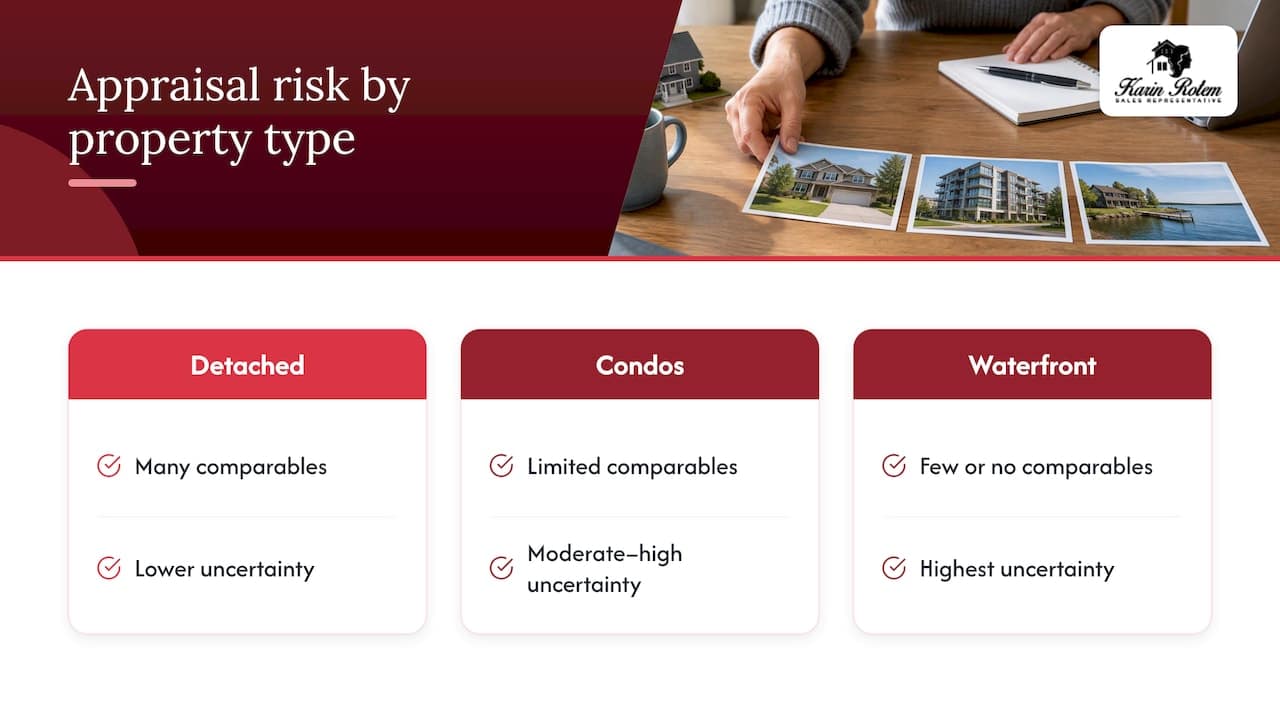
Detached homes in established neighbourhoods with plenty of recent, similar sales tend to appraise more predictably, because the appraiser has ample comparable data to work from. A bidding war can still push the price above appraised value, but the gap is usually smaller and easier to bridge.
Condos carry a different set of risks. In buildings with a mix of unit layouts, or in newer developments without much resale history, the appraiser may have to stretch to find comparables, sometimes reaching into other buildings or neighbourhoods entirely. Friday Harbour is a good example: as a lifestyle-driven, marina-side community with a limited resale history relative to downtown Toronto condos, appraisers sometimes have fewer direct matches to draw on, which can widen the gap between contract price and appraised value.
Waterfront and lifestyle properties, including vacation homes and condo hotel units, often face the steepest valuation uncertainty because buyers are paying partly for amenities and lifestyle that don’t always translate into a comparable-sales framework. Detached rural or shoreline properties can also raise questions around septic systems, shore road allowances, and other features that standard appraisal models weren’t built to price precisely.
Role of appraisal gap insurance or gap coverage options for buyers
Unlike some other markets, there’s no widely available consumer insurance product in Ontario that specifically covers an appraisal shortfall the way, for example, mortgage default insurance covers lender risk on a low down payment. What exists instead are financing structures that help absorb the gap rather than insure against it.
CMHC’s default insurance protects the lender, not you, if you default on an insured mortgage, and it doesn’t fill an appraisal gap. The more practical tools are a cash buffer set aside before you offer, a home equity line of credit you can draw on quickly, or bridge financing arranged in advance so you’re not scrambling after a low appraisal lands. For buyers juggling the sale of one property while purchasing another, our guide to deciding whether to buy or sell first and our overview of bridge financing for Ontario buyers are both worth reviewing well before you’re under contract.
Some buyers also ask their mortgage broker about restructuring the loan, extending amortization, or shifting lenders to find a loan-to-value ratio that still works. None of these are insurance in the strict sense. They’re contingency planning, and the buyers who fare best are the ones who’ve lined up a plan before they need it.
How sellers can address or manage appraisal gaps to avoid deal fall-throughs
Appraisal risk isn’t just a buyer problem. A seller who watches a deal collapse over a valuation shortfall loses time, carrying costs, and sometimes momentum in a cooling market.
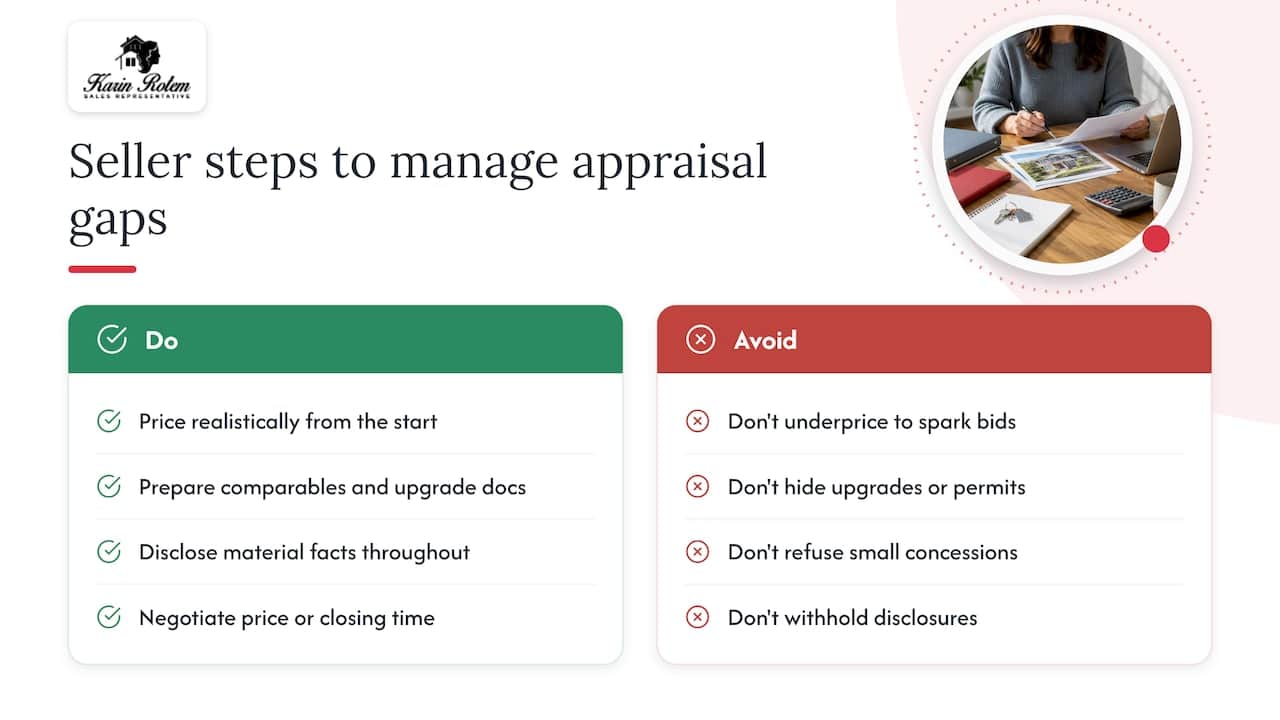
Pricing realistically from the start, rather than deliberately underpricing to spark a bidding war, reduces the odds that the winning offer drifts far enough above recent comparables to trigger a low appraisal. Sellers can also prepare a package of recent comparable sales and documentation of any upgrades, which gives the buyer’s appraiser more to work with and can support a stronger valuation.
RECO’s guidance on material facts also reminds sellers and their agents that disclosure obligations run throughout the transaction, which matters when a low appraisal prompts renegotiation and both sides are relying on accurate information to find a path forward. A seller willing to negotiate, whether by adjusting price slightly or giving the buyer more time to source additional funds, often fares better than one who holds firm and risks a second failed closing. Clear seller disclosure also reduces the odds of disputes later, something we cover in more detail in our seller disclosure checklist for Ontario.
Upgrades can matter too. A seller who has documentation for recent improvements, including something as specific as a properly permitted EV charger installation, gives the appraiser concrete evidence of added value rather than leaving it to guesswork.
First-person takeaway: one priority every Ontario buyer should act on
If I could get every buyer to do one thing, it would be this: set your appraisal buffer before you fall in love with a property, not after. In Innisfil and Friday Harbour especially, where comparables can be thin, that buffer is what keeps a great offer from becoming a legal headache. Reach out before you write your next offer and we’ll build a pre-offer plan around your actual numbers.
— Felix
How Karin Rotem’s team can help buyers manage appraisal risk
We work through appraisal risk with clients before it becomes a problem, not after a low valuation lands and the clock is already running. That means pulling realistic comparables before you offer, coordinating with your mortgage broker so financing scenarios are mapped out in advance, and helping you negotiate a path forward if an appraisal does come in short.
- Pre-offer comparable sales analysis tailored to the specific building or neighbourhood you’re considering.
- Coordination with mortgage professionals so financing conditions and timelines reflect real appraisal risk, not guesswork.
- Negotiation support if a low appraisal requires renegotiating price, timeline, or deposit terms.
Our focus on Friday Harbour and Innisfil gives us a close read on where comparables run thin and where they don’t, and that local knowledge shapes every offer strategy we build with you. If you’re weighing a purchase in the area, start with our tailored real estate solutions page or browse current Friday Harbour condos for sale to see what’s available now.
FAQ
How often is there an appraisal gap?
Appraisal gaps are more likely in fast-moving or low-inventory markets where comparable sales lag behind current pricing, though no single Ontario-wide frequency figure is publicly tracked. Buyers in multiple-offer situations face a meaningfully higher chance of a shortfall than those buying at or near asking price.
How much does a home appraisal typically cost in Ontario?
CMHC notes that appraisal costs vary by property and lender requirements, and buyers should confirm the exact fee and turnaround with their mortgage professional before relying on a timeline. Costs are generally paid by the buyer as part of the mortgage approval process.
What are the real estate predictions for Ontario in 2026?
Specific 2026 price forecasts aren’t something we can state as fact without a named, current source, but the underlying appraisal risk we describe here, comparable-sales lag against fast-moving pricing, remains a consistent feature of competitive Ontario markets. Buyers should treat appraisal risk as an ongoing planning factor rather than a temporary condition tied to any single year.
What is a red flag on an appraisal?
A red flag typically includes a valuation that relies on comparables from a different neighbourhood or an older time period, a property with unique features the appraiser notes as difficult to compare, or a gap between the contract price and appraised value large enough to affect your loan-to-value ratio. Any of these should prompt a conversation with your mortgage broker before you remove financing conditions.
Can I use a different appraiser than the one the lender chooses?
Generally, the lender selects or approves the appraiser because the report is prepared to protect the lender’s collateral, not yours. You can still commission your own independent appraisal for your own planning purposes, as the Appraisal Institute of Canada recommends, but it won’t replace the lender’s required report.
Sources
- AIC consumer guide (PDF)
- Your home value | CMHC
- Court of Appeal for Ontario decision (CanLII)
- RECO bulletin on material facts