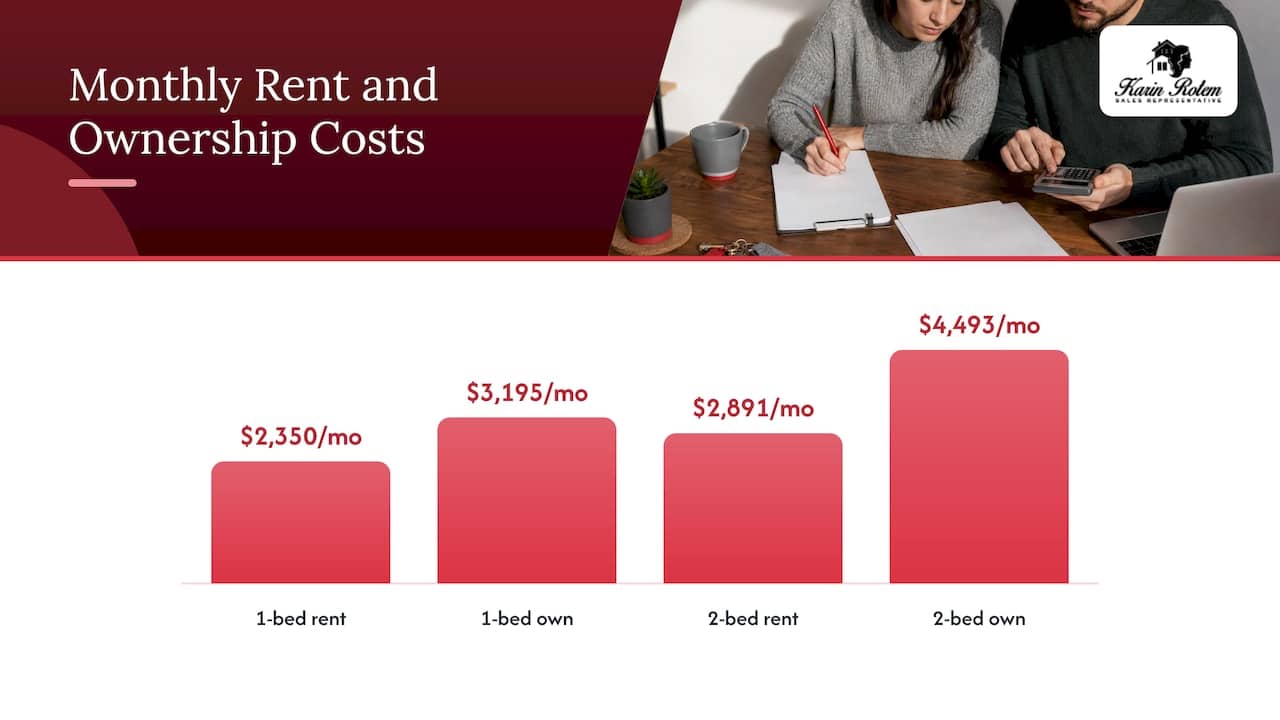
In Toronto, renting is cheaper month to month, and buying usually pays off only if you stay put for many years. For a one-bedroom condo, owning costs about $845 more a month than renting. The gap is smaller once you count the part of your mortgage payment that builds equity. What I tell my clients is that the right answer depends less on the market headline and more on how long you will stay, how stable your income is and how much cash you have left after closing.
TL;DR
- A Toronto one-bedroom condo costs about $2,350 a month to rent and $3,195 to own, a gap of $845. For a two-bedroom the gap is $1,602.
- Part of every mortgage payment is principal, so the true economic gap is smaller than the cash gap. Closing costs, especially land transfer tax, are paid up front and do not come back.
- Published Toronto break-even estimates run from roughly 10 to 14 years. They swing a lot with price growth and investment return assumptions.
- Rent if you need flexibility or have uncertain income. Buy if you have stable income, a solid down payment and a long runway.
- Prices and asking rents have both softened recently, which gives you time to run your numbers properly.
The monthly cost gap: rent versus own
Start with the simplest comparison, then fix what it leaves out.
Benchmark Money’s September 2026 comparison puts a Toronto one-bedroom condo at $2,350 a month to rent and $3,195 a month to own. The ownership figure is a $2,229 mortgage payment on a $494,000 purchase (4.69%, 25 years, 20% down), plus $316 in property tax and a $650 condo fee. A two-bedroom costs $2,891 to rent and $4,493 to own.
| Unit | Monthly rent | Monthly cost to own | Gap |
|---|---|---|---|
| One-bedroom condo | $2,350 | $3,195 | $845 |
| Two-bedroom condo | $2,891 | $4,493 | $1,602 |
Those are cash numbers. Payotte’s July 2026 analysis adds a useful second view. At a 4.58% five-year fixed rate, 20% down and a 25-year amortization, carrying Toronto’s reference home of $908,800 costs $2,918 a month more in cash than the average two-bedroom rent of $2,046. Once the principal portion of the payment is treated as savings, the gap falls to $1,610 a month.
What most buyers don’t realize is that both views are right. The cash gap is what leaves your account every month. The economic gap is what ownership really costs you after the equity you build. You need to be able to carry the first number to enjoy the second.
Costs that don’t show up in the mortgage payment
One analyst at Benchmark Money argues that comparing rent with a mortgage payment is the mistake almost every version of this comparison makes. The payment leaves out property tax, the condo fee and land transfer tax paid in cash on closing day. It also flatters owning in the other direction, because part of the payment comes back to you as principal.
CMHC’s buyer’s guide lists the recurring costs of owning a condo: condominium fees, property taxes, insurance, utilities, internet, a contingency for emergency repairs and unit maintenance, plus amenity fees such as storage or extra parking if they aren’t in the common expenses.
For a freehold house the maintenance line gets bigger. Ratehub’s Toronto example for a $1,128,100 home, published in 2024, included $1,880 a month set aside for repairs and maintenance, based on the rule of thumb of setting aside 2% of the home’s value each year. Those are 2024 figures, so use them as a shape of the budget, not as today’s quote.
When we review a condo, I always ask for the status certificate. It shows the reserve fund health and any planned special assessments, which is how you judge whether a fee is stable. A condo fee that looks high but sits behind a well-funded reserve is often better than a low fee on a building that has been under-saving.
Closing costs: the cash you pay on day one
Toronto buyers pay both Ontario’s land transfer tax and a municipal land transfer tax. The combined marginal rate is 4.0% on the portion of the price between $400,000 and $2,000,000. On Benchmark Money’s examples, land transfer tax comes to $12,813 on a $494,000 one-bedroom and $22,893 on a $746,000 two-bedroom, including a $103 administration fee.
Eligible first-time buyers can recover a lot of that. The maximum combined rebate is $8,475: $4,000 provincial and $4,475 municipal. With rebates, the same two examples fall to $4,338 and $14,418. The rebate is applied at closing by your lawyer.
If you want the details, we’ve broken them down in our guides to the Toronto municipal land transfer tax rebate and Ontario land transfer tax for 2026. Add legal fees, title insurance and moving costs, and plan on closing costs that a renter simply never pays.
Land transfer tax also affects the market itself. A study of GTA sales and leasing data from 2006 to 2018 found that Toronto’s 2008 municipal tax pushed the ratio of leases to sales up by 23%. Transaction costs change behaviour, and they should change yours: the more you pay to get in, the longer you need to stay.
How long do you need to stay for buying to win?
This is the question that decides most cases. The honest answer from published models is: longer than the old five-year rule suggests, and it depends on your assumptions.
- HomeCalc puts Toronto’s break-even at roughly 11 to 14 years, with transaction costs above $70,000 on an average $1,120,000 home. It says the five-year rule doesn’t translate to markets with high price-to-rent ratios.
- GlassLayer’s Toronto model shows how sensitive the answer is. At 3% price growth and 5% investment returns, renting is ahead after 10 years by $4,550. At 1% price growth, renting wins by $117,858 over the same period. After 25 years, buying wins by $154,971.
These are modelling outputs from online calculators, not forecasts. They share a pattern, though. In the first decade, the result is close or favours renting and investing the difference. Over the long run, ownership pulls ahead because your housing cost is partly fixed while rents tend to rise.
GlassLayer also puts Toronto’s price-to-rent ratio at 22.4, and notes that above about 25 renting and investing tends to win over 5 to 10 years. At 22, Toronto sits in the middle: not a clear win for either side.
How to estimate your own break-even
You don’t need a spreadsheet wizard. You need five numbers and an honest time horizon.
- Upfront cash. Down payment, land transfer tax (after any rebate), legal fees and moving costs.
- Monthly cost of owning. Mortgage payment, property tax, condo fee, insurance, utilities and a repair allowance.
- Monthly rent for a comparable place.
- The monthly difference, which is the amount a renter could invest.
- Two growth assumptions: how fast the home price rises and what your savings could earn.
Then run three scenarios: price growth of 1%, 3% and 5%. If buying only wins in the optimistic case, you need a longer stay or a larger cushion. If it wins in the middle case at your planned stay, you have a reasonable footing.
A worked illustration using the figures above: Payotte’s assumptions are a 20% down payment, 25-year amortization and a 4.58% rate. On a $908,800 home, 20% down is $181,760 sitting in the house instead of an investment account. That is the opportunity cost many people forget. Include it, and the break-even moves out.
Two small adjustments make the estimate more realistic. First, use your actual mortgage rate quote, not a headline rate. Second, test what happens if you must sell in year four because of a job move. That is the scenario that hurts, and it is the one to plan for.
What the Toronto market is doing right now
Both sides of the equation are softer than they were two years ago.
Prices. In September 2026, the TRREB composite benchmark was down 4.7% year over year, with the average selling price at $1,006,409, down 5.1%. That makes the picture different from the years when waiting felt expensive.
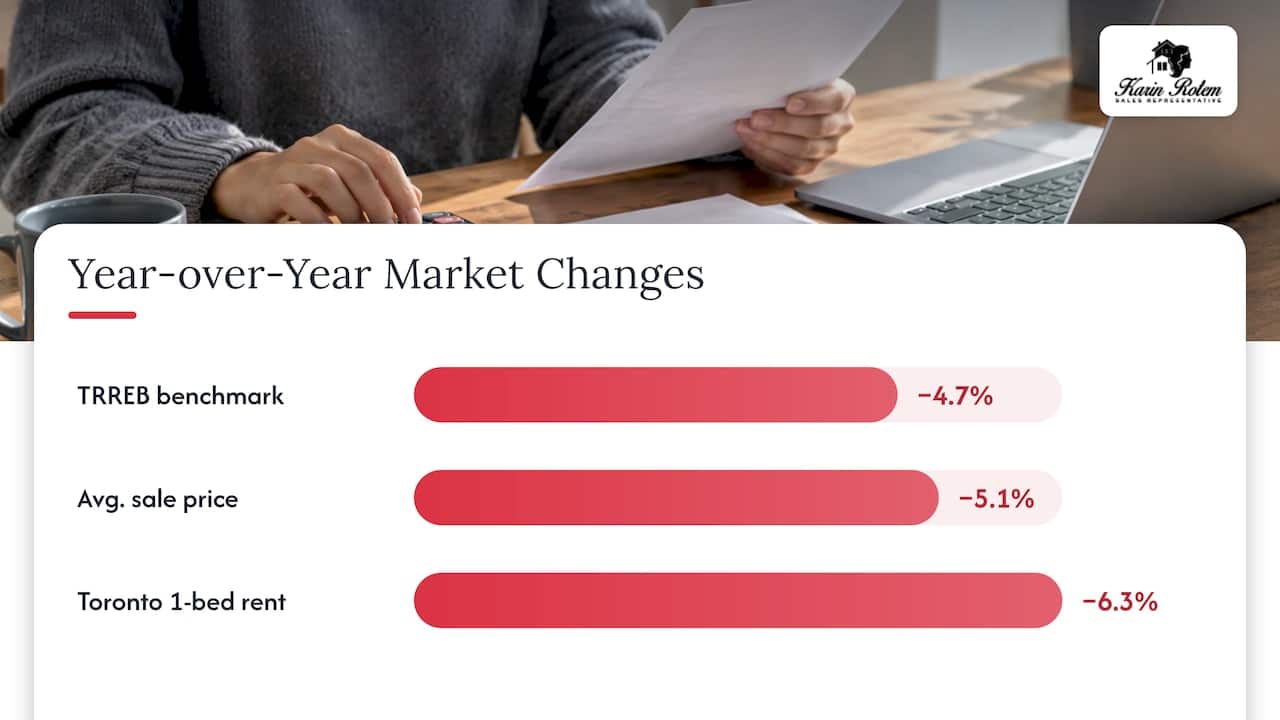
Rents. Average asking rents for all unit types in Ontario fell 5.4% year over year in March 2026, and Toronto one-bedrooms fell 6.3% to $2,195, per Rentals.ca data reported by Canadian Mortgage Professional. Nationally, average asking rents were at a 35-month low.
Supply. Purpose-built rental completions reached a more than 40-year high of 6,379 units across the GTHA in 2025, with 59% still available for lease at year-end. That gives renters more choice and negotiating room.
CMHC’s October 2025 survey is the baseline for what sitting tenants pay: about $1,761 for a one-bedroom and $2,046 for a two-bedroom. Those averages are lower than the asking rents for new leases, which is worth remembering if you’re already renting under an older lease. Moving costs you more than staying.
If you’re curious how vacancy and rent shifts affect your timing, a primer on the rental income mortgage shows how lenders look at rental income, which matters if you plan to offset costs by renting out part of your home.
On the affordability side, the barrier is the down payment. One commentary citing the National Bank’s Affordability Monitor says a median-income household needs 25 to 28 years to save a 20% down payment in Toronto. That is a blogger’s summary of a bank’s measure, so treat it as a sense of scale, not a precise rule. It does explain why many first-time buyers look at smaller condos or nearby communities.
When renting is the better call
I’ll be direct: renting is the right choice for some people, and I’d rather you rent well than buy stretched.
- You may move in the next three to five years for work or family.
- Your income is variable, or you’re early in a career change.
- Buying would drain your savings so you’d have no emergency fund.
- You’d need to take on a payment that leaves no room for repairs or a rate reset.
Canadian Mortgage Professional quotes an analyst who makes the same point: a softer rental market doesn’t make renting right for everyone. The case for buying still holds for households with stable income, sufficient savings and a long-term plan to stay, while renting can be clearer for those who need flexibility.
When buying makes sense
- You plan to stay at least a decade, or you can keep the place as a rental if plans change.
- Your down payment still leaves a real cash cushion after closing costs.
- You value control: renovating, pets, no landlord selling out from under you.
- You’d like to lock in a large part of your housing cost for the long run.
If you’re a first-time buyer, the rebates are real money, so build them into the plan from the start. And if you don’t need to be in the city core, look at where your dollar goes further. We’ve compared why a condo in Innisfil can beat Toronto on cost and lifestyle, and shown how Friday Harbour condo prices compare to Toronto.
Our perspective on rent versus buy
What I tell my clients is that rent versus buy is not a market question, it’s a life question with a market attached. We start by asking how long you’ll stay, what your cash cushion looks like and what you want from where you live.
In Toronto, the monthly gap is real and the closing costs are real. That’s why we put the numbers in front of you early: land transfer tax, condo fees, reserve fund health and a realistic stay. We would rather walk you through a clear plan than rush you into a purchase.
For many Toronto professionals, the answer isn’t all-or-nothing. Some keep renting in the city and buy a waterfront condo in Friday Harbour or Innisfil as a weekend retreat. Others sell in Toronto and trade up in lifestyle. Our team knows Friday Harbour and Innisfil closely, and we can show you how those options compare with staying in the city.
Felix
Make the decision with real numbers
If you’re weighing a Toronto purchase against another year of renting, we can build a side-by-side for your situation: your budget, your timeline and the specific buildings you like. If a weekend or lakeside option appeals, browse Friday Harbour condos for sale or The Harbour rentals to see what’s available. If you’re ready to talk through your plan, get in touch with Karin’s team.
FAQ
Is it cheaper to rent or buy in Toronto?
Renting is cheaper per month. A one-bedroom condo costs about $845 more a month to own than to rent. Owning builds equity through principal repayment and possible price growth, so the long-run comparison can differ.
How long do I need to stay in Toronto for buying to make sense?
Published models put the break-even at about 10 to 14 years, depending on assumptions. If you’re likely to move within five years, renting often holds up better financially.
Are first-time buyers in Toronto eligible for land transfer tax rebates?
Yes, eligible first-time buyers can receive up to $8,475 combined: $4,000 provincial and $4,475 municipal. Your lawyer applies it at closing. Confirm your eligibility with your lawyer before you rely on it.
What costs do I forget when comparing rent with a mortgage?
Property tax, condo fees, insurance, utilities, repairs and closing costs. CMHC’s list of recurring condo costs is a good checklist to price before you decide.
Sources
- Renting vs Owning a Condo in Toronto, Benchmark Money
- Rent or Buy? The Monthly Gap in 16 Canadian Cities, Payotte
- Average Rent by City in Canada, Payotte
- Condominium Buyer’s Guide: Expenses and Recurring Costs, CMHC
- How much does it cost to own a home in Toronto, Ratehub.ca
- Toronto Land Transfer Tax Calculator, WOWA
- Ontario Land Transfer Tax 2026 Rates and Rebate Guide, LendSimpl
- To Own or to Rent? The Effects of Transaction Taxes, LSE
- 5-Year Rule for Rent vs Buy in Canada, HomeCalc
- Rent vs Buy in Toronto (2026), GlassLayer
- TRREB statistics, CREA
- Falling rents give Ontario buyers room to wait, Canadian Mortgage Professional
- Toronto Average Rent and Vacancy Rate, 18 Brownlow
- The payback, Greater Fool
- Rental Income Mortgage: What Canadian Applicants Need