An open mortgage lets you repay some or all of the loan at any time without a penalty, and you pay for that freedom with a higher interest rate. A closed mortgage usually has a lower rate but limits how much extra you can pay and charges a penalty if you break it early. Which one fits depends mostly on how long you expect to keep the property and how likely you are to have a lump sum to put against it.
I’m Karin Rotem, and I work with buyers, sellers and investors in Toronto, Innisfil and Friday Harbour. This question comes up in almost every purchase conversation, so here is how I walk clients through it.
TL;DR
- Open: you can prepay in full or in part, or break the contract, without a prepayment penalty. Open mortgages typically carry higher rates than closed mortgages with a similar term.
- Closed: lower rate, but extra payments are capped by your prepayment privileges, and breaking the term early can trigger a penalty.
- Rule of thumb: an open mortgage suits a short horizon (selling soon, or a big lump sum coming). A closed mortgage suits you if you plan to hold through the term.
- Before you sign: read the disclosure box for the mortgage type, prepayment limits and how penalties are calculated.
What is the difference between an open and a closed mortgage?
The Financial Consumer Agency of Canada (FCAC) says the main difference is the flexibility you have to make extra payments or pay off the mortgage. Everything else flows from that: the rate, the penalty and who the product is for.
| Open mortgage | Closed mortgage | |
|---|---|---|
| Extra payments | Allowed without a penalty | Limited by prepayment privileges |
| Paying off in full | Any time, no penalty | Penalty if done before the term ends |
| Interest rate | Typically higher | Typically lower |
| Renegotiating mid-term | Possible before the term is up | May involve a prepayment charge |
| Best for | Short horizon, expected lump sums | Holding through the term |
The Autorité des marchés financiers (AMF) describes the open mortgage the same way: repay some or all of the loan whenever you want, with no penalty, and renegotiate before the term ends. For a closed mortgage, it says you can’t repay more than the contract specifies. Some contracts let you increase payments up to a set limit or prepay a portion each year, but exceeding those limits can bring high penalties.
Both bodies are regulators or government agencies, so this is the neutral baseline. The rest of this guide is how I apply it to real purchases.
Open mortgages: what you get and what you pay
With an open mortgage you can put extra money toward the principal from time to time. FCAC lists situations where that helps, such as paying off the mortgage soon or planning to sell soon. It also says that if you have an open mortgage you can make extra payments without paying a penalty.
The trade-off is the rate. Because the lender is giving you the right to leave at any time, it prices that in. That is why an open mortgage rarely makes sense as a default for someone staying put for years.
Who I see choosing open:
- A seller who has bought the next home before selling the current one and expects the sale to close within months.
- A buyer waiting on a known lump sum, for example a bonus, an inheritance or proceeds from another property.
- An owner of a vacation property who plans to list it soon.
What most buyers don’t realize is that an open mortgage is often a bridge, not a destination. Many lenders let you move to a longer term later, so ask your lender or broker what that conversion looks like on your contract.
Closed mortgages: lower rate, defined rules
A closed mortgage is the standard product most people picture. FCAC says closed mortgages typically have lower rates and usually limit extra payments through prepayment privileges. It suggests this fits if you plan to keep your home for the rest of the term and the privileges give you enough flexibility.
Those privileges differ from lender to lender. FCAC’s first-home guide gives examples: one lender may allow a 20% lump sum each year while another allows only 10%, and some allow you to increase regular payments. The guide is from 2015, so treat the percentages as an illustration of the variation, not as current numbers. Your own contract is what counts.
When I review a closed mortgage with a client, I look at three things:
- How much can you prepay per year, and is it a lump sum, an increase to regular payments, or both?
- When can you prepay, on any date or only on payment dates or the anniversary?
- How is the penalty calculated if you do need to leave early?
A closed mortgage with generous privileges can give you most of the practical flexibility of an open one at a lower rate.
What it costs to break a closed mortgage
This is where the two products really diverge. FCAC says the cost of breaking your contract depends on whether it is open or closed, and that an open mortgage lets you break without a prepayment penalty. The AMF says an open mortgage is the one exception to paying a penalty when you end a mortgage before maturity.
For a fixed-rate closed mortgage, the AMF says institutions usually charge the higher of three months’ interest or an interest rate differential amount, and the calculation varies by institution. That variation is why two people with the same balance and rate can be quoted very different penalties.
A few practical points from the same sources:
- Use your prepayment privilege first. The AMF notes that doing so before breaking can reduce the balance the penalty is calculated on.
- The penalty is not the only cost. FCAC lists possible administration, appraisal, reinvestment and discharge fees on top.
- Ask your lender for the penalty figure in writing before you commit to selling or refinancing.
A worked scenario
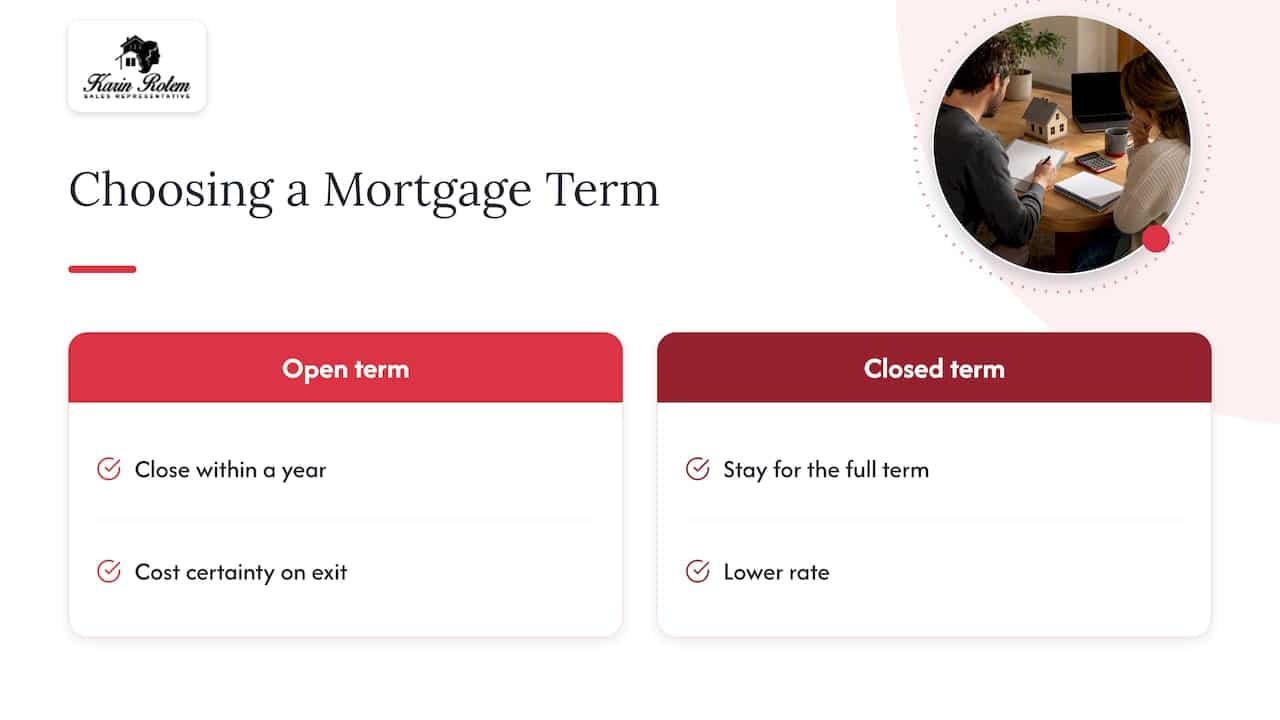
Say a Toronto couple plans to sell a condo and move to Innisfil, but the timing is open: maybe eight months, maybe two years. If they expect to close within a year, an open term gives them certainty about cost on exit. If they are likely to stay in the new place for the full term, a closed term at a lower rate is usually the more comfortable fit. I never pick for them. I give them the questions to take to their lender or mortgage broker, and the timeline from the real estate side.
How do you tell if your mortgage is open or closed?
Your paperwork says so. FCAC explains that lenders must disclose whether the mortgage is open or closed, with a brief explanation of what that means, in the information box when you apply. They must also disclose the amount of any penalty charges if you prepay before the end of the term and briefly explain how they are calculated.
If you can’t find it, here is where I would look:
- The disclosure or information box from your original mortgage application.
- The mortgage commitment letter and the mortgage contract.
- Your lender’s online account or annual statement, which often lists the term and prepayment options.
- A call to your lender, asking directly: “Is my mortgage open or closed, and what are my prepayment privileges?”
Choosing based on how you’ll use the property
The right answer changes with the purpose of the purchase. Here is how I think it through for the people I work with.
Primary residence for the long haul
If you are relocating from Toronto for a quieter, lifestyle-focused life and plan to stay, a closed mortgage matches FCAC’s guidance for people keeping their home through the term. Compare the prepayment privileges closely, because they are your flexibility. If you are weighing the sale of your Toronto home against your purchase, our Toronto-to-Innisfil guide and the buy first or sell first checklist cover the sequencing side.
Weekend retreat or second home
A second home you will keep for years tends to fit a closed term. If you may sell within a year or two, say, because your plans for a waterfront place are still forming, that is the situation where an open term is worth discussing with your lender. Keep your other mortgage’s terms in view as well, since the two interact when you sell one property to fund another. Our page on mortgage portability explains what moving a mortgage to a new property involves.
Investment or rental property
Investors often hold for years, which points to closed terms, but plans change when a property is renovated and resold or when a better opportunity appears. If you expect to flip or exit quickly, the penalty exposure on a closed term belongs in your numbers from day one. How lenders treat rental income is a separate question, which we cover in how lenders count rental income.
International and non-resident buyers
Lender options and terms can look different for buyers living outside Canada, so start with our guide to non-resident mortgage options in Ontario and confirm the open or closed terms in writing before you make an offer.
What to check before you sign
FCAC’s checklist is a good one. Before you choose, confirm in your disclosure and contract:
- The mortgage type, open or closed.
- The prepayment privileges: the amount, timing and number of prepayments permitted.
- The penalty charges and how they are calculated.
- Any other charges that may apply, per FCAC’s rights when applying for a mortgage.
When you are buying with a mortgage, also think about how your financing interacts with your offer. Our article on whether to include a financing condition in Ontario walks through that decision. Your lender or mortgage broker is the right person for rate quotes and product details. I am a real estate agent, not a lender, so I keep my advice to timing, property and strategy.
Our perspective
We see the open vs closed question go wrong in two ways. Buyers either chase the lowest rate without asking how long they will really own the property, or they pay for flexibility they will never use.
Our approach is to start with the property plan, not the product. For a Friday Harbour condo you intend to enjoy for years, a closed term is often the natural fit. For a buyer with a sale pending or a large lump sum arriving, an open term deserves a proper look. We map out your likely holding period, and then you take that timeline to your lender or broker.
As the team that ranks #1 at The Harbour and sits in the Top 100 Worldwide at RE/MAX, we have watched many transactions where the financing timeline mattered as much as the price. Our job is to make the real estate side clear and well planned, so the mortgage decision you make is an informed one.
Felix
Planning a purchase in Innisfil or Friday Harbour?
If you are thinking about a waterfront condo or a home in Innisfil, we can help you define your timeline, your budget and the questions to bring to your lender before you make an offer. Browse Friday Harbour condos for sale, or get in touch with our team for tailored guidance.
FAQ
Is an open or closed mortgage better?
Neither is better in general. FCAC says an open mortgage may suit you if you plan to pay it off or sell soon, or expect extra money for payments. A closed mortgage may suit you if you will keep your home through the term and its prepayment privileges give you enough flexibility.
Why are open mortgage rates higher?
Open mortgages give you the right to repay or leave at any time, and lenders price that flexibility in. FCAC says open mortgages typically have higher rates than closed mortgages with similar terms. Ask your lender or broker for a side-by-side quote for your situation.
Can I make extra payments on a closed mortgage?
Usually yes, within limits. FCAC says a closed mortgage has a limit on extra principal each year, though it may include prepayment privileges. Those privileges vary by lender, so check the amount, timing and number of prepayments in your contract.
Is there a penalty to break an open mortgage?
No prepayment penalty applies. FCAC says an open mortgage lets you break the contract without one. Other fees, such as a discharge fee, can still apply, so ask your lender for the full list before you act.
Sources
- Choosing a mortgage that is right for you, Canada.ca (FCAC)
- Breaking your mortgage contract, Canada.ca (FCAC)
- Mortgage prepayment: know your rights, Canada.ca (FCAC)
- Getting a mortgage: know your rights, Canada.ca (FCAC)
- Buying your first home: Three steps to successful mortgage shopping (FCAC, 2015)
- Mortgage features, AMF
- Penalties for breaking your mortgage, AMF