If you buy a new home or condo in Ontario, the builder’s warranty is set by law, and Tarion is the body that makes sure you receive it. The coverage has two parts: financial protection before you take possession, and protection against construction defects after you move in, split into one-, two- and seven-year periods. Below is what each part covers, the current limits, what is left out, and how to claim. I added what I tell my clients about using the warranty well.
TL;DR
- Before closing, the warranty protects your deposit and compensates you if closing or occupancy is delayed. After closing, it covers defects in three periods: 1, 2 and 7 years.
- For agreements of purchase and sale (APS) signed on or after July 1, 2023, the maximum coverage is $400,000 for freehold homes and $300,000 for condo units.
- Normal wear and tear, damage from poor maintenance and changes you make yourself are not covered.
- Claims run on deadlines. Missing a form window can cost you Tarion’s help, so put the dates in your calendar on possession day.
- The warranty stays with the home for seven years from the original possession date, so later owners get the balance.
What the Tarion warranty is and who stands behind it
By law, every new home built in Ontario comes with a warranty from the builder, under the Ontario New Home Warranties Plan Act. The Home Construction Regulatory Authority explains that Tarion’s role is to make sure buyers receive the coverage they are entitled to under that builder warranty.
Two points surprise buyers:
- The builder is your first call. Tarion’s freehold booklet says the builder is responsible for resolving warranty claims directly with you. You must tell the builder when an issue arises and give them a chance to fix it. Tarion steps in if the builder fails to resolve the claim or you disagree about whether an item is covered.
- Not every home is eligible. The HCRA decides which types of homes the warranty covers, and Tarion can tell you whether a particular home is eligible.
What most buyers don’t realize is how much of this is about paperwork. The warranty is strong, but it rewards the owner who documents things early and files on time.
Coverage before you close
Tarion describes four main types of pre-possession coverage: deposit protection, delayed closing or occupancy coverage, condominium cancellations, and financial loss coverage for contract homes.
Deposit protection
Per Tarion’s deposit protection page:
| Home type | Deposit protection |
|---|---|
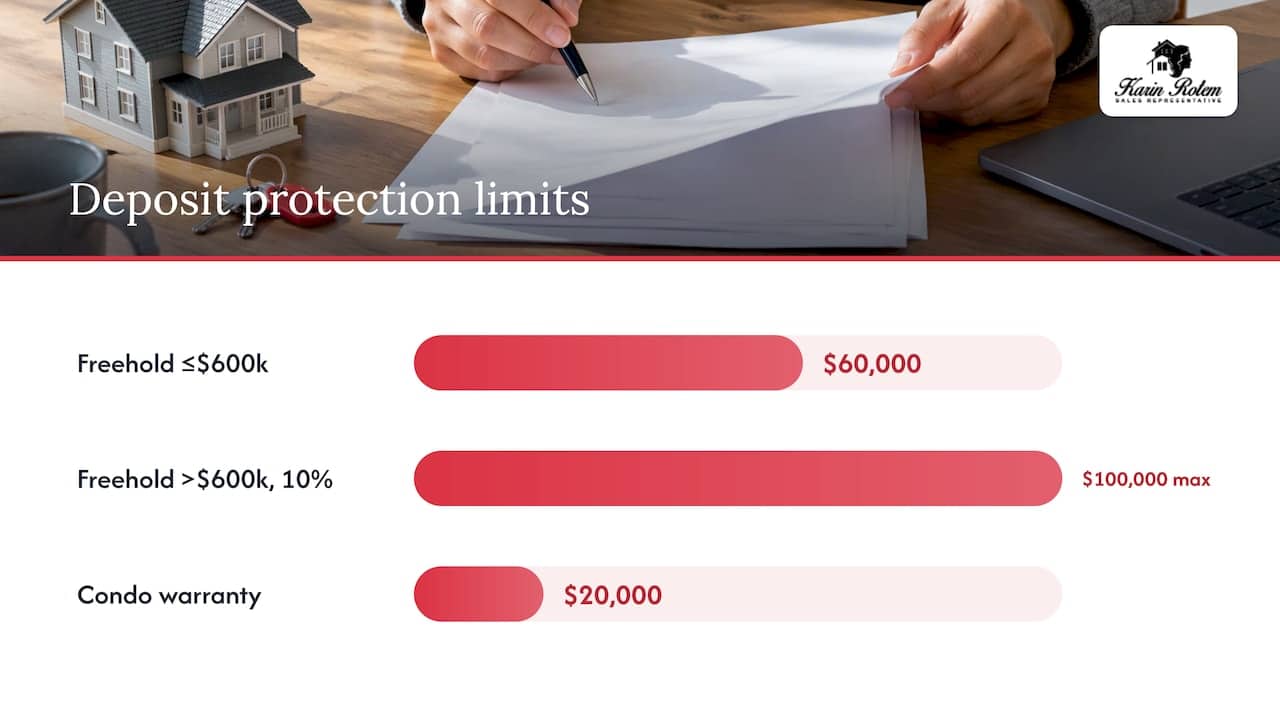
| Freehold, priced at $600,000 or less | Up to $60,000 |
| Freehold, priced over $600,000 | 10% of the price, up to $100,000 |
| Condo unit | First level is the Condominium Act trust provisions, then up to $20,000 from the new home warranty |
The protection applies if the builder goes bankrupt, fundamentally breaches the agreement, or you exercise a statutory right to rescind before closing. It also covers other payments tied to the home, within those limits, such as upgrades and extras like hardwood flooring or granite counters. It does not cover money paid to reserve or hold a home before the purchase agreement is signed.
That last point matters on hot launches. A reservation fee paid before you sign is not protected by the warranty, so ask what happens to it if you don’t proceed.
Delayed closing and occupancy
If the builder misses the closing or occupancy date, compensation is capped at $7,500. That includes $150 per day for direct living expenses, and receipts are required for other costs, according to Tarion.
Builders can legitimately extend dates for an unavoidable delay: an extraordinary event outside anyone’s control, such as a strike, fire, explosion, act of God, act of war or terrorism, or a pandemic. Tarion’s pre-closing page says the builder may extend deadlines by up to the length of that delay without paying delayed closing compensation.
If you are making a Delayed Closing or Delayed Occupancy claim, the form must be submitted within one year of possession or occupancy.
Financial loss on contract homes
A contract home is built on land you already own. If the builder fails to substantially perform the construction contract, financial loss coverage compensates you for the difference between what you paid and the value of the work and materials supplied, up to $40,000.
Coverage after you take possession: the 1-, 2- and 7-year warranties
Freehold homes, contract homes, condo units and condo conversions share the same three-period structure, per Tarion’s coverage page. The one-year warranty starts on the possession date, or the occupancy date for a condominium.
| Period | What it covers |
|---|---|
| Year 1 | Work done in a workmanlike manner, free from defects in material, fit for habitation, compliance with the Ontario Building Code, and no unauthorized substitutions |
| Year 2 | Water penetration through the basement or foundation walls, water penetration through the building envelope, exterior cladding that detaches, displaces or deteriorates, defects in the electrical, plumbing and heating delivery and distribution systems, and Building Code violations affecting health and safety |
| Years 3 to 7 | Major structural defects, including soil movement and major cracks in basement walls, chemical failure of materials, environmentally harmful substances, and collapse or serious distortion of joints or roof structure |
These summaries come from Tarion’s post-possession coverage page.
What counts as a major structural defect
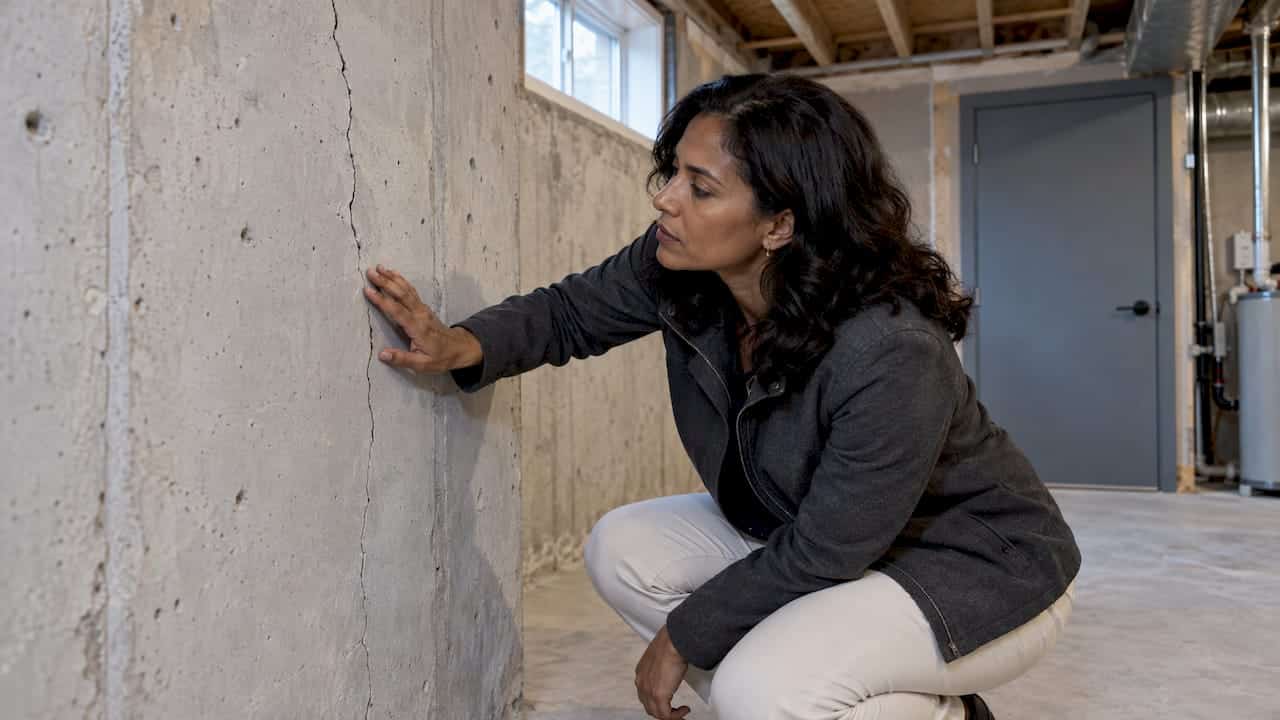
For homes after June 30, 2012, Tarion’s builders guide defines it as a defect in work or materials that does one of three things. It causes failure of a load-bearing element. It materially and adversely affects a load-bearing element’s ability to carry structural loads. Or it materially and adversely affects the use of a significant portion of the building for ordinary residential purposes. A hairline crack in a basement wall is a conversation. A major crack tied to soil movement is what the seven-year coverage is built for.
Current coverage limits
The limits depend on when your APS was signed. For agreements signed on or after July 1, 2023, Tarion lists these maximums:
- $400,000 for freehold homes
- $300,000 for condominium units
- $100,000 per unit for common elements, up to $3.5 million
- $50 million combined for a condominium project
- $50,000 for environmentally harmful substances
For APS signed before February 1, 2021, the same page shows lower figures: $300,000 for freehold homes and condo units, and $15,000 for environmentally harmful substances. Check the date on your own agreement before relying on any number.
Condo buyers: units versus common elements
Your unit and the building’s common elements are covered differently. Common element coverage begins when the condominium corporation is registered, and the corporation, not individual owners, submits those claims. Tarion notes that common elements in common elements condominiums and vacant land condominiums are not covered, and that in condo conversions, pre-existing elements are not covered by the one-year workmanship and materials warranty.
What I tell my clients buying new condos: read the status certificate and the reserve fund study as carefully as you read the warranty. The warranty protects against defects in new construction, but long-term upkeep comes from maintenance fees and the reserve fund. Our reserve fund study guide shows what a healthy plan looks like. If amenities drive your decision, our luxury condo amenities guide explains what you are paying for each month.
What the warranty does not cover
This is where disappointment usually happens. Tarion’s exclusions for freehold homes, contract homes and condo units include:
- Defects in materials, design or work supplied by the homeowner
- Secondary damage caused by a defect that is itself under warranty
- Normal wear and tear, and normal shrinkage of materials
- Dampness or condensation damage when the homeowner has not maintained ventilation
- Damage caused by the homeowner or visitors, and alterations, deletions or additions the homeowner makes
- Settling of land around the building or along utility lines (other than beneath footings)
- Damage from insects or rodents, unless construction did not meet Building Code specifications
- Damage caused by municipal services or other utilities
- Surface defects that you specified and accepted in writing at possession
- Damage from an act of God
- Contractual warranties outside the Ontario New Home Warranties Plan Act
Tarion’s freehold information sheet also lists elevators and HVAC appliances among the exclusions.
The practical lesson: the walkthrough is your best protection against the “accepted in writing” exclusion. Before you sign anything at the pre-delivery inspection, make sure every scratch, chip and gap you see is written down as an item to fix. Tarion requires a pre-delivery inspection for all enrolled new homes, and its main purpose is to document the condition of the home before possession or occupancy.
How to make a claim, step by step
- Take possession and note the date. Every deadline counts from it.
- Report issues to your builder in writing. Tarion encourages homeowners to do this as soon as possible within the coverage period, and to work with the builder before creating a claim.
- Use the right form for the period. The easiest route is MyHome, Tarion’s online portal, as Tarion’s FAQ explains.
- Watch the timelines. Tarion’s claim forms page sets them out:
- Initial Form: items can be added from day one after possession, and it is auto-submitted on day 41.
- Mid-Year Form: items added from day 42, auto-submitted on day 183.
- Year-End Form: items added from day 183, auto-submitted on day 365, with a 10-day grace period.
- Second Year Form: any time during year two.
- Major Structural Defect Form: any time after year two, but no later than seven years from possession.
- Allow the builder to repair. Under Tarion’s Customer Service Standard, the builder has an initial repair period of up to 120 days.
- Request conciliation if items remain. If the builder hasn’t resolved everything, you can ask for conciliation by contacting Tarion within 30 days after that period, plus a 10-day grace period.
- Tarion settles if the builder doesn’t. If items are still unresolved 30 days after Tarion’s Warranty Assessment Report, Tarion settles the remaining warranted items directly with you, by compensation or arranging repairs, and invoices the builder.
The same bulletin describes a 30-Day Form within the first 30 days after possession, so confirm in MyHome which form schedule applies to your home. Rules have changed over time depending on your agreement date.
Buying a resale home that is still under warranty
The warranty stays with the home for seven years from the original possession date, and later owners benefit from the balance. If you buy from another homeowner and the home is under seven years old, Tarion says you may email customerservice@tarion.com to transfer the warranty into your name.
This is a real selling point for a three-year-old home. If you are on the selling side, tell buyers how much warranty remains. Our seller disclosure checklist covers what else you need to put in front of them.
Our perspective on the warranty
We see the Tarion warranty as one of the strongest reasons to consider a new build, and we want our clients to use it with confidence rather than treat it as fine print.
Buyers who do best with it do three things. They treat the pre-delivery inspection as a serious exercise, not a formality. They log every issue in writing from the first week. And they diarize the form dates the day they get their keys. The buyers who struggle usually aren’t unlucky. They simply found the problem after the window closed.
In a resort-style community like Friday Harbour, where many buyers are also thinking about weekend use, rental potential or a second home, the timing matters even more. If you are only at the property on weekends, issues take longer to spot. We suggest a systematic check of windows, plumbing and finishes in the first few visits, and reporting anything right away.
We also help our clients weigh the bigger picture alongside the warranty: the deposit structure, closing costs, HST treatment and long-term fees. Our new home HST rebate guide is a good starting point for that part of the budget.
Our goal is a purchase that fits your plans, whether that is a primary residence, a lifestyle property or an investment.
Felix
Buying new in Innisfil or Friday Harbour
If you are looking at a new or recently built home or condo near Lake Simcoe, ask us early which properties are new construction and which are resales, because that decides which warranty stage applies. We can walk you through the agreement, the deposit schedule and the key dates before you commit.
You can browse current Friday Harbour condos for sale or The Harbour listings, or contact us through our main site for guidance tailored to your goals. If you are weighing a move out of the city, our Toronto-to-Innisfil guide lays out the sequence.
If you will need a mortgage on a new build, think about timing too, since closing dates can move. Our guide to a financing condition in Ontario explains how to protect yourself.
FAQ
Is the Tarion warranty mandatory for new homes in Ontario?
Yes. By law, every new home built in Ontario carries a builder’s warranty under the Ontario New Home Warranties Plan Act, and Tarion’s role is to make sure buyers receive that coverage. The HCRA determines which types of homes are covered, and Tarion can confirm whether a specific home is eligible.
How long does Tarion coverage last?
After possession, coverage is divided into one-, two- and seven-year periods, each protecting against specific items. The warranty remains with the home for seven years from the original possession date, so later owners get whatever time is left.
What is the maximum Tarion coverage?
For agreements signed on or after July 1, 2023, it is $400,000 for freehold homes and $300,000 for condo units. Older agreements have different limits, including $300,000 for freehold homes signed before February 1, 2021. Check the date on your own APS.
Does Tarion protect my deposit?
Yes, within limits. For freehold homes at $600,000 or less it covers up to $60,000. Over $600,000 it covers 10% of the price, up to $100,000. For condo units, the Condominium Act trust provisions come first, with up to $20,000 more from the warranty. Money paid to reserve a home before you sign is not covered.
Can I claim if I bought the home from the first owner?
Often yes, if the home is under seven years old from the original possession date. Email customerservice@tarion.com to have the warranty transferred into your name, then use MyHome to file within the relevant period.
Sources
- What is the new home warranty | Tarion
- Ontario New Home Warranty | HCRA
- What is not covered by the new home warranty | Tarion
- Coverage and coverage limits after you move in | Tarion
- Coverage for freehold, contract, condo units and condo conversions | Tarion
- Warranty coverage after you close | Tarion
- Warranty Information for Freehold Homes | Tarion
- Coverage before you close | Tarion
- How does deposit protection work on new homes? | Tarion
- Purchaser and Homeowner FAQs | Tarion
- Claim forms and timelines | Tarion
- Registrar Bulletin 01, Customer Service Standard | Tarion
- Welcome Homeowners | Tarion
- Warranty coverage for your new freehold or contract home | Tarion
- Requirements for new home builders and vendors in Ontario | Tarion