Ontario does have a 10-day cooling-off period for home purchases, but only for new homes. It applies to new condominiums bought from a builder today, and it is scheduled to extend to qualifying new freehold homes for agreements signed on or after January 1, 2027. If you are buying a resale house or resale condo, you have no automatic right to change your mind once your offer is firm. Your protection comes from the conditions you write into the offer.
I am Karin Rotem, and I get this question from Toronto buyers weighing a move to Innisfil and Friday Harbour. What I tell my clients is simple: find out which side of the line your purchase sits on before you sign anything.
TL;DR
- The 10-day cooling-off period applies to new condominium sales, not resales, and the deposit is refunded with interest.
- The clock does not start at signing. It starts after you receive the required documents, including the disclosure statement and the Residential Condominium Buyers’ Guide.
- New freehold homes get a similar 10-day right under O. Reg. 290/26, for agreements entered on or after January 1, 2027.
- On a resale, your exit is a condition (financing, inspection, lawyer review), not a cooling-off right.
Who actually gets a 10-day cooling-off period
The phrase “cooling-off period” gets used loosely online, so here is the sorting I do with buyers.
| Purchase type | Statutory cooling-off right? |
|---|---|
| New or pre-construction condo from a builder | Yes, 10 days |
| New freehold home (house or townhouse from a builder) | Not yet in force; scheduled for agreements entered on or after January 1, 2027 |
| Resale house | No |
| Resale condo | No |
The Condominium Authority of Ontario confirms that purchasers of pre-construction condos have a 10-day period in which they may rescind the agreement of purchase and sale. CMHC’s Ontario fact sheet is explicit that the right covers new condominiums only and that resales are outside it.
That matters if you are shopping a resort-style community. In a place like Friday Harbour, you may be looking at a unit bought directly from a builder or at a resale from an owner. The paperwork, the risks and your exit rights are different in each case, even if the two units look identical on a tour.
How the 10 days work for a new condo
The most common mistake I see is assuming the 10 days run from the day you sign. They do not.
According to the CAO, the agreement is not binding until you have received both the disclosure statement and Ontario’s Residential Condominium Buyers’ Guide. The cooling-off period begins after you receive those documents. If a document is late, the window opens late.
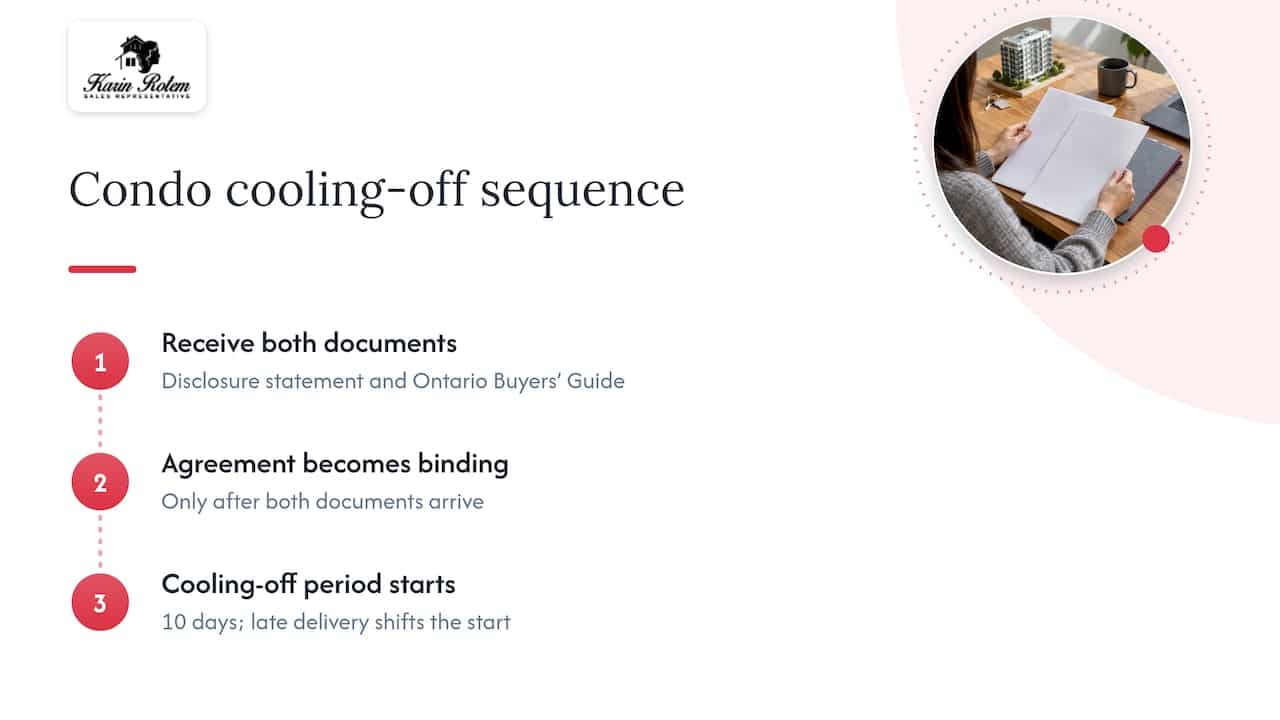
What most buyers don’t realize is how much material arrives in that package. You are getting a thick disclosure statement, an addendum and an information sheet, often at a sales event where you signed in an afternoon. The 10 days exist so you can read all of it calmly.
What to do inside the window
- Write down the date each document arrived. Keep emails and courier receipts. The start date is the one thing you cannot afford to argue about later.
- Book a real estate lawyer immediately. HCRA tells buyers to review the agreement, the Condominium Information Sheet and the Addendum with a lawyer, and to check the early-termination conditions and their timelines.
- Check the builder’s outs. HCRA’s buyer sheet explains that the vendor can terminate if certain sales, zoning or financing conditions are not met by the dates in the agreement. A cooling-off right protects you from your own doubts. It does not protect you from the builder walking away.
- Confirm your financing. Talk to your lender about the deposit schedule and whether the mortgage will be available at closing, which may be years away.
- Decide, then act in writing. If you are cancelling, do it in writing, through your lawyer, and keep proof of delivery before the 10 days end.
What happens to your deposit
If you rescind properly, CMHC states the deposit is refunded with interest. Have your lawyer confirm how and when the builder’s trust holder will return it. If you are still working out how deposits are structured on a new build, our guide to pre-construction deposit structures walks through the usual payment stages. For how deposits differ from your down payment at closing, see our 90-day paper trail for deposits and down payments.
The new freehold rule coming January 1, 2027
Until now, someone buying a newly built house or townhouse from a builder had no statutory cooling-off right. That is changing under the Homeowner Protection Act, 2024.
Here is what the published rules say:
- The Act sets up a framework where the purchase is not binding until prescribed information and requirements are satisfied, and written rescission must be received within 10 days after the latest of the specified delivery, compliance and signed-agreement dates.
- O. Reg. 290/26 sets the cooling-off period for new freehold homes. It applies to qualifying agreements entered on or after January 1, 2027. Agreements entered before that date are excluded.
- O. Reg. 289/26 requires the vendor, for agreements entered on or after January 1, 2027, to include the prescribed New Freehold Home Addendum and Information for Buyers documents, subject to stated exceptions for certain condominium structures.
- Tarion reports that the information sheet and addendum must be completed and included in the agreement for it to bind the buyer and for the 10-day period to begin.
The practical point for today: if you sign a builder’s freehold agreement before January 1, 2027, this cooling-off right does not apply to you. If your agreement is dated on or after that day, check that the addendum and information sheet are actually in your package. Without them, the clock does not start. Because dates and regulations can be amended, confirm the current status on Ontario’s e-Laws pages before relying on it.
Resale homes and condos: no cooling-off, so build your own
This is where buyers get hurt. An Ontario legal explainer notes that most resale agreements have no statutory cooling-off period and that once the agreement is firm, you generally cannot cancel simply because you changed your mind. The same firm says that backing out of a firm agreement without a valid contractual right can cost the defaulting party the deposit and damages.
So on a resale, your “cooling-off period” is whatever conditions you negotiate into the offer. The common ones:
- Financing condition. Lets you walk if your mortgage does not come through. Whether to include one is a strategy question in a competitive market, and we cover it in should you include a financing condition in Ontario.
- Home inspection condition. Gives you a short window to inspect and back out or renegotiate.
- Status certificate review (condos). Lets your lawyer review the reserve fund, maintenance fees, special assessments and any legal action against the corporation.
- Lawyer review. Sometimes used to give your lawyer a short window to review the agreement.
Every condition has a deadline, and missed deadlines usually mean the condition is gone. If you are in a multiple-offer situation, the trade-off is real: fewer conditions make your offer stronger and your exit narrower. I walk clients through that math before they write a number. Our piece on bully offers in Ontario explains how pre-emptive offers change that equation.
Other cooling-off rules you may be thinking of
The 10-day rule in the search results is not the only one in Ontario, and the others do not apply to buying a home.
Contracts signed at your door under the Consumer Protection Act, 2002 are a different regime. Under the Act, a consumer may cancel a direct agreement until 10 days after receiving the written copy. Those agreements cover things like furnaces, air conditioners and water heaters, not real estate purchases. A buyer who types “3 days to change your mind” or “14 days” is usually remembering rules for other jurisdictions or other kinds of contracts.
What this means for you: the right to cancel a home purchase in Ontario comes from the specific housing rules above, not from a general consumer right.
Questions I hear from Toronto buyers eyeing Innisfil
“I bought at a launch event and I’m nervous. Can I still get out?” If it is a new condo, and you are still within 10 days of receiving the required documents, yes, in writing. If you are past the window, speak to your lawyer about what remains in the agreement.
“I signed a builder’s freehold agreement in 2026.” Then the new freehold rule does not cover you, because it applies to agreements entered on or after January 1, 2027.
“I’m buying a resale condo in Friday Harbour.” There is no statutory right. Your protection is your conditions, and the status certificate is the big one. Ask for it early, and give your lawyer enough time to read it.
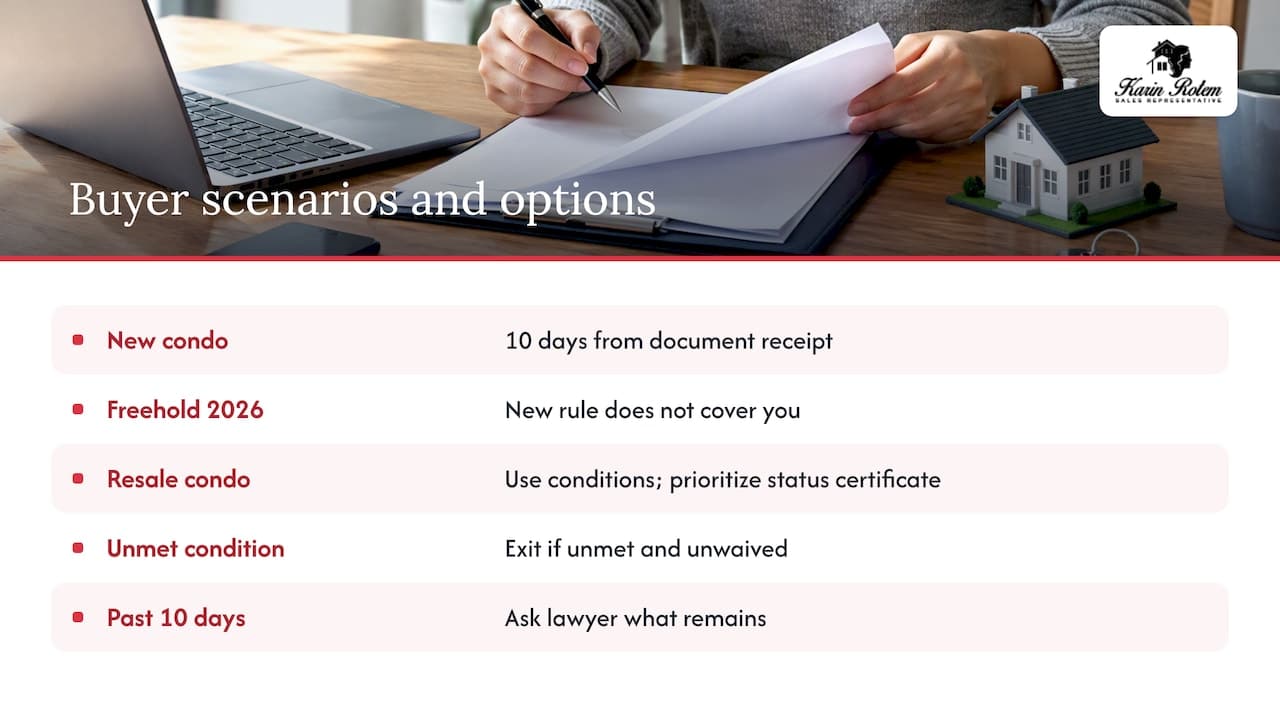
“Is there any scenario where the deal falls apart for me without penalty on a resale?” Yes: a condition that is not satisfied and that you have not waived. That is why I never let a client waive a condition they do not understand.
Our perspective
What I see in this market is that the people who get into trouble are rarely the ones who made a bad choice. They are the ones who assumed a safety net existed and found out too late that it did not.
We work with a mix of buyers: Toronto professionals looking for a waterfront second home, families relocating to Innisfil, and investors who want a resort-community income property. For each of them, the first question we ask is whether they are buying new from a builder or resale from an owner. The answer decides everything: how much time they have, who holds their deposit, what the builder can do and what their exit looks like.
With a new condo, we tell clients to treat the 10 days as paid-for thinking time. Read the disclosure, put it in front of a lawyer, and do not let the excitement of a sales centre set the pace. With a resale, we help you build the protection into the offer, and we are honest when a strong offer means giving up some of it. Sometimes the right call is to keep a condition and lose the property. I would rather you do that than close on something you cannot carry.
Friday Harbour is a lifestyle purchase, but it is still a contract. Our job is to make sure you understand it before you commit.
Felix
Thinking about Friday Harbour or Innisfil?
If you are comparing a builder-sold unit with a resale, we can lay out the paperwork, timelines and your options side by side before you decide. Browse current Friday Harbour condos for sale or get in touch with our team and we will help you work out which route fits your goals. If you are selling in Toronto to fund the move, our Toronto-to-Innisfil guide covers how to line up the two transactions, and our closing timeline guide shows what you can control once the deal is firm.
FAQ
Does Ontario have a 10-day cooling-off period for home purchases?
Only for new homes. The 10-day period applies to new condominiums bought from a builder, and a similar right is scheduled for new freehold homes under agreements entered on or after January 1, 2027. It does not apply to resale houses or resale condos.
When does the 10-day period start?
Not at signing. For a pre-construction condo, it begins after you receive the required documents, and the agreement is not binding until you have received both the disclosure statement and the Residential Condominium Buyers’ Guide. Record the delivery date of each document.
Can I cancel a resale purchase if I change my mind?
Generally no. Once the agreement is firm, you cannot cancel simply because you changed your mind, and doing so without a contractual right can put your deposit at risk. Your exit has to come from a condition in the offer, such as financing or inspection, that has not yet been waived.
Do I get my deposit back if I cancel a new condo within the 10 days?
Yes. CMHC states the deposit is refunded with interest when a new condo purchaser uses the cooling-off right. Ask your lawyer to send the cancellation in writing and confirm the refund process with the builder’s trust holder.
Should I have a lawyer before I sign a new condo agreement?
Ideally yes, and at the latest within the 10 days. HCRA directs buyers to review the agreement, information sheet and addendum with a lawyer, and to check the early-termination conditions.
Sources
- CMHC: Ontario condominium fact sheet
- Condominium Authority of Ontario: Pre-construction condos
- Ontario Regulation 290/26: Cooling-off period
- Ontario Regulation 289/26: Addenda and information sheets
- Homeowner Protection Act, 2024
- Tarion: Important updates for home buyers and owners
- HCRA directive: Condominium Information Sheet
- HCRA: Information for buyers of new condominium homes
- Insight Law Firm: Agreement of Purchase and Sale
- Niagara Law: Direct agreements and the Consumer Protection Act