
Most published guidance puts an Ontario home appraisal at roughly $250 to $600, and the lender usually requires it and passes the fee to the buyer. For an ordinary house or condo, that is the whole story. Waterfront is different. A shoreline, a septic system or a road allowance can move the value by far more than the fee, and sparse local sales make comparables harder to find. That is where local knowledge earns its keep.
What I tell my clients in Innisfil and at Friday Harbour is simple: budget for the appraisal, but do not mistake it for your price strategy. Below is what it costs, what drives the fee, and what to line up before the appraiser arrives.
TL;DR
- Published ranges for a residential appraisal in Canada run from about $250 to $600, depending on the source. CMHC lists $250 to $350, and Scotiabank says $300 to $600.
- The fee is generally flat and reflects the complexity of the job and the hours it takes, not the price of your home.
- Waterfront, rural or unusual properties take more work, so expect the upper end of the range or more.
- Buyers are usually asked by the lender to pay. Sellers can get a clear view of value from a local agent before listing.
- Gather your property details, renovation dates and recent listing history before the appraiser visits.
What a home appraisal costs in Ontario
There is no Ontario-wide fee schedule. Appraisers set their own fees, so the best you can do is read the published ranges and expect a quote inside them.
| Source | Published range |
|---|---|
| CMHC home-buying cost guidance | $250 to $350 |
| NerdWallet Canada closing-cost guidance | $300 to $500 or more |
| Scotiabank Advice+, July 2025 | $300 to $600 |
Those are national figures, not an Ontario price list. For a straightforward detached home or condo in the GTA, I would plan around the middle of that spread and keep room above it. A waterfront home on Lake Simcoe, a property with outbuildings or a large lot should be budgeted higher, for reasons covered below.
The fee normally covers the appraiser’s inspection of the property, the research into comparable sales and the written report. The lender is usually the one who needs it, and CMHC notes the lender may require the borrower to pay.
Who pays, and when
If you are buying with a mortgage, your lender typically orders the appraisal to confirm the property supports the loan. NerdWallet describes it as an independent third-party review of value, usually required before mortgage approval. In practice, that means the cost lands on you as a closing cost, so put it on the same list as legal fees and land transfer tax.
If you are selling, nobody forces an appraisal on you. Some owners commission one for an estate, a separation or a tax reason. Most sellers, though, want to know what the market will pay, and that is a different question from what an appraiser will certify. More on that below.
If you want to see how the appraisal fee fits into your whole purchase budget, our mortgage and affordability calculators let you set closing costs against your down payment.
What makes the fee higher or lower
The Appraisal Institute of Canada, the professional body for appraisers, says fees are generally flat and based on the complexity of the assignment and the hours required, not on the appraised value. Inspection time depends on the property’s size and characteristics.
Here is a simple illustration. Take a 700 square foot condo in a modern building and a 3,500 square foot lakefront house with a boathouse. The condo might have plenty of nearby sales to compare. The lakefront house needs more time on site, more measurement, and more digging for comparables. The second job costs more because it is more work, not because the house is worth more.
Factors that usually push a fee up:
- Larger lots, multiple buildings or outbuildings
- Rural or seasonal locations where sales are thin
- Unusual construction, heavy renovations or additions
- Waterfront features such as shoreline, docks and private water access
- Tight turnaround times
Factors that keep it down: a standard condo or townhouse, an active market with many recent sales nearby, and a clean set of documents handed over at the start.
Why waterfront and Innisfil homes are different
This is the part most generic fee articles skip, and it is the part that matters if you are looking at Lake Simcoe or Friday Harbour.
Waterfront is a bundle of features, not one feature
The Municipal Property Assessment Corporation (MPAC), which assesses property for Ontario’s tax system, explains that a property can count as waterfront through direct access to a natural or man-made waterway. It can also qualify when a right-of-way, private road or unopened road separates it from the water. MPAC’s waterfront guidance lists the attributes that affect value, including:
- the water body and the amount of frontage
- seasonal or year-round access
- shoreline type and topography
- island versus mainland location
- water source, heating and exposure
- sanitary services, hydro and secondary structures
MPAC also compares waterfront properties with similar local sales and looks at land-title documents, building permits and, often, on-site inspections. A private appraiser works the same way in principle, which is why two lakefront homes that look alike online can value very differently.
Comparables get harder
The AIC notes that most valuation work happens after the inspection and can involve analysing three to ten or more comparable properties. On a street of condos, finding ten is easy. For a lot with 100 feet of frontage on Lake Simcoe, there may be two or three genuinely similar sales in the last year. When sales are scarce, the appraiser has to widen the search and adjust for differences, and that takes judgment and time.
The same issue shows up for valuation of distinctive waterfront properties elsewhere, and how appraisers select comparable sales in those cases follows the same logic: find the closest matches, then adjust for what differs.
Shoreline and planning rules
Innisfil’s Official Plan includes specific policies for the Lake Simcoe shoreline and shoreline residential areas, with goals that include protecting the lake’s health and natural heritage. You can read them in the Innisfil Official Plan. For a buyer, that means what you can build or change near the water is not a given. Our guide to Ontario waterfront setback rules explains why a 30 metre distance does not prove a lot is buildable, and our pre-offer checks for waterfront buyers cover the shore and septic questions that can change a value.
If you are looking more broadly at the lake, Lake Simcoe waterfront market cues, shoreline, permits and insurance goes through what GTA buyers should know.
An appraisal is not the same as a market assessment
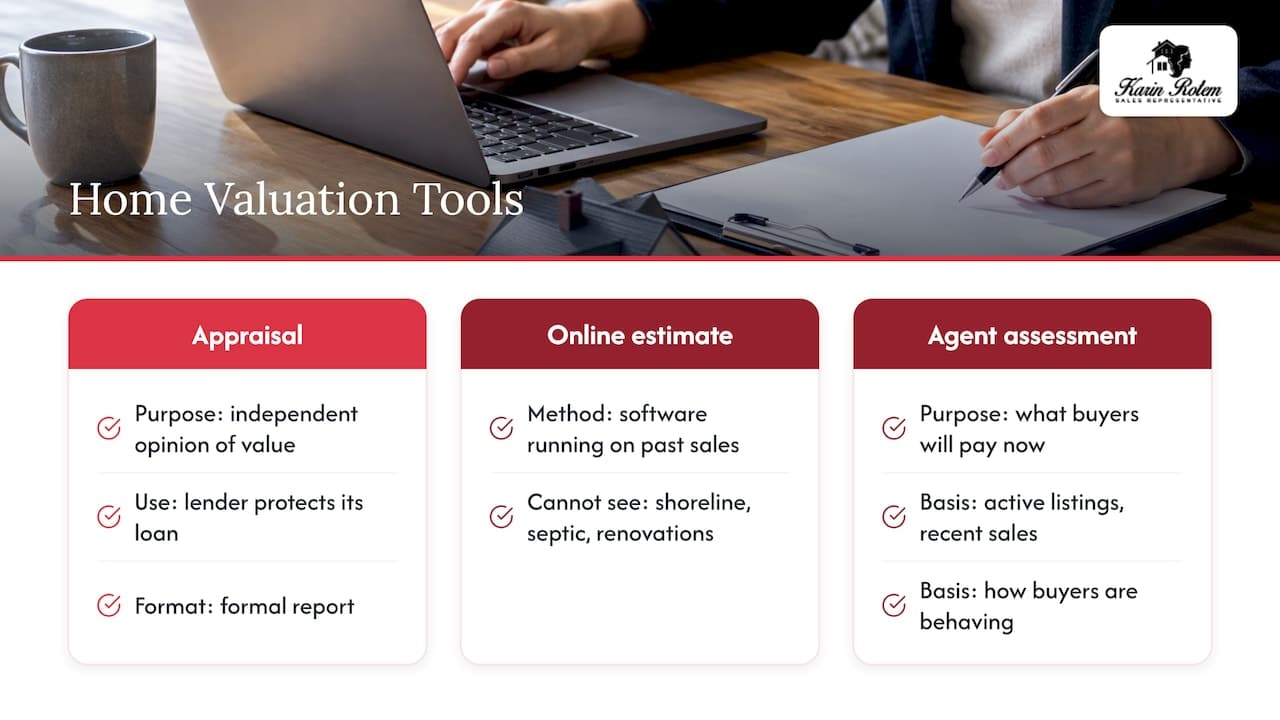
People use these words interchangeably, and they are different tools.
A professional appraisal is an independent opinion of value for a specific purpose, according to the AIC. A lender uses it to protect its loan. It is a formal report.
An online estimate is software running on past sales. It cannot see your shoreline, your septic or the renovation you finished last spring.
An agent’s market assessment is a practical read of what buyers will pay now, grounded in active listings, recent sales and how buyers are behaving.
What most buyers do not realize is that the lender’s appraisal and the price you agree to are separate numbers. If your offer is higher than the appraised value, the lender lends against the appraisal and you cover the gap. In a competitive pocket like Friday Harbour, that gap is a real planning issue, so I talk through it before an offer goes in, not after.
For sellers, the useful question is not what a report will say but where to price and how to position the home so it sells for top value. Our guide on selling an Ontario waterfront home in 60 to 90 days covers the preparation side, including the permit details that tend to slow a sale.
How to prepare before the appraiser visits
The AIC advises owners to have information on hand. A smooth visit saves time, and since the job is priced on hours and complexity, being organized helps the appraiser work efficiently.
- Layout and measurements. Floor plans, lot dimensions and any survey you have.
- Improvements and outbuildings. Docks, boathouses, sheds, garages, finished basements.
- Dates. When the home was built and when major additions or renovations were done.
- Listing and sale history. The AIC asks about listings or offers in the past 12 months and sales in the prior three years.
- Water, septic and heating details. For waterfront and rural homes, these are among the attributes MPAC lists as affecting value.
- Permits. Building permits for work you completed, which MPAC also reviews on assessments.
Condo owners should add the unit’s upgrades, parking and locker details, and the building’s amenities. If you are looking at a resort-style building, our overview of Friday Harbour condos for sale shows what is currently on offer.
What I tell clients to budget
Here is the practical version, for each type of reader.
Buyers using a mortgage. Set aside several hundred dollars for the appraisal inside your closing costs, and more if the property is waterfront or unusual. Ask your lender or broker early whether they will order it and when you will be billed.
Second-home and vacation buyers. Your lender may treat a recreational property differently from a primary residence, so confirm the requirements before you commit. The appraisal is one step; the shoreline and septic checks matter just as much.
Investors. The appraisal tells the lender what the building is worth. It does not tell you what the unit will earn. Run the income side separately, and see our look at property management fees in Ontario for one of the costs to include.
Sellers. If your goal is the best price, start with a market read from someone who sells in your area every week. Then decide whether a formal appraisal serves any purpose for you.
Toronto owners relocating. If you are selling in the city and buying in Innisfil, you will deal with a valuation on one side and a market offer on the other. Our Toronto-to-Innisfil guide for 2026 walks through the sequence.
Working with us on value
We focus on Friday Harbour, Innisfil and the wider Toronto area, and we help buyers, sellers and investors with property searches, listing alerts and transactions. If you want a clear view of what a home or condo is worth to buyers right now, or you are comparing waterfront options, start with our Friday Harbour listings for sale or contact us through our site and tell us what you are planning.
Our perspective
We work this market every day, and the pattern is consistent: people worry about a fee of a few hundred dollars and overlook the decisions worth tens of thousands.
The appraisal is a necessary step on many purchases, and we want our buyers to budget for it without surprise. But the number that shapes your outcome is the price you agree to, and on the waterfront that depends on things a form cannot capture: frontage, shoreline, septic, permits, and how buyers are responding to a particular lot this season.
That is why we put so much weight on local market insight, strategic marketing and negotiation. Our approach is high-touch and client-first. We would rather walk you through the trade-offs of a property before you make an offer than hand you a report afterward.
If you are buying at Friday Harbour, selling in Innisfil or weighing a second home on the lake, we will help you understand what the property offers and whether it fits your goals.
Felix
FAQ
How much does a home appraisal cost in Ontario?
Published guidance for Canada ranges from about $250 to $600, with some sources noting higher fees for complex properties. Appraisers set their own fees, so get a quote through your lender. A waterfront or rural home usually costs more than a standard condo.
Is the appraisal fee based on the home’s value?
Generally no. The Appraisal Institute of Canada says the fee is usually flat and reflects the complexity of the assignment and the hours required. A larger, more complex property takes more time, so it costs more, but a higher price tag alone does not raise the fee.
Who pays for the appraisal when buying a home?
The lender normally requires it, and CMHC notes the lender may ask the borrower to pay. Plan for it as part of your closing costs. Confirm with your lender when it will be ordered and how it will be billed.
Why would a waterfront appraisal cost more or take longer?
Waterfront value depends on frontage, shoreline type, water access, septic and other features that MPAC lists. Similar sales can be scarce, so the appraiser may need a wider search and more adjustments. That extra work is what shows up in the fee.
What should I have ready for the appraiser?
Have measurements, a list of improvements and outbuildings, construction and renovation dates, and your recent listing and sale history. For waterfront homes, add water, septic and permit details. Being organized helps the visit go smoothly.
Sources
- CMHC: How Much Will My Home Really Cost?
- Appraisal Institute of Canada: For Residential Property Owners
- NerdWallet Canada: Home Closing Costs Calculator
- Scotiabank Advice+: Understand closing costs in Canada
- MPAC: Waterfront Home Property Assessments
- Innisfil Official Plan