If you are buying your first home in Ontario, you can get back up to $4,000 of provincial land transfer tax, and up to another $4,475 if the home is inside the City of Toronto. The rebate is built for a primary residence, so it does not apply to a weekend retreat, a rental or an investment unit, and that distinction matters for anyone looking at Innisfil or Friday Harbour. Below I explain who qualifies, what it is worth, how to claim it and what to do if it was missed at closing.
TL;DR
- Ontario refunds up to $4,000 of land transfer tax to eligible first-time buyers, which means no provincial tax on the first $368,000 of the price (ontario.ca).
- Toronto adds a separate municipal rebate of up to $4,475, but only for homes inside the city, not Innisfil or Friday Harbour.
- You must move in within nine months and never have owned a home anywhere in the world, so second homes and investment properties do not qualify.
- Your lawyer normally claims the rebate at closing. If it was missed, you have 18 months from registration to apply.
- Land transfer tax is a closing cost, not a deduction on your personal income tax return.
What land transfer tax is, and what the rebate does
When you buy land or an interest in land in Ontario, you pay land transfer tax. It is due when the transfer is registered at closing, which is why it shows up in your lawyer’s statement of adjustments, the closing-day tally of what you owe and what the seller is credited. Treadstone Law notes the tax is paid when the transfer is tendered for registration.
The rebate is a refund of all or part of that tax for first-time buyers of an eligible home. For transfers on or after January 1, 2017, the maximum is $4,000, up from $2,000 before that date, according to Ontario’s official guidance. In practice, the provincial tax on a home up to about $368,000 is wiped out. On a more expensive home, you still pay tax on the amount above that, and the $4,000 comes off the bill.
What most buyers don’t realize is that the rebate is not a cheque that arrives later. When it is claimed properly, it reduces the amount you bring to closing. That is real cash flow at the moment you need it most, alongside your down payment, legal fees and moving costs. For the full list of what else lands on closing day, see our Ontario closing costs guide.
Who qualifies for the Ontario rebate
Ontario sets out the conditions. You qualify if you meet all of these:
- You are at least 18 years old.
- You will occupy the home as your principal residence within nine months of the transfer date.
- You have never owned an eligible home, or an interest in one, anywhere in the world, at any time.
- If you have a spouse, they did not own a home while they were your spouse.
- You are a Canadian citizen or permanent resident, or you obtain that status within 18 months.
All of this comes from the ontario.ca first-time homebuyer page.
What counts as an eligible home
The definition is wider than most people expect. Under the Land Transfer Tax Act, eligible homes include detached, semi-detached and townhouse properties, condominium units, duplexes, triplexes and fourplexes, co-operative housing shares and some mobile and manufactured homes. A Friday Harbour condo or an Innisfil townhouse can therefore be an eligible home, provided you meet the other conditions, including living in it as your main home.
The spouse rule catches people out
If your spouse owned any home while you were spouses, neither of you gets the refund. GLG LLP flags this as a common disqualifier. Ownership also counts worldwide, so a property held abroad, even years ago, counts against you.
Partial rebates when co-buyers differ
If one buyer is a first-time buyer and the other is not, the refund is proportionate to the qualifying buyer’s share. Ontario’s example is a 50/50 purchase between parent and child, which yields 50% of the $4,000 maximum, or $2,000. Canada Life gives the same 50% result for a buyer purchasing with a spouse who is not a first-time buyer. If you are planning to buy with a parent, sibling or partner, decide who goes on title before you make an offer, and talk it through with your lawyer.
How much you can actually save
The provincial rebate tops out at $4,000. Toronto has its own municipal land transfer tax, and first-time buyers of newly built and resale homes there can claim a separate rebate of up to $4,475, according to the City of Toronto. Together that is up to $8,475, as WOWA’s calculator page shows. Our Toronto municipal land transfer tax guide goes deeper on that side.
| Where the home is | Provincial rebate | Municipal rebate | Maximum total |
|---|---|---|---|
| Toronto | Up to $4,000 | Up to $4,475 | Up to $8,475 |
| Innisfil, Friday Harbour and the rest of Ontario | Up to $4,000 | None | Up to $4,000 |
The municipal rebate fully covers Toronto’s tax on homes up to $400,000, per the City of Toronto. It does not apply to commercial, industrial or multi-residential properties.
A worked example
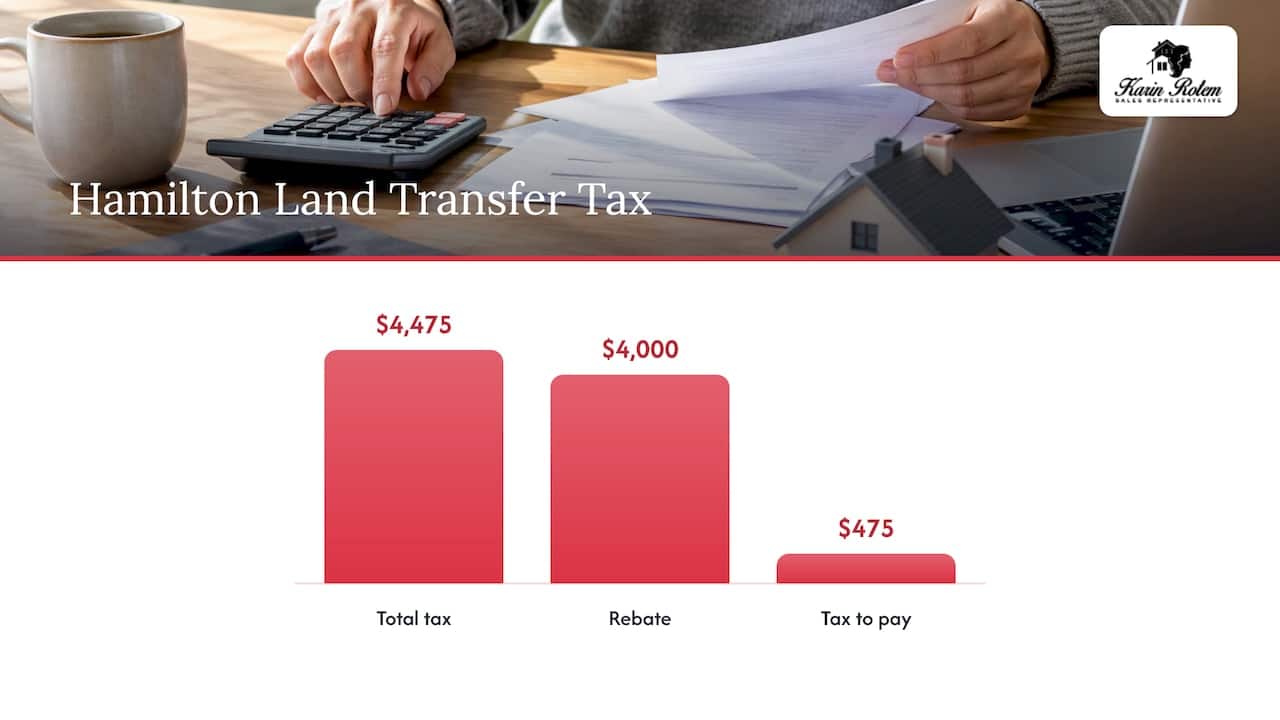
Canada Life offers a clean illustration. On a $400,000 home in Hamilton, the total land transfer tax is $4,475. The $4,000 rebate leaves $475 to pay. At that price you save $4,000, and the same logic scales: on a more expensive home, the tax is larger, but the rebate stays capped at $4,000.
Now think about a first-time buyer purchasing a condo in Friday Harbour. The price will usually be well above $368,000, so you would pay tax on the portion above that point and receive the $4,000 as a reduction. You would not receive a Toronto rebate, because the property is in Innisfil. Budgeting for the right number early keeps surprises off closing day. Our Mortgage and affordability calculators help you build that into your numbers.
What changed in Toronto in 2026
On December 17, 2025, Toronto City Council approved graduated municipal rates for high-value homes with one or two single-family residences, effective April 1, 2026, the City reports. These new tiers start on the portion of the price above $3 million, so they affect luxury sellers and buyers, not the first-time rebate.
Vacation homes, rentals and investment properties
This is where I give my Toronto and waterfront clients the honest version. The first-time buyer rebate requires you to live in the home as your principal residence within nine months. If you are buying a weekend place on Lake Simcoe, a Friday Harbour condo you plan to use seasonally, or a unit for short-term rental income, the rebate is not available. You should budget the full land transfer tax in your closing costs.
That is not a reason to hold back. It is a reason to plan correctly. Investors and second-home buyers who run the numbers with the full tax included make better decisions and avoid a shortfall at closing. If you are an international buyer, there is also a separate tax to understand, covered in our guide to the Non-Resident Speculation Tax.
If you are a Toronto family moving to Innisfil to live there full time, the picture is different. A first-time buyer who moves into the home within nine months and meets the other conditions can qualify, even though the home is in a resort-style community. Our guide to selling your Toronto home and buying in Innisfil covers the sequence for owners making that move. If you already own a Toronto home, you are not a first-time buyer, so the rebate would not apply to your next purchase.
How to claim the rebate
At closing, through your lawyer
The usual route is simple. Your real estate lawyer claims the refund when the transfer is registered, by completing the statements in the electronic land transfer tax affidavit, or by filing the paper refund affidavit at the Land Registry Office, as ontario.ca explains. LegalClarity describes this electronic claim as the fastest route, because the tax owing is reduced instantly at closing.
What I tell my clients: confirm with your lawyer, before closing, that both the Ontario and, if relevant, the Toronto rebate are being claimed, and that the statements about your status are accurate. Your lawyer relies on what you tell them about prior ownership and your spouse.
After closing, if it was missed
If the rebate was not claimed, you pay the tax and can apply afterwards. The deadline is 18 months after the registration date, and no interest is paid on late refunds. You apply to the Ministry of Finance through its online portal using the “Submit an application for the FTHB refund” service, with:
- the registered transfer document
- your agreement of purchase and sale
- the statement of adjustments
- proof you moved in
- proof of citizenship or permanent residence
All of this is listed on ontario.ca. LegalClarity stresses that the 18-month limit is strict, with no extension, so do not wait.
For Toronto’s rebate, you apply directly to the City within the same 18 months, using its application form and supporting documents. The City charges a processing fee for after-registration requests, which WOWA puts at $221.22. Claiming at closing avoids it.
For proof that you moved in, the City lists items such as telephone or cable bills and a driver’s licence, and says utility and property tax bills are not accepted, per its lawyer resources page. Update your address on your licence and set up a phone or cable account after you move.
Can you claim land transfer tax on your income tax return?
No. Ratehub states that Ontario land transfer tax is a closing cost and cannot be claimed on your personal income tax return. The rebate is the relief available to first-time buyers, and it is claimed through registration or the Ministry of Finance, not your tax return. If you buy an investment property, ask your accountant how closing costs are treated for your situation.
If you overpaid for a reason other than the first-time rebate, ontario.ca says you can ask the Ministry of Finance for a refund within four years of payment. The 18-month limit applies to first-time buyer refund requests.
Planning closing costs around the rebate
The rebate helps, but it only offsets part of what you bring on closing day. Legal fees, title insurance, adjustments and, for new builds, HST can all appear. Some buyers negotiate closing-cost help from the seller; here is a general look at seller concessions versus a price reduction as two ways of easing the cash needed to close. If you are buying a new build, our HST rebate guide covers a separate set of rebates, and our Ontario land transfer tax explainer walks through the tax itself.
Our perspective
Most first-time buyers ask us the same question: “Will I get the rebate?” The better question is whether the rebate fits your plan for the home. If you are moving into Innisfil or Friday Harbour as your main residence and it is your first purchase, the provincial rebate is yours to claim, and we make sure it is on the closing checklist from the start.
If you are buying a waterfront retreat or an income property, we help you build the full tax into your numbers before you make an offer, so closing day holds no surprises. That is the kind of local, decision-focused guidance our team is known for in Friday Harbour and Innisfil.
Felix
Talk to us before you write an offer
If you are weighing a first home or a second home in Friday Harbour, Innisfil or the Toronto area, we can walk you through the real closing numbers for your price range. Browse Friday Harbour condos for sale or contact Karin Rotem’s team to talk through your plan.
FAQ
Do I get a rebate if I buy a condo in Friday Harbour?
A condo is an eligible home under Ontario’s Land Transfer Tax Act. If you are a first-time buyer and will live in it as your principal residence within nine months, you can claim up to $4,000. If you will use it only as a seasonal retreat or rental, the rebate does not apply.
Can I get the Toronto rebate on an Innisfil purchase?
No. Toronto’s municipal land transfer tax and rebate apply to homes inside the City of Toronto. An Innisfil buyer can claim the Ontario rebate only, up to $4,000.
What if I am buying with a spouse who has owned a home before?
If your spouse owned a home while you were spouses, neither of you qualifies, according to GLG LLP. If you are buying with a non-spouse co-owner who is not a first-time buyer, you can claim a share proportionate to your interest, such as $2,000 on a 50/50 purchase.
How long do I have to claim the rebate if my lawyer missed it?
You have 18 months from the registration date to apply to the Ministry of Finance, and the same window applies to Toronto’s rebate. No interest is paid on late refunds, and LegalClarity reports there is no extension after the deadline.
Is there a rebate for non-residents?
Since January 1, 2017, the purchaser must be a Canadian citizen or permanent resident, or obtain that status within 18 months, to qualify for the Ontario refund. International buyers should review the non-resident rules in our foreign buyer guide.
Sources
- Land Transfer Tax Refunds for First-Time Homebuyers, ontario.ca
- Land Transfer Tax, ontario.ca
- Land Transfer Tax Act, R.S.O. 1990, c. L.6
- Municipal Land Transfer Tax rebate opportunities, City of Toronto
- Municipal Land Transfer Tax, City of Toronto
- MLTT resources for lawyers, City of Toronto
- Ontario Land Transfer Tax: How Much You Pay, Treadstone Law
- Residential Real Estate FAQs, GLG LLP
- Toronto Land Transfer Tax Calculator, WOWA
- Land transfer tax rebates for first time homebuyers, Canada Life
- How to Apply for the Land Transfer Tax Rebate in Ontario, LegalClarity
- Ontario Land Transfer Tax Rates, Ratehub