Toronto allows short-term rentals (stays under 28 consecutive days) only in the operator’s principal residence, and the host must register with the City and show the registration number on every listing. If you are buying a Toronto property to run as an Airbnb, the rules do not allow it. The City’s operator rules tie the licence to the place you actually live. That one fact decides where an investor should look, and it is why many of my clients end up shopping for a resort-style community outside the city.
TL;DR
- A short-term rental in Toronto means a stay of less than 28 consecutive days, and it is allowed only in your principal residence.
- Registration costs $390 and is valid for one year. Entire-home rentals are capped at 180 nights a calendar year; up to three bedrooms can be rented for unlimited nights.
- Hosts collect and remit a 6% Municipal Accommodation Tax, and the income is taxable with the CRA.
- Condo corporations can ban or limit short-term rentals even when the City allows them.
- If income is the goal, a purchase outside Toronto’s principal-residence regime, such as Friday Harbour in Innisfil, needs its own rules checked first.
The core rule: principal residence only
The City defines a short-term rental as all or part of a dwelling used for sleeping accommodation for less than 28 consecutive days in exchange for payment, including existing bed and breakfasts. A stay of 28 days or more is a regular rental, and different rules apply.
The operator must live in the home, and can have only one principal residence at a time. By-law 503-2024 also restricts a principal residence to a single dwelling unit. The City’s stated goals are to limit short-term rental activity to principal residences and protect long-term rental stock for tenants.
What most buyers don’t realize is that this makes a Toronto condo bought purely as an Airbnb unworkable under the City’s registration system. A second property, a cottage-style unit or an investment suite cannot be registered. If you already own a home in the city and live in it, you can host.
The 180-night cap and the three-bedroom option
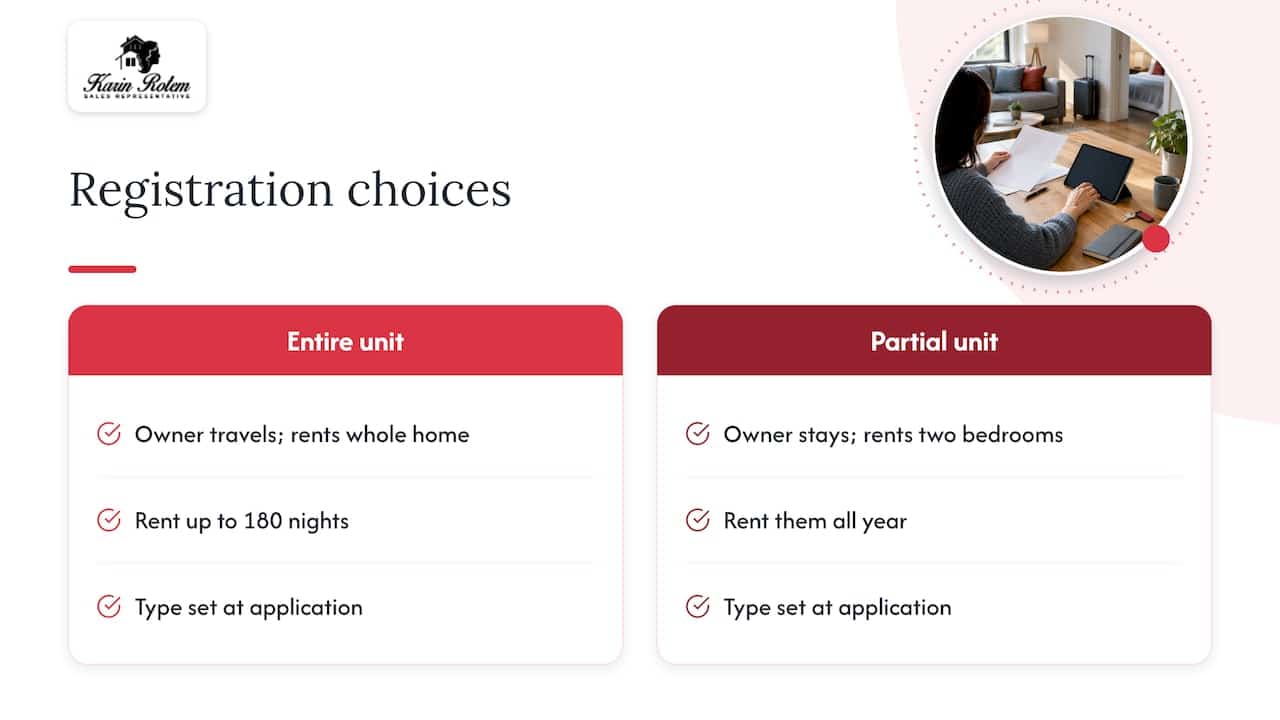
Since January 1, 2025, a host chooses one of two registration types:
| Registration type | What you rent | Night limit |
|---|---|---|
| Entire unit | The whole home | 180 nights per calendar year |
| Partial unit | Up to three bedrooms | Unlimited nights |
Per the City, nights rented under either type count toward the 180 limit for entire-unit registrations. Partial-unit operators may advertise one fewer bedroom than the home has.
A worked example
Say you live in a three-bedroom Toronto townhouse and travel for work. Registered as an entire unit, you can rent it for up to 180 nights while you are away, roughly six months. If you stay home and rent two spare bedrooms, you can register as a partial unit and rent them all year. Choose based on how you actually live, because the registration type is set when you apply.
How registration works
The City’s process, as published:
- You must be 18 or older and be able to show that the home is your principal residence.
- Apply online with an Ontario Driver’s Licence or Photo Card whose address matches, plus two additional principal-residence documents.
- Provide rental details and a 24-hour emergency contact.
- Pay the $390 non-refundable fee by credit card.
Registration lasts one year from approval. You renew online up to 30 days before the renewal date; the 2026 renewal fee is $390, and all Municipal Accommodation Tax reports and payments must be submitted first. If renewal and late fees are not paid within 90 days, the registration is cancelled automatically and you reapply.
Eligibility has limits too. Under By-law 503-2024 you cannot hold more than one registration, and multi-tenant house operators are barred. Someone whose registration was refused or revoked is generally ineligible for a year.
Phased changes
The by-law came in stages: June 30, 2024 for new definitions, emergency contacts, exit diagrams and enforcement; September 30, 2024 for extra principal-residence documents, interviews, inspection authority and one registration per dwelling unit; and January 1, 2025 for the fee increase and the entire/partial choice. The City can also run annual inspections.
What your listing must show
- Your City-issued registration number, in the format STR-0000-XXXXXX.
- Your full legal name, as on your Ontario Driver’s Licence or Photo Card.
- 24-hour contact information and a physically posted diagram of all building exits.
- No discrimination against guests on the grounds the City lists.
These come from the City’s 10 things to know page. Platforms carry duties as well: companies like Airbnb need a City licence, must verify registration numbers and must cancel future bookings for unregistered operators within 24 hours of a City request. Airbnb’s own help page confirms that Toronto hosts register and post their number.
Condos and leases
The City permits short-term rentals in a condominium when it is your principal residence, but the condo corporation may prohibit or limit them, and owners must follow the corporation’s rules. Tenants do not need landlord consent to register with the City, but the City suggests checking the lease or getting written consent, since a landlord can seek remedies at the Landlord and Tenant Board.
What I tell my clients: before you make an offer on any condo, ask the management office in plain words whether short-term rentals are allowed and whether there is a minimum stay. Get the answer in writing, and read the declaration and rules in the status certificate (the document summarizing a condo’s finances and rules). If you are weighing a rental in the Friday Harbour resort area, our owner rental rules guide covers how that community approaches it.
Taxes: the City and the CRA
Municipal Accommodation Tax
Registered operators must collect and remit the MAT on all rentals. The temporary higher rate ended on August 1, 2026, and the rate is now 6%. Rates can change by City decision, so confirm on the City page. Failing to report and remit can lead to revocation or denial of renewal.
Income tax and GST/HST
The CRA treats accommodation-sharing income as taxable. It is generally rental income on Form T776 when you provide only basics like heat, utilities, parking and laundry, and business income on Form T2125 if you add services such as meals, security or cleaning. Stays under one month are subject to GST/HST, and you must register once gross revenue passes $30,000 over four calendar quarters.
Does Airbnb report to the CRA? Platforms that let sellers rent real property in Canada must report seller and activity information, and the first return was due January 31, 2025. Also, since January 1, 2024, expenses for non-compliant short-term rentals cannot be deducted. Registering is a tax decision as well as a legal one. Our guide on T776 steps for short-term rental owners walks through the deductions, and your accountant should confirm your own case.
What this means if you are buying
The principal-residence rule changes the investment math:
- Buying to live in Toronto and host part-time: workable, within the 180-night or three-bedroom limits.
- Buying a Toronto condo purely for Airbnb income: not registrable, so underwrite it as a long-term rental or a resale instead. For that route, see how to price by effective rent.
- Buying a vacation or income property outside the city: the rules come from that municipality and the building, so verify zoning and condo rules before you commit. Our page on Airbnb zoning compliance in Ontario is a good starting point.
- Setting up from scratch: our guide to setting up a short-term rental in Ontario legally lays out the order of steps.
If you are selling a house that has been used for short-term rentals, tell your agent early. Buyers will ask about registration history and any condo restrictions.
Our perspective
I work with Toronto professionals who want a lakeside weekend place and investors who want income, and the first question is always the same: can I rent it short term? In the city the honest answer is usually no, unless it is where you live.
That is why we spend time on the rules before we show a single listing. At Friday Harbour in Innisfil, where our team is the number one team at The Harbour, we can walk you through how a building’s rules and the local approach fit your plan, so the property matches how you intend to use it.
What I tell my clients is to decide the use first and the property second. A resort-style condo that suits your family weekends and your goals is a better purchase than a Toronto unit you cannot register.
Felix
Looking at Friday Harbour
If you want a waterfront retreat with a rental angle, start with Friday Harbour condos for sale, or browse The Harbour for rent to see how the community is used. Reach out through karinrotem.com and we will match the property to your plan, then check the building’s rules together before you offer.
FAQ
Can I Airbnb my Toronto condo?
Only if it is your principal residence and the condo corporation permits short-term rentals. The corporation can prohibit or limit them even where the City allows them, so ask the management office and get the answer in writing.
How much does it cost to register a short-term rental in Toronto?
The application fee is $390, non-refundable, and the 2026 renewal fee is also $390. Registration is valid for one year, and the City asks for any MAT reports to be filed before renewal.
Do I have to register if I only rent a room?
Yes. A short-term rental includes part of a home. You can register as a partial unit and rent up to three bedrooms for unlimited nights, as long as the home is your principal residence.
Does Airbnb report my income to the CRA?
Reporting platform operators that allow rentals of real property in Canada must report seller information and amounts paid to the CRA. You still report the income yourself, usually on Form T776.
Can I rent out a second property on Airbnb in Toronto?
No. Registration is limited to your one principal residence, and a person cannot hold more than one registration. A second property needs a long-term rental plan or a location outside Toronto’s regime.
Sources
- Short-Term Rental Operators/Hosts, City of Toronto
- Short-Term Rental Companies/Platforms, City of Toronto
- Guests and Municipal Accommodation Tax, City of Toronto
- By-law 503-2024, City of Toronto
- Short-Term Rental Program Audit Committee presentation, July 2024
- FAQ: Advertising short-term rentals online, City of Toronto
- 10 Things You Should Know About Short-Term Rentals, City of Toronto
- Airbnb Canada help: Toronto registration
- CRA: Sharing economy and taxes
- CRA: Operating a digital platform
- CRA: Rental Income guide T4036