If you are not a Canadian citizen or permanent resident, you can still buy in Canada, but the answer depends on three things: what you are buying, where it sits, and your immigration status. A federal ban on foreign purchases of residential property is in force, Ontario adds a 25% tax on top, and a cross-border mortgage usually asks for a much larger down payment than a resident pays. This guide walks through each in the order you will meet them, with Ontario, Innisfil and Friday Harbour in mind. Budget 2026 has also proposed changes, which we cover below.
TL;DR
- The federal ban covers buyers who are not citizens, permanent residents or Indian Act registrants. It has exceptions, including certain work-permit holders and buyers with an eligible Canadian spouse.
- Budget 2026 proposes extending the ban on existing homes to January 1, 2029 and adding an exemption for new residential properties. It is a proposal until legislation passes.
- Ontario’s Non-Resident Speculation Tax is 25% of the purchase price on designated property, in addition to land transfer tax.
- Lenders commonly ask non-residents for 20% to 35% down from their own funds, held in a Canadian account, plus documents and reserves.
- Have the rules checked against the exact property before you make an offer, not after.
Who the federal foreign buyer ban applies to
The Prohibition on the Purchase of Residential Property by Non-Canadians Act came into force on January 1, 2023. According to the CMHC FAQ on the Act, it applies to anyone who is not a Canadian citizen, a person registered under the Indian Act, or a permanent resident. Foreign-controlled corporations are included.
It matters because it covers tourists, visitors and many people living abroad. It also covers some people living in Canada on temporary status.
The Act itself covers direct and indirect purchases. It lists exceptions for qualifying temporary residents, protected persons, foreign states buying for diplomatic or consular purposes, and non-Canadians buying together with a spouse or common-law partner who is a Canadian citizen or permanent resident.
What counts as residential property
The CMHC FAQ explains that the Act defines residential property as buildings with up to three dwelling units, including semi-detached homes and condo units. It applies only inside census metropolitan areas and census agglomerations, which are the urban zones Statistics Canada defines around cities and towns. Non-Canadians can buy residential property outside those zones, and buildings with four or more units are not prohibited.
What most buyers don’t realize is that this is a map question as much as a status question. Whether a particular address falls inside one of those zones, and how a condo unit in a particular building is treated, should be confirmed by your real estate lawyer before you write an offer. We will not guess it for you in an article, and neither should a listing site.
Exceptions that matter to working and studying newcomers
The Regulations set out the detail:
- Work permit holders: at least 183 days of validity remaining on the permit, and no more than one residential property purchased.
- International students: enrolled at a designated learning institution, with all required tax returns filed for the previous five taxation years, at least 244 days in Canada in each of the previous five calendar years, a purchase price of $500,000 or less, and no more than one residential property purchased.
If you are on a temporary permit and your remaining days are close to the line, tell your agent and lawyer at the start. A deal that looks fine on a Tuesday can fail an eligibility test by closing.
What has changed: the ban extension and Budget 2026
The Department of Finance announced on February 4, 2024 that the ban, originally set to expire on January 1, 2025, would run to January 1, 2027.
Budget 2026 was tabled on November 5, 2026. According to a law firm analysis of the budget, it proposes two things: extending the ban on non-Canadian purchases of existing residential property to January 1, 2029, and creating a new exemption for newly built residential properties. Legislation and a regulatory process were promised, but no bill had been tabled as of the time of that analysis.
Two practical points follow:
- Nothing changes for you until a bill passes. The current rules still apply to any offer you make now.
- The definition of “new” will decide who benefits. The same analysis points to open questions: whether presales and assignments count, whether any never-occupied unit qualifies, and how condo conversions are treated. A second legal commentary notes that the new-home carve-out reflects what policymakers have advocated and is meant to encourage new housing supply while protecting affordability in existing homes.
What I tell my clients abroad: do not sign a presale contract on the assumption that the exemption will cover you. Wait for the final wording, and have a lawyer read it against your status.
Ontario’s 25% tax on foreign buyers
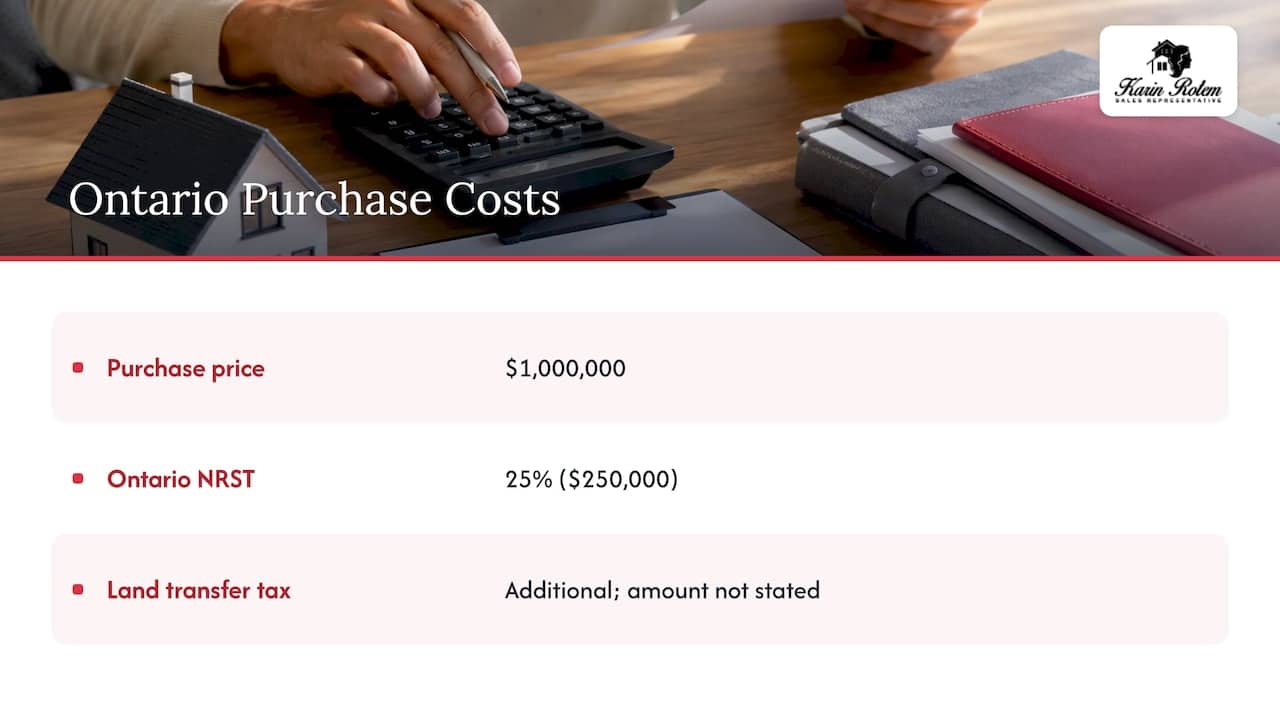
Even where the federal ban does not stop you, Ontario may tax you. The province’s Non-Resident Speculation Tax is 25% of the purchase price, effective since October 25, 2022. It applies province-wide to foreign nationals, foreign corporations and taxable trustees buying land that contains one to six single-family residences, including cottages and cabins. It is charged in addition to the general land transfer tax. Since March 27, 2024, condo parking and storage units are also designated land.
Exemptions may be available for nominees under the Ontario Immigrant Nominee Program, protected persons, and qualifying spouses. A rebate may be available if the buyer becomes a permanent resident within four years.
A worked example
Say a non-resident buys a $1,000,000 home that is designated land and no exemption applies. The 25% tax is $250,000, on top of the regular land transfer tax. That is why the first conversation with a lawyer should be about the tax, before any conversation about the kitchen. Our guide to the Non-Resident Speculation Tax in Ontario goes deeper, and the Ontario land transfer tax explained covers the regular tax you pay on top of it.
Toronto has also looked at its own layer. City staff recommended a 10% municipal non-resident speculation tax in a January 2024 report, proposed for January 1, 2025, with similar exemptions. Confirm its status with your lawyer if you are buying within the city.
How a cross-border mortgage works
The second half of the keyword is the money. A cross-border or non-resident mortgage is a Canadian mortgage for a buyer who lives outside Canada, or who has no Canadian credit history yet. Only some lenders offer it, and the terms are tighter than for a resident.
Down payment
Canada’s minimum down payment rules apply to everyone, as RBC’s newcomer guide lays out:
- 5% for homes under $500,000.
- 5% of the first $500,000 plus 10% of the remainder for homes from $500,000 to $1,499,999.
- 20% for homes of $1.5 million or more.
- Mortgage insurance is required when the down payment is under 20%.
Non-residents usually face a higher bar than that minimum. One non-resident mortgage page describes a typical 20% minimum for U.S. residents and 35% for buyers outside Canada and the U.S. The funds should be your own, held in a Canadian bank account before funding, with 90 days of proof of funds. A mortgage broker’s Ontario guide says most Ontario lenders want at least 35% down, usually sitting in a Canadian account for at least 30 days before closing. Lenders differ, so treat these as typical ranges and get a written quote.
Documents
Expect to provide:
- Passport and a second piece of ID.
- Two years of tax returns.
- Paystubs and an employment letter, or business and tax records if you are self-employed.
- Bank statements showing the down payment.
- An international credit report or a bank reference.
- The purchase agreement.
- Proof of reserves. One lender’s foreign-national checklist mentions 12 months of mortgage payments held in reserve.
Insured mortgages for newcomers with work permits
If you are legally authorized to work in Canada, you may not need a non-resident product at all. CMHC’s Newcomers page says insured financing is available to permanent and non-permanent residents who are legally authorized to work, with up to 95% loan-to-value on one- to two-unit owner-occupied homes and a 25-year maximum amortization (30 years possible through Home Start). The lending value must be below $1,500,000.
Our non-resident mortgage options guide lays out the routes in more detail.
Vacation home or investment property?
The mortgage broker guide above observes that vacation and second homes are generally the most straightforward purchases for foreign buyers. Rental or investment properties face larger down payments and more conservative terms, and some banks will not finance rentals for non-residents at all. If you plan to rent the property, say so to the lender and your accountant on day one. Rental income paid to a non-resident landlord has its own Canadian tax withholding rules, which an accountant should set up before the first guest arrives.
Currency, closing costs and the lawyer
Budget for more than the price and the tax:
- Legal fees: the same broker guide puts a Canadian real estate lawyer at roughly $1,500 to $3,000, plus title insurance and possible appraisal fees.
- Land transfer tax: payable by every buyer, and larger for non-residents once the 25% tax is added.
- Exchange rate: moving a deposit and a closing balance across a border means the currency rate on the day you transfer matters. Our currency exchange guide for Canadian real estate explains how to plan the timing.
RBC recommends speaking with a lawyer or notary to confirm your eligibility to buy residential property in Canada before you begin a home search. We agree, and we would add that you should do it before you fall for a specific unit.
If you are American, see our guide for Americans buying property in Canada. For the wider picture, our foreign buyer rules in Ontario and non-resident property purchase guide cover what we do not repeat here.
The cross-border buying process, step by step
- Confirm your status. Citizen, permanent resident, work-permit holder, student or visitor decides which rules apply. Do this first.
- Get a lawyer’s read on the address. Ask whether the property is inside a census metropolitan area or agglomeration, how many units the building has, and whether the 25% tax applies.
- Line up financing. Ask for the lender’s non-resident terms in writing, and move your down payment into a Canadian account early enough to meet the holding period.
- Search with the rules in mind. A good agent filters out properties you are not eligible to buy before you tour them.
- Make the offer with the right conditions. Financing, status and legal review conditions protect you.
- Close and plan ownership. Insurance, condo fees, property tax, and, if you rent, the non-resident landlord tax steps.
Friday Harbour and Innisfil for cross-border buyers
Friday Harbour on Lake Simcoe, in Innisfil, appeals to Toronto professionals and international buyers who want a resort-style waterfront setting within reach of the GTA. Our team is the number one team at The Harbour, which is our own claim based on our work there, and it is where much of our knowledge comes from.
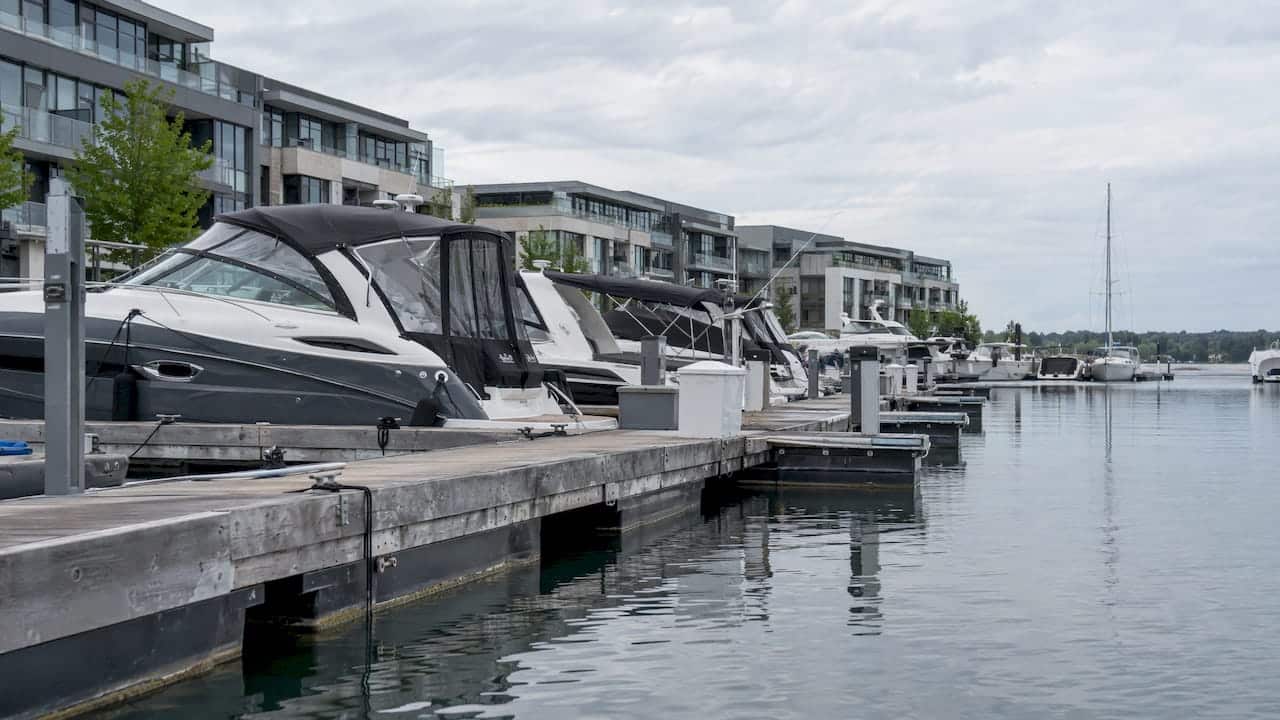
For a cross-border buyer, the practical questions are specific: which buildings and units you are eligible to buy, what the condo fees cover, what the carrying costs look like, and whether you can rent the unit. Start with our Friday Harbour condos for sale and compare costs with the city in how Friday Harbour condo prices compare to Toronto. If you are drawn to a house on the shoreline rather than a condo, read about buying Lake Simcoe waterfront.
Our perspective
Most cross-border buyers come to us thinking about the view. The ones who end up happy are the ones who first spent a week on status, tax and financing.
What most buyers don’t realize is that the rules are not one wall but a sequence of three doors: the federal ban, Ontario’s 25% tax, and the lender’s own conditions. A property can clear one and fail another. We walk clients through all three before they see a unit, because it is far cheaper to learn that at the start than at the deposit.
We work in Toronto, Innisfil and Friday Harbour, and we know which buildings and communities suit a second home, a family move or an income property. Our approach is tailored guidance, strong negotiation and a clear view of whether a property fits your goals, working alongside your lawyer, lender and accountant.
With Budget 2026 proposing a new-home exemption, we are watching the legislation closely. When the definition is final, we will help you work out what it means for your purchase.
Felix
Talk to us before you make an offer
If you are weighing a Friday Harbour condo, a Toronto home or a Lake Simcoe property from outside Canada, or on a temporary status, we can help you search only among properties that fit your situation. Browse the current Friday Harbour listings for sale or contact us through our site and tell us your goals. We will take it from there with your lawyer and lender.
FAQ
Can a tourist buy a house in Canada?
Under the federal ban, a visitor is a non-Canadian, so buying residential property inside the covered urban areas is generally prohibited unless an exception applies. Property outside those areas, and buildings with four or more units, fall outside the ban according to the CMHC FAQ. Ontario’s 25% tax can still apply. Speak with a real estate lawyer before you make an offer.
Can a non-resident get a mortgage in Canada?
Yes, from lenders that offer non-resident products. Typical down payments range from 20% for U.S. residents to 35% for buyers elsewhere, from your own funds in a Canadian account. You will also need income, credit and reserve documents.
Is the foreign buyer ban permanent?
No. It was extended to January 1, 2027, and Budget 2026 proposes extending it for existing homes to January 1, 2029. That extension needs legislation, so check the current status before you buy.
How much is the Ontario tax on foreign buyers?
The Non-Resident Speculation Tax is 25% of the purchase price on designated residential property anywhere in Ontario, on top of the regular land transfer tax. Exemptions or a rebate may apply, for example for Ontario nominees, protected persons, qualifying spouses, or buyers who become permanent residents within four years.
Is it better to buy a vacation home or an investment property as a non-resident?
A vacation or second home is generally the simpler route to financing. Rentals tend to need larger down payments and some lenders will not finance them for non-residents. We can help you compare both for Friday Harbour and Innisfil.
Sources
- CMHC FAQ on the Prohibition on the Purchase of Residential Property by Non-Canadians Act
- Prohibition on the Purchase of Residential Property by Non-Canadians Act, section 4
- Regulations SOR-2022-250, section 5
- Department of Finance: two-year extension to the foreign ownership ban
- Budget 2026 and the federal foreign-buyer ban: legal analysis
- Plan to extend the foreign buyer ban to 2029 with a new exemption: legal commentary
- Ontario Non-Resident Speculation Tax
- City of Toronto report on a municipal non-resident speculation tax
- RBC mortgages for newcomers to Canada
- CMHC Newcomers mortgage insurance program
- Non-resident mortgage requirements
- Foreign national mortgage document checklist
- Mortgages for non-residents in Ontario