
A prepayment penalty is the fee a lender charges when you pay off a closed mortgage before the term ends. It is usually the greater of three months’ interest or the interest rate differential (IRD), and on a fixed-rate mortgage it can run to thousands of dollars. What I tell my clients in Toronto and Innisfil is simple: look up the penalty before you list, make an offer or sign a conditional deal on a new property. The number changes what a sale really nets you, and in many cases it changes the timing of the whole move.
TL;DR
- A penalty can apply when you sell, refinance, switch lenders or pay down more than your yearly allowance on a closed mortgage. An open mortgage carries none.
- Variable-rate closed mortgages usually cost three months’ interest. Fixed-rate closed mortgages cost the greater of three months’ interest or the IRD.
- Porting your mortgage, using your prepayment privileges, waiting for maturity and blend-and-extend are the main ways to cut or avoid the fee.
- Ask your lender for a written payout figure with the rates used, and build it into your sale or purchase plan before you commit.
What a prepayment penalty is, and when it applies
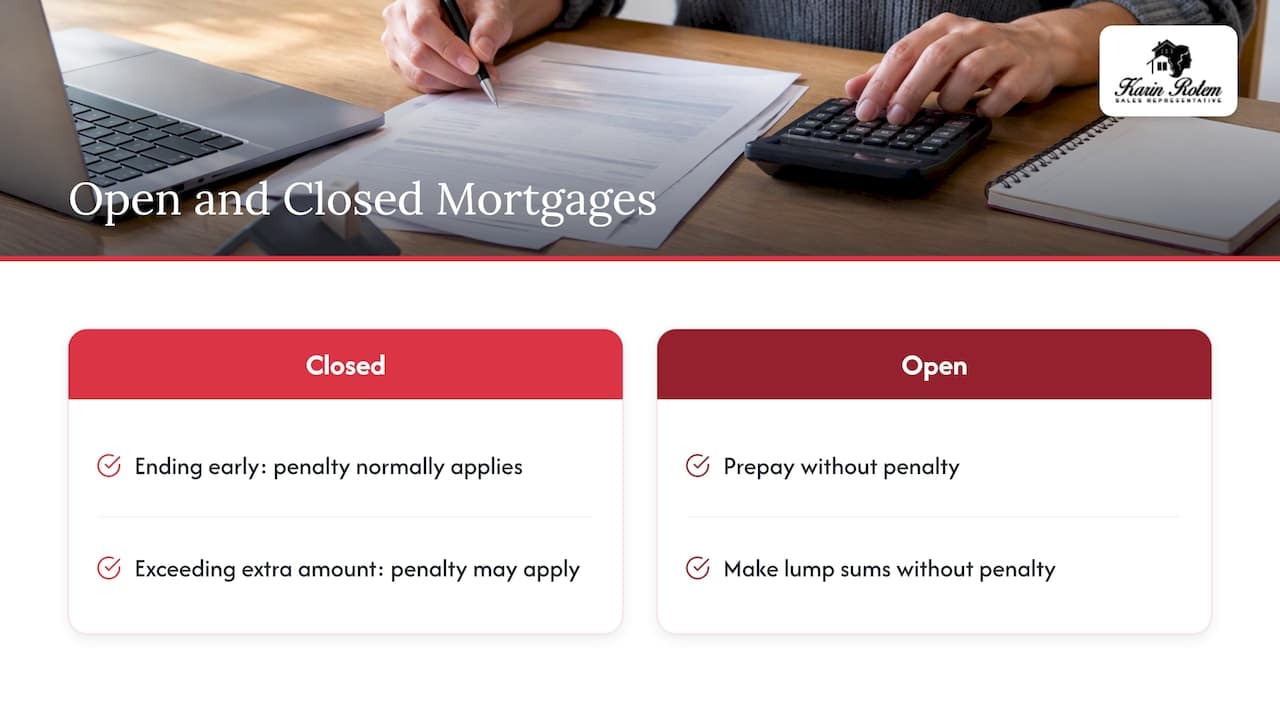
The Financial Consumer Agency of Canada (FCAC), the federal consumer regulator, explains that a lender may charge a prepayment penalty if you pay more than your allowed extra amount, break the contract, transfer the mortgage to another lender mid-term, or repay the whole balance before the term ends. That last case includes selling your home. With an open mortgage you can prepay or make lump-sum payments without a penalty.
The terms “break penalty” and “prepayment penalty” describe nearly the same thing. The FCAC treats the break penalty as the prepayment penalty you normally pay when you end a closed mortgage early. Breaking the contract can also bring other costs: an administration fee, an appraisal fee, a discharge fee, and repayment of any cash back you received when the mortgage started.
In Ontario, each lender sets its own rules, but the lender must give you a list of penalties and how the fees are calculated in your mortgage contract. That document is where you start.
How the penalty is calculated
There are two methods, and which one you face depends mostly on whether your rate is fixed or variable.
- Three months’ interest. Take your remaining balance, multiply by your rate, divide by four. This is the usual penalty on a closed variable-rate mortgage, according to Quebec’s financial regulator, the AMF.
- Interest rate differential (IRD). This is the interest the lender expects to lose if it re-lends your money at today’s lower rates for the rest of your term. The FCAC says the penalty is usually the higher of the two methods, and the IRD tends to win when your rate is above current rates and you signed less than five years ago.
A worked example
The FCAC’s own example uses a $200,000 balance at 6%, with 36 months left in a five-year term and a posted 36-month rate of 4%.
| Method | Result |
|---|---|
| Three months’ interest | $3,000 |
| Interest rate differential | $12,000 |
| Penalty you pay | $12,000, plus any administration fee |
That gap is why I never let a client assume the penalty is “just a few months of interest”. On a fixed rate signed when rates were higher, it can be several times that.
If rates have risen since you signed, the IRD may come out at zero or close to it, and the three-month figure applies. Rates move constantly, so any penalty you read online is a snapshot. Your lender’s figure on the day you ask is the one that counts.
Why two lenders can quote very different penalties
The IRD depends on which rates the lender plugs in. The FCAC explains that the lender compares the rate at signing with the current rate for a similar term, and many lenders subtract the discount you originally received from the current posted rate. The AMF notes that the posted rate at signing is your rate plus your discount, and advises borrowers to check which rates the institution used because they significantly affect the penalty.
The AMF’s example: $200,000 × (4.5% − 4.09%) × 4 years remaining = $3,280. Change one of those posted rates and the result moves noticeably.
Federally regulated institutions are expected to disclose how their charges are calculated, including the key variables such as the posted rate and any discount, under FCAC Commissioner Guidance CG-9. So you are entitled to see the method, not only the total. Ask for both.
The AMF also makes a point I repeat to clients who want to “break and grab a better rate”: because the IRD measures a shortfall caused by falling rates, saving money by breaking a fixed closed mortgage for a lower rate can be a challenge. Do the arithmetic on the penalty first.
When this hits Friday Harbour and Innisfil buyers and sellers
Most of the people I work with meet this penalty in one of four situations.
- Selling a Toronto home to move to Innisfil. Your mortgage is repaid on closing, so a closed term with time left means a penalty comes out of your proceeds. If you are planning that move, our guide on how to sell your Toronto home and buy in Innisfil covers the sequence. Add the penalty to your net proceeds calculation before you set a budget.
- Buying a second home or waterfront retreat. If you want to keep your existing mortgage and borrow against equity for a second property, a refinance can trigger the penalty. Know the figure before you decide how to fund the purchase.
- Investors adding income properties. If you hold a closed fixed mortgage on one property and plan to sell it to free up capital, the penalty reduces the capital you can redeploy. How lenders treat rent when you qualify is covered in our guide to a rental income mortgage in Canada.
- Selling in Innisfil for top value. A strong sale price and a poorly timed payout can cancel each other out. Align your listing date with your maturity date if the calendar allows it.
There is also the stress test to think about if you switch lenders or refinance. Our explainer on the mortgage stress test in Canada shows how qualification works.
Ways to reduce or avoid the penalty
The FCAC lists the main strategies: use your prepayment privileges fully each year, make a lump-sum prepayment before breaking the mortgage, wait until the term ends, port the mortgage when you buy a new home, and shop around at renewal. Here is how each plays out in practice.
Port the mortgage
Porting means moving your existing mortgage and rate to the new property. If you are selling and buying at the same time, it can avoid the penalty altogether. Lenders have their own rules on timing and on what happens if the new mortgage is larger. I walk through the dates and dollars in our guide to mortgage portability in Toronto and Innisfil. Check the portability window in your contract before you set closing dates, because a gap between sale and purchase can defeat it.
Use your privileges before you break
Most closed mortgages let you add to your payments and make lump sums each year without penalty. The FCAC describes this as a prepayment privilege, typically a percentage of the original mortgage, and notes that unused amounts generally cannot be carried forward. Its sample mortgage disclosure shows a “10+10” privilege: once a year, raise payments by 10% and make a lump sum of 10% of the original amount. Some lenders restrict prepayments close to the break date, so do this early rather than the week before you list.
Wait for maturity
At the end of your term you can usually repay without a penalty. If your term ends within a few months of when you would like to sell, waiting can be the cheapest option. This is worth raising before you pick a listing date.
Blend-and-extend
If you want a lower rate and are staying put, the FCAC describes blend-and-extend: the lender extends your mortgage early and blends your old rate with the new term’s rate, so no prepayment penalty is owed, though administrative fees may apply. The trade-off, as Forbes Advisor Canada points out, is that you get a rate between your old and the current one, not the full current rate.
Choose the right mortgage type from the start
An open mortgage lets you repay at any time without a penalty, but it usually carries a higher rate. Whether open or closed suits you depends on how sure you are of your plans. Our comparison of open vs closed mortgages helps with that choice.
Check your privileges and get an accurate payout figure
Privileges differ by lender and product, so read your own contract. As one example, CIBC’s Ontario standard charge terms allow 10% of the original principal per calendar year on fixed closed mortgages and 20% on its Variable Flex product, with a $100 minimum. Yours may differ.
The same document explains how a payout statement works: you can request one with an effective date up to 30 days after it is prepared, and payments received in between are not processed, which means interest keeps accruing. Practical takeaways:
- Ask for the payout statement in writing, and ask which posted rates and discount were used.
- Match the statement’s effective date to your closing date, and do not send extra payments between the statement and closing.
- Budget for the other costs as well: discharge and legal fees. Our guide to what closing costs include in Ontario lists them.
Lender calculators are estimates. BMO, for instance, notes that its online calculator figures are estimates only. Use them for planning, then get the real number in writing.
To model your numbers alongside your purchase budget, our mortgage and affordability calculators are a good place to start.
Our perspective
What most buyers don’t realize is that the penalty rarely decides whether a move is a good one. It decides when and how you do it. In our experience with Toronto owners heading to Innisfil and Friday Harbour, the families who feel calm at closing are the ones who asked for the payout figure and the porting terms before they ever toured a condo.
Our approach is to put the penalty in the same spreadsheet as the sale price, the commission, the legal fees and the new down payment. Then you compare the true net, not the headline. Sometimes that points to porting. Sometimes it points to a closing date a few weeks later, once a term matures. Our team’s focus on Friday Harbour and Innisfil, and on the Toronto market around it, means we can line up the sale and the purchase so these dates work for you.
What I tell my clients is to treat the lender’s contract as part of the transaction plan. Bring it to our first conversation, and we will map the timing together.
Felix
Planning a move in Friday Harbour or Innisfil?
If you are weighing a sale and a purchase together, we can build the timeline around your mortgage terms. Browse Friday Harbour condos for sale to see what is on the market, or get in touch through our main site and we will go through your numbers with you.
FAQ
Is there a prepayment penalty on an open mortgage?
No. The FCAC states that with an open mortgage you can prepay or make a lump-sum payment without a penalty. The trade-off is typically a higher interest rate than a closed term.
How much is the penalty to break a mortgage in Canada?
It depends on your balance, rate, remaining term and lender. A closed variable-rate mortgage usually costs three months’ interest, and a closed fixed-rate mortgage costs the greater of that or the IRD. In the FCAC’s example of a $200,000 mortgage, the figures were $3,000 and $12,000, so the borrower paid $12,000.
Do I pay a penalty if I sell my house?
If you repay a closed mortgage before the term ends, including because you sell, a penalty can apply. Porting your mortgage to a new home, or selling close to maturity, can avoid it. Check your contract’s portability terms before you set dates.
Can I estimate the penalty myself?
Yes, roughly. Three months’ interest is your balance times your rate, divided by four. For the IRD, many lenders offer an online calculator, and the FCAC suggests using your bank’s prepayment penalty calculator. Then ask the lender for a written payout figure before you commit to a closing date.
Sources
- Mortgage fees: Prepayment penalties, Canada.ca
- Breaking your mortgage contract, Canada.ca
- CG-9 Mortgage prepayment penalty disclosure, Canada.ca
- Credit agreement for a variable interest loan for a fixed term, Canada.ca
- Signing a Mortgage Contract, FSRAO
- Penalties for breaking your mortgage, AMF
- What Happens If You Break Your Mortgage Contract, Forbes Advisor Canada
- Standard Charge Terms, Ontario 2026/04, CIBC
- Your mortgage prepayment options, BMO