If you are buying a rental property in Canada and will not live in it, plan on at least 20% down. The rules for owner-occupied homes, second homes and small multi-unit buildings differ, and that difference can save you tens of thousands of dollars or cost you the deal. Here is how it works, with real numbers, from someone who helps buyers structure these purchases around Innisfil, Friday Harbour and Toronto.
TL;DR
- A non-owner-occupied property with one to four units generally needs at least 20% down, because it is not eligible for high-ratio mortgage insurance.
- If you live in one unit of a duplex, the minimum can fall to 5%. For a triplex or fourplex it is 10%.
- A second home meant for your own use can qualify for insured financing with 5% on the first $500,000 and 10% on the rest, if it meets the criteria.
- Budget beyond the deposit: closing costs in Ontario typically run 2% to 4% of the price, plus a cash reserve.
The short answer: 20% for a pure rental
When you buy a property you will not occupy, lenders treat it as an investment. Properties with one to four units that are rented out are not eligible for high-ratio default insurance, so the lender needs 20% down. The insurer’s own small-rental program for two to four units caps the loan at 80% of the property value, which comes to the same thing.
That is the floor, not a guarantee. Lenders can ask for more if your file is weaker. The federal consumer agency notes that self-employed borrowers or those with poor credit may be asked for a larger down payment. What I tell my clients is to treat 20% as the entry ticket and ask the mortgage professional early whether your profile needs more.
Five or more units is a different world. Those buildings are generally treated as commercial, with tougher qualification criteria. Most individual investors I work with are buying condos, townhomes, single-family homes or small multi-unit properties, so the rest of this article stays in the one-to-four-unit range.
What the down payment looks like in dollars
Let’s make it concrete. These are 20% examples for a property you will not live in:
| Purchase price | 20% down payment | Typical closing costs (2% to 4%) |
|---|---|---|
| $500,000 | $100,000 | $10,000 to $20,000 |
| $700,000 | $140,000 | $14,000 to $28,000 |
| $900,000 | $180,000 | $18,000 to $36,000 |
| $1,200,000 | $240,000 | $24,000 to $48,000 |
The closing cost range comes from a rental property guide for Ontario and covers items such as land transfer tax and legal fees. Toronto buyers should know that the city charges its own land transfer tax on top of the provincial one, so the top of the range is realistic there. Your lawyer can give you an exact figure before you make an offer.
What most buyers don’t realize is that the deposit you pay when you write the offer is not an extra cost. It is part of your down payment, but it needs to be in the bank, and the lender will want to see where it came from. More on that below.
How occupancy and unit count change the minimum
The single biggest lever is whether you will live in the property. The major difference between owner-occupied and non-owner-occupied financing is how much down payment you need.
For a building with four or fewer units:
- You rent every unit: 20% down.
- You live in one unit of a duplex: as low as 5%.
- You live in one unit of a triplex or fourplex: as low as 10%.
A bank’s advice page for rental owners describes the same pattern: renting all units requires 20%, occupying one unit lowers it. Insured mortgages also come with a premium, and when your down payment is under 20%, mortgage loan insurance typically costs 0.6% to 4.5% of the mortgage amount. Factor that into your numbers.
A worked example: the duplex you live in
Say you find a $600,000 duplex and plan to live in one side. The federal consumer agency describes the minimum for a home priced between $500,000 and $1.5 million as 5% of the first $500,000 plus 10% of the remainder. That is $25,000 plus $10,000, so $35,000, compared with $120,000 if you rented both units and put 20% down.
That gap is why house hacking appeals to so many first-time investors. The trade-off is real, though: you share a property with tenants, and you need to be honest with yourself about whether that suits your life. If it does not, saving longer for a pure investment is the better path, and I will tell you that to your face.
The price tiers for owner-occupied purchases
For owner-occupied homes, the minimum depends on price. The official breakdown is:
- $500,000 or less: 5% of the purchase price.
- $500,000 to $1.5 million: 5% of the first $500,000 and 10% of the portion above it.
- $1.5 million or more: 20% of the purchase price.
The insured price cap rose from $1 million to $1.5 million as of December 15, 2024, which is why the middle tier now stretches that far. The same announcement expanded 30-year amortizations to all first-time buyers and all new build purchases.
This matters for Friday Harbour and Toronto condo buyers because many units sit in that middle band. If you are buying to live in it, the tier math applies. If you are buying to rent it out, it does not, and 20% is the number.
Vacation homes and second homes
This is the question I get most from Toronto professionals eyeing a waterfront weekend place: does a cottage or resort condo count as an investment?
It depends on how you use it. A second home that you intend to occupy yourself can qualify for insured financing with 5% on the first $500,000 and 10% on the remainder. The conditions are specific:
- The property must be priced below $1.5 million.
- It must be suitable for year-round occupancy.
- It must be intended for homeowner use, not as a rental business.
- A borrower can have a maximum of two eligible properties at any time.
A seasonal cottage without year-round access or heating will not meet that test. Example: a $700,000 year-round second home that qualifies would need $25,000 plus $20,000, or $45,000 down. The same property bought mainly to rent out would be treated as an investment and need $140,000.
If you plan to use the place yourself and rent it out part of the year, talk to a mortgage professional before you write an offer. How a lender views your intended use can change the structure, and I would rather you hear that before you are conditional on financing. If you are weighing a waterfront purchase of this kind, our guide to Friday Harbour condo prices compared with Toronto shows the cost difference side by side.
How lenders look at your income and the rent
The down payment gets you in the door. Qualifying is the next gate. Lenders look at tenancy documents or a market-rent opinion, and they want to see enough non-rental income to carry your obligations. A major lender lists the latest Notice of Assessment, the T776 form, and current leases or a market-rent opinion among the documents.
For small non-owner-occupied rentals of two to four units, the insurer’s program often allows up to 50% of gross rental income or a net rental income approach in the debt service calculation. Every lender counts rent a little differently, so the same property can qualify at one and fall short at another. I break this down further in how lenders count rental income.
If you plan to run a short-term rental, tax records matter from day one. Our walkthrough on T776 steps for short-term rental owners explains what to keep so deductions hold up.
Where the money can come from
The insurer lists savings, proceeds from selling a property and non-repayable gifts from relatives as traditional down payment sources. Non-traditional sources such as unsecured personal loans or lines of credit may be allowed for one- or two-unit properties at 90.01% to 95% loan-to-value for borrowers with a strong credit history. That is an insured, owner-occupied scenario. For a pure investment at 20% down, expect lenders to look harder at borrowed funds, and to count the new debt in your ratios.
A few practical points:
- Sale proceeds: If you are selling a Toronto home and buying in Innisfil, the equity can become your down payment. Our Toronto to Innisfil guide covers timing.
- Gifts: Expect a signed gift letter confirming no repayment is expected.
- Registered funds: Eligible first-time buyers may use Home Buyers’ Plan withdrawals for a rental property only if they intend to live in the unit they buy.
- Listed shares: Some owners with large share portfolios consider borrowing against them instead of selling. If that is you, read up on stock-backed loan red flags first, and remember that a lender will still want to see the source of your funds.
Whatever the source, lenders want a clear paper trail. Our piece on the 90-day paper trail for deposits and down payments shows what to prepare so a large transfer does not stall your closing.
Costs beyond the down payment
A 20% deposit is not the whole cheque. Besides closing costs, one bank suggests setting aside an accessible security fund of about 3.5% of the property’s price and accounting for taxes and maintenance. Treat it as one perspective rather than a rule, but the logic holds: the first vacancy or furnace repair should not force you to sell.
On a $700,000 purchase, a sensible cash plan might look like this:
- Down payment at 20%: $140,000
- Closing costs at 2% to 4%: $14,000 to $28,000
- Reserve at 3.5%: $24,500
That totals roughly $178,500 to $192,500 in cash, not $140,000. For furnished rentals, add the cost of furnishing; our list of furnished rental features investors need helps you budget it. Do not skip landlord insurance in Ontario, and look at title insurance at closing.
If you are comparing monthly carrying costs, run your own figures through our mortgage and affordability calculators.
Our perspective on down payments for resort-style investments
We see the same pattern with investors in Innisfil and Friday Harbour. The buyers who do well are not the ones who stretch to the minimum. They are the ones who decide how they will use the property before they shop, then build the deposit, closing costs and reserve around that decision.
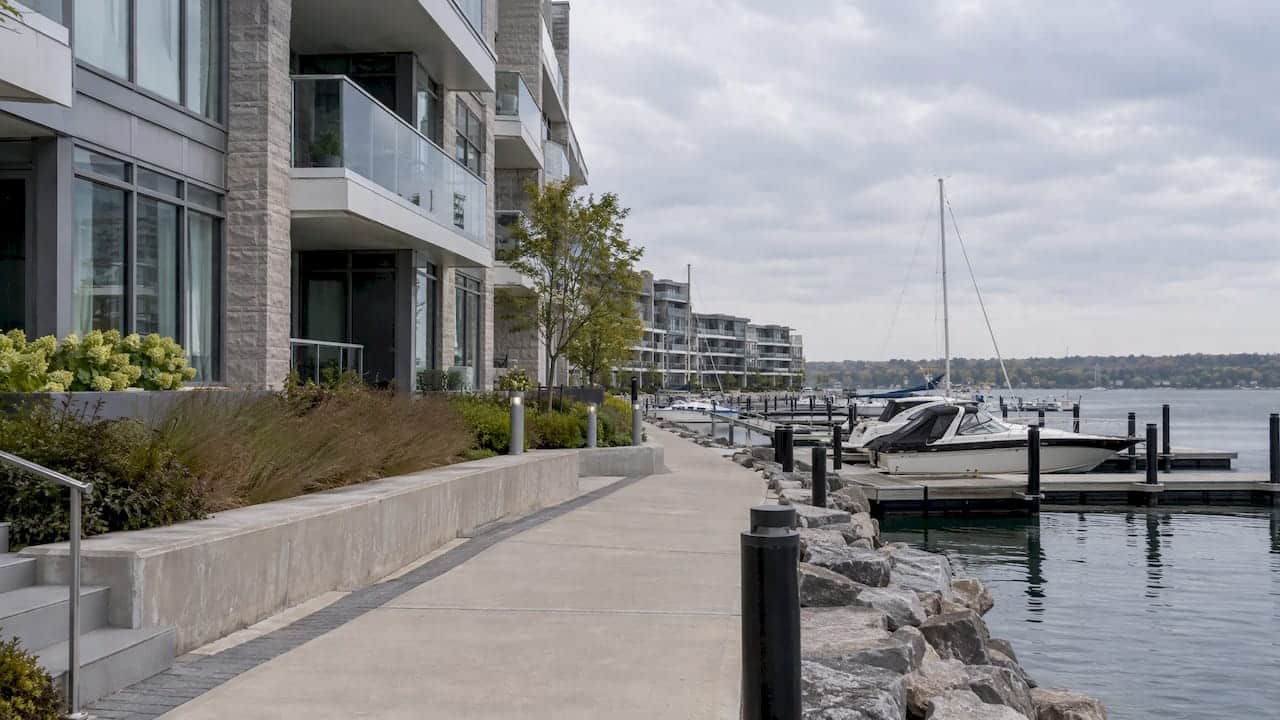
What most buyers don’t realize is that a resort-style community changes the math in both directions. A condo you will use on weekends and rent out the odd week is a different file from a unit bought purely for income. Lenders look at intended use, and so should you. We help clients sort that out before the first showing, so the offer is written on terms that will actually finance.
Our team has been the top team at The Harbour, and we are a Top 100 team worldwide with REMAX. That experience comes down to something simple: we know which units suit which goals, and we will say plainly when a property is not the right fit. If your numbers work better with a different building, or you should wait six months to save more, we will tell you.
Felix
Working with us
If you are buying in Friday Harbour, we can show you what is available now and walk through how your intended use affects financing. Start with our Friday Harbour condos for sale, or browse the current Harbour listings. If you want to test the rental side, see the Harbour rentals. We also work with Toronto and GTA buyers and investors, and with international buyers; if you do not live in Canada, start with our guide to non-resident mortgage options in Ontario.
FAQ
What is the minimum down payment on an investment property in Canada?
For a one-to-four-unit property that you will not live in, the minimum is 20%. It is not eligible for high-ratio mortgage insurance. If you will live in one unit, the minimum can drop to 5% for a duplex or 10% for a triplex or fourplex.
How much is the down payment on a $500,000 house in Ontario?
If you will live in it, the minimum is 5%, or $25,000. If you are buying it purely as a rental, the minimum is 20%, or $100,000. Closing costs of roughly 2% to 4% come on top.
Is the down payment different for a vacation home?
It can be. A second home meant for your own use may qualify for insured financing with 5% on the first $500,000 and 10% on the rest, if it is under $1.5 million and suitable for year-round use. A property bought mainly to rent out is treated as an investment and needs 20%.
Can I use a gift or a line of credit for the down payment?
Non-repayable gifts from relatives are a recognized source. Unsecured loans or lines of credit may be permitted in some insured, owner-occupied cases, but not as a simple workaround for an investment purchase. Ask your lender before you rely on borrowed funds.
How much cash should I have besides the down payment?
Plan for closing costs of about 2% to 4% of the price in Ontario, plus a reserve for repairs and vacancies. One bank suggests roughly 3.5% of the price as a security fund, which is a reasonable starting point.
Sources
- How much you need for a down payment, Financial Consumer Agency of Canada
- Investment Property Mortgages, Ratehub.ca
- Flexible Financing for Second Homes with CMHC Insurance
- Mortgage Loan Insurance: CMHC Income Property
- Buying an Investment Property, RBC Royal Bank
- General requirements, CMHC
- Is Investing in Residential Rental Property a Good Idea?, National Bank
- Rental Property Down Payment Canada, Streetwise Wealth
- Question Period Notes, Government of Canada
- Stock-Backed Loans: 7 Red Flags Every Borrower Should Know