
A private mortgage in Ontario is a loan from an individual, a private company or a mortgage investment corporation instead of a bank or credit union. It is approved mostly on the value of the property, it can fund quickly, and it is usually meant to be short. Used with a clear exit plan, it can bridge a purchase that a traditional lender will not fund yet. What I tell my clients is simple: the product is not the risk, a missing plan for the end of the term is.
TL;DR
- A private mortgage is funded by a private lender, so the terms, rates and fees vary far more than at a bank or credit union.
- Lenders usually look at the property and the loan-to-value ratio first, and commonly want 15% down or a loan of 85% of value or less.
- Terms are typically one to two years, so plan how you will refinance into a lower-cost mortgage before you sign.
- Work with a licensed professional, read the power of sale terms, and get independent legal advice.
- Compare the all-in cost (interest, lender fee, broker fee, legal fees), not only the rate.
What a private mortgage is and how it works
The Financial Services Regulatory Authority of Ontario (FSRA) describes a private mortgage as a loan from a private lender, which could be a mortgage investment corporation, a private company, or an individual or friend. Its terms can vary significantly. That is the main difference from a bank mortgage, where products are standardized and the rules are well known to most buyers.
In practice, the sequence looks like this:
- You or your broker present the property and your plan to a private lender.
- The lender values the property and decides how much it will lend against it.
- If approved, a lawyer registers the mortgage on title, and the lender advances funds on closing.
- You make payments, often interest-only, until the term ends.
- At maturity you repay the loan, usually by refinancing with a bank or credit union, or by selling.
Private mortgages are typically uninsured, with a term of one year or less, and lend at 85% of value or less. Many Ontario lenders write one- to two-year terms, which is why the exit matters so much.
Who a private mortgage suits
FSRA notes that borrowers who cannot qualify for a mortgage from a bank or credit union may use a private mortgage temporarily, for one or two years, while working toward a lower-cost option. In my files, the situations that come up most often are:
- Self-employed buyers whose tax returns understate what they really earn.
- Recent newcomers or non-residents who lack a Canadian credit history. If this is you, read our guide to non-resident mortgage options in Ontario first, because some traditional lenders do work with you.
- Buyers with a short window, such as a purchase that must close before another property sells. A bridge financing plan is sometimes the better tool, so compare both.
- Owners with a credit blemish who have strong equity and need time to rebuild.
- Investors who need to close quickly on a property and refinance once it is stabilized.
FSRA also says borrowers may be assessed on the property’s value rather than income. That flexibility is real, and it is exactly why you should be honest with yourself about whether you can carry the payments and refinance later.
Private mortgage rates in Ontario
Rates depend on the lender, the property and the position of the mortgage (first or second). Open Mortgage Rates, a rate comparison site, listed 84 private products on its Ontario private rates page, with displayed rates running from 5.35% to 11.99%. The 5.35% figure applies to specific, low-loan-to-value scenarios as of 29 October 2026, so treat it as the floor, not what most borrowers will see. Rates move, so check current figures with your broker.
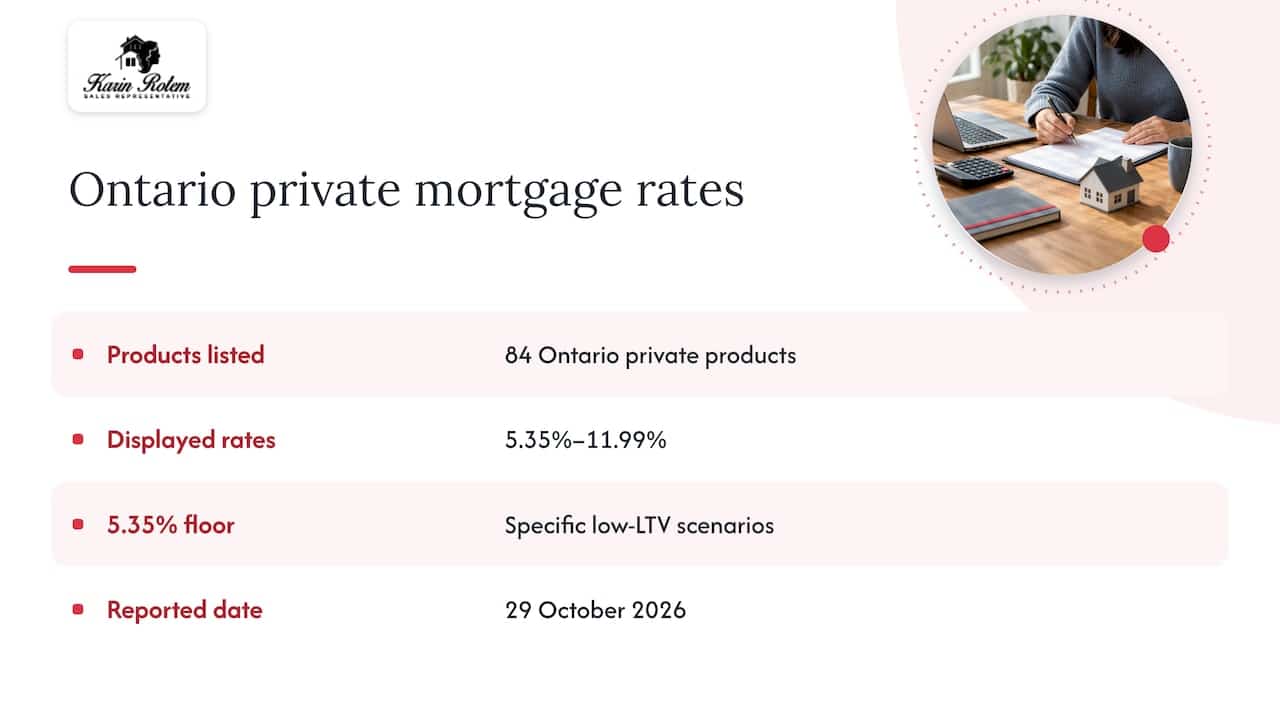
The biggest driver is loan-to-value (LTV). Lower LTV ratios, such as under 50%, generally bring lower interest rates. A buyer with 40% down is a very different risk to a private lender than one with 15% down.
Fees beyond the rate
The rate is only part of the cost. Ask for every fee in writing before you commit:
- Lender fee: often charged as a percentage of the loan.
- Broker fee: a mortgage broker’s fee on a private deal is commonly between 1% and 2% of the mortgage, which is higher than the nothing you would normally pay on a bank deal.
- Legal fees: your lawyer’s and often the lender’s lawyer’s.
- Appraisal fees: the lender typically requires its own valuation.
- Renewal or extension fees: if you need more time at maturity.
A worked example
Say you borrow $500,000 for two years. At 9% interest-only, you pay about $45,000 a year in interest, or roughly $3,750 a month. Add a 1% lender fee ($5,000) and a 1% broker fee ($5,000), and your first-year cost is about $55,000 before legal fees. This is an illustration with made-up round numbers, not a quote. Its purpose is to show why a short, planned term matters: the same loan refinanced into a lower-rate mortgage after twelve months costs far less than one carried for three years. You can test your own figures with our mortgage and affordability calculators.
Private mortgage vs bank mortgage
| Feature | Private mortgage | Bank or credit union mortgage |
|---|---|---|
| Funded by | Individual, private company or mortgage investment corporation | Regulated financial institution |
| Main approval focus | Property value and LTV | Income, credit and debt ratios |
| Typical term | One to two years | Commonly five years, with shorter options |
| Typical rate | Higher, varies widely | Lower, more standardized |
| Fees | Lender and broker fees are common | Fewer upfront fees |
| Speed | Can be quick | Usually slower |
| Best use | Short bridge to a better option | Long-term home financing |
The private route is a tool for a specific stretch of time. The traditional route is where most people want to live long term.
Credit union or bank: how to choose
Many readers who search for private mortgages are also deciding between a bank and a credit union, so here is how I frame it. Both are regulated, mainstream lenders, and both can be a good home for your mortgage once you qualify.
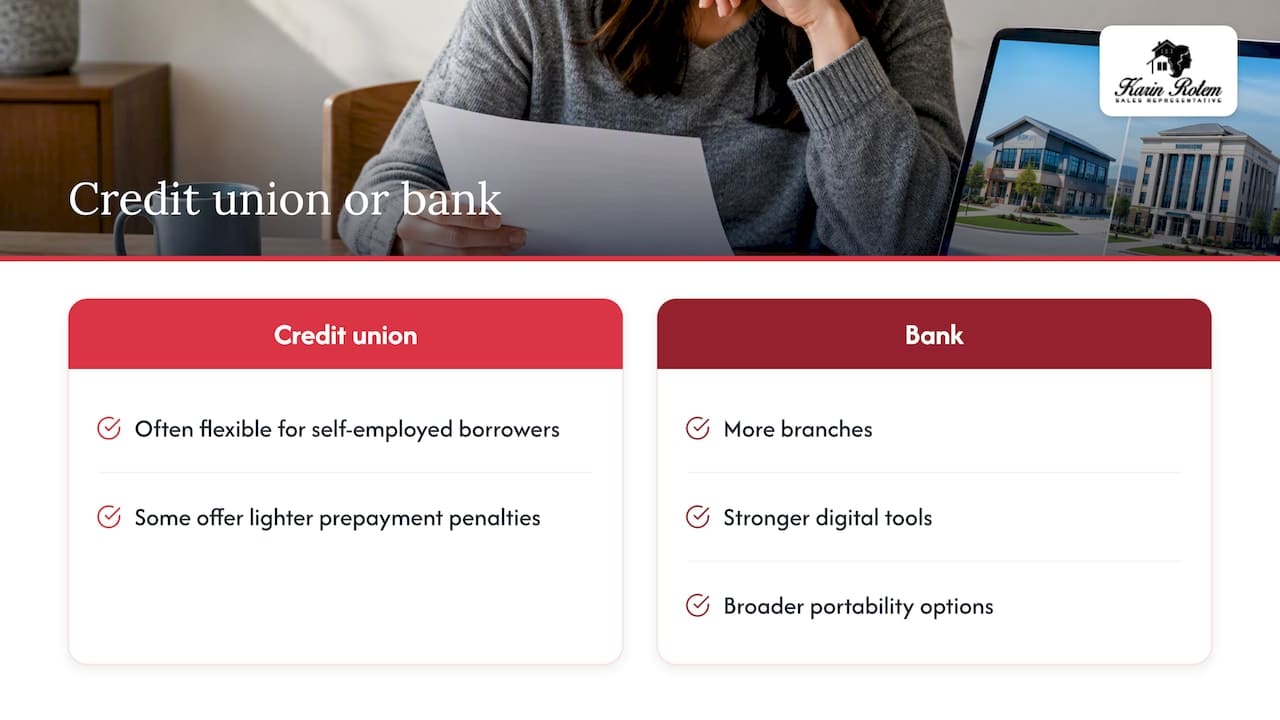
Credit unions are often described as more flexible with self-employed borrowers or non-standard income, and some offer lighter prepayment penalties. Banks may have more branches, stronger digital tools and broader portability options. Rates change constantly, so neither type is automatically cheaper.
What most buyers don’t realize is that the penalty and portability terms can matter more than a small rate difference. If you might sell and move, for example from a Toronto home to Innisfil, read how mortgage portability works in Toronto and Innisfil before you pick a lender. Ask both types of lender for the same details: rate, term, prepayment privileges, penalty method and whether the mortgage is portable.
If a bank or credit union declines you today, that is often when a private mortgage enters the picture. The goal is to use it as a bridge back to one of them.
Rules and borrower protections in Ontario
Private lending is regulated in Ontario, and you can use that to your advantage.
- Licensing: people who arrange mortgages in Ontario must be licensed by FSRA, and licensees arranging private mortgages must take reasonable steps to arrange a transaction suitable for both the borrower and the private lender. Ask for the licence number and check it.
- Exit strategies: FSRA says it focuses on adequate consideration of exit strategies to help consumers transition back to a traditional lender. A good broker will ask about yours early.
- Terms to read closely: FSRA advises that private mortgages may carry higher interest rates, lender fees, shorter terms and interest-only conditions, and that you should check how quickly power of sale could start after a missed payment.
- Independent legal advice: one Ontario law firm advises borrowers, especially those in vulnerable positions, to get their own lawyer. I agree: your lawyer should work for you, not for the lender.
Power of sale
If a borrower defaults, a private lender may enforce through power of sale, and the borrower usually has a 35-day redemption period after notice is served. That is a short runway. Our guide to power of sale in Ontario explains the process for homeowners and buyers. If payments get tight, speak to your broker and lawyer early, before any notice arrives.
Market context
FSRA’s 2024 report on private residential lending found that the mortgage delinquency rate for non-bank lenders in Canada rose from 0.14% in Q3 2022 to 0.20% by Q3 2024. The numbers remain small, but they are a reminder to borrow only what your cash flow supports.
How to qualify and apply
Borrowers typically need a minimum down payment of 15%, or a loan of 85% of value or less. Here is the order I suggest:
- Define the purpose and the timeline. Why do you need private money, and for how long?
- Write your exit plan first. Who will refinance you, at what income and credit level, and what has to change by then?
- Gather documents: ID, property details, proof of down payment or equity, income records and a credit report.
- Speak to a licensed mortgage professional who can access several private lenders and compare full costs.
- Get the commitment letter reviewed by your lawyer before you accept it.
- Budget for closing. Our guide to what closing costs include in Ontario shows what to set aside beyond the down payment.
If you are buying, two other pieces matter. First, think carefully about whether a financing condition belongs in your offer, because private approvals can hinge on the appraisal. Second, understand the risk of an appraisal gap, since a lender who lends a percentage of value will fund less if the appraisal comes in under the price.
Private financing for rental and vacation properties
Investors sometimes use a private first mortgage to close on a property and refinance once it is rented. If rent is part of your plan, see how lenders count rental income, because the number a traditional lender accepts will decide whether your exit works.
Other ways to bridge a gap
A private mortgage is not the only way to fill a financing gap. A seller may agree to hold part of the price, which is covered in our guide to the seller takeback mortgage in Ontario. A bridge loan can cover a closing overlap. The right choice depends on your timeline, equity and how certain your exit is.
Our perspective
We see private financing as a planning tool, not a last resort and not a shortcut. In waterfront and resort-style communities like Friday Harbour and Innisfil, buyers often have strong equity, complex income or a tight timeline, and those are exactly the profiles where a short private term can make a purchase work.
What I tell my clients is to start with the exit. Before we write an offer, I want to know who will refinance you in twelve to twenty-four months and what that lender will need to see. Then we work backwards: the right price, the right conditions and the right closing date.
My team’s role is to bring the real estate side of that plan together. We know how local appraisals tend to behave, how sellers respond to different offer structures and when a deal fits your goals and when it does not. We work alongside your licensed mortgage professional and your lawyer so each piece fits.
If a private mortgage is the right bridge, we will help you use it well. If a bank or credit union can do the job, we will say so.
Felix
Buying in Friday Harbour or Innisfil with flexible financing
If you are planning a purchase on Lake Simcoe, we can help you line up the property search with a financing plan that works for your situation. Browse Friday Harbour condos for sale or get in touch through our main site for personal guidance on buying, selling or investing. If you are weighing a move out of the city, our guide to selling your Toronto home and buying in Innisfil is a good place to start.
Questions to ask before you sign
Bring this list to your broker and lawyer:
- What is the total cost of borrowing over the full term, including every fee?
- Is the loan interest-only, and what happens to the principal?
- What are the renewal and extension terms if I need more time?
- Is there a prepayment penalty or a minimum interest period?
- How quickly can power of sale begin after a missed payment?
- Who will refinance me at maturity, and what do they require?
A good answer to each is specific and written down. A vague answer is a reason to keep shopping.
FAQ
Is a private mortgage legal and regulated in Ontario?
Yes. Private lending is legal, and anyone who arranges mortgages in Ontario must be licensed by FSRA. Licensees arranging private mortgages must take reasonable steps to make the transaction suitable for both borrower and lender. Always ask for the licence number and check it with FSRA.
What down payment do I need for a private mortgage?
Lenders commonly want at least 15% down, which means a loan of 85% of the property’s value or less. Lower LTV ratios generally bring lower rates. Each lender sets its own limits, so confirm yours with your broker.
How long does a private mortgage last?
Terms are usually one to two years, and some are shorter. That is why you need an exit strategy, most often a refinance with a bank or credit union. Ask what extension options exist if your plan takes longer.
Is a credit union mortgage better than a bank mortgage?
Neither is better for everyone. Credit unions are often more flexible with non-standard income, while banks may offer wider branch networks and portability options. Compare rate, penalty method, prepayment privileges and portability for your situation.
What happens if I miss payments on a private mortgage?
The lender can begin enforcement, which may include power of sale. In Ontario the borrower usually has a 35-day redemption period after notice is served. Contact your broker and a lawyer as soon as you see payments becoming difficult.
Sources
- Private Mortgages, Financial Services Regulatory Authority of Ontario
- Private Residential Mortgage Lending in Ontario Report 2024, FSRA
- Broker and Borrower FAQs, CMI
- Private mortgage rates in Ontario, Open Mortgage Rates
- Private Mortgage Rates Ontario, BestRates
- How Private Mortgages Work in Canada, NerdWallet Canada
- Private Lending in Ontario: Definition, Benefits and Risks, Insight Law Firm
- A Quick Guide to Ontario Mortgage Lender Fees, WealthTrack
- Credit Union or Bank Mortgage Guide, LendToday