
Most Ontario property managers charge 8% to 12% of the rent they collect each month, or a flat $150 to $350 per unit, and then add one-time fees for finding a tenant. That headline number is only part of the real cost. What I tell my clients is that the exclusions list is the price, so you need to read the whole fee schedule before you compare percentages.
I work with owners and investors in Toronto, Innisfil and Friday Harbour, so I see these agreements from the owner’s side regularly. Below, I walk through what the fees look like, what they usually cover, what gets billed on top, how the tax side works, and how to compare quotes without getting surprised in month three.
TL;DR
- The monthly fee is typically 8% to 12% of gross rent collected, or a flat $150 to $350 per unit.
- A tenant placement fee of 50% to 100% of one month’s rent is common, and renewals, inspections, maintenance markups and eviction support can be extra.
- Management fees are generally deductible against rental income, and so are condo fees, but they are two different costs.
- Ask for a written schedule that names every chargeable item, and check the exit terms before you sign.
What property managers charge in Ontario
There are two main structures. The first is a percentage of the rent actually collected. The second is a flat monthly amount per unit. According to one Ontario manager’s 2026 cost breakdown, typical rates run 8% to 12% of gross rent collected or a flat $150 to $350 per unit each month.
The province does not set these prices for you. Ontario’s property management industry isn’t regulated at the consumer-pricing level, so each provider can structure fees however it likes. That is why two quotes for the same condo can look nothing alike.
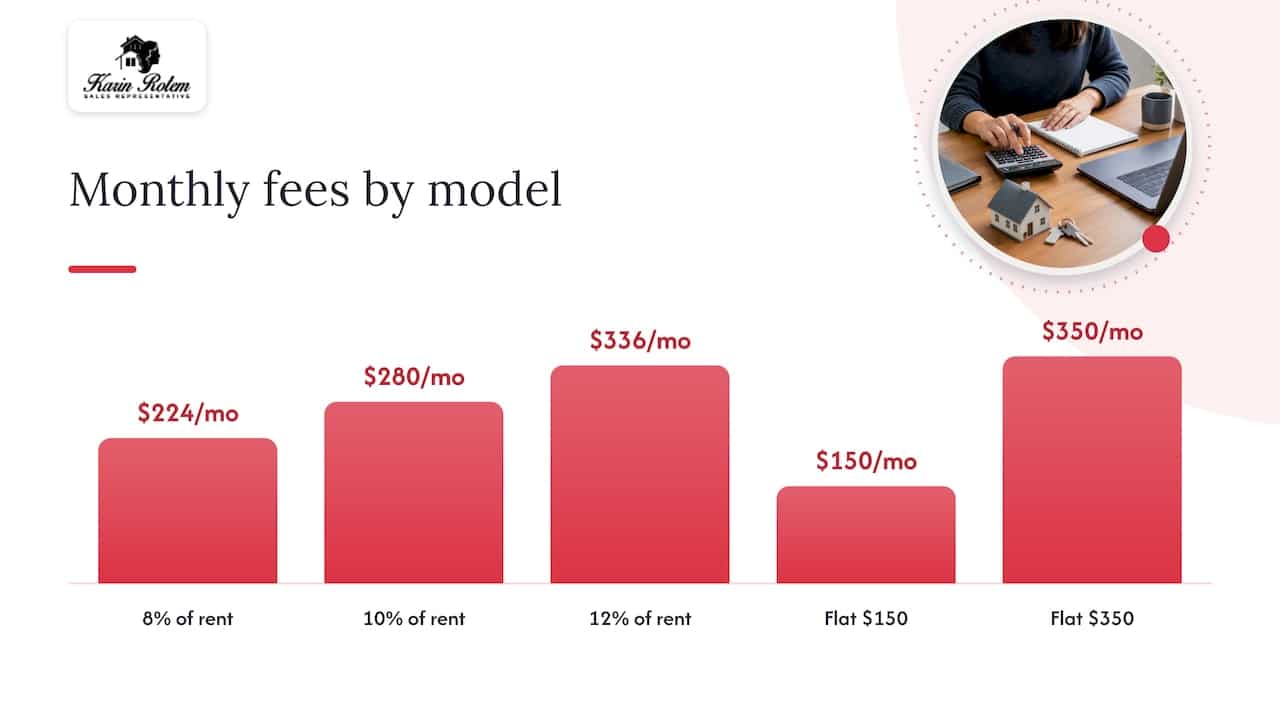
Here is how the numbers play out on a unit renting for $2,800 a month:
| Fee model | Monthly cost | Annual cost |
|---|---|---|
| 8% of rent | $224 | $2,688 |
| 10% of rent | $280 | $3,360 |
| 12% of rent | $336 | $4,032 |
| Flat $150 | $150 | $1,800 |
| Flat $350 | $350 | $4,200 |
These figures are my own arithmetic on the published ranges, not a quote from any company. They show why a flat fee tends to look cheaper on a high-rent unit and a percentage tends to look cheaper on a low-rent one.
Percentage fees versus flat fees
A percentage fee grows when rent grows. That can be a good thing: the manager earns more when you earn more, so they have a reason to push rent to market and keep the unit full. Some industry commentary notes that a flat fee may remove that incentive to chase market-rate increases or shorten vacancies.
On the other side, Toronto-focused analysis points out that flat fees can be more predictable for high-rent properties, while percentage fees can be more cost-effective for lower-rent units. The same analysis concludes there is no single better model. The right one depends on your rent level, how many units you own, and how much service is bundled in.
What most owners don’t realize is that the percentage applies to rent collected, not rent charged. If a tenant is late or doesn’t pay, a fee based on collected rent should shrink with it. Ask the manager to confirm which one their contract uses.
What the monthly fee should cover
A full-service monthly fee in Ontario should cover rent collection, maintenance coordination and financial reporting for the owner. In practice, I would want to see these in writing:
- Rent collection and deposit into your account on a set date each month.
- Monthly statements, plus year-end summaries you can hand to your accountant.
- A 24-hour contact for tenant emergencies.
- Coordination of repairs, with a clear spending limit before they need your approval.
- Communication with the tenant about routine issues and notices.
Notice the word coordination. The manager arranges the work. The invoice from the plumber still lands on you.
Fees that sit on top of the monthly rate
This is where quotes diverge. Property management fees typically consist of a monthly fee plus separate one-time charges such as leasing or tenant placement fees. One Ontario source lists the following as the common extras:
| Extra charge | Typical range |
|---|---|
| Tenant placement | 50% to 100% of one month’s rent |
| Lease renewal | $150 to $350 |
| Maintenance coordination markup | 10% to 15% |
| Eviction management | $300 to $800 |
| Setup or administration | $0 to $300 |
Those ranges come from a 2026 Ontario fee guide, and repair and maintenance invoices are passed through to the landlord on top. Another source says the markup on contractor invoices is often 10% to 20%, so it is worth asking for the exact figure rather than assuming.
A first-year example
Take the same $2,800 unit at 10% with a placement fee of 75% of one month’s rent. The monthly fee is $3,360 over twelve months. The placement fee is $2,100. That is $5,460 in year one before a renewal fee, any repair markup or inspection charges. In year two, without a new tenant, the cost drops to $3,360 plus whatever renewal fee applies.
That is why I tell clients to think in annual cost, not monthly percentage. A manager at 8% with high extras can cost more than one at 10% with a clean schedule.
Items that are usually not in the fee at all
Core maintenance and repair costs, government filing fees for Landlord and Tenant Board applications, and major capital expenditures are generally charged separately to the landlord. Project oversight for big improvements, such as a kitchen or bathroom renovation, is another item that may be billed as an extra, along with property inspections.
Some landlords push back on setup fees and maintenance markups. One Ontario manager’s own commentary notes that critics see them as double-dipping for overhead the firm should already absorb. I wouldn’t treat either as automatically wrong. A markup that pays for real vetting and after-hours coordination can be fair. A vague one with no description is the one to question.
Short-term and furnished rentals cost more to manage
Everything above describes a standard long-term residential lease. If you plan to run a furnished or short-term unit, the work is different: guest turnover, cleaning, restocking and pricing. Management of that kind is normally quoted separately from long-term tenancy rates, so do not assume the 8% to 12% range applies. Get a written quote for your specific setup.

Before you hire anyone for that model, make sure the unit is legal to operate. Our guide on how to set up a short-term rental in Ontario legally covers the municipal side, and the features furnished rental investors need will help you decide what to put in the unit.
Recurring upkeep also matters more with guests coming and going. For example, regular pest checks can protect a holiday rental from costly problems and bad reviews. Ask any manager whether routine pest and cleaning contracts are inside their fee or billed through to you.
Property management fees versus condo fees
The two get mixed up constantly, especially by first-time condo investors. They are different costs paid to different parties.
- Condo (maintenance) fees go to the condominium corporation. They cover your share of the common elements, such as the building’s operating costs, the reserve fund and shared amenities.
- Property management fees go to the person or company managing your rental unit: finding the tenant, collecting rent, handling repairs.
If you own a condo and rent it out, you pay both. Before buying, I always ask clients to read the status certificate and look at the reserve fund, because a building with a thin reserve can lead to special assessments later. Those are costs the property manager does not absorb.
Are the fees tax-deductible?
Generally yes. The Canada Revenue Agency’s guide to rental income treats management fees as a current rental expense, and the same publication allows landlords of condo units to deduct their share of common expenses, such as the fees paid to the condominium corporation. Keep every invoice and the year-end statement from your manager.
Tax treatment depends on your situation, so confirm the details with an accountant, especially if you have mixed personal and rental use or you are deciding whether a cost is a repair or a capital improvement.
If you live outside Canada
Non-resident owners face an extra layer. Toronto-based comparisons of management companies show that NR6 filing support can cost $300 to $708 a year. If you are buying from abroad, read our overview of the non-resident property purchase process in Ontario and the 25% non-resident speculation tax, so the management fee is one line in a complete budget, not a surprise.
How to compare quotes
Here is the process I walk investors through.
- Ask for the full fee schedule in writing. Landlords should request a complete written schedule and ask about leasing, renewal, inspection and maintenance charges. A verbal assurance that extras are rare is not a schedule. Ask for a written list naming every chargeable item.
- Convert each quote to an annual figure. Use your expected rent and include placement, renewal and a realistic repair markup.
- Check the exclusions. Two quotes that look identical can differ by thousands over a year depending on what is billed separately.
- Read the term and exit clauses. Some contracts carry long lock-in periods or penalties for early termination.
- Ask about spending limits. How much can they spend on a repair before calling you? Who chooses the contractor?
- Ask what happens when rent is late. Who handles the Landlord and Tenant Board filing, and who pays the filing fee?
Red flags I watch for
- A low percentage with a long list of line items you can’t get in writing.
- No clear description of what a markup pays for.
- Placement fees charged again at every renewal.
- A contract that auto-renews with a penalty for leaving.
- Vague answers on where your rent is held and when it reaches you.
If you own in a rent-controlled unit, also ask how the manager handles annual increases. Our guide to Ontario rent control rules explains the notice period, and a manager who doesn’t know it cold is a manager to avoid. Review your coverage too: landlord insurance in Ontario is a separate cost that your manager will normally expect you to carry.
Do you need a manager at all?
This depends on your time, your distance and your tolerance for late-night calls. If you live in Toronto and own one unit down the street, you might self-manage. If you own a vacation property in Innisfil or a Friday Harbour condo you use some weekends and rent the rest, a manager often earns the fee through vacancy reduction and tenant screening alone.
What I tell my clients: price your investment with the manager’s fee already in the numbers. If the deal only works when you self-manage for free, it is thinner than it looks. Run it at 10% and see whether it still makes sense. If it doesn’t, that is useful information before you buy, not after.
Our perspective on management costs
We look at management fees as part of the purchase decision, not an afterthought. Every investor we work with in Toronto, Innisfil and Friday Harbour gets the same advice: model the property with a manager’s fee, a placement fee and a repair reserve built in, and only then decide whether the unit is a fit.
In resort-style communities like The Harbour, the details matter more. Rules, rental use and seasonal demand differ from a downtown condo, and the right manager is one who understands the building and the community. We help buyers and investors weigh those trade-offs before they commit, and we are honest when a property is not the right fit for the goal.
Our team has built its reputation on a high-touch, client-first process, from property search to negotiation to leasing. If you are considering an income property, we would rather walk through the full cost with you now than have you discover it in the first year.
Felix
Thinking about a rental property in Friday Harbour or Toronto?
If you are weighing an income property, we can help you look at the numbers properly, including management, condo fees and the rental rules that apply to the building. Browse Friday Harbour condos for sale or see what is available for rent at The Harbour to get a feel for the market, then contact our team for a plan built around your goals.
FAQ
How much does a property manager cost in Ontario?
Most charge 8% to 12% of the rent they collect, or a flat $150 to $350 per unit each month. A one-time tenant placement fee of 50% to 100% of a month’s rent is common on top. Always convert the quote to an annual total before you compare.
What percentage do most property management companies charge?
The middle of the market sits around 10% of collected rent, with smaller or larger portfolios moving it up or down. A lower percentage can hide higher extras, so the fee schedule matters more than the headline rate.
Are property management fees regulated in Ontario?
Not at the consumer-pricing level. Providers can structure their fees however they choose, which is why a written agreement and a full schedule of charges are your main protection.
Is a management fee the same as a condo fee?
No. A condo fee goes to the condominium corporation for the building’s shared costs. A management fee goes to whoever manages your rental unit. A landlord with a rented condo pays both, and both are generally deductible as rental expenses.
Can I deduct property management fees on my taxes?
Generally yes, as a current expense against rental income, according to the Canada Revenue Agency’s rental income guide. Keep your invoices and speak with an accountant about your own situation.
Sources
- Property Management Fees in Ontario: 2026 Cost Breakdown
- Property Management Fees Ontario: Complete 2026 Breakdown
- Property Management Fees in Ontario 2026: What Landlords Pay
- Best Property Management Companies in Toronto 2026
- Property Management Fees in Ontario: What You’re Actually Paying For
- 12 Questions to Ask an Ontario Property Manager
- Rental Income, Canada Revenue Agency
- Keep Pests Out of Your Holiday Rental Property